IA 1.1 – : : PROCESSUS INCLUSIFS PERMETTANT de DÉFINIR des STRATÉGIES et des PRIORITÉS pour le SECTEUR AGRICOLE et de S’ALIGNER SUR les PRIORITÉS et les ENGAGEMENTS NATIONAUX et INTERNATIONAUX
INSTRUMENT DE MISE EN OEUVRE DES POLITIQUES
Sources d'information, outils et matériel de lecture utiles accessibles en ligne
Haut
Sources d'information, outils et matériel de lecture utiles accessibles en ligne
Haut
| Renforcement de la capacité du secteur agricole d’élaboration de plans d’investissements agricoles appropriés, harmonisés et alignés sur les priorités et les engagements sectoriels, nationaux et internationaux. | |
|---|---|
| Justification | Les investissements dans le secteur agricole ne se font pas dans le vide. Les plans de développement du secteur doivent tenir compte d’une série de priorités et d’engagements potentiellement différents. Au niveau national, il faudra également tenir compte des priorités et des plans économiques plus vastes dans d’autres secteurs de l’économie nationale, ainsi que des priorités dans les différentes zones du pays. Aux niveaux régional et international, les gouvernements se sont engagés à respecter une série d’obligations et de cibles découlant des traités (comme les objectifs de développement durable des Nations Unies – ODD) et certaines conditions qui doivent être respectées et prises en compte dans la planification sectorielle. Les ministères ou départements de l’agriculture doivent renforcer leur capacité à intégrer ces engagements dans leurs plans nationaux d’investissement dans l’agriculture et être en mesure d’élaborer des plans pour leur secteur qui soient réalistes (compte tenu des priorités économiques du pays), favorables aux (et soutenus par les) améliorations dans d’autres secteurs clés, harmonisés avec les objectifs nationaux de développement et pleinement conformes aux les obligations internationales. La capacité de mener à bien la planification du secteur agricole d’une manière qui intègre systématiquement ces priorités et ces engagements ne peut être tenue pour acquise, mais peut nécessiter un renforcement des capacités spécifiques au sein du secteur afin de développer et de diffuser les compétences appropriées en matière de planification. Cet IMP propose des mesures qui contribueront au renforcement de cette capacité. Le renforcement de la capacité dans ce domaine sera soutenu par l’IMP 1.1.2, et ceci permettra de s'assurer que la planification du secteur réponde aux besoins et aux priorités des parties prenantes du secteur. Dans le cadre du DI 1.2, l’IMP 1.2.1 garantira que la planification sectorielle est soutenue par la capacité organisationnelle et institutionnelle afin d’accroître la confiance à tous les niveaux qui sont importants pour renforcer la capacité à harmoniser et aligner les plans d’investissement, à la fois dans l’ensemble du secteur et dans d’autres secteurs. Il est également essentiel d’élaborer les systèmes de responsabilisation prévus par l’IMP 1.2.2 afin de garantir que les processus de détermination des priorités et des objectifs sectoriels soient transparents et que les informations concernant le secteur soient facilement accessibles. Dans le cadre de l’IMP 1.4, des mesures seront également prises pour que les planificateurs du secteur agricole participent pleinement à la planification intersectorielle au niveau national (IMP 1.4.1) et mettent en œuvre des normes appropriées pour la coordination intersectorielle (IMP 1.4.2). |
| Objectif | Les planificateurs et les principaux décideurs du secteur agricole produisent des plans d’investissement agricole qui sont pleinement harmonisés et alignés sur les plus vastes priorités et les engagements nationaux et internationaux. La mise en place d’un mécanisme de suivi et d’évaluation sera également essentielle pour être en mesure d’évaluer correctement l’efficacité des mesures ultérieures de renforcement des capacités. Le processus de renforcement des capacités sera axé sur la capacité de planification et comportera une formation aux compétences en matière de planification, l’accent étant mis en particulier sur les processus d’harmonisation et d’alignement avec les priorités et les engagements nationaux et internationaux. |
| Combinaisons de mesures dans le cadre de cet IMP | Cet IMP est axé sur les mesures de renforcement des capacités. Celles-ci comprennent une évaluation initiale des capacités de planification actuelles au sein des principaux organismes agricoles du secteur public et une évaluation des besoins en matière de renforcement des capacités. Cela constituera un point de départ important pour cet IMP. Des évaluations similaires sont proposées dans le cadre de l'IMP 1.2.1 et, le cas échéant, elles pourraient être combinées. Pour pouvoir évaluer correctement l'efficacité des mesures ultérieures de renforcement des capacités, la mise en place d'un mécanisme de suivi et d'évaluation sera également essentielle. Le processus de renforcement des capacités sera axé sur la capacité de planification et comprendra une formation aux compétences en matière de planification, l’accent étant mis en particulier sur les processus d’harmonisation et d’alignement avec les priorités et les engagements nationaux et internationaux. |
| Bénéficiaires |
• Les ministères de l’agriculture et d’autres organismes du secteur public impliqués dans le secteur de l’agriculture grâce à l'amélioration de leur capacité à fournir des résultats favorables au secteur. • Les acteurs du secteur agroalimentaire en général grâce à l’amélioration de la fourniture de résultats favorables au secteur. |
| Mesures | Dépenses éligibles | Agences de mise en œuvre éligibles | Budget | Cible | Modalités |
|---|---|---|---|---|---|
| 1. Mesures de renforcement des capacités pour préparer, mettre en œuvre et suivre les résultats des activités de renforcement des capacités (formation du personnel impliqué dans la planification, élaboration des procédures de planification) |
• Coût de l’évaluation : o Rôles, capacités et rendement actuels en matière de planification dans les organismes du secteur public concernés o Besoins de renforcement des capacités en matière de planification |
• Fournisseurs de services sélectionnés • Instituts de recherche pertinents |
• Tous les organismes publics concernés auront terminé l'évaluation d'ici à la première année • Programmes de renforcement des capacités à court, moyen et long terme pour les organismes compétents élaborés d’ici à l’année xxx • Engagements institutionnels à entreprendre des programmes convenus d’ici à l’année xxx |
• Sous-traitance de l’assistance technique à des prestataires de services/instituts de recherche appropriés (locaux, régionaux ou internationaux) | |
| • Coût de la conception et de la mise en œuvre d'un mécanisme de suivi et d'évaluation du processus de renforcement des capacités. |
• Ministères de l’agriculture • Autres organismes pertinents du secteur public • Organismes externes de suivi et d’évaluation (secteur public, recherche, prestataires de services) |
xxxx |
• Indicateurs de résultats de la planification convenus d'ici à l'année xxx • Processus d'examens réguliers convenus et engagés d'ici à l'année xxx • Processus d'évaluation convenu et engagé d'ici à l'année xxx |
• Mémorandums d’accord entre le Ministère de l’agriculture et d’autres organismes pertinents du secteur public • Mémorandum d’accord/contrat avec des organismes de suivi et d’évaluation externes |
|
| • Coûts de la mise en œuvre des activités de renforcement des capacités et de formation | • Fournisseurs de services/instituts de recherche sélectionnés | $xxx | • Tous les organismes pertinents du secteur public mettront en œuvre leurs programmes de renforcement des capacités d’ici à l’année xxx; | • Sous-traitance de l’assistance technique (locale, régionale ou internationale) | |
| • Coûts de mise en place et de mise en œuvre de procédures de planification améliorées |
• Ministères de l’agriculture • Autres organismes pertinents du secteur public • Fournisseurs de services/ instituts de recherche sélectionnés |
$xxx |
• Les organismes du secteur public concernés mettent en œuvre des procédures de planification améliorées d’ici à l’année xxx • Indicateurs de résultats de la planification atteints d’ici à l’année xxx |
• Sous-traitance de l’assistance technique (locale, régionale ou internationale) • Dépenses directes |
|
| TOTAL BUDGET for this measure) | $xxx | ||||
| BUDGET TOTAL (pour cet IMP) | $xxx |
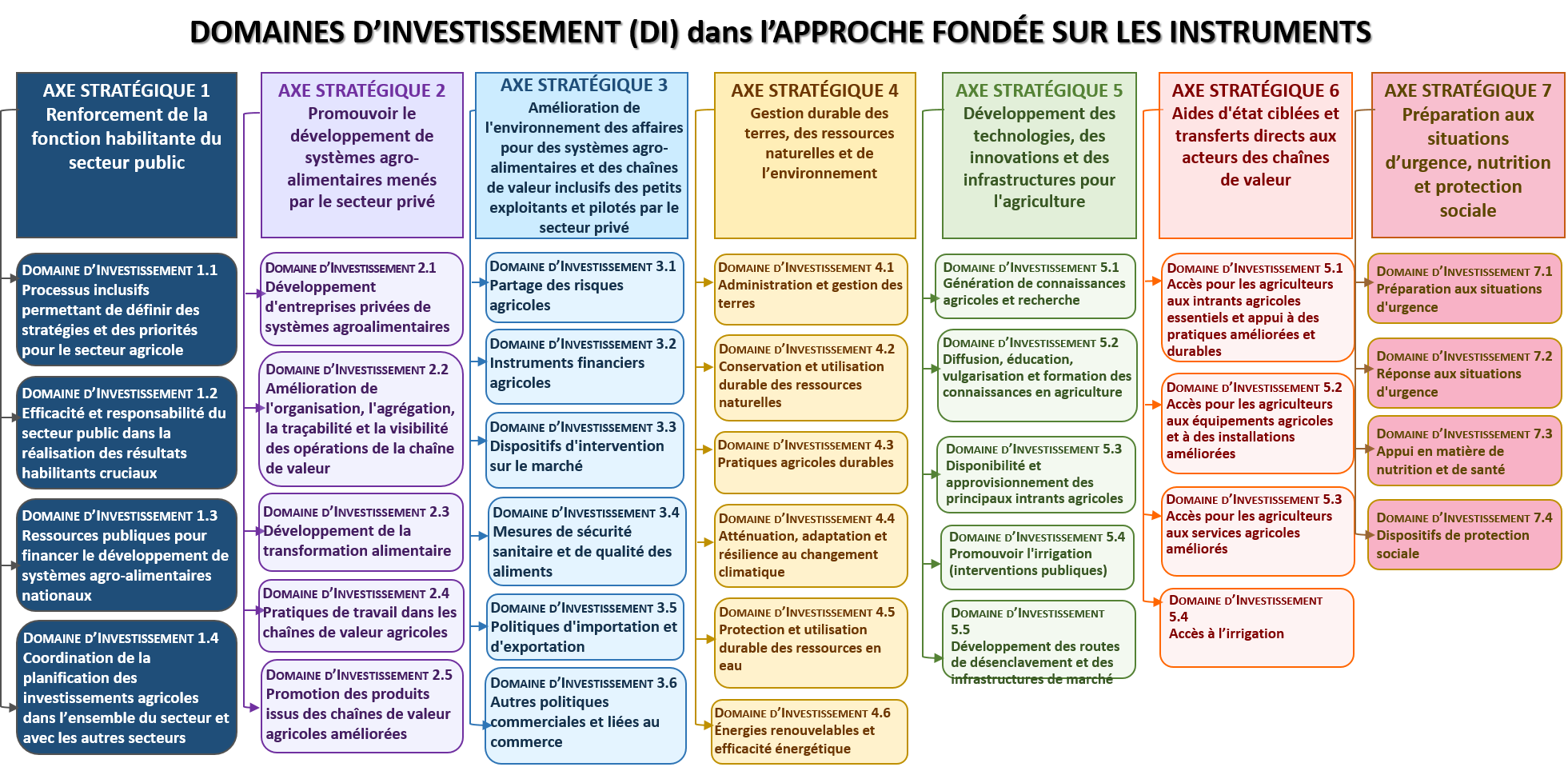
| Domaine d’investissement 1.1 | Domaine d’investissement 1.2 | Domaine d’investissement 1.3 | Domaine d’investissement 1.4 |
PROCESSUS INCLUSIFS PERMETTANT de DÉFINIR des STRATÉGIES et des PRIORITÉS pour le SECTEUR AGRICOLE et de S’ALIGNER SUR les PRIORITÉS et les ENGAGEMENTS NATIONAUX et INTERNATIONAUX
IMP 1.1.2 |
EFFICACITÉ et RESPONSABILITÉ du SECTEUR PUBLIC dans la RÉALISATION des RÉSULTATS HABILITANTS CRUCIAUX IMP 1.2.1 IMP 1.2.2 |
RESSOURCES PUBLIQUES pour FINANCER le DÉVELOPPEMENT de SYSTÈMES AGRO-ALIMENTAIRES NATIONAUX |
COORDINATION de la PLANIFICATION des INVESTISSEMENTS AGRICOLES DANS l’ENSEMBLE du SECTEUR et AVEC les AUTRES SECTEURS IMP 1.4.1 IMP 1.4.2 |
|---|
-
1. Campbell, J. 2011. Guidelines for using programmatic approaches in agriculture. FAO/ECOWAS, October 2011. Food and Agriculture Organization of the United Nations, Rome:
http://www.fao.org/3/au758e/au758e.pdf
2. Committee on World Food Security (CFS). 2014 Principles for Responsible Investment in Agriculture and Food Systems (2014): http://www.fao.org/3/au866e/au866e.pdf
3. FAO. 2016. Strengthening Coherence between Agriculture and Social Protection to Combat Poverty and Hunger in Africa – Diagnostic Tool. Food and Agriculture Organization of the United Nations, Rome: http://www.fao.org/3/i5385e/i5385e.pdf
4. FAO. Ongoing. Monitoring and Analysing Food and Agricultural Policies (MAFAP) programme webpage: http://www.fao.org/in-action/mafap
5. FAO. Ongoing. Social Analysis webpage: http://www.fao.org/investment-learning-platform/themes-and-tasks/social-analysis/en/
6. InWEnt – Internationale Weiterbildung und Entwicklung gGmbH. 2009. Capacity development in agriculture and rural sectors: lessons and future directions: an international workshop sponsored by InWEnt Capacity Building International and the International Food Policy Research Institute: Fildafing, Germany, November 10-12, 2008. http://www.hubrural.org/IMG/pdf/cb-x-report-hangstein-1232634111429.pdf
7. Rice, E. B. 1999. Capacity building in the agriculture sector in Africa. World Bank Operations Evaluation Department (OED) Précis No.180. Spring 1999. https://ieg.worldbankgroup.org/sites/default/files/Data/reports/180precis.pdf
8. Tropical Agriculture Platform. 2016. Common Framework on Capacity Development for Agricultural Innovation Systems: Guidance Note on Operationalization. CAB International, Wallingford, UK. https://www.cabi.org/Uploads/CABI/about-us/4.8.5-other-business-policies-and-strategies/tap-guidance-note.pdf
9. World Bank. 2007. Tools for Institutional, Political, and Social Analysis of Policy Reform: A Sourcebook for Development Practitioners. World Bank, Washington, DC: https://openknowledge.worldbank.org/handle/10986/6652
Haut
| Mise en place et entretien des mécanismes de retour d'information et de communication réguliers entre les décideurs politiques et les parties prenantes du secteur agricole | |
|---|---|
| Justification | Les stratégies, les plans et les investissements du secteur public dans le secteur agricole doivent être ancrés dans une bonne compréhension des réalités et des problématiques auxquels sont confrontés les différents intervenants du secteur. Une recherche appropriée peut jouer un rôle essentiel dans la création de cette compréhension, mais les problèmes auxquels le secteur est confronté sont très dynamiques et répondront à l’évolution des conditions économiques, sociales et politiques. Les canaux de communication et de retour d'information qui permettent aux décideurs et aux planificateurs du secteur agricole de suivre les tendances et les changements, de comprendre comment les problèmes auxquels sont confrontées les parties prenantes du secteur évoluent, et de comprendre également comment leurs politiques et leurs investissements affectent la vie et les moyens de subsistance des différentes personnes actives dans le secteur sont donc extrêmement importants. Les mécanismes de communication et de consultation avec les intervenants du secteur établis dans le cadre de cet IMP travailleront en étroite collaboration avec d’autres IMP dans le cadre du DI 2. Cet IMP contribuera de manière significative à l’IMP 1.2.1 (Renforcement des capacités organisationnelles et institutionnelles du secteur public dans l’agriculture) et à l’IMP 1.2.4 (Évaluation et amélioration des politiques sectorielles) en faisant participer les parties prenantes du secteur à la discussion sur le rôle du secteur public dans l’obtention de résultats habilitants. En particulier, les mesures de l’IMP 1.2.2 visant à instaurer une plus grande responsabilité et transparence dans le secteur agricole seront fortement soutenues par la mise en place de forums appropriés impliquant les parties prenantes du secteur. Dans le cadre de l'AS 2, la promotion et le renforcement des Associations interprofessionnelles du secteur (IMP 2.2.5) et des associations d'agriculteurs et de producteurs (IMP 2.2.6) compléteront aussi considérablement cet IMP. Comme pour beaucoup d'autres DI et IMP relevant de l'axe stratégique 1, la contribution de cette IMP à une meilleure transparence, à une plus grande responsabilité et à une confiance accrue dans le secteur contribuera à la mise en œuvre de nombreuses autres mesures relevant d'autres AS. |
| Objectif | Renforcement de la confiance, de la communication et de la transparence entre les organismes du secteur public, le secteur privé et toutes les parties prenantes du secteur agricole. |
| Combinaisons de mesures dans le cadre | Les mesures de communication les plus appropriées pour établir les mécanismes recommandés dans le cadre de cet IMP dépendront de la taille et de la complexité du secteur agricole dans chaque pays. Les mesures suggérées ici fournissent une gamme de mécanismes différents qui ont été déployés avec succès dans différents contextes pour interagir avec les parties prenantes à la fois dans l'agriculture et dans d'autres secteurs. Des forums publics avec les parties prenantes du secteur agricole pour discuter des questions et des politiques du secteur peuvent être organisés sur une base régulière mais nécessitent une préparation et une facilitation minutieuses. Des groupes de discussion et/ou des jurys de citoyens avec des groupes sélectionnés plus petits de parties prenantes du secteur peuvent également être utilisés pour discuter et examiner des questions politiques spécifiques auxquelles le secteur est confronté. La technologie en ligne offre une gamme d'options pour établir des canaux réguliers de communication et de retour d'information entre les organismes publics dans le domaine de l'agriculture et les parties prenantes du secteur, mais ceux-ci nécessitent une gestion constante si l'on veut qu'ils soient efficaces et dignes de la confiance du public. |
| Bénéficiaires | • Les ministères de l’agriculture et d’autres organismes du secteur public impliqués dans le secteur agricole grâce à une plus grande compréhension, à de meilleurs contacts et à une confiance accrue entre les parties prenantes du secteur agricole, permettant ainsi d’obtenir des résultats plus habilitants. • Les acteurs du secteur agro-alimentaire en général grâce à une influence accrue sur les décisions affectant le secteur et une plus grande confiance dans les organismes du secteur public impliqués. |
| Mesures | Dépenses éligibles | Agences de mise en œuvre éligibles | Budget | Cible | Modalités |
|---|---|---|---|---|---|
| 1. Mesures de communication pour mener des discussions de groupe et/ou des jurys de citoyens pour discuter de questions spécifiques de politique sectorielle | • Coûts de préparation des groupes de discussion/ jurys de citoyens, y compris la diffusion et l’obtention de la participation des parties prenantes |
• Ministères de l’agriculture • Autres organismes pertinents du secteur public • Prestataires de services appropriés |
$ xxx | • Participation de nombre x de participants confirmés aux forums |
• Contrats avec les prestataires de services appropriés • Dépenses directes |
| • Coûts de la tenue de forums, y compris le lieu, la facilitation (si nécessaire), les équipements technologiques y afférent, les matériels d’information, l’appui ciblé pour les participants |
• Ministères de l’agriculture • Autres organismes pertinents du secteur public • Prestataires de services appropriés |
$ xxx |
• nombre x de forums mis en œuvre d’ici l’année x • nombre x de participants aux forums d’ici à l’année xxx |
• Contrats avec les prestataires de services appropriés | |
| • Coûts de la rédaction des rapports sur les débats et les résultats du forum, et distribution aux parties prenantes |
• Ministères de l’agriculture • Autres organismes pertinents du secteur public • Prestataires de services appropriés |
$ xxx | • nombre x de rapports et de matériels d’information sur les forums distribués |
• Contrats avec les prestataires de services appropriés • Dépenses directes |
|
| 2. Mesures de communication pour mener des discussions de groupe et/ou des jurys de citoyens pour discuter de questions spécifiques de politique sectorielle | • Coûts de préparation des groupes de discussion/ jurys de citoyens, y compris la diffusion et l’obtention de la participation des parties prenantes |
• Ministères de l’agriculture • Autres organismes pertinents du secteur public • Prestataires de services appropriés |
$ xxx | • Participation de nombre x confirmé des participants aux groupes de discussion/jurys de citoyens | • Contrats avec les prestataires de services appropriés • Dépenses directes |
| • Coûts de la tenue de groupes de discussion/jurys de citoyens, y compris le lieu, la facilitation, les équipements technologiques y afférent, les matériels d’information, le soutien aux participants |
• Ministères de l’agriculture • Autres organismes pertinents du secteur public • Prestataires de services appropriés |
$ xxx |
• nombre x de groupes de discussion/jurys de citoyens mis en œuvre d’ici à l’année xxx • nombre x de participants participant à des groupes de discussion ou à des jurys de citoyens d’ici à l’année xxx |
• Contrats avec les prestataires de services appropriés • Dépenses directes |
|
| • Coûts de la rédaction des rapports sur les discussions et les résultats des groupes de discussion et des jurys de citoyens, et distribution aux parties prenantes |
• Ministères de l’agriculture • Autres organismes pertinents du secteur public • Prestataires de services appropriés |
$ xxx | • nombre x de rapports et de matériels d’information sur les groupes de discussion/ jurys de citoyens distribués |
• Contrats avec les prestataires de services appropriés • Dépenses directes |
|
| Budget total (pour cette mesure) | $xxx | ||||
| 2. Mesures de communication visant à établir une plateforme en ligne pour le retour d’information et une discussion des questions relatives au secteur agricole | • Coûts de fourniture de logiciels et de conception d’une plateforme en ligne appropriée |
• Ministères de l’agriculture. • Prestataires de services appropriés |
xxxx | • Conception terminée d’ici à l’année xxx | • Contrats avec les prestataires de services appropriés |
| • Coûts de promotion de la plateforme en ligne |
• Ministères de l’agriculture • Prestataires de services appropriés |
$xxx | • Matériel publicitaire préparé et diffusé d’ici à l’année xxx | • Contrats avec les prestataires de services appropriés | |
| • Coûts de maintenance technique de la plateforme | • Prestataires de services appropriés | $xxx |
• Plate-forme en ligne établie et opérationnelle d'ici à l'année xxx |
• Contrats avec les prestataires de services appropriés | |
| • Coûts de modération, d’interaction et de réponse aux questions et aux discussions en ligne | • Ministères de l’agriculture | $xxx |
• Retour d’information fourni régulièrement • Commentaires positifs des utilisateurs |
• Mémorandums d’accord internes avec les ministères pertinents | |
| Budget total (pour cette mesure) | $xxx | ||||
| BUDGET TOTAL (pour cet IMP) | $xxx |
|
Instruments complémentaires de mise en oeuvre des politiques |
|---|
| Domaine d’investissement 1.1 | Domaine d’investissement 1.2 | Domaine d’investissement 1.3 | Domaine d’investissement 1.4 |
PROCESSUS INCLUSIFS PERMETTANT de DÉFINIR des STRATÉGIES et des PRIORITÉS pour le SECTEUR AGRICOLE et de S’ALIGNER SUR les PRIORITÉS et les ENGAGEMENTS NATIONAUX et INTERNATIONAUX |
EFFICACITÉ et RESPONSABILITÉ du SECTEUR PUBLIC dans la RÉALISATION des RÉSULTATS HABILITANTS CRUCIAUX IMP 1.2.1 IMP 1.2.2 IMP 1.2.4 |
RESSOURCES PUBLIQUES pour FINANCER le DÉVELOPPEMENT de SYSTÈMES AGRO-ALIMENTAIRES NATIONAUX |
COORDINATION de la PLANIFICATION des INVESTISSEMENTS AGRICOLES DANS l’ENSEMBLE du SECTEUR et AVEC les AUTRES SECTEURS |
|---|
| Domaine d’investissement 2.1 | Domaine d’investissement 2.2 | Domaine d’investissement 2.3 |
DÉVELOPPEMENT D'ENTREPRISES PRIVÉES dans les SYSTÈMES AGRO-ALIMENTAIRES IMP 1.1.2 |
AMÉLIORATION de l'ORGANISATION, de l'AGRÉGATION, de la TRAÇABILITÉ et de la VISIBILITÉ des OPÉRATIONS de la CHAÎNE DE VALEUR IMP 2.2.5 IMP 2.2.6 |
DÉVELOPPEMENT de la TRANSFORMATION AGROALIMENTAIRE |
|---|
-
1. African Center for Economic Transformation (ACET). (Ongoing). Smallholder Voices Portal: https://smallholdervoices.acetforafrica.org/?gclid=Cj0KCQjwkZiFBhD9ARIsAGxFX8CP3GDg6Q_PtBHxi6kJyIZ3gEUZ-SbZr0QQmGSubvDh9wFT76L9JoQaAm1nEALw_wcB
2. Centre for Agroecology, Water and Resilience (CAWR) at Coventry University. 2019. Democratizing Agricultural Research for Food Sovereignty in West Africa: https://excludedvoices.org/democratising-agricultural-research-food-sovereignty-west-africa
3. Environmental Mainstreaming Initiative (2009). Profiles of Tools and Tactics for Environmental Mainstreaming. No. 4. Citizen Jury. (International Institute for Environment and Development (IIED)): https://www.environmental-mainstreaming.org/documents/EM%20Profile%20No%204%20%20Citizen's%20Jury%20(6%20Oct%2009).pdf
4. Pimbert, M., Barry, B., Berson, A. & Tran-Thanh, K. 2010. Democratising Agricultural Research for Food Sovereignty in West Africa. IIED, CNOP, Centre Djoliba, IRPAD, Kene Conseils, URTEL, Bamako and London. https://pubs.iied.org/14603iied
5. van de Gevel, J.M.J., Bijdevaate, M., Mwenda, P., Morimoto, Y. & Fadda, C. 2014. Guiding focus group discussions on varietal diversification and adaptation to climate change in Each Africa. Bioversity International: https://www.bioversityinternational.org/fileadmin/_migrated/uploads/tx_news/Guiding_focus_group_discussions_on_varietal_diversification_and_adaptation_to_climate_change_in_East_Africa_1826.pdf
6. Wageningen Centre for Development Innovation webpage (ongoing). Multi-stakeholder partnerships. http://www.mspguide.org/tool/citizen-jury
Haut
IA 1.2: ENHANCING THE EFFICIENCY AND ACCOUNTABILITY OF THE PUBLIC SECTOR IN DELIVERING CRITICAL ENABLING RESULTS.
POLICY IMPLEMENTATION INSTRUMENTS
Sources d'information, outils et matériel de lecture utiles accessibles en ligne
Haut
Sources d'information, outils et matériel de lecture utiles accessibles en ligne
Haut
Useful references, tools, reading materials.
Haut
Instruments complémentaires de mise en oeuvre des politiques
Haut
Useful references, tools, reading materials.
Haut
Useful references, tools, reading materials.
Haut
| Renforcement des capacités organisationnelles et institutionnelles du secteur public | |
|---|---|
| Justification | Le gouvernement a un rôle essentiel à jouer dans la création des conditions permettant au secteur agricole du pays de fournir la nourriture dont la population a besoin, de créer des emplois et de contribuer au développement économique du pays. Pour commencer, les organismes publics doivent être clairs quant à leur rôle. Le secteur agricole est composé en grande partie d’entreprises du secteur privé. Ce sont ces entreprises, qu’il s’agisse de grandes sociétés agricoles ou de petits exploitants agricoles, qui obtiendront réellement les résultats que le secteur doit atteindre. Le rôle des agences du secteur public est de créer les conditions permettant au secteur privé de l'agriculture d'être plus performant. Leur rôle ne devrait pas être de s'impliquer directement dans la fourniture d'intrants ou la production de biens agricoles eux-mêmes, car ce n'est pas ce que les pouvoirs publics savent faire ! Les organismes du secteur public doivent renforcer leur capacité à s’acquitter de ce rôle. En particulier lorsque les organismes du secteur public dans le secteur agricole sont faibles, qu’ils disposent de peu de ressources et qu’ils ont été habitués à jouer principalement d’autres rôles (tels que l’administration de subventions ou la gestion d’entreprises agricoles d’État), le renforcement des capacités des organismes du secteur public nécessitera du temps et un engagement à long terme en faveur du changement institutionnel. Les mesures contenues dans cet instrument de mise en œuvre des politiques fournissent certaines des étapes clés nécessaires à la réalisation de ces changements. Les mesures suggérées dans cet IMP pour catalyser le changement institutionnel dans les organismes du secteur public sont axées sur les processus clés de changements institutionnels qui doivent être initiés au sein de ces organismes. Mais le changement institutionnel exige une action à de nombreux niveaux. D’autres domaines d’investissement et instruments de mise en œuvre des politiques relevant de l’axe stratégique 1 traitent d’autres aspects importants du renforcement des capacités habilitantes du secteur public et sont susceptibles d’être nécessaires pour compléter cet IMP. Le secteur public doit renforcer un éventail de capacités spécifiques, y compris la planification stratégique pour le secteur (IMP 1.1.1), l’engagement avec les parties prenantes au sein du secteur (IMP 1.1.2), ses systèmes de responsabilité et de gestion financière (IMP 1.2.2), et sa capacité à coordonner et à aligner ses actions avec d’autres secteurs de l’économie (IMP 1.4.1). La capacité organisationnelle et institutionnelle du secteur public dans l’agriculture sous-tendra le déploiement réussi de tous les instruments de mise en œuvre des politiques de cette plate-forme. |
| Objectif | Les organismes publics du secteur agricole, y compris les ministères et les départements de l’agriculture, ont la capacité d’obtenir des résultats habilitants essentiels pour le secteur agro-alimentaire. |
| Combinaisons de mesures dans le cadre de cet IMP |
Les mesures proposées au titre de cet instrument de mise en œuvre sont axées sur des mesures de renforcement des capacités. L’élaboration et la mise en œuvre de ces mesures comportent trois étapes clés : • Une évaluation indépendante des besoins en matière de renforcement des capacités au sein des organismes du secteur public (l’indépendance de ceux qui effectuent l’évaluation est importante car les évaluations internes sont susceptibles d’être soumises à l’influence et à la pression de différents groupes d’intérêt au sein de l’organisation). • Mettre en place des mécanismes efficaces de suivi et d’évaluation du processus de changement institutionnel. Cela peut être particulièrement délicat lorsque des changements sont planifiés sur une période relativement longue. Il est également important de veiller à ce que ces mécanismes soient indépendants des groupes d’intérêt au sein des organismes faisant l'objet du suivi. • Mesures visant à mettre effectivement en œuvre le renforcement des capacités, y compris l’amélioration des capacités technologiques et de matériels, la formation et les processus à plus long terme de tutorat et de développement institutionnel. Il sera probablement important ici de trouver un équilibre entre la réponse aux besoins de renforcement des capacités à court terme, conduisant à des résultats plus immédiats, et les processus de renforcement des capacités à plus long terme. |
| Bénéficiaires |
• Les ministères de l’agriculture et autres organismes du secteur public impliqués dans le secteur agricole grâce à une meilleure capacité d’obtenir des résultats habilitants pour ce secteur. • Les acteurs du secteur agro-alimentaire en général grâce à l’amélioration des résultats habilitants pour le secteur. |
| Mesures | Agences de mise en œuvre éligibles | Dépenses éligibles | Budget | Cible | Modalités |
|---|---|---|---|---|---|
| 1 Mesures de renforcement des capacités pour préparer, mettre en œuvre et suivre les effets des activités de renforcement des capacités institutionnelles (réorganisation, capacités opérationnelles et de gestion, équipement, formation du personnel) |
• Coût de l’évaluation : o Les rôles habilitants et le partage des rôles entre les divers organismes publics du secteur agricole o L’adéquation organisationnelle et les besoins en capacités des organismes et institutions concernés |
• Fournisseurs de services sélectionnés • Instituts de recherche pertinents |
• Tous les organismes pertinents du secteur public auront terminé l’évaluation d’ici à l’année 1; • Élaboration de programmes de renforcement des capacités à court, moyen et long terme à l’intention des organismes pertinents et engagements institutionnels à mettre en œuvre des programmes d’ici à l’année xxx; |
• Sous-traitance de l'assistance technique (locale, régionale ou internationale) | |
| • Coût de la mise en place d’un mécanisme de suivi et d’évaluation du processus de changement institutionnel |
• Ministères de l’agriculture • Autres organismes pertinents du secteur public; • Organismes externes de suivi et d’évaluation (secteur public, recherche, prestataire de services) |
xxxx |
• Indicateurs de performance institutionnels convenus d’ici à l’année xxx • Processus d’examen réguliers convenus et engagés d’ici à l’année xxx • Processus d’évaluation convenu et engagé d’ici à l’année xxx |
• Mémorandums d’accord entre le Ministère de l’agriculture et d’autres organismes pertinents du secteur public • Mémorandum d’accord/contrat avec des organismes externes de suivi et d’évaluation |
|
|
• Ministries of Agriculture. • Other relevant public sector agencies. • External monitoring and evaluation agencies (public sector, research, service provider). |
• Ministères de l’agriculture • Autres organismes pertinents du secteur public • Organismes externes de suivi et d’évaluation (secteur public, recherche, prestataire de services) |
$xxx |
• Nombre x des processus d’examen réguliers mis en œuvre. • Processus d’évaluation global terminé et documenté |
• Mémorandums d’accord entre le Ministère de l’agriculture et d’autres organismes pertinents du secteur public; • Mémorandum d’accord/contrat avec des organismes externes de suivi et d’évaluation |
|
| • Coûts des mesures de renforcement des capacités institutionnelles | • Ministères de l’agriculture • Autres organismes pertinents du secteur public • Fournisseurs de services/instituts de recherche sélectionnés | $xxx |
• Tous les organismes pertinents du secteur public mettront en œuvre leurs programmes de renforcement des capacités d’ici à l’année xxx; • Tous les organismes pertinents du secteur public seront opérationnels dans leur structure organisationnelle et leurs capacités d’ici à la fin de l’année xxx; • Indicateurs de résultats institutionnels atteints d’ici à l’année xxx |
• Sous-traitance de l’assistance technique à des prestataires de services/instituts de recherche appropriés (locaux, régionaux ou internationaux) | |
| Budget total (pour cette mesure) | $xxx | ||||
| BUDGET TOTAL (pour cet IMP) | $xxx |
|
Instruments complémentaires de mise en oeuvre des politiques |
|---|
| Domaine d’investissement 1.1 | Domaine d’investissement 1.2 | Domaine d’investissement 1.3 | Domaine d’investissement 1.4 | PROCESSUS INCLUSIFS PERMETTANT de DÉFINIR des STRATÉGIES et des PRIORITÉS pour le SECTEUR AGRICOLE et de S’ALIGNER SUR les PRIORITÉS et les ENGAGEMENTS NATIONAUX et INTERNATIONAUX IMP 1.1.1 IMP 1.1.2 | EFFICACITÉ et RESPONSABILITÉ du SECTEUR PUBLIC dans la RÉALISATION des RÉSULTATS HABILITANTS CRUCIAUX IMP 1.2.2 | RESSOURCES PUBLIQUES pour FINANCER le DÉVELOPPEMENT de SYSTÈMES AGRO-ALIMENTAIRES NATIONAUXS |
COORDINATION de la PLANIFICATION des INVESTISSEMENTS AGRICOLES DANS l’ENSEMBLE du SECTEUR et AVEC les AUTRES SECTEURS IMP 1.4.1 |
|---|
-
1. FAO’s online resources on capacity development, and more particularly, module 4 on Organization analysis and development:
http://www.fao.org/capacity-development/en/
2. Anyonge, T., Jonckheere, S., Romano, M. & Gallina, A. 2013. Strengthening institutions and organizations. International Fund for Agricultural Development: https://www.ifad.org/documents/38714170/39135645/Strengthening+institutions+and+organizations+-+An+analysis+of+lessons+learnt+from+field+application+of+IFAD's+sourcebook+on+institutional+and+organizational+analysis+for+pro-poor+change/b0d5e54a-d06a-438e-b241-a335e8f65eea
3. World Bank. 2000. Reforming Public Institutions and Strengthening Governance, A World Bank Strategy: http://www1.worldbank.org/publicsector/Reforming.pdf
4. United Nations. Economic Commission for Africa. Development Policy Management Division. 2004-08. Public sector management reforms in Africa: lessons learned. Addis Ababa: https://repository.uneca.org/bitstream/handle/10855/5552/bib-39573_I.pdf?sequence=1&isAllowed=y
5. Hydén, G., Buch Kristensen, M., Buch Kristensen, K., & Nixon, H. 2016. Sida’s Support to Public Administration and Institutional Capacity Development 2003-2015. Swedish International Development Cooperation Agency, Stockholm: https://www.sida.se/contentassets/6542f79922f24a1e976ab75fc7f53e7f/22365.pdf
Haut
| Amélioration du système de redevabilité du secteur agricole | |
|---|---|
| Justification | Des systèmes de responsabilisation du secteur public sont nécessaires pour instaurer la transparence et la confiance entre les parties prenantes du secteur (public, privé et partenaires de développement). Cela signifie qu’il faut mettre en place un système de suivi, d’évaluation et de compte rendu sur les interventions du secteur public, ainsi qu’un système de gestion financière efficace pour les contributions du secteur public. Cet IMP spécifique vise à doter le secteur public de la capacité de mettre en œuvre et de pérenniser un système permettant de gérer efficacement son intervention et assurer la redevabilité et la transparence. Il travaille en étroite collaboration avec l’IMP 1.2.1 qui vise à renforcer les capacités organisationnelles et institutionnelles plus larges du secteur public et dépendra de l’amélioration de la définition des rôles et responsabilités institutionnels générés par l’IMP 1.2.1. Mais la redevabilité dépend également de la participation efficace des intervenants du secteur aux discussions concernant le développement du secteur et l’utilisation des ressources publiques pour soutenir son développement. L’établissement de mécanismes de rétroaction entre divers intervenants du secteur et les organisations responsables du secteur public est également important (IMP 1.1.2). Le renforcement d’une coordination efficace avec d’autres secteurs de l’économie dépendra souvent de la confiance générée par une redevabilité et des systèmes de gestion financière appropriés dans le secteur agricole (IMP 1.4.1). Lorsque les institutions publiques apportent un soutien ciblé aux parties prenantes du secteur agricole qui ont besoin de transferts directs pour participer au développement du secteur, il est particulièrement important de mettre en place des systèmes appropriés de redevabilité, de gestion financière et de compte rendus pour garantir la transparence (AS 6). Les systèmes de redevabilité doivent couvrir tous les aspects des interventions du secteur public dans l’agriculture et sont donc liés à tous les autres axes stratégiques suggérés dans cette plate-forme. Public sector agencies in the agricultural sector are transparent, fully accountable, and managed efficiently and effectively. |
| Objectif | Les organismes du secteur public dans le secteur agricole sont transparents, pleinement redevables et gérés de manière efficiente et efficace. |
| Combinaisons de mesures dans le cadre de cet IMP | Pour renforcer le système de redevabilité du secteur agricole, il faut combiner une série de mesures clé de renforcement des capacités. Un système de suivi, d’évaluation et de compte rendus est essentiel pour garantir que des progrès soient accomplis par rapport à des objectifs clairement définis et que les résultats convenus soient atteints. La production régulière de compte rendus et l’accès à l’information contenue dans les rapports par les autres intervenants clés du secteur agricole sont des éléments clés pour assurer la transparence. Il est également essentiel de doter le secteur agricole d’un système de gestion financière qui : i) lie le financement sectoriel à un cadre de dépenses à moyen terme; ii) alloue des ressources du secteur à des instruments spécifiques de mise en œuvre des politiques; iii) tient compte des mécanismes de financement des donateurs et les harmonise avec les politiques gouvernementales; v) renforce les capacités parlementaires de contrôle du budget et des dépenses du secteur; et vi) assure un audit et une révision périodiques. Il est également important d’inclure des mesures pour évaluer l’impact et l’efficacité des activités de renforcement des capacités. |
| Bénéficiaires |
• Les organismes du secteur public bénéficieront d’une fiabilité et d’une légitimité accrues aux yeux du public. • Les citoyens et les parties prenantes concernées bénéficieront du fait qu'ils auront les moyens de s’assurer que les ministres et les fonctionnaires agissent dans l’intérêt des citoyens et des parties prenantes qu’ils servent • L’économie de marché et l’économie en général en bénéficieront, car des institutions publiques transparentes et dignes de confiance sont plus susceptibles d’attirer à la fois des investissements étrangers et nationaux. |
| Mesures | Dépenses éligibles | Agences de mise en œuvre éligibles | Budget | Cible | Modalités |
|---|---|---|---|---|---|
| 1. Mesure de renforcement des capacités pour évaluer les besoins en matière de mise à niveau des systèmes de suivi, d’évaluation et de compte rendu et des systèmes de gestion financière | • Coût de l’évaluation des besoins du secteur en matière de suivi, d’évaluation et de compte rendu |
• Fournisseurs de services sélectionnés • Institutions de recherche pertinentes |
$xxx | • Évaluation des organismes pertinents effectuée au cours de l’année xxx | • Externalisation de l’assistance technique pertinente (locale ou internationale) |
| • Coût de l’évaluation des systèmes de gestion financière pour le secteur |
• Fournisseurs de services sélectionnés • Institutions de recherche pertinentes |
$xxx | • Évaluation des organismes pertinents effectuée au cours de l’année xxx | • Externalisation de l’assistance technique pertinente (locale ou internationale) | |
| Budget total (pour cette mesure) | $xxx | ||||
| 2. Mesures de renforcement des capacités visant à renforcer, mettre à niveau et mettre en œuvre des systèmes améliorés de suivi, d’évaluation et de compte rendu, ainsi que des systèmes de gestion financière | • Coût des logiciels et de la technologie pour améliorer le S&E et la gestion des données |
• Fournisseurs de services sélectionnés • Institutions de recherche pertinentes |
xxxx |
• Contrats de logiciels et de technologie signés d’ici à l’année xxx • Logiciels et technologies livrés d’ici à l’année xxx |
• Marchés passés avec les fournisseurs concernés |
| • Coût de la formation du personnel en matière de S&E, de compte rendu, de gestion des données, de logiciels et de solutions technologiques pour améliorer la transparence et la redevabilité |
• Fournisseurs de services sélectionnés • Institutions de recherche pertinentes |
xxxx |
• Mémorandums d’accord/contrats pour la formation signés d’ici à l’année xxx • Programme de formation mis en œuvre d’ici à l’année xxx; • Nombre x de personnel formé d’ici à l’année xxx |
• Externalisation de l’assistance technique pertinente (locale ou internationale) • Contrats de prestation de services |
|
| • Coûts du programme d’appui institutionnel et de tutorat à plus long terme | • Fournisseurs de services sélectionnés | xxxx |
• Mémorandums d’accord/contrats pour la fourniture d’appui/tutorat signés d’ici à l’année xxx • Programme d’appui institutionnel et de tutorat mis en œuvre d’ici à l’année xxx; |
• Externalisation de l’assistance technique pertinente (locale ou internationale) | |
| • Coût du matériel selon les besoins | • Fournisseurs de services sélectionnés | xxxx | • Contrats d’achat de matériel signés d’ici à l’année xxx • Matériel livré d’ici à l’année xxx | • Marchés passés avec des fournisseurs concernés | |
| • Coût de l’évaluation de l’impact des mesures de renforcement des capacités; | • Les unités pertinentes des organismes concernés du secteur public | xxxx | • Nombre x d’évaluations menées sur les mesures de renforcement des capacités | ||
| Budget total (pour cette mesure) | $xxx | ||||
| BUDGET TOTAL (pour cet IMP) | $xxx |
|
Instruments complémentaires de mise en oeuvre des politiques |
|---|
| Domaine d’investissement 1.1 | Domaine d’investissement 1.2 | Domaine d’investissement 1.3 | Domaine d’investissement 1.4 | PROCESSUS INCLUSIFS PERMETTANT de DÉFINIR des STRATÉGIES et des PRIORITÉS pour le SECTEUR AGRICOLE et de S’ALIGNER SUR les PRIORITÉS et les ENGAGEMENTS NATIONAUX et INTERNATIONAUX IMP 1.1.1 IMP 1.1.2 | EFFICACITÉ et RESPONSABILITÉ du SECTEUR PUBLIC dans la RÉALISATION des RÉSULTATS HABILITANTS CRUCIAUX IMP 1.2.2 | RESSOURCES PUBLIQUES pour FINANCER le DÉVELOPPEMENT de SYSTÈMES AGRO-ALIMENTAIRES NATIONAUXS |
COORDINATION de la PLANIFICATION des INVESTISSEMENTS AGRICOLES DANS l’ENSEMBLE du SECTEUR et AVEC les AUTRES SECTEURS IMP 1.4.1 |
|---|
-
1. The Accountability Framework initiative:
https://accountability-framework.org/the-framework/contents/core-principles/
2. Committee on World Food Security (CFS). 2014. Principles for responsible investment in agriculture and food systems: http://www.fao.org/3/a-au866e.pdf
3. Miller, M. & Hart, T. 2017. Strengthening public investment management: Reviewing the role of external actors. Overseas Development Institute, London: : https://odi.org/en/publications/strengthening-public-investment-management-reviewing-the-role-of-external-actors/
4. Holmes, M. & Evans, A. 2003. A Review of Experience in Implementing Medium Term Expenditure Frameworks in a PRSP Context: A Synthesis of Eight Country Studies. Overseas Development Institute, London: : https://odi.org/en/publications/a-review-of-experience-in-implementing-medium-term-expenditure-frameworks-in-a-prsp-context-a-synthesis-of-eight-country-studies/
Haut
| Mise en place et fonctionnement du système national d'informations géoréférencées agricoles (SIGA) | |
|---|---|
| Justification | La disponibilité en temps opportun de systèmes de gestion de données géoréférencées fiables sur les terres, le climat, les éléments nutritifs du sol, l'eau et la production agricole, intégrés aux facteurs infrastructurels et socio-économiques, est essentielle pour une politique et une prise de décisions efficaces. Elle permet aux parties prenantes, aux décideurs des politiques, aux entreprises et aux utilisateurs des terres de prendre des décisions éclairées nécessaires pour parvenir à une production agricole et à des systèmes alimentaires durables. Pour y parvenir, il est essentiel que le gouvernement mette en place et gère des systèmes d'information agricole géoréférencés fiables, qui effectueront des évaluations périodiques des conditions actuelles et des perspectives futures du secteur agricole. Ces informations seront utilisées pour rédiger des analyses fondées sur des données probantes qui permettront, entre autres, de mieux comprendre l'efficacité des politiques et des prises de décisions publiques. Cet IMP complète bon nombre des mesures proposées dans le cadre d'autres axes stratégiques en permettant de relier rapidement les problèmes, les initiatives et les développements à des zones géographiques spécifiques et aux acteurs du secteur agricole opérant dans ces zones. Le SIGA peut contribuer à l'accès aux informations sur le secteur pour les parties prenantes du secteur et d'autres secteurs, ceci en complément de la planification sectorielle (IMP 1.1.1) et de la planification intersectorielle (IMP 1.4.1), ainsi que l'amélioration de la redevabilité et la transparence du secteur (IMP 1.2.2). Il sera particulièrement important pour soutenir l’IMP 2.2.1 de l’AS 2 traitant des initiatives de développement territorial et l’IMP 2.5.3 de l’AS 2 portant sur les mécanismes d'attestation de l'origine géographique des produits. Dans le cadre du SA 4, tous les IMP spécifiques contribuant à l'amélioration de l'administration et de la gestion foncières (DI 4.1) seront grandement facilités par un système SIGA fonctionnel. De même, les IMP contribuant à la conservation et à l'utilisation durable des ressources naturelles (DI 4.2) ainsi qu’à la protection et à l'utilisation durable des ressources en eau (DI 4.5) bénéficieront de l'accès facile aux informations géographiques spécifiques qu'un système SIGA peut fournir. Dans le cadre de l’AS 5, la compréhension des facteurs influençant la disponibilité et l'approvisionnement des principaux intrants agricoles (IA 5.3), la promotion de l'irrigation (IA 5.4) et le développement des routes de desserte et des infrastructures de marché (IA 5.5) gagneront tous à être intégrés dans un SIGA. Le ciblage du soutien de l'État et des transferts directs vers des groupes d’acteurs plus faibles dans la chaîne de valeur agricole dans le cadre de l'AS 6 nécessitera probablement des informations spatiales précises sur la répartition des groupes cibles, et un SIGA opérationnel peut faciliter la mise en œuvre des IMP sous cet axe stratégique. De même, les mesures de préparation aux situations d'urgence, de nutrition et de protection sociale (AS 7) auront probablement toutes des dimensions spatiales spécifiques auxquelles un système SIGA peut contribuer de manière significative. |
| Objectif | Un système d'informations géoréférencées agricoles (SIGA) fiable fournit aux décideurs des politiques, aux investisseurs et aux autres parties prenantes des informations complètes sur les dimensions géographiques des paramètres clés du secteur dans son ensemble, ainsi que des sous-secteurs spécifiques. |
| Combinaisons de mesures dans le cadre de cet IMPP | Les mesures contenues dans cette IMP sont des mesures institutionnelles dédiées afin d’assurer l’élaboration et la mise en place d'un SIGA et, surtout, l'investissement requis pour maintenir et mettre le système constamment à jour une fois qu'il est mis en place ainsi que pour l'adapter aux différentes utilisations spécifiques requises à l'appui d’autres IMP. |
| Bénéficiaires |
La disponibilité et l'accès aux données et informations géoréférencées permettant de prendre des décisions stratégiques et en connaissance de cause bénéficieront: • Les décideurs et les planificateurs des politiques du secteur public, tant dans l'agriculture que dans d'autres secteu • Les investisseurs du secteur privé et les acteurs de la chaîne de valeur. |
| Mesures | Dépenses éligibles | Agences de mise en œuvre éligibles | Budget | Cible | Modalités |
|---|---|---|---|---|---|
| 1. Mesure institutionnelles dédiées afin d’assurer l’élaboration, la mise en place et l'exploitation des Systèmes d'Information Géo-référencés Agricoles (SIGA) | • Coût de conception et de mise en place des Systèmes d'information agricole géoréférencés (SIGA) |
• Ministères de l'Agriculture • Autres agences pertinentes du secteur public • Prestataires de services appropriés |
$xxx | • LE SIGA est opérationnel au plus tard à la fin de l'année 2 | • Externalisation de l'assistance technique (locale et/ou internationale) |
| • Coût d'exploitation, de maintenance, de mise à jour et d'adaptation du SIGA pour différents usages |
• Ministères de l'Agriculture • Prestataires de services appropriés |
$xxx |
• Analyses sectorielles et comptes rendus annuels réalisés à partir de l'année 1 d'exploitation • Nombre de demandes d'utilisateurs répondues et satisfaites |
• Dépenses directes pour l'exploitation et la maintenance du SIGA • Externalisation de l'assistance technique | |
| Total Budget (for this measure) | $xxx | ||||
| BUDGET TOTAL (pour cet IMP) | $xxx |
|
Instruments complémentaires de mise en oeuvre des politiques |
|---|
| Domaine d’investissement 1.1 | Domaine d’investissement 1.2 | Domaine d’investissement 1.3 | Domaine d’investissement 1.4 |
PROCESSUS INCLUSIFS PERMETTANT de DÉFINIR des STRATÉGIES et des PRIORITÉS pour le SECTEUR AGRICOLE et de S’ALIGNER SUR les PRIORITÉS et les ENGAGEMENTS NATIONAUX et INTERNATIONAUX IMP 1.1.2 |
EFFICACITÉ et RESPONSABILITÉ du SECTEUR PUBLIC dans la PRODUCTION DE RÉSULTATS HABILITANTS CRUCIAUX IMP 1.2.1 IMP 1.2.2 |
RESSOURCES PUBLIQUES pour FINANCER le DEVELOPPEMENT des SYSTEMES AGROALIMENTAIRES NATIONAUX |
COORDINATION de la PLANIFICATION des INVESTISSEMENTS AGRICOLES DANS l’ENSEMBLE du SECTEUR et AVEC les AUTRES SECTEURS IMP 1.4.1 IMP 1.4.2 |
|---|
| Domaine d’investissement 2.1 | Domaine d’investissement 2.2 | Domaine d’investissement 2.3 |
DÉVELOPPEMENT D’ENTREPRISES PRIVÉES dans les SYSTÈMES AGRO-ALIMENTAIRES IMP 2.1.1 IMP 2.1.2 IMP 2.1.4 |
AMÉLIORATION de l'ORGANISATION, de l'AGRÉGATION, de la TRAÇABILITÉ et de la VISIBILITÉ des OPÉRATIONS de la CHAÎNE DE VALEUR IMP 2.2.1 IMP 2.2.2 IMP 2.2.3 IMP 2.2.4 IMP 2.2.5 IMP 2.2.6 IMP 2.2.7 |
DÉVELOPPEMENT de la TRANSFORMATION AGROALIMENTAIRE |
|---|
| Domaine d’investissement 2.4 | Domaine d’investissement 2.5 |
|---|---|
| PRATIQUES DE TRAVAIL dans les CHAÎNES DE VALEUR AGRICOLES |
PROMOTION des PRODUITS issus des CHAÎNES DE VALEUR AGRICOLES AMÉLIORÉES IMP 2.5.3 |
| Domaine d’investissement 4.1 | Domaine d’investissement 4.2 | Domaine d’investissement 4.3 | ||||||||||||||||||||||||||||||||||||||||||||||||||||||||||||||||||||||||||||||||||||||||||||||||||||||||||||||||||||||||||||||||||||||||||||||||||||||||||||||||||||||||||||||||||||||||||||||||||||||||||||||||||||||||||||||||||||||||||||||||||||||||||||||||||||||||||||||||||||||||||||||||||||||||||||||||||||||||||||||||||||||||||||||||||||||||||||||||||||||||||||||||||||||||||||||||||||||||||||||||||||||||||||||||||||||||||||||||||||||||||||||||||||||||||||||||||||||||||||||||||||||||||||||||||||||||||||||||||||||||||||||||||||||||||||||||||||||||||||||||||||||||||||||||||||||||||||||||||||||||||||||||||||||||||||||||||||||||||||||||||||||||||||||||||||||||||||||||||||||||||||||||||||||||||||||||||||||||||||||||||||||||||||||||||||||||||||||||||||||||||||||||||||||||||||||||||||||||||||||||||||||||||||||||
|---|---|---|---|---|---|---|---|---|---|---|---|---|---|---|---|---|---|---|---|---|---|---|---|---|---|---|---|---|---|---|---|---|---|---|---|---|---|---|---|---|---|---|---|---|---|---|---|---|---|---|---|---|---|---|---|---|---|---|---|---|---|---|---|---|---|---|---|---|---|---|---|---|---|---|---|---|---|---|---|---|---|---|---|---|---|---|---|---|---|---|---|---|---|---|---|---|---|---|---|---|---|---|---|---|---|---|---|---|---|---|---|---|---|---|---|---|---|---|---|---|---|---|---|---|---|---|---|---|---|---|---|---|---|---|---|---|---|---|---|---|---|---|---|---|---|---|---|---|---|---|---|---|---|---|---|---|---|---|---|---|---|---|---|---|---|---|---|---|---|---|---|---|---|---|---|---|---|---|---|---|---|---|---|---|---|---|---|---|---|---|---|---|---|---|---|---|---|---|---|---|---|---|---|---|---|---|---|---|---|---|---|---|---|---|---|---|---|---|---|---|---|---|---|---|---|---|---|---|---|---|---|---|---|---|---|---|---|---|---|---|---|---|---|---|---|---|---|---|---|---|---|---|---|---|---|---|---|---|---|---|---|---|---|---|---|---|---|---|---|---|---|---|---|---|---|---|---|---|---|---|---|---|---|---|---|---|---|---|---|---|---|---|---|---|---|---|---|---|---|---|---|---|---|---|---|---|---|---|---|---|---|---|---|---|---|---|---|---|---|---|---|---|---|---|---|---|---|---|---|---|---|---|---|---|---|---|---|---|---|---|---|---|---|---|---|---|---|---|---|---|---|---|---|---|---|---|---|---|---|---|---|---|---|---|---|---|---|---|---|---|---|---|---|---|---|---|---|---|---|---|---|---|---|---|---|---|---|---|---|---|---|---|---|---|---|---|---|---|---|---|---|---|---|---|---|---|---|---|---|---|---|---|---|---|---|---|---|---|---|---|---|---|---|---|---|---|---|---|---|---|---|---|---|---|---|---|---|---|---|---|---|---|---|---|---|---|---|---|---|---|---|---|---|---|---|---|---|---|---|---|---|---|---|---|---|---|---|---|---|---|---|---|---|---|---|---|---|---|---|---|---|---|---|---|---|---|---|---|---|---|---|---|---|---|---|---|---|---|---|---|---|---|---|---|---|---|---|---|---|---|---|---|---|---|---|---|---|---|---|---|---|---|---|---|---|---|---|---|---|---|---|---|---|---|---|---|---|---|---|---|---|---|---|---|---|---|---|---|---|---|---|---|---|---|---|---|---|---|---|---|---|---|---|---|---|---|---|---|---|---|---|---|---|---|---|---|---|---|---|---|---|---|---|---|---|---|---|---|---|---|---|---|---|---|---|---|---|---|---|---|---|---|---|---|---|---|---|---|---|---|---|---|---|---|---|---|---|---|---|---|---|---|---|---|---|---|---|---|---|---|---|---|---|---|---|---|---|---|---|---|---|---|---|---|---|---|---|---|---|---|---|---|---|---|---|---|---|---|---|---|---|---|---|---|---|---|---|---|---|---|---|---|---|---|---|---|---|---|---|---|---|---|---|---|---|---|---|---|---|---|---|---|---|---|---|---|---|---|---|---|---|---|---|---|---|---|---|---|---|---|---|---|---|---|---|---|---|---|---|---|---|---|---|---|---|---|---|---|---|---|---|---|---|---|---|---|---|---|---|---|---|---|---|---|---|---|---|---|---|---|---|---|---|---|---|---|---|---|---|---|---|---|---|---|---|---|---|---|---|---|---|---|---|---|---|---|---|---|---|---|---|---|---|---|---|---|---|---|---|---|---|---|---|---|---|---|---|---|---|---|---|---|---|---|---|---|---|---|---|---|---|---|---|---|---|---|---|---|
|
ADMINISTRATION et GESTION DES TERRES |
CONSERVATION et UTILISATION DURABLE des RESSOURCES NATURELLES IMP 4.2.1 IMP 4.2.2 IMP 4.2.3 IMP 4.2.4 IMP 4.2.5 |
PRATIQUES AGRICOLES DURABLES |
| Domaine d’investissement 4.4 | Domaine d’investissement 4.5 | Domaine d’investissement 4.6 |
|---|---|---|
| ATTÉNUATION, ADAPTATION et RÉSILIENCE au CHANGEMENT CLIMATIQUE |
PROTECTION et UTILISATION DURABLE des RESSOURCES EN EAU |
ÉNERGIES RENOUVELABLES et EFFICACITÉ ÉNERGÉTIQUE |
| Domaine d’investissement 5.1 | Domaine d’investissement 5.2 | Domaine d’investissement 5.3 | GÉNÉRATION de CONNAISSANCES AGRICOLES et RECHERCHE | DIFFUSION, ÉDUCATION, VULGARISATION et FORMATION DES CONNAISSANCES en AGRICULTURE |
DISPONIBILITÉ et APPROVISIONNEMENT des PRINCIPAUX INTRANTS AGRICOLES IMP 5.3.1 IMP 5.3.2 IMP 5.3.3 IMP 5.3.4 |
|---|
| Domaine d’investissement 5.4 | Domaine d’investissement 5.5 |
PROMOUVOIR L'IRRIGATION (INTERVENTIONS PUBLIQUES)
IMP 5.4.1 IMP IMP 5.4.2 IMP 5.4.3 IMP 5.4.4 |
DÉVELOPPEMENT DES ROUTES de DÉSENCLAVEMENT et DES INFRASTRUCTURES DE MARCHÉ IMP 5.5.1 IMP 5.5.2 IMP 5.5.3 IMP 5.5.4 |
|---|
| Domaine d’investissement 6.1 | Domaine d’investissement 6.2 | Domaine d’investissement 6.3 | Domaine d’investissement 6.4 |
ACCÈS POUR les AGRICULTEURS aux INTRANTS AGRICOLES ESSENTIELS et APPUI à des PRATIQUES AMÉLIORÉES et DURABLES IMP 6.1.1 IMP 6.1.2 IMP 6.1.3 IMP 6.1.4 |
ACCÈS POUR LES AGRICULTEURS aux EQUIPEMENTS AGRICOLES et à DES INSTALLATIONS AMÉLIORÉES IMP 6.2.1 IMP 6.2.2 IMP 6.2.3 |
ACCÈS DES AGRICULTEURS aux SERVICES AGRICOLES AMÉLIORÉS IMP 6.3.1 IMP 6.3.2 IMP 6.3.3 IMP 6.3.4 |
ACCÈS À L'IRRIGATION |
|---|
| Domaine d’investissement 7.1 | Domaine d’investissement 7.2 | Domaine d’investissement 7.3 | Domaine d’investissement 7.4 |
PRÉPARATION aux SITUATIONS D’URGENCE IMP 7.1.1 IMP 7.1.2 IMP 7.1.3 IMP 7.1.4 |
RÉPONSE aux SITUATIONS D’URGENCE IMP 7.2.1 IMP 7.2.2 IMP 7.2.3 |
APPUI en matière de NUTRITION et de SANTÉ IMP 7.3.1 IMP 7.3.2 IMP 7.3.3 IMP 7.3.4 |
DISPOSITIFS de PROTECTION SOCIALE IMP 7.4.1 IMP 7.4.2 IMP 7.4.3 IMP 7.4.4 |
|---|
-
1. Bernard, B., Emmanuel, O. & Muganga, P. 2017. GIS application in agricultural development (2017); Training Manual based on QGIS software (version 2.18.3). Kilimo Trust, Kampala:
https://kilimotrust.org/reacts/files/GIS_Manual.pdf
2. Collett, A. & Lindemann H. GIS and agricultural natural resources. National Department of Agriculture, South Africa: https://www.ee.co.za/wp-content/uploads/legacy/6%20GIS%20and%20agricultural%20natural%20resources.pdf
3. Economic Commission for Africa. 2007. Land Management Information Systems in the Knowledge Economy: Discussion and Guiding Principles for Africa. Economic Commission for Africa, Addis Ababa: https://landportal.org/node/71021
4. FAO. 2000. Land resources information systems for food security in SADC countries. Proceedings of a subregional workshop held in Harare, Zimbabwe, 3-5 November 1999. Food and Agriculture Organization of the United Nations: http://www.fao.org/3/a-x7091e.pdf
5. Huisman, O. & de By, R. A. Eds. 2009. Principles of Geographic Information Systems. The International Institute for Geo-Information Science and Earth Observation, Enschede, Netherlands: https://webapps.itc.utwente.nl/librarywww/papers_2009/general/principlesgis.pdf
6. Oshunsanya, S. O. & Aliku, O. O. 2016. GIS applications in agronomy. Geospatial Technology - Environmental and Social Applications. InTechOpen: https://www.intechopen.com/books/geospatial-technology-environmental-and-social-applications/gis-applications-in-agronomy
7. Rong, R. B. & Fenech, A. 2007. Geographic Information Systems as Integrative Platforms for Climate Change Impact and Adaptation Analysis. Linking Climate Models to Policy and Decision-Making. University of Prince Edward Island, Canada: https://projects.upei.ca/climate/files/2012/10/Book-1_Paper-10.pdf
Haut
| Évaluation et amélioration des politiques sectorielles | |
|---|---|
| Justification | Les politiques sectorielles constituent le nœud de l'environnement favorable car elles servent de point de ralliement pour les plaidoyers et les actions et elles orientent les choix d'investissement public vers des résultats ciblés. L'efficacité des services habilitants fournis par le secteur public dépend de la qualité des politiques publiques et de la capacité du secteur à les mettre en œuvre. Ces politiques, ainsi que les divers instruments de mise en œuvre des politiques utilisés pour traiter des questions spécifiques, doivent être constamment évalués et examinés afin de déterminer si les politiques établies sont appropriées et si les instruments de mise en œuvre des politiques utilisés pour mettre en œuvre ces politiques sont adéquats. Il est essentiel de procéder à une analyse périodique du lien de cause à effet entre les instruments de mise en œuvre des politiques spécifiques et leurs résultats attendus. Cette analyse peut ensuite servir de base à l'examen continu des politiques, à l'évaluation des instruments de mise en œuvre des politiques et à l'ajustement minutieux de leurs modalités de mise en œuvre. L'évaluation et l'examen des politiques sectorielles dans le cadre de cet IMP apporteront une contribution importante à la capacité de planification du secteur (IMP 1.1.1) et devraient pouvoir utiliser les canaux de retour d'information et de communication établis avec l'IMP 1.1.2. L'évaluation et l'examen des politiques devraient également contribuer au renforcement général des capacités institutionnelles du secteur (IMP 1.2.1) et accroître la redevabilité du secteur (IMP 1.2.2). Une évaluation et un examen réguliers des politiques renforceraient également la mise en œuvre de tous les IMP sous d'autres axes stratégiques en augmentant la confiance dans l'ensemble du secteur quant à la pertinence des politiques et en garantissant l'efficacité des instruments de mise en œuvre des politiques déployés. |
| Objectif | La pertinence et les impacts des politiques du secteur agricole sont améliorés grâce à une évaluation et un examen réguliers. |
| Combinaisons de mesures dans le cadre de cet IMP | Cet IMP envisage des mesures de renforcement des capacités et de processus. Les premières mesures de renforcement des capacités financent une évaluation annuelle régulière de l'impact des instruments politiques déjà mis en œuvre et de leur efficacité à générer les résultats souhaités, ainsi qu'un service de conseil chargé d'utiliser les résultats de cette évaluation régulière pour examiner les politiques actuelles et leur mise en œuvre et proposer des ajustements minutieux des politiques et d'éventuels nouveaux instruments de mise en œuvre des politiques pour l'avenir. Cette action serait soutenue par une formation régulière et continue à l'analyse, au développement et à la formulation des politiques, afin de renforcer la capacité institutionnelle à élaborer des politiques appropriées. Deuxièmement, une mesure de processus pour financer des consultations inclusives des parties prenantes pour discuter des résultats de ces évaluations et des améliorations possibles des politiques pour le secteur et le déploiement d'instruments de mise en œuvre des politiques différents ou affinés. Ce processus devrait inclure des représentants de tous les groupes de parties prenantes clés du secteur et devrait contribuer à l'élaboration d'une feuille de route pour la mise en œuvre des politiques futures ainsi qu'à d'éventuels ajustements des politiques pour le secteur. |
| Bénéficiaires |
• Les institutions chargées de la mise en œuvre des politiques bénéficieront de cadres politiques améliorés qui guideront leurs interventions et leur permettront de traduire les engagements aux niveaux national, régional et mondial en ensembles concrets d'actions mesurables • Les investisseurs privés, les producteurs et les acteurs de la chaîne de valeur bénéficieront de politiques améliorées pour le secteur, en particulier lorsque la formulation et l'examen ont été effectués à travers un processus participatif et inclusif, où les différents intérêts et besoins ont été intégrés et reflétés dans la politique de manière équitable. |
| Mesures | Dépenses éligibles | Agences de mise en œuvre éligibles | Budget | Cible | Modalités |
|---|---|---|---|---|---|
| 1. Mesures de renforcement des capacités pour l'évaluation annuelle de l’impact d'instruments spécifiques de mise en œuvre des politiques, l'examen et l'élaboration des IMP, et des formations/ateliers réguliers sur l'analyse, l'élaboration et la mise en œuvre des politiques | • Coût de l'évaluation annuelle de l'impact d’instruments spécifiques de mise en œuvre des politiques et leur efficacité à générer les résultats souhaités |
• Ministère de l'Agriculture • Institutions de recherche pertinentes • Prestataires de services appropriés |
$xxx | • Rapports annuels d'examen des politiques élaborés et diffusés |
• Dépenses directes pour l'examen et la formulation des politiques • Externalisation de l'assistance technique (locale ou internationale) • Contrats avec les prestataires de services appropriés |
| • Coûts du service de conseil pour examiner les résultats de l'évaluation, examiner les instruments de mise en œuvre des politiques et développer de nouveaux IMP ou affiner ceux existant |
• Ministère de l'Agriculture et autres agences du secteur public concernées • Partenaires de développement pertinents • Prestataires de services appropriés |
$ xxx | • Instruments de mise en œuvre des politiques nouveaux ou affinés élaborés |
• Dépenses directes • Externalisation de l'assistance technique (nationale et/ou internationale) |
|
| • Coût de la conduite de formations régulières et/ou d'ateliers sur la politique agricole pour les décideurs et le personnel des agences du secteur public concernées |
• Ministère de l'Agriculture et autres agences du secteur public concernées • Prestataires de services appropriés |
$ xxx | • Organisation régulière de formations/ateliers sur les politiques | • Externalisation de l'assistance technique (nationale et/ou internationale) pour la facilitation de la formation | |
| Budget total (pour cette mesure) | $xxx | ||||
| 2. Mesure de processus pour mener des consultations avec les parties prenantes sur les politiques et leur mise en œuvre |
• Coût des consultations avec les parties prenantes pour discuter de l'examen des politiques et des instruments de mise en œuvre des politiques, élaborer une feuille de route pour la mise en œuvre des politiques et dégager un consensus |
• Ministère de l'Agriculture • Autres agences pertinentes du secteur public • Partenaires de développement pertinents • Autres parties prenantes du secteur agricole • Prestataires de services appropriés (pour la facilitation) | $xxx |
• Consultations des parties prenantes tenues • Feuille de route annuelle de mise en œuvre des politiques élaborée |
• Dépenses directes pour les consultations • Externalisation de l'assistance technique (nationale et/ou internationale) pour la facilitation |
| Budget total (pour cette mesure) | $xxx | ||||
| BUDGET TOTAL (pour cet IMP) | $xxx |
|
Instruments complémentaires de mise en oeuvre des politiques |
|---|
| Domaine d’investissement 1.1 | Domaine d’investissement 1.2 | Domaine d’investissement 1.3 | Domaine d’investissement 1.4 |
PROCESSUS INCLUSIFS PERMETTANT de DÉFINIR des STRATÉGIES et des PRIORITÉS pour le SECTEUR AGRICOLE et de S’ALIGNER SUR les PRIORITÉS et les ENGAGEMENTS NATIONAUX et INTERNATIONAUX IMP 1.1.1 IMP 1.1.2 |
EFFICACITÉ et RESPONSABILITÉ du SECTEUR PUBLIC dans la RÉALISATION des RÉSULTATS HABILITANTS CRUCIAUX IMP 1.2.1 IMP 1.2.2 |
RESSOURCES PUBLIQUES pour FINANCER LE DEVELOPPEMENT de SYSTEMES AGROALIMENTAIRES NATIONAUX | COORDINATION de la PLANIFICATION des INVESTISSEMENTS AGRICOLES DANS l’ENSEMBLE du SECTEUR et AVEC les AUTRES SECTEURS |
|---|
-
1. Alliance for a Green Revolution in Africa (AGRA). 2014. An assessment of agricultural policy and regulatory constraints to agribusiness investment in Burkina Faso, Ethiopia, Ghana, Nigeria and Tanzania. AGRA: Nairobi, Kenya.
https://www.rockefellerfoundation.org/wp-content/uploads/an-assessment-of-agricultural-policy-and-regulatory-constraints-to-agribusiness-investment.pdf
2. Khan, A. & Khandaker, S. 2016. A Critical Insight into Policy Implementation and Implementation Performance. Public Policy and Administration. 2016, Vol. 15, No 4, p. 538–548: https://pdfs.semanticscholar.org/aa81/89950e4c696a035d1ad7b4e84a78360603af.pdf
3. Liberia Ministry of Agriculture. 2007. Comprehensive Assessment of the Agriculture Sector in Liberia : Volume 1, Synthesis Report.World Bank: https://openknowledge.worldbank.org/handle/10986/7677
4. Nwozor, a. & Olanrewaju, J. S. 2020. The ECOWAS agricultural policy and the quest for food security: assessing Nigeria’s implementation strategies, Development Studies Research, 7:1, 59-71 https://doi.org/10.1080/21665095.2020.1785904
5. OECD. 2015. Analysing policies to improve agricultural productivity growth, sustainably. Revised Framework: https://www.oecd.org/agriculture/Hautics/agricultural-productivity-and-innovation/documents/analysing-policies-to-improve-agricultural-productivity-growth-sustainably.pdf
6. OECD. 2019. Impacts of agricultural policies on productivity and sustainability performance in agriculture: a literature review: https://www.oecd.org/officialdocuments/publicdisplaydocumentpdf/?cote=COM/TAD/CA/ENV/EPOC(2019)3/FINAL&docLanguage=En
7. OECD. Ongoing. Agricultural policy monitoring and evaluation webpage: https://www.oecd.org/agriculture/Hautics/agricultural-policy-monitoring-and-evaluation/
8. van Tongeren, F., van Meijl, H. & Surry, Y. 2001 , Global models applied to agricultural and trade policies: a review and assessment. Agricultural Economics, 26: 149-172. https://doi.org/10.1111/j.1574-0862.2001.tb00060.x
Haut
| Transfert de propriété et/ou de gestion des biens publics au secteur privé | |
|---|---|
| Justification | Bien que certains services soient souvent mieux assurés par le gouvernement, l'expérience a montré que, chaque fois que cela est approprié et possible, la prestation de services est de meilleure qualité, plus efficace, plus accessible et moins chère pour les utilisateurs finaux lorsqu'elle est assurée par des entreprises privées en concurrence avec d'autres entreprises privées pour la clientèle. Chaque pays doit bien sûr décider lui-même des services actuellement fournis par le gouvernement ou les entreprises publiques qu'il est "approprié" de transférer au secteur privé, mais en prenant cette décision, il doit garder à l'esprit les facteurs clés qui se sont avérés affecter la qualité des services, qu'ils soient fournis par le secteur privé ou le secteur public. Il s'agit notamment de: 1) le choix - les utilisateurs de services devraient pouvoir choisir les prestataires de services auxquels ils font appel; 2) la concurrence - pour avoir le choix, il faut qu'il y ait plus d'un prestataire de services disponible et qu’ils se fassent concurrence pour les clients sur des «règles du jeu équitables»; 3) le cadre réglementaire – que les services soient fournis par le secteur public ou le secteur privé, il est essentiel que des règles soient en place pour établir et faire respecter les normes, la responsabilité et la transparence de la prestation de services; 4) la capacité de gestion et incitations – que ce soit dans le secteur privé ou dans le secteur public, les gestionnaires doivent être capables de gérer les services qui leur sont confiés, et ils doivent être incités à bien faire leur travail; 5) un environnement commercial et une gouvernance d'entreprise favorables - quiconque gère une entreprise de prestation de services doit opérer dans un environnement commercial qui lui permet de fournir les meilleurs services possibles à ses clients ; cela signifie qu'il doit avoir accès aux services dont il a besoin pour faire fonctionner son entreprise (crédit et financement, compétences, information), qu'il doit être en mesure de concurrencer équitablement les autres entreprises, qu'il doit maintenir des normes élevées de gouvernance d'entreprise et qu'il doit pouvoir éviter les risques de capture par l'élite, à la fois de ses services et de son entreprise. Les choix en matière de prestation de services privés ou publics doivent être faits sur la base d'une évaluation minutieuse du secteur le plus à même de satisfaire ces exigences clés. Dans l'agriculture, les services importants pour lesquels les gouvernements ont souvent joué un rôle clé mais qui peuvent être envisagés pour une privatisation afin d'améliorer la prestation de services, comprennent : la production et la distribution d'intrants clés tels que les semences, les engrais et les équipements ; l'achat, l'agrégation et la commercialisation des produits agricoles ; les services d'eau et d'irrigation ; les services de soutien aux entreprises ; les services de vulgarisation agricole. Les IMP du DI 1.3 qui visent à rendre les ressources publiques disponibles pour l'agriculture et les infrastructures rurales peuvent jouer un rôle important dans le soutien des processus de privatisation en fournissant des financements aux prestataires de services nouvellement privatisés. De même, les IMP du DI 2.1 visent toutes à permettre le développement d'entreprises privées dans les systèmes agro-alimentaires et seront donc complémentaires à cet IMP. Dans le DI 2.2, les IMP 2.2.2 et IMP 2.2.6 peuvent être particulièrement pertinents pour soutenir les prestataires de services nouvellement privatisés, tandis que les IMP 2.2.4 et IMP 2.2.5 peuvent jouer un rôle lorsqu'il est envisagé de céder la prestation de services à des associations interprofessionnelles du secteur et de producteurs. L'attention portée aux pratiques de travail dans les chaînes de valeur agricoles (DI 2.4) devra également être prise en compte lors des processus de privatisation. Les instruments de financement agricole décrits dans le DI 3.2 peuvent également jouer un rôle important dans le soutien à la privatisation selon le type de services en question. Lorsque des questions se posent concernant les changements dans l'accès aux services parmi les sujets les plus pauvres et les plus vulnérables du secteur agricole, la mesure de soutien de l'État ciblée dans l’AS 6 et les mesures de protection sociale dans le DI 7.4 peuvent toutes jouer un rôle dans l'atténuation des impacts négatifs potentiels résultant des mesures de privatisation. |
| Objectif | L'efficacité, la qualité, le choix, l'accessibilité et l'abordabilité des services aux parties prenantes du secteur agricole sont améliorés par le transfert de la propriété, des biens et/ou des entreprises du gouvernement (y compris les projets et programmes financés par les partenaires du développement) au secteur privé. |
| Combinaisons de mesures dans le cadre de cet IMP | L'efficacité, la qualité, le choix, l'accessibilité et l'abordabilité des services aux parties prenantes du secteur agricole sont améliorés par le transfert de la propriété, des biens et/ou des entreprises du gouvernement (y compris les projets et programmes financés par les partenaires du développement) au secteur privé. |
| Bénéficiaires |
• Le secteur public bénéficiera d'une réduction des coûts de prestation de services, d'une efficacité accrue et des revenus provenant de la vente de services aux opérateurs privés. • Le secteur privé bénéficiera de l'élargissement des opportunités d'investissements générant des revenus. • Les producteurs et autres opérateurs de la chaîne de valeur agricole bénéficieront d'une amélioration de la qualité, de l'efficacité, de l'accessibilité et du choix des services. |
| Mesures | Dépenses éligibles | Agences de mise en œuvre éligibles | Budget | Cible | Modalités |
|---|---|---|---|---|---|
| 1. Mesures réglementaires visant à concevoir et à approuver un cadre réglementaire pour les services privatisés, et à mettre en place et à faire fonctionner un organisme de réglementation | • Coûts d'élaboration d'un projet de cadre réglementaire | • Prestataires de services appropriés | $xxx | • Cadre réglementaire et procédures opérationnelles élaborés d’ici au mois x | • Externalisation de l'assistance technique (locale ou internationale) |
| • Coûts des consultations sur le cadre réglementaire avec les principales parties prenantes | • Organismes pertinents du secteur public. • Associations interprofessionnelles du secteur (AIS) et autres associations et organisations de parties prenantes | $ xxx | • nombre x de consultations des parties prenantes tenues d’ici au mois x | • Dépenses directes pour la tenue des consultations | |
| • Frais d'assistance technique/juridique sur l'approbation et la mise en œuvre des mesures de financement | • Commissions parlementaires/ mécanismes d'approbation appropriés | $ xxx | • Le cadre réglementaire et les procédures opérationnelles reçoivent les approbations pertinentes d’ici au mois x | • Contrats avec les prestataires de services appropriés | |
| Budget total (pour cette mesure) | $xxx | ||||
| 2. Mesures institutionnelles dédiées afin d’établir et faire fonctionner un organisme de réglementation | • Coûts pour le renforcement des capacités de l'organisme de réglementation |
• Prestataires de services appropriés • Agences du secteur public pertinentes | $xxx | • nombre x de membres de l'organisme de réglementation formés d’ici à l’année xxx | • Contrats avec les prestataires de services appropriés | • Coûts d'établissement et de pérennisation d'un organisme de réglementation approprié (y compris les capacités physiques et techniques requises) |
• Organismes pertinents du secteur public. • Associations interprofessionnelles du secteur (AIS) et autres associations et organisations de parties prenantes |
$ xxx |
• Structures physiques et techniques pour l'organisme de réglementation établies d'ici à l'année xxx • Organisme de réglementation opérationnel d'ici à l’année xxx |
• Contrats avec les prestataires de services appropriés • Dépenses directes |
| Budget total (pour cette mesure) | $xxx | ||||
| 3. Communications et renforcement des capacités, mesures pour la conception, la préparation et l'évaluation des impacts de la mise en œuvre de la privatisation | • Coûts de conception et de mise en œuvre d'une évaluation de la faisabilité, des modalités et des impacts de la privatisation | • Prestataires de services appropriés | $xxx |
• Conception de l'évaluation développée d'ici au mois x • Évaluation mise en œuvre d'ici au mois x |
• Externalisation de l'assistance technique (locale ou internationale) |
| • Coûts des consultations des parties prenantes pour examiner les résultats de l'évaluation et discuter de la faisabilité, des impacts et des modalités de la privatisation |
• Agences du secteur public pertinentes • Prestataires de services appropriés • Associations interprofessionnelles du secteur (AIS) et autres associations et organisations de parties prenantes |
$ xxx | • nombre x de consultations des parties prenantes tenues d'ici au mois x |
• Dépenses directes pour la tenue des consultations • Contrats avec les prestataires de services appropriés pour la facilitation | |
| • Coûts de renforcement des capacités pour les prestataires de services privés si nécessaire | • Prestataires de services appropriés | $ xxx | • nombre x de prestataires de services privés formés d’ici à l’année xxx | • Contrats avec les prestataires de services appropriés | |
| • Coûts du suivi et de l'évaluation réguliers des performances et des impacts de la privatisation |
• Prestataires de services appropriés • Agences du secteur public pertinentes • Organisme de réglementation |
$ xxx |
• Procédures annuelles de suivi et d'évaluation menées • Rapports annuels de suivi et d'évaluation publiés |
• Contrats avec les prestataires de services appropriés • Mémorandum d’accord avec l'organisme de réglementation |
|
| Budget total (pour cette mesure) | $xxx | ||||
| 4. Mesure économique pour mettre en œuvre le processus de privatisation | • Coûts de mise en œuvre des transferts/ventes du secteur public au secteur privé, y compris les coûts d'assistance technique/juridique pour la privatisation |
• Prestataires de services appropriés • Agences du secteur public pertinentes • Organisme de réglementation • Parlementaires |
$xxx |
• Documents et procédures pertinents pour la privatisation élaborés et soumis d'ici au mois x • nombre x de transferts du secteur public vers le secteur privé réalisés d'ici à l'année xxx |
• Contrats avec les prestataires de services appropriés • Dépenses directes |
| Budget total (pour cette mesure) | $xxx | ||||
| BUDGET TOTAL (pour cet IMP) | $xxx |
|
Instruments complémentaires de mise en oeuvre des politiques |
|---|
| Domaine d’investissement 1.1 | Domaine d’investissement 1.2 | Domaine d’investissement 1.3 | Domaine d’investissement 1.4 |
PROCESSUS INCLUSIFS PERMETTANT de DÉFINIR des STRATÉGIES et des PRIORITÉS pour le SECTEUR AGRICOLE et de S’ALIGNER SUR les PRIORITÉS et les ENGAGEMENTS NATIONAUX et INTERNATIONAUX IMP 1.1.2 |
EFFICACITÉ et RESPONSABILITÉ du SECTEUR PUBLIC dans la PRODUCTION DE RÉSULTATS HABILITANTS CRUCIAUX IMP 1.2.1 IMP 1.2.2 |
RESSOURCES PUBLIQUES pour FINANCER le DEVELOPPEMENT des SYSTEMES AGROALIMENTAIRES NATIONAUX |
COORDINATION de la PLANIFICATION des INVESTISSEMENTS AGRICOLES DANS l’ENSEMBLE du SECTEUR et AVEC les AUTRES SECTEURS IMP 1.4.1 IMP 1.4.2 |
|---|
| Domaine d’investissement 2.1 | Domaine d’investissement 2.2 | Domaine d’investissement 2.3 |
DÉVELOPPEMENT D’ENTREPRISES PRIVÉES dans les SYSTÈMES AGRO-ALIMENTAIRES IMP 2.1.1 IMP 2.1.2 IMP 2.1.4 |
AMÉLIORATION de l'ORGANISATION, de l'AGRÉGATION, de la TRAÇABILITÉ et de la VISIBILITÉ des OPÉRATIONS de la CHAÎNE DE VALEUR IMP 2.2.1 IMP 2.2.2 IMP 2.2.3 IMP 2.2.4 IMP 2.2.5 IMP 2.2.6 IMP 2.2.7 |
DÉVELOPPEMENT de la TRANSFORMATION AGROALIMENTAIRE |
|---|
| Domaine d’investissement 2.4 | Domaine d’investissement 2.5 |
|---|---|
| PRATIQUES DE TRAVAIL dans les CHAÎNES DE VALEUR AGRICOLES |
PROMOTION des PRODUITS issus des CHAÎNES DE VALEUR AGRICOLES AMÉLIORÉES IMP 2.5.3 |
| Domaine d’investissement 3.1 | Domaine d’investissement 3.2 | Domaine d’investissement 3.3 |
|---|---|---|
|
PARTAGE des RISQUES AGRICOLES |
INSTRUMENTS FINANCIERS AGRICOLES IMP 3.2.1 IMP 3.2.2 IMP 3.2.3 IMP 3.2.4 IMP 3.2.5 |
DISPOSITIFS D'INTERVENTION SUR LE MARCHÉ |
| Domaine d’investissement 6.1 | Domaine d’investissement 6.2 | Domaine d’investissement 6.3 | Domaine d’investissement 6.4 |
ACCÈS POUR les AGRICULTEURS aux INTRANTS AGRICOLES ESSENTIELS et APPUI à des PRATIQUES AMÉLIORÉES et DURABLES IMP 6.1.1 IMP 6.1.2 IMP 6.1.3 IMP 6.1.4 |
ACCÈS POUR LES AGRICULTEURS aux EQUIPEMENTS AGRICOLES et à DES INSTALLATIONS AMÉLIORÉES IMP 6.2.1 IMP 6.2.2 IMP 6.2.3 |
ACCÈS POUR LES AGRICULTEURS aux SERVICES AGRICOLES AMÉLIORÉS IMP 6.3.1 IMP 6.3.2 IMP 6.3.3 IMP 6.3.4 |
ACCÈS À L'IRRIGATION IMP 6.4.1 IMP 6.4.2 |
|---|
| Domaine d’investissement 7.1 | Domaine d’investissement 7.2 | Domaine d’investissement 7.3 | Domaine d’investissement 7.4 |
PRÉPARATION aux SITUATIONS D’URGENCE |
RÉPONSE aux SITUATIONS D'URGENCE |
APPUI en matière de NUTRITION et de SANTÉ |
DISPOSITIFS de PROTECTION SOCIALE IMP 7.4.1 IMP 7.4.2 IMP 7.4.3 IMP 7.4.4 |
|---|
-
1. Dan, S. & Andrews, R. 2015. Market-Type Mechanisms and Public Service Equity: A Review of Experiences in European Public Services. Public Organization Review. 16. 10.1007/
https://core.ac.uk/download/pdf/34632595.pdf
2. Estrin, P. & Pelletier, A. 2018. Privatization in Developing Countries: What Are the Lessons of Recent Experience? World Bank Research Observer, Volume 33, Issue 1, February 2018, pp. 65–102: https://doi.org/10.1093/wbro/lkx007
3. FAO. 2013. Strategy for Partnerships with the Private Sector. 2013. Food and Agriculture Organization of the United Nations, Rome: http://www.fao.org/3/i3444e/i3444e.pdf
4. Grosse, R. & Yañes, J. 1998. Carrying out a Successful Privatization: The YPF Case. The Academy of Management Executive (1993-2005), vol. 12, no. 2, 1998, pp. 51–63. JSTOR, www.jstor.org/stable/4165457
5. Goodman, J. B. & Loveman, G. W. 1991. Does Privatization Serve the Public Interest? Harvard Business Review: https://hbr.org/1991/11/does-privatization-serve-the-public-interest
6. Lienert I., 2009. Where Does the Public Sector End and the Private Sector Begin? IMP Working Paper: Fiscal Affairs Department, June 2009. International Monetary Fund: https://www.imf.org/external/pubs/ft/wp/2009/wp09122.pdf
7. Proneos GmbH. 2006. Private Sector Interaction in the Decision-Making Processes of Public Research Policies: https://ec.europa.eu/invest-in-research/pdf/download_en/psi_mainreport.pdf
8. Rabatsky, R. and M. Krause. 2017. Private Sector Provision of Rural Advisory Services. Note 29. GFRAS Global Good Practice Notes for Extension and Advisory Services. GFRAS: Lindau, Switzerland: https://www.g-fras.org/en/good-practice-notes/29-private-sector-provision-of-rural-advisory-services.html
Haut
IA1.3: RESSOURCES PUBLIQUES pour FINANCER le DÉVELOPPEMENT de SYSTÈMES AGRO-ALIMENTAIRES NATIONAUX
POLICY IMPLEMENTATION INSTRUMENTS
Sources d'information, outils et matériel de lecture utiles accessibles en ligne
Haut
Sources d'information, outils et matériel de lecture utiles accessibles en ligne
Haut
| Mise en place, financement et pilotage de la mise en œuvre des Fonds de développement agricole (FAD) | |
|---|---|
| Justification | Un Fonds de développement agricole (FAD) peut constituer un instrument clé pour la mise en œuvre des politiques d'un gouvernement dans le secteur agro-alimentaire. Il offre aux gouvernements un moyen flexible de cibler les investissements du secteur public, en particulier dans des domaines d'investissement essentiels qui peuvent ne pas être attrayants pour les investisseurs privés ou pour stimuler les investissements dans des domaines stratégiques prioritaires qui soutiendront le développement futur du secteur. UN FAD peut également jouer un rôle clé en mobilisant davantage d'investissements publics et privés dans le secteur agricole pour améliorer la sécurité alimentaire, réduire la pauvreté rurale et renforcer la contribution du secteur à la croissance économique. Un FAD peut également jouer un rôle en fournissant des incitations appropriées pour les investissements du secteur privé et en atténuant les risques souvent perçus pour l'investissement dans l'agriculture. Un FAD est susceptible d'être particulièrement important pour canaliser les financements vers l'agriculture dans les zones rurales les plus pauvres et les plus isolées où les liens avec les financements privés et bancaires sont limités. Pour être efficace, le développement de dispositifs de gouvernance appropriés pour le FAD est essentiel. Un FAD efficace doit être géré comme un mécanisme indépendant où l'ensemble des parties prenantes du secteur agricole est représenté. Ceci est essentiel si le FAD doit être géré efficacement, sans ingérence politique et en se concentrant uniquement sur la réalisation de ses objectifs déclarés pour le secteur. Que le FAD soit géré comme un organisme gouvernemental ou comme une entité totalement indépendante, ces conditions doivent être garanties. Dans cet IMP, il est envisagé que le FAD soit géré par une Association interprofessionnelle du secteur (AIS) appropriée, mais d'autres arrangements sont possibles, comme un comité de pilotage avec des représentants d'un éventail d'associations interprofessionnelles qui superviserait une équipe de gestion indépendante constituée de gestionnaires de fonds professionnels possédant l'expérience et les compétences appropriées. Quel que soit le mécanisme mis en place, la transparence et l'entière redevabilité seront absolument essentielles à la pérennité et au succès du fonds. Cet IMP devrait être étroitement coordonné et complémentaire au IMP 1.3.2 qui traite de la création d'un Fonds de développement des infrastructures rurales (RIDF). Le FAD et le RIDF sont ici différenciés parce que les types de mesures impliquées dans le RIDF, la portée des partenariats public-privé-producteurs et les formes de coordination avec d'autres organismes du secteur public sont susceptibles d'être très différents de ceux requis pour établir le FAD. L'ensemble des IMP contenus dans le DI 1.2, concernant l'efficacité et la responsabilité du secteur public dans l'agriculture sera particulièrement important pour soutenir et compléter le travail du FAD envisagé dans cet IMP. Ils permettront de renforcer la capacité institutionnelle du secteur public ainsi que la redevabilité et la transparence du secteur dans son ensemble. Dans le cadre de l’AS 2, la promotion et le renforcement des associations interprofessionnelles du secteur (IMP 2.2.4) et des associations d'agriculteurs et de producteurs (IMP 2.2.5) peuvent être nécessaires afin de renforcer les capacités de participation à la gestion et à la gouvernance du FAD avant sa création. Le FAD ne doit pas être considéré comme le seul instrument de mise en œuvre pour canaliser les financements vers le secteur agricole. L'éventail des IMP du DI 3.2 visant à développer et à améliorer une gamme d'instruments de financement du secteur menés par le secteur privé complétera le FAD et permettra de cibler ses activités sur les sous-secteurs et les parties prenantes qui ont particulièrement besoin du soutien du secteur public. |
| Objectif | Un Fonds de développement agricole institué et fonctionnant comme un instrument de mise en œuvre des politiques gouvernementales dans le secteur agro-alimentaire. |
| Combinaisons de mesures dans le cadre de cet IMP | Cet IMP contient quatre séries de mesures qui sont susceptibles d'être utilisées pour la constitution d'un FAD. Une première étape cruciale consistera en des mesures réglementaires pour l'élaboration d'un cadre réglementaire approprié pour le FAD et des procédures exhaustives pour sa mise en œuvre. Des consultations détaillées avec les parties prenantes pour examiner et discuter de ce cadre réglementaire et procédural seront essentielles pour assurer une transparence et une redevabilité appropriées et pour s'assurer que les parties prenantes du secteur ont confiance dans les mécanismes de gouvernance du FAD. La gestion du FAD nécessitera des aptitudes et des compétences spécifiques. Même lorsque des professionnels expérimentés doivent être engagés pour assumer des rôles clés, des mesures de renforcement des capacités seront nécessaires pour renforcer les capacités des gestionnaires du fonds et des membres du comité de pilotage et pour garantir qu'ils comprennent leurs rôles au sein des mécanismes du FAD. Les associations interprofessionnelles du secteur auxquelles la mise en œuvre du fonds peut être confiée devront probablement faire l'objet d'une attention particulière une attention particulière pour s'assurer qu'elles disposent des compétences requises pour accomplir leurs tâches. Des mesures économiques seront nécessaires pour mettre en place des mécanismes de financement appropriés (obligations, impôts, taxes), obtenir leur approbation et assurer leur pérennité à plus long terme. Enfin, la mise en œuvre du FAD implique des mesures institutionnelles dédiées afin de s'assurer que le FAD est institué et fonctionne. Cela demande un certain degré de soutien continu. Alors que la gestion quotidienne doit être intégrée dans le budget propre de fonctionnement du FAD, un soutien pour certains des coûts initiaux de mise en place et un soutien continu pour assurer des réunions régulières du comité de pilotage, un suivi et une évaluation réguliers ainsi que des rapports et une diffusion appropriés, peuvent être nécessaires. |
| Bénéficiaires | • Les producteurs et les acteurs de la chaîne de valeur bénéficieront de l'accès aux ressources du FAD et des opportunités de les combiner avec des financements bancaires pour leur permettre d'accéder aux biens et services dont ils ont besoin pour développer des infrastructures productives et commerciales. • Les entreprises du secteur privé bénéficieront de l'utilisation des ressources du FAD pour réduire et partager les risques dans leurs activités agricoles. |
| Mesures | Dépenses éligibles | Agences de mise en œuvre éligibles | Budget | Cible | Modalités |
|---|---|---|---|---|---|
| 1. Mesures réglementaires pour développer un cadre réglementaire et des procédures opérationnelles pour le FAD | • Coûts des contrats pour développer le cadre réglementaire et les procédures opérationnelles | • Prestataires de services appropriés | $xxx |
• Cadre réglementaire et procédures opérationnelles élaborés d’ici au mois x • Le cadre réglementaire et les procédures opérationnelles reçoivent les approbations pertinentes d’ici au mois x |
• Externalisation de l'assistance technique (locale ou internationale) |
| • Coûts des consultations des parties prenantes pour examiner et discuter du cadre réglementaire et des procédures opérationnelles |
• Prestataires de services appropriés • Agences du secteur public pertinentes |
$ xxx | • nombre x de consultations des parties prenantes tenues par mois x | • Dépenses directes pour les consultations des parties prenantes | |
| Budget total (pour cette mesure) | $xxx | ||||
| 2. Mesure de renforcement des capacités pour renforcer les capacités du mécanisme de gouvernance du FAD | • Coûts des programmes de formation pour les gestionnaires et les membres du comité de pilotage | • Prestataires de services appropriés pour fournir un soutien en matière de formation et de mentorat | $xxx |
• nombre x de gestionnaires formés en 1ère année • nombre x des membres du comité de pilotage formés en 1ère année • Compétences et aptitudes des gestionnaires et des membres du comité de pilotage évaluées avant la nomination définitive |
• Externalisation de l'assistance technique (locale ou internationale) |
| Budget total (pour cette mesure) | $xxx | ||||
| 3. Mesures économiques de mobilisation des ressources publiques pour financer le FAD | • Coûts de conception et de rédaction de nouveaux impôts ou taxes pour financer le FAD | • Prestataires de services appropriés | $xxx | • Impôts et taxes rédigés d’ici l’année xxx | • Externalisation de l'assistance technique (locale ou internationale) |
| • Coûts de conception des achats d'obligations sur les marchés financiers | • Prestataires de services appropriés | $ xxx | • Achats d'obligations préparés d’ici à l'année xxx | • Externalisation de l'assistance technique (locale ou internationale) | |
| • Frais d'assistance technique/juridique sur l'approbation et la mise en œuvre des mesures de financement | • Commissions parlementaires/ mécanismes d'approbation appropriés | $ xxx | • xxx $ mobilisés et disponibles pour investissement d'ici à l'année xxx | • Contrats avec les prestataires de services appropriés | |
| Budget total (pour cette mesure) | $xxx | ||||
| 4. Mesures institutionnelles dédiées afin d’assurer l’appui de la mise en œuvre, du fonctionnement et de l’examen régulier du FAD | • Coûts de mise en place d'une capacité de gestion physique et technique |
• Prestataires de services appropriés • AIS chargée de la mise en œuvre du FAD |
$xxx | • Structures de gestion physiques et techniques établies d’ici l’année xxx | • Contrats avec les prestataires de services appropriés |
| • Coûts de soutien au comité de pilotage | • Coordinateurs du comité de pilotage | $ xxx | • Réunions régulières du comité directeur organisées suivies d’un compte rendu écrit | • Dépenses directes pour l'organisation de réunions | |
| • Coûts du suivi et de l'évaluation réguliers de la performance du FAD |
• Prestataires de services appropriés • AIS chargée de la mise en œuvre du FAD |
$ xxx |
• Procédures de suivi et d'évaluation menées annuellement • Rapports annuels de suivi et d'évaluation publiés |
• Externalisation de l'assistance technique (locale ou internationale) | |
| Budget total (pour cette mesure) | $xxx | ||||
| BUDGET TOTAL (pour cet IMP) | $xxx |
|
Instruments complémentaires de mise en oeuvre des politiques |
|---|
| Domaine d’investissement 1.1 | Domaine d’investissement 1.2 | Domaine d’investissement 1.3 | Domaine d’investissement 1.4 |
PROCESSUS INCLUSIFS PERMETTANT de DÉFINIR des STRATÉGIES et des PRIORITÉS pour le SECTEUR AGRICOLE et de S’ALIGNER SUR les PRIORITÉS et les ENGAGEMENTS NATIONAUX et INTERNATIONAUX IMP 1.1.2 |
EFFICACITÉ et RESPONSABILITÉ du SECTEUR PUBLIC dans la PRODUCTION DE RÉSULTATS HABILITANTS CRUCIAUX IMP 1.2.1 IMP 1.2.2 |
RESSOURCES PUBLIQUES pour FINANCER le DEVELOPPEMENT des SYSTEMES AGROALIMENTAIRES NATIONAUX |
COORDINATION de la PLANIFICATION des INVESTISSEMENTS AGRICOLES DANS l’ENSEMBLE du SECTEUR et AVEC les AUTRES SECTEURS IMP 1.4.1 IMP 1.4.2 |
|---|
| Domaine d’investissement 2.1 | Domaine d’investissement 2.2 | Domaine d’investissement 2.3 |
DÉVELOPPEMENT D’ENTREPRISES PRIVÉES dans les SYSTÈMES AGRO-ALIMENTAIRES IMP 2.1.1 IMP 2.1.2 IMP 2.1.4 |
AMÉLIORATION de l'ORGANISATION, de l'AGRÉGATION, de la TRAÇABILITÉ et de la VISIBILITÉ des OPÉRATIONS de la CHAÎNE DE VALEUR IMP 2.2.1 IMP 2.2.2 IMP 2.2.3 IMP 2.2.4 IMP 2.2.5 IMP 2.2.6 IMP 2.2.7 |
DÉVELOPPEMENT de la TRANSFORMATION AGROALIMENTAIRE |
|---|
| Domaine d’investissement 2.4 | Domaine d’investissement 2.5 |
|---|---|
| PRATIQUES DE TRAVAIL dans les CHAÎNES DE VALEUR AGRICOLES |
PROMOTION des PRODUITS issus des CHAÎNES DE VALEUR AGRICOLES AMÉLIORÉES IMP 2.5.3 |
| Domaine d’investissement 3.1 | Domaine d’investissement 3.2 | Domaine d’investissement 3.3 |
|---|---|---|
|
PARTAGE des RISQUES AGRICOLES |
INSTRUMENTS FINANCIERS AGRICOLES IMP 3.2.1 IMP 3.2.2 IMP 3.2.3 IMP 3.2.4 IMP 3.2.5 |
DISPOSITIFS D'INTERVENTION SUR LE MARCHÉ |
-
1. Achancho, V. (2013), Review and analysis of national investment strategies and agricultural policies in central Africa: the Case of Cameroun, In: Rebuilding West Africa’s Food Potential, A. Elbehri (ed.), FAO/IFAD.
http://www.fao.org/3/i3222e/i3222e04.pdf
2. The Sustainable Agricultural Development Fund Secretariat. 2020. Sustainable Agricultural Development Fund, Application Guidelines. Hong Kong: https://www.afcd.gov.hk/english/agriculture/sadf/files/SADF_guideline_Eng20.pdf
3. Eze, C. et al. 2010. Agricultural financing policies and rural development in Nigeria. Agricultural Economics Society - AES > 84th Annual Conference, March 29-31, 2010, Edinburgh, Scotland: https://ageconsearch.umn.edu/record/91677/
4. Miller, C., Ono, t. & Petruljeskov, M. 2018. Agricultural investment funds for development. Descriptive analysis and lessons learned from fund management, performance and private–public collaboration. Food and Agriculture Organization of the United Nations, Rome: http://www.fao.org/policy-support/tools-and-publications/resources-details/en/c/1178689/
5. Ministère de l’Agriculture, de la Pêche Maritime du Développement Rural et des Eaux et Forêts, Royaume du Maroc. Promotion de l’investissement et accompagnement: https://www.ada.gov.ma/fr/promotion-de-linvestissement-et-accompagnement
6. Ministère de l’Agriculture, de la Pêche Maritime du Développement Rural et des Eaux et Forêts, Royaume du Maroc. Fonds de Développement Agricole. Les Aides Financières de l’État pour l’encouragement des investissements agricoles, Édition avril 2013: http://onca.gov.ma/phocadownload/manuel%20fda.pdf
7. Ministère de l’Agriculture, de la Pêche Maritime du Développement Rural et des Eaux et Forêts, Royaume du Maroc. Fonds de Développement Agricole. Les Aides Financières de l’État pour l’encouragement des investissements agricoles, Édition avril 2019: http://www.agriculture.gov.ma/sites/default/files/fda/FDA_2019_VF.pdf
8. OCDE. 2010. Cadre d’action publique pour une réglementation financière efficace et efficiente: . https://www.oecd.org/daf/fin/financial-markets/policyframeworkforeffectiveandefficientfinancialregulation.htm
9. OECD. 2010. Policy Framework for Effective and Efficient Financial Regulation: https://www.oecd.org/daf/fin/financial-markets/policyframeworkforeffectiveandefficientfinancialregulation.htm
10. Ruete, M. 2015. Financing for Agriculture: How to boost opportunities in developing countries. Investment In Agriculture Policy Brief #3. The International Institute for Sustainable Development, Winnipeg, Canada: https://www.iisd.org/system/files/publications/financing-agriculture-boost-opportunities-devloping-countries.pdf
Haut
| Mise en place, financement et pilotage de la mise en œuvre du Fonds de développement des infrastructures rurales (FDIR) | |
|---|---|
| Justification | Le développement des infrastructures rurales, telles que les routes de désenclavement, l'approvisionnement en eau des zones rurales, les systèmes de traitement des eaux usées, les ouvrages de prévention des inondations, joue un rôle important pour relever les défis auxquels sont confrontées les populations rurales. L'amélioration des infrastructures peut contribuer à stimuler la croissance économique dans les zones rurales, à réduire la pauvreté et l'insécurité alimentaire, à attirer des investissements dans ces zones et à encourager les populations rurales à rester à la campagne, ainsi qu’à créer un environnement dans lequel les entreprises agricoles sont en mesure de se développer et de créer des emplois, d’améliorer la sécurité alimentaire et de générer un développement économique. Cependant, il est souvent difficile de générer des financements pour les infrastructures dans les zones rurales. La pression politique pour fournir des infrastructures aux zones rurales relativement sous-peuplées est souvent limitée et les zones urbaines ont tendance à attirer une plus grande part des investissements dans les infrastructures. La mise en place d'un fonds dédié pour canaliser les ressources publiques vers le développement d'infrastructures appropriées pour les zones rurales peut apporter une contribution essentielle à la réalisation des objectifs nationaux de développement agricole et à la mise en place d'un système agro-alimentaire national plus efficace. Un Fonds de développement des infrastructures rurales (FDIR) est souvent considéré comme une sous-section du Fonds national de développement agricole (FDIR), mais les investissements publics dans les infrastructures rurales sont susceptibles de nécessiter des types de mesures légèrement différents et offrent plus de possibilités pour les Partenariats public-privé-producteur (PPPP), et le Fonds peut donc être justifié en tant qu'entité distincte. Une coordination étroite avec l’IMP 1.3.1 est clairement importante pour que les investissements clés dans le développement agricole soient étroitement soutenus par la création d'infrastructures appropriées pour soutenir ces investissements. L'ensemble d’IMP contenus dans le DI 1.2, concernant l'efficacité et la responsabilité du secteur public dans l'agriculture, sera particulièrement important pour soutenir et compléter le travail du FDIR envisagé dans cet IMP. Ceux-ci renforceront la capacité institutionnelle du secteur public ainsi que la redevabilité et la transparence du secteur dans son ensemble et peuvent contribuer à attirer des partenariats du secteur privé pour les investissements dans les infrastructures rurales. Le développement des infrastructures peut impliquer des organismes publics qui ne sont pas uniquement concernés par l'agriculture, tels que les services de travaux publics, les autorités locales et les ministères des transports, de l'eau, des terres et de l'environnement. Afin de s'engager efficacement avec ces secteurs, les IMP contenus dans le DI 1.4, qui renforceront les capacités de planification intersectorielle, seront également complémentaires. Il peut être important de promouvoir et de renforcer les associations interprofessionnelles du secteur (IMP 2.2.4) et les associations d'agriculteurs et de producteurs (IMP 2.2.5) afin qu'elles puissent également jouer un rôle dans les PPPP pour développer et gérer les infrastructures rurales clés. D'autres instruments financiers, tels que ceux mentionnés dans le DI 3.2, peuvent également jouer un rôle dans la mobilisation de financements pour l'investissement dans les infrastructures rurales et peuvent être explorés en tant qu’IMP complémentaires. |
| Objectif | Un Fonds de développement des infrastructures rurales institué et fonctionnant et permettant le financement du développement des infrastructures rurales essentielles au développement du secteur agricole. |
| Combinaisons de mesures dans le cadre de cet IMP | Comme pour l’institution du FDIR, la mise en place du FDIR comporte quatre étapes clés: des mesures réglementaires pour établir un cadre réglementaire approprié et des procédures détaillées pour le fonctionnement du Fonds de développement des infrastructures rurales (FDIR); des mesures de renforcement des capacités pour développer les aptitudes et compétences requises pour la gestion et le fonctionnement du FDIR; la mise en œuvre de mesures économiques appropriées pour assurer le financement du FDIR; et des mesures dédiées pour une institution afin d’assurer un soutien continu au fonctionnement du FDIR, au renforcement des capacités et au suivi de ses opérations et de ses performances. La coordination du FDIR entre les secteurs sera essentielle. Cela nécessitera des mesures supplémentaires de communication et de renforcement des capacités pour assurer une bonne coordination du FDIR avec les secteurs impliqués dans le développement des infrastructures rurales. Ce mécanisme devra veiller à ce que les procédures d'investissement du FDIR soient harmonisées avec celles des autres secteurs concernés, ce que les rôles et les responsabilités dans la mise en œuvre et l'exploitation des infrastructures rurales sont clairement définis, et que les opportunités de création de partenariats public-privé-producteurs pour la gestion des infrastructures soient développées. |
| Bénéficiaires |
• Les producteurs et les acteurs de la chaîne de valeur bénéficieront d'un meilleur accès aux infrastructures de production et commerciales et aux marchés. • Les entreprises du secteur privé bénéficieront d'un meilleur environnement commercial et des opportunités d'investissement créées par le FDIR. • Les associations interprofessionnelles du secteur (AIS) et les associations de producteurs pourront bénéficier de leur engagement dans les PPPP. |
| Mesures | Dépenses éligibles | Agences de mise en œuvre éligibles | Budget | Cible | Modalités |
|---|---|---|---|---|---|
| 1. Mesures réglementaires pour développer un cadre réglementaire et des procédures opérationnelles pour le FDIR | • Coûts des contrats pour développer le cadre réglementaire et les procédures opérationnelles | • Prestataires de services appropriés | $xxx |
• Cadre réglementaire et procédures opérationnelles élaborés d’ici au mois x • Le cadre réglementaire et les procédures opérationnelles reçoivent les approbations pertinentes d’ici au mois x |
• Externalisation de l'assistance technique (locale ou internationale) |
| • Coûts des consultations des parties prenantes pour examiner et discuter du cadre réglementaire et des procédures opérationnelles |
• Prestataires de services appropriés • Agences du secteur public pertinentes |
$ xxx | • nombre x de consultations des parties prenantes tenues par mois x | • Dépenses directes pour les consultations des parties prenantes | |
| Budget total (pour cette mesure) | $xxx | ||||
| 2. Mesures de renforcement des capacités pour renforcer la capacité du mécanisme de gouvernance du FDIR | • Coûts des programmes de formation pour les gestionnaires et les membres du comité de pilotage | • Prestataires de services appropriés pour fournir un soutien en matière de formation et de mentorat | $xxx |
• nombre x de gestionnaires formés en 1ère année • nombre x des membres du comité de pilotage formés en 1ère année • Compétences et aptitudes des gestionnaires et des membres du comité de pilotage évaluées avant la nomination définitive |
• Externalisation de l'assistance technique (locale ou internationale) |
| Budget total (pour cette mesure) | $xxx | ||||
| 3. Mesures économiques de mobilisation des ressources publiques pour financer le FDIR | • Coûts de conception et de rédaction de nouveaux impôts ou taxes pour financer le FDIR | • Prestataires de services appropriés | $xxx | • Impôts et taxes rédigés d’ici l’année xxx | • Externalisation de l'assistance technique (locale ou internationale) |
| • Coûts de conception des achats d'obligations sur les marchés financiers | • Prestataires de services appropriés | $ xxx | • Achats d'obligations préparés d’ici à l'année xxx | • Externalisation de l'assistance technique (locale ou internationale) | |
| • Frais d'assistance technique/juridique sur l'approbation et la mise en œuvre des mesures de financement | • Commissions parlementaires/ mécanismes d'approbation appropriés | $ xxx | • xxx $ mobilisés et disponibles pour investissement d'ici à l'année xxx | • Contrats avec les prestataires de services appropriés | |
| Budget total (pour cette mesure) | $xxx | ||||
| 4. Mesures institutionnelles dédiées afin d’assurer un appui à la mise en œuvre du FDIR | • Coûts de mise en place d'une capacité de gestion physique et technique |
• Prestataires de services appropriés • AIS chargée de la mise en œuvre du FDIR |
$xxx | • Structures de gestion physiques et techniques établies d’ici l’année xxx | • Contrats avec les prestataires de services appropriés |
| • Coûts de soutien au comité de pilotage | • Coordinateurs du comité de pilotage | $ xxx | • Réunions régulières du comité directeur organisées suivies d’un compte rendu écrit | • Dépenses directes pour l'organisation de réunions | |
| • Coûts du suivi et de l'évaluation réguliers de la performance du FDIR |
• Prestataires de services appropriés • AIS chargée de la mise en œuvre du FDIR |
$ xxx |
• Procédures de suivi et d'évaluation menées annuellement • Rapports annuels de suivi et d'évaluation publiés |
• Externalisation de l'assistance technique (locale ou internationale) | |
| Budget total (pour cette mesure) | $xxx | ||||
| 5. Mesures de communication et de renforcement des capacités pour renforcer la coordination pour le FDIR | • Coûts d'établissement et de pérennisation d'un mécanisme de coordination régulier |
• Gestionnaires FDIR • Autres agences pertinentes du secteur public • Associations interprofessionnelles du secteur (AIS) ou associations de producteurs engagées dans la mise en œuvre du FDIR |
$xxx | • Réunions de coordination régulières tenues | • Dépenses directes pour soutenir les procédures de coordination |
| • Coûts pour assurer l'harmonisation des procédures opérationnelles avec d'autres secteurs |
• Gestionnaires FDIR • Prestataires de services appropriés |
$ xxx | • Rapport sur l'harmonisation des modes opérationnels finalisé | • Externalisation de l'assistance technique (locale ou internationale) | |
| Budget total (pour cette mesure) | $xxx | ||||
| BUDGET TOTAL (pour cet IMP) | $xxx |
|
Instruments complémentaires de mise en oeuvre des politiques |
|---|
| Domaine d’investissement 1.1 | Domaine d’investissement 1.2 | Domaine d’investissement 1.3 | Domaine d’investissement 1.4 |
PROCESSUS INCLUSIFS PERMETTANT de DÉFINIR des STRATÉGIES et des PRIORITÉS pour le SECTEUR AGRICOLE et de S’ALIGNER SUR les PRIORITÉS et les ENGAGEMENTS NATIONAUX et INTERNATIONAUX IMP 1.1.2 |
EFFICACITÉ et RESPONSABILITÉ du SECTEUR PUBLIC dans la PRODUCTION DE RÉSULTATS HABILITANTS CRUCIAUX IMP 1.2.1 IMP 1.2.2 |
RESSOURCES PUBLIQUES pour FINANCER le DEVELOPPEMENT des SYSTEMES AGROALIMENTAIRES NATIONAUX |
COORDINATION de la PLANIFICATION des INVESTISSEMENTS AGRICOLES DANS l’ENSEMBLE du SECTEUR et AVEC les AUTRES SECTEURS IMP 1.4.1 IMP 1.4.2 |
|---|
| Domaine d’investissement 2.1 | Domaine d’investissement 2.2 | Domaine d’investissement 2.3 |
DÉVELOPPEMENT D’ENTREPRISES PRIVÉES dans les SYSTÈMES AGRO-ALIMENTAIRES IMP 2.1.1 IMP 2.1.2 IMP 2.1.4 |
AMÉLIORATION de l'ORGANISATION, de l'AGRÉGATION, de la TRAÇABILITÉ et de la VISIBILITÉ des OPÉRATIONS de la CHAÎNE DE VALEUR IMP 2.2.1 IMP 2.2.2 IMP 2.2.3 IMP 2.2.4 IMP 2.2.5 IMP 2.2.6 IMP 2.2.7 |
DÉVELOPPEMENT de la TRANSFORMATION AGROALIMENTAIRE |
|---|
| Domaine d’investissement 2.4 | Domaine d’investissement 2.5 |
|---|---|
| PRATIQUES DE TRAVAIL dans les CHAÎNES DE VALEUR AGRICOLES |
PROMOTION des PRODUITS issus des CHAÎNES DE VALEUR AGRICOLES AMÉLIORÉES IMP 2.5.3 |
| Domaine d’investissement 3.1 | Domaine d’investissement 3.2 | Domaine d’investissement 3.3 |
|---|---|---|
|
PARTAGE des RISQUES AGRICOLES |
INSTRUMENTS FINANCIERS AGRICOLES IMP 3.2.1 IMP 3.2.2 IMP 3.2.3 IMP 3.2.4 IMP 3.2.5 |
DISPOSITIFS D'INTERVENTION SUR LE MARCHÉ |
-
1. European Union. Common agricultural policy funds. European Agricultural Guarantee Fund (EAGF):
https://ec.europa.eu/info/food-farming-fisheries/key-policies/common-agricultural-policy/financing-cap/cap-funds_en#eagf
2. Government of Kerala webpage. Implementation of RIDF example. KERALA LOCAL SELF GOVERNMENT DEPARTMENT - ENGINEERING WING https://www.celsgd.kerala.gov.in/celsgd/gen/schemes_guidelines.php
3. Kurup, B. 2007. PowerPoint presentation of the Indian Rural Infrastructure Development Fund (RIDF): http://megplanning.gov.in/programmes/ridf_nabard.pdf
4. National Bank for Agriculture & Rural Development - India. Rural Infrastructure Development Fund (RIDF) Portal: https://ridf.nabard.org/ridfui/
5. Planning Department of Arunachal Pradesh webpage on the State Rural Infrastructure Development Fund: http://arunachalplan.nic.in/html/ridf.htm
6. Turley, L. & Uzsoki, D. 2018. Financing Rural Infrastructure: Priorities and pathways for ending hunger. International Institute for Sustainable Development (IISD). Winnipeg, Canada https://www.iisd.org/system/files/publications/financing-rural-infrastructure.pdf
Haut
IA 1.4: COORDINATION de la PLANIFICATION des INVESTISSEMENTS AGRICOLES DANS l’ENSEMBLE du SECTEUR et AVEC les AUTRES SECTEURS
INSTRUMENT DE MISE EN OEUVRE DES POLITIQUES
Sources d'information, outils et matériel de lecture utiles accessibles en ligne
Haut
Sources d'information, outils et matériel de lecture utiles accessibles en ligne
Haut
| Renforcement des capacités et de la participation des organismes agricoles du secteur public dans la planification intégrée sectorielle et intersectorielle | |
|---|---|
| Justification | Pour créer un environnement véritablement favorable au secteur agricole, les investissements publics doivent être planifiés de manière cohérente dans l'ensemble du secteur agricole, en veillant à ce que les investissements dans les différents sous-secteurs se soutiennent mutuellement. De même, les investissements dans l'agriculture doivent être harmonisés avec ceux d'autres secteurs clés susceptibles qui sont susceptibles d'interagir avec le secteur agricole et de l'affecter. La capacité d'entreprendre une planification cohérente dans l'ensemble du secteur agricole et en harmonie avec d'autres secteurs de l'économie ne peut être tenue pour acquise. Les structures institutionnelles et les cultures des différents départements et ministères impliqués peuvent souvent rendre difficile une bonne coordination et des mesures spécifiques seront probablement nécessaires pour renforcer la capacité institutionnelle à coordonner la planification des investissements. Lorsque des mécanismes formels existent déjà, tels que les organismes nationaux de planification, la participation des planificateurs du secteur agricole peut être limitée et leur capacité à présenter et à intégrer des plans d'investissement agricole dans des plans plus larges pour l'économie peut être relativement faible. Cet IMP a pour but de faire en sorte que la capacité du secteur public dans le domaine de l'agriculture à assurer une coordination efficace tant au sein des secteurs qu'entre eux soit accrue, contribuant ainsi à l'amélioration globale de la capacité habilitante du secteur. Il est complémentaire à l’IMP 1.4.2 qui vise à élaborer des lignes directrices et des normes pour la coordination dans l'élaboration et la planification des politiques. Il existe un certain chevauchement entre cet IMP et les processus décrits dans le DI 1.1, bien que ceux-ci soient axés sur l'alignement et l'harmonisation aux plus hauts niveaux nationaux et internationaux alors que cet IMP s'intéresse davantage à la coordination au niveau de la mise en œuvre. Ces différents IMP devraient se renforcer mutuellement. Les mesures contenues dans l'IA 1.2 joueront également un rôle important dans le renforcement des capacités de coordination. L’AS 4 contient plusieurs IMP pour lesquels une coordination étroite entre les différentes agences concernées par la protection de l'environnement est susceptible d'être requise et cet IMP est susceptible d'être particulièrement complémentaire à ces mesures. De même, l’AS 7 traite d'une série de domaines d'investissement concernant la préparation et la réponse aux situations d'urgence, l'assistance en matière de nutrition et de santé et la protection sociale, qui sont tous susceptibles d'être mis en œuvre en étroite coordination avec d'autres agences du secteur public impliquées dans la protection civile et la réponse aux catastrophes, les services de santé, les affaires concernant les femmes et les jeunes, et l'assistance sociale. Le renforcement de la capacité de coordination est donc susceptible de contribuer fortement à l'efficacité des IMP dans le cadre de cet axe stratégique également. |
| Objectif | Les planificateurs du secteur public de l'agriculture participent et contribuent efficacement aux mécanismes de coordination de la planification au sein du secteur et avec d'autres secteurs économiques clés. |
| Combinaisons de mesures dans le cadre de cet IMP | Cet IMP contient une série de mesures possibles qui peuvent contribuer à renforcer la capacité de coordination avec les agences agricoles du secteur public. Les mesures de renforcement des capacités en matière de coordination et de planification intégrée joueront un rôle central. Une évaluation initiale de la capacité de coordination existante et l'efficacité est un point de départ essentiel. Cela devrait également impliquer une analyse minutieuse des mécanismes de coordination existants tant au sein du secteur agricole que dans l'ensemble du secteur public. Ensuite, selon les besoins, des activités de renforcement des capacités permettront de s'assurer que les personnes chargées des fonctions de planification avec le secteur disposent des compétences et des connaissances nécessaires pour garantir que leurs plans sont coordonnés de manière appropriée dans l'ensemble du secteur et avec d'autres secteurs clés. Il sera essentiel d'évaluer régulièrement la manière dont se déroule la coordination dans le secteur et son efficacité, ainsi que la coordination avec les autres secteurs. Selon la mesure dans laquelle des mécanismes formels de coordination sont déjà en place, à la fois dans le secteur agricole et dans l'ensemble de l'économie, il peut être nécessaire de prendre des mesures spécifiques pour aider le secteur agricole à prendre l'initiative d'établir et de pérenniser ces mécanismes. Si ces mécanismes sont déjà en place, il peut être plus approprié d'adopter des mesures supplémentaires de renforcement des capacités visant à assurer une participation et une contribution efficaces à ces mécanismes. |
| Bénéficiaires | • Les planificateurs et les décideurs du secteur public bénéficieront du renforcement de leur capacité à produire des résultats clés habilitants. • Les parties prenantes du secteur agricole bénéficieront de l'amélioration de la qualité des plans du secteur public et des investissements dans ce secteur. |
| Mesures | Dépenses éligibles | Agences de mise en œuvre éligibles | Budget | Cible | Modalités |
|---|---|---|---|---|---|
| 1. Mesures de renforcement des capacités pour renforcer la capacité de coordination dans le secteur public | • Coûts pour la conception et la mise en œuvre d'une évaluation des mécanismes de coordination et de leur efficacité | • Prestataires de services appropriés | $xxx | • Évaluation effectuée d’ici à l’année xxx | • Externalisation de l'assistance technique (locale ou internationale) |
| • Coûts d'une évaluation des besoins de renforcement des capacités | • Prestataires de services appropriés | $ xxx | • Évaluation effectuée d’ici à l’année xxx | • Externalisation de l'assistance technique (locale ou internationale) | |
| • Coûts pour la conception et la mise en œuvre d'activités de formation et de renforcement des capacités appropriées |
• Prestataires de services appropriés • Organismes du secteur public pertinents |
$ xxx | • Nombre x de personnel des agences du secteur public pertinentes formé d’ici à l’année xxx |
• Externalisation de l'assistance technique (locale ou internationale) • Dépenses directes pour les activités de renforcement des capacités |
|
| • Coûts de l'évaluation de l'efficacité des activités de renforcement des capacités |
• Prestataires de services appropriés • Organismes du secteur public pertinents |
$ xxx | • Évaluation effectuée d’ici à l’année xxx | • Externalisation de l'assistance technique (locale ou internationale) | |
| Budget total (pour cette mesure) | $xxx | ||||
| 2. Mesures institutionnelles spécifiques et/ou de renforcement des capacités pour établir des mécanismes de coordination sectoriels et intersectoriels appropriés | • Coûts des consultations au sein du secteur et entre les secteurs pour identifier les mécanismes de coordination appropriés | $xxx | • Nombre x de consultations tenues par mois x | • Dépenses directes pour les consultations | |
| • Coûts de mise en place des capacités physiques et techniques des mécanismes de coordination |
• Prestataires de services appropriés • Organismes du secteur public pertinents |
$xxx | • Capacité physique et technique établie d’ici à l’année xxx | • Contrats avec les prestataires de services appropriés | |
| • Coûts pour le soutien continu de la mise en œuvre des mécanismes de coordination | • Organismes du secteur public pertinents | $xxx | • Nombre x des activités de coordination mises en œuvre | • Dépenses directes pour la mise en œuvre des activités de coordination | |
| • Coûts de l'examen des termes de référence du personnel pertinent chargé d’intégrer les activités de coordination |
• Prestataires de services appropriés • Organismes du secteur public pertinents |
$xxx | • Examens des termes de référence du personnel pertinent terminés |
• Externalisation de l'assistance technique (locale ou internationale) • Dépenses directes |
|
| • Coûts du suivi et de l'évaluation réguliers de la participation aux et de l'efficacité des activités de coordination |
• Prestataires de services appropriés • Organismes du secteur public pertinents |
$xxx | • Rapports de suivi et d'évaluation régulièrement publiés | • Externalisation de l'assistance technique (locale ou internationale) | |
| Budget total (pour cette mesure) | $xxx | ||||
| BUDGET TOTAL (pour cet IMP) | $xxx |
|
Instruments complémentaires de mise en oeuvre des politiques |
|---|
| Domaine d’investissement 1.1 | Domaine d’investissement 1.2 | Domaine d’investissement 1.3 | Domaine d’investissement 1.4 |
PROCESSUS INCLUSIFS PERMETTANT de DÉFINIR des STRATÉGIES et des PRIORITÉS pour le SECTEUR AGRICOLE et de S’ALIGNER SUR les PRIORITÉS et les ENGAGEMENTS NATIONAUX et INTERNATIONAUX IMP 1.1.1 IMP 1.1.2 |
EFFICACITÉ et RESPONSABILITÉ du SECTEUR PUBLIC dans la RÉALISATION des RÉSULTATS HABILITANTS CRUCIAUX IMP 1.2.1 IMP 1.2.2 IMP 1.2.3 IMP 1.2.4 IMP 1.2.5 |
RESSOURCES PUBLIQUES pour FINANCER le DÉVELOPPEMENT de SYSTÈMES AGRO-ALIMENTAIRES NATIONAUX |
COORDINATION de la PLANIFICATION des INVESTISSEMENTS AGRICOLES DANS l’ENSEMBLE du SECTEUR et AVEC les AUTRES SECTEURS IMP 1.4.2 |
|---|
| Domaine d’investissement 2.1 | Domaine d’investissement 2.2 | Domaine d’investissement 2.3 |
DÉVELOPPEMENT D'ENTREPRISES PRIVÉES dans les SYSTÈMES AGRO-ALIMENTAIRES
IMP 2.1.1 IMP 2.1.2 IMP 2.1.4 |
AMÉLIORATION de l'ORGANISATION, de l'AGRÉGATION, de la TRAÇABILITÉ et de la VISIBILITÉ des OPÉRATIONS de la CHAÎNE DE VALEUR VISIBILITY IMP 2.2.1 IMP 2.2.2 IMP 2.2.3 IMP 2.2.4 IMP 2.2.5 IMP 2.2.6 IMP 2.2.7 |
DÉVELOPPEMENT de la TRANSFORMATION AGROALIMENTAIRE IMP 2.3.1 IMP 2.3.2 |
|---|
| Domaine d’investissement 2.4 | Domaine d’investissement 2.5 |
|---|---|
|
PRATIQUES DE TRAVAIL dans les CHAÎNES DE VALEUR AGRICOLES IMP 2.4.1 IMP 2.4.2 IMP 2.4.3 IMP 2.4.4 |
PROMOTION des PRODUITS issus des CHAÎNES DE VALEUR AGRICOLES AMÉLIORÉES IMP 2.5.1 IMP 2.5.2 IMP 2.5.2 |
-
1. Boettiger, S., Denis, N., Sanghvi, S. 2017. Successful agricultural transformations: Six core elements of planning and delivery. McKinsey & Company, Agriculture & Chemicals November 2017:
https://www.mckinsey.com/industries/chemicals/our-insights/successful-agricultural-transformations-six-core-elements-of-planning-and-delivery#
2. Cabral, L. 2010. Sector-based approaches in agriculture, From expensive experiment to genuine impact. Briefing paper #58, Overseas Development Institute, London: https://cdn.odi.org/media/documents/5674.pdf
3. Campbell, J. 2011. Guidelines for using programmatic approaches in agriculture. Food and Agriculture Organization of the United Nations, Rome. http://www.fao.org/3/au758e/au758e.pdf
4. Distefano, E. and Kalas, P. P. 2018. Institutional capacity assessment approach for national adaptation planning in the agriculture sectors, Food and Agriculture Organization of the United Nations, Rome. http://www.fao.org/in-action/naps/resources/detail/en/c/1110835/
5. FAO Sector Wide Approaches webpage: http://www.fao.org/investment-learning-platform/themes-and-tasks/swaps/en/
6. Herbel, D., Crowley, E., Ourabah Haddad, N. and Lee, M. 2012. Good practices in building innovative rural institutions to increase food security. Food and Agriculture Organization of the United Nations. International Fund for Agricultural Development. Rome. 7. Ruete, M. 2015. Financing for Agriculture: How to boost opportunities in developing countries. Investment In Agriculture Policy Brief #3. The International Institute for Sustainable Development, Winnipeg, Canada: https://www.iisd.org/system/files/publications/financing-agriculture-boost-opportunities-devloping-countries.pdf
8. Shakya, C. et al. 2018. Building institutional capacity for enhancing resilience to climate change: An operational framework and insights from practice. Learning paper, ACT (Act on Climate Today). http://www.acclimatise.uk.com/collaborations/action-on-climate-today/
Haut
| Élaboration de lignes directrices et de critères pour la coordination intersectorielle dans l'élaboration et la planification des politiques | |
|---|---|
| Justification | Il est fréquemment reproché aux institutions et aux organisations de fonctionner dans leur propre "silo", sans vraiment tenir compte des priorités des autres organismes (unités, départements, ministères, etc.), tant dans leur propre secteur que dans les autres secteurs avec lesquels elles interagissent. Une bonne coordination exige donc des efforts considérables, un changement de culture organisationnelle et des incitations à améliorer la coordination. L'IMP 1.4.1 se concentre sur comment stimuler ces changements. L'élaboration de lignes directrices et de normes solides ou encore d’exigences en matière de coordination sectorielle et intersectorielle peut constituer un stimulus supplémentaire pour assurer une meilleure coordination et aider les organisations pour lesquelles la planification coordonnée est nouvelle à établir les procédures et les mécanismes de contrôle qui les aideront à être plus efficaces. Les directives et les normes élaborées dans le cadre de cet IMP devront tenir compte des processus décrits dans le DI 1.1. Ceux-ci sont axés sur l'alignement et l'harmonisation aux niveaux nationaux et internationaux les plus élevés, alors que le présent IMP s'intéresse davantage à la coordination au niveau de la mise en œuvre. Ces différents IMP devraient se renforcer mutuellement. Les mesures contenues dans le DI 1.2 joueront également un rôle important dans le renforcement des capacités de coordination. L'AS 4 contient plusieurs IMP pour lesquels une coordination étroite entre les différents organismes concernés par la protection de l'environnement est susceptible d'être impliquée et les lignes directrices et les procédures établies dans le cadre de cet IMP sont susceptibles d'être particulièrement complémentaires à ces mesures. De même, l'AS 7 traite d'une série de domaines d'investissement concernant la préparation et la réponse aux situations d'urgence, l'assistance en matière de nutrition et de santé et la protection sociale, qui sont tous susceptibles d'être mis en œuvre en étroite coordination avec d'autres agences du secteur public impliquées dans la protection civile et la réponse aux catastrophes, les services de santé, les affaires concernant les femmes et les jeunes, et le bien-être social. Les lignes directrices et les procédures visant à renforcer la capacité de coordination sont donc susceptibles de contribuer également fortement à l'efficacité des IMP relevant de cet axe stratégique. |
| Objectif | Les planificateurs du secteur public de l'agriculture peuvent accéder à des lignes directrices et des procédures claires pour garantir des normes élevées de coordination au sein du secteur et avec d'autres secteurs économiques clés. |
| Combinaisons de mesures dans le cadre de cet IMP | Les mesures contenues dans cette IMP sont des mesures réglementaires pour le développement et la conception de lignes directrices pour les planificateurs qui se concentrent sur les procédures visant à assurer une coordination appropriée au sein du secteur agricole et à travers d’autres secteurs de l'économie. Des mesures distinctes se concentreraient également sur le développement d'exigences et de normes de coordination appropriées pouvant être suivies pour garantir que les procédures de coordination clés ont été appliquées dans tous les processus de planification. Les consultations avec les principales parties prenantes, tant dans le secteur public que dans le secteur privé, seront importantes pour garantir que ces normes sont transparentes et largement comprises et que le secteur public est tenu responsable de leur application. Des mesures institutionnelles spécifiques seront nécessaires pour mettre en place un mécanisme approprié de suivi et d'application des lignes directrices et des exigences et normes associées pour la coordination, y compris le renforcement des capacités du personnel chargé de faire fonctionner un tel mécanisme. |
| Bénéficiaires |
• Les planificateurs et les décideurs du secteur public bénéficieront d'une capacité accrue pour obtenir des résultats clés habilitants. • Les parties prenantes du secteur agricole bénéficieront de l'amélioration des plans du secteur public et des investissements dans le secteur. |
| Mesures | Dépenses éligibles | Agences de mise en œuvre éligibles | Budget | Cible | Modalités |
|---|---|---|---|---|---|
| 1. Mesure réglementaire pour établir des exigences et des normes pour la coordination sectorielle et intersectorielle et élaborer des lignes directrices appropriées | • Coûts de conception et d'élaboration de propositions d'exigences et de normes pour la coordination sectorielle et intersectorielle | • Prestataires de services appropriés | $xxx | • Ébauche d'exigences et de normes élaborées d’ii à l'année x | • Externalisation de l'assistance technique (locale ou internationale) |
| • Coûts des consultations des parties prenantes sur les exigences et les normes |
• Organismes pertinents du secteur public • Associations interprofessionnelles du secteur (AIS) et autres associations et organisations de parties prenantes |
$ xxx |
• nombre x de consultations des parties prenantes tenues • Accord sur les exigences et les normes atteint d’ici l’année x |
• Dépenses directes pour les consultations | |
| • Coûts du processus d'approbation des exigences et des normes | • Commissions parlementaires / mécanismes d'approbation appropriés | $ xxx | • Exigences et normes approuvées d’ici au mois x | • Dépenses directes | |
| • Coûts de conception et d'élaboration de lignes directrices sur la coordination sectorielle et intersectorielle | • Prestataires de services appropriés | $ xxx | • Lignes directrices élaborées d’ici l’année x | • Externalisation de l'assistance technique (locale ou internationale) | |
| Budget total (pour cette mesure) | $xxx | ||||
| 1. Mesures institutionnelles spécifiques afin d’établir des mécanismes de surveillance et d'application | • Coûts de renforcement des capacités du personnel chargé du mécanisme de suivi et d'application | • Organismes pertinents du secteur public | $xxx | • nombre x de personnel formé d’ici à l’année xxx | • Externalisation de l'assistance technique (locale ou internationale) |
| • Coûts de la capacité physique et technique du mécanisme de contrôle et d'application de la loi | • Prestataires de services appropriés | $xxx | • Structures physiques et techniques pour les mécanismes d'exécution établies d’ici à l'année xxxc | • Contrats avec les prestataires de services appropriés | |
| • Coûts pour le suivi et l'évaluation réguliers de la mise en œuvre des lignes directrices et des exigences de coordination |
• Prestataires de services appropriés • Organismes pertinents du secteur public • Membres du mécanisme d'exécution |
$xxx | • Physical and technical structures for enforcement mechanisms established by year xxx | • Contracts with appropriate service providers | |
| • Coûts pour le suivi et l'évaluation réguliers de la mise en œuvre des lignes directrices et des exigences de coordination |
• Prestataires de services appropriés • Organismes pertinents du secteur public • Membres du mécanisme d'exécution |
$xxx |
• Procédures annuelles de suivi et d'évaluation menées • Rapports annuels de suivi et d'évaluation publiés |
• Contrats avec les prestataires de services appropriés • Mémorandum d’accord avec mécanisme d'application |
|
| Budget total (pour cette mesure) | $xxx | ||||
| BUDGET TOTAL (pour cet IMP) | $xxx |
|
Instruments complémentaires de mise en oeuvre des politiques |
|---|
| Domaine d’investissement 1.1 | Domaine d’investissement 1.2 | Domaine d’investissement 1.3 | Domaine d’investissement 1.4 |
PROCESSUS INCLUSIFS PERMETTANT de DÉFINIR des STRATÉGIES et des PRIORITÉS pour le SECTEUR AGRICOLE et de S’ALIGNER SUR les PRIORITÉS et les ENGAGEMENTS NATIONAUX et INTERNATIONAUX IMP 1.1.1 IMP 1.1.2 |
EFFICACITÉ et RESPONSABILITÉ du SECTEUR PUBLIC dans la RÉALISATION des RÉSULTATS HABILITANTS CRUCIAUX IMP 1.2.1 IMP 1.2.2 IMP 1.2.3 IMP 1.2.4 IMP 1.2.5 |
RESSOURCES PUBLIQUES pour FINANCER le DÉVELOPPEMENT de SYSTÈMES AGRO-ALIMENTAIRES NATIONAUX |
COORDINATION de la PLANIFICATION des INVESTISSEMENTS AGRICOLES DANS l’ENSEMBLE du SECTEUR et AVEC les AUTRES SECTEURS IMP 1.4.2 |
|---|
| Domaine d’investissement 2.1 | Domaine d’investissement 2.2 | Domaine d’investissement 2.3 |
DÉVELOPPEMENT D'ENTREPRISES PRIVÉES dans les SYSTÈMES AGRO-ALIMENTAIRES
IMP 2.1.1 IMP 2.1.2 IMP 2.1.4 |
AMÉLIORATION de l'ORGANISATION, de l'AGRÉGATION, de la TRAÇABILITÉ et de la VISIBILITÉ des OPÉRATIONS de la CHAÎNE DE VALEUR VISIBILITY IMP 2.2.1 IMP 2.2.2 IMP 2.2.3 IMP 2.2.4 IMP 2.2.5 IMP 2.2.6 IMP 2.2.7 |
DÉVELOPPEMENT de la TRANSFORMATION AGROALIMENTAIRE IMP 2.3.1 IMP 2.3.2 |
|---|
| Domaine d’investissement 2.4 | Domaine d’investissement 2.5 |
|---|---|
|
PRATIQUES DE TRAVAIL dans les CHAÎNES DE VALEUR AGRICOLES IMP 2.4.1 IMP 2.4.2 IMP 2.4.3 IMP 2.4.4 |
PROMOTION des PRODUITS issus des CHAÎNES DE VALEUR AGRICOLES AMÉLIORÉES IMP 2.5.1 IMP 2.5.2 IMP 2.5.2 |
-
1. Allain-Dupré, D. European Commission. 2017. Effective Public Investment across levels of government. Sub-national Capacities in a Multi-level Governance Context. European Seminar on "Fiscal Policy and Public Investment for Re-launching Potential Growth" 24 January 2017:
https://ec.europa.eu/economy_finance/events/2017/20170124-ecfin-workshop/documents/presentation_dupre_en.pdf
2. Ash, D., Sethuraman, K. & Bachou, H. 2017. Strengthening Multisectoral Governance for Nutrition. USAID, FANTA III, fhi360: https://www.fantaproject.org/sites/default/files/MSN-GOV.pdf
3. Distefano, E. & Kalas, P.P. 2018. Institutional capacity assessment approach for national adaptation planning in the agriculture sectors. Briefing Note. Food and Agriculture Organization of the United Nations, Rome. United Nations Development Programme, New York: http://www.fao.org/3/I8900EN/i8900en.pdf
4. Government of Seychelles. 2018. Seychelles’ Blue Economy. Strategic Policy Framework and Roadmap: Charting the Future (2018-2030). Blue Economy Department. Office of the Vice President: https://seymsp.com/wp-content/uploads/2018/05/CommonwealthSecretariat-12pp-RoadMap-Brochure.pdf
5. Ministry of Development Planning and Aid Coordination Honiara, Solomon Islands. 2016. National Development Strategy 2016 to 2035. Improving the Social and Economic Livelihoods of all Solomon Islanders: https://www.adb.org/sites/default/files/linked-documents/cobp-sol-2017-2019-ld-01.pdf
6. Pacific Region Infrastructure Facility. National Infrastructure Investment Plans. Asian Development Bank, Sydney, Australia: https://www.theprif.org/national-infrastructure-investment-plans
7. Tosun, J. & Lang, A. 2013. Coordinating and Integrating Cross-Sectoral Policies: A Theoretical Approach: http://projects.mcrit.com/foresightlibrary/attachments/article/1244/cd28bc3f-5dd9-43ba-a6c9-61f11a5ff0b8.pdf
Haut
DI 2.1 – : DÉVELOPPEMENT D'ENTREPRISES PRIVÉES dans les SYSTÈMES AGRO-ALIMENTAIRES
INSTRUMENT DE MISE EN OEUVRE DES
| Permettre le développement des entreprises de services du cluster agricole (ESCA) en tant que moteurs des chaînes de valeur agricoles inclusives des petits exploitants | |
|---|---|
| Justification | Pour mieux fonctionner et produire de meilleurs résultats pour les producteurs et les opérateurs de chaînes de valeur qui y travaillent, les chaînes de valeur doivent être desservies par des entreprises viables qui relient tous les acteurs de la chaîne de valeur dans un modèle d’entreprise commercialement réaliste pour améliorer la productivité, la valeur ajoutée et la compétitivité. Ces entreprises de services du cluster agricole (ESCA) peuvent jouer un rôle clé en regroupant les produits des petits agriculteurs et en les incluant dans des chaînes de valeur organisées, en leur garantissant l’accès au capital et à tous les biens et services nécessaires pour produire leurs produits respectifs. L'absence de telles entreprises, ou le manque de choix quant aux prestataires de services à utiliser, est souvent une contrainte majeure pour les petits exploitants agricoles dans l'accès à de meilleures chaînes de valeur qui produiront de meilleurs revenus. Le secteur public peut jouer un rôle important et nécessaire en stimulant et en catalysant le développement de ces ESCA. Plusieurs options peuvent être envisagées, mais l'approche suggérée dans cet IMP est que le gouvernement facilite initialement la création d'ESCA dans les chaînes de valeur agricoles prioritaires (ou dans les zones prioritaires où de telles entreprises font défaut) sous forme de co-entreprises. Celles-ci rassembleraient les organisations d'agriculteurs et de producteurs, les entreprises privées, le grand public et le secteur public, y compris les agences publiques agricoles et les autorités locales telles que les conseils de district. La participation du secteur public sera probablement nécessaire au début pour aider à la croissance des entreprises naissantes, mais le secteur public devrait éventuellement viser à vendre ses parts au grand public dès que les entreprises auront été établies et se seront avérées viables. La couverture géographique et le nombre de produits couverts par chaque entreprise du pôle de la chaîne de valeur joueront un rôle important dans leur viabilité. Cet IMP complète étroitement d'autres IMP dans DI 2.1 – l’IMP 2.1.2 qui se concentre sur les entreprises de hub de marché, l’IMP 2.1.3 qui soutient le développement des petites et moyennes entreprises de manière plus générale, et l’IMP 2.1.4 qui se concentre sur les fournisseurs de services de stockage. Toutes les IMP du DI 2.2 soutiennent également étroitement cela, les IMP 2.2.5 et IMP 2.2.6 susceptibles d'être particulièrement importantes si des co-entreprises sont explorées. Le DI 2.3 sera également potentiellement important. Le DI 2.5 peut également jouer un rôle dans la promotion des produits des chaînes de valeur impliquant des ESCA nouvellement créées (IMP 2.5.1), la facilitation des événements commerciaux avec la participation de l'ESCA (IMP 2.5.2) et la promotion des mécanismes de certification de l'origine géographique (IMP 2.5.3). Les ESCA devront également utiliser les mécanismes de partage des risques agricoles proposés dans le DI 3.1 et les instruments de financement agricole suggérés dans le DI 3.2. Le soutien ciblé de l'État aux acteurs les plus vulnérables de la chaîne de valeur agricole (AS 6) peut également contribuer à l'engagement et à la participation des groupes les plus pauvres et les plus vulnérables dans les ESCA. |
| Objectif | Les chaînes de valeur agricoles prioritaires sont soutenues de manière efficace par les entreprises de services aux clusters agricoles (ESCA) qui fonctionnent sous forme de co-entreprises. |
| Combinaisons de mesures dans le cadre de cet IMP | Cet IMP est composé de plusieurs mesures différentes visant à encourager la création et le fonctionnement des ESCA. Une série de mesures de renforcement des capacités est nécessaire pour concevoir l'architecture des ESCA et des éventuelles ESCA faîtières au niveau des régions ou des districts, y compris les modalités des coentreprises impliquant les organisations de producteurs, les entreprises privées, le grand public et le secteur public, et notamment les autorités locales telles que les conseils de district. En outre, des outils de gestion appropriés pour les ESCA afin de faciliter le bon fonctionnement de ces instances une fois qu'elles seront établies devront être développés, expliqués dans les exercices de renforcement des capacités et utilisés. Un renforcement supplémentaire des capacités sera ensuite nécessaire pour faciliter le processus d'établissement des ESCA et des ESCA faîtières et la mise en place de l'architecture appropriée. Cela impliquera une période de facilitation, de soutien et de formation du personnel concerné des organisations participantes, ainsi que des dirigeants et du personnel des ESCA et des ESCA faîtières. La participation des organismes publics pertinents tels que le département responsable des coopératives, du développement des petites entreprises et de la finance rurale est susceptible d'être particulièrement importante pour aider les ESCA à développer et à établir des accords de co-entreprise pertinents. Quel que soit le type de mécanisme (co-entreprise, entreprises coopératives, etc.) finalement retenu pour les ESCA, des mesures économiques seront probablement nécessaires pour encourager la participation. Celles-ci pourraient prendre la forme de subventions de contrepartie, de prêts pour le capital de démarrage ou de garanties pour les prêts du Fonds de développement agricole ou d'autres sources de financement. Des crédits pour ce soutien financier seront nécessaires. Il est envisagé qu'une certaine participation initiale du secteur public soit nécessaire pour lancer le processus avec la possibilité de passer à l'avenir à une implication purement du secteur privé, public et/ou des associations de producteurs. Le suivi de la mise en œuvre et du développement des ESCA et des ESCA faîtières sera essentiel pour identifier les problèmes et les besoins constants en matière de renforcement des capacités. Cela nécessitera des mesures de processus spécifiques pour garantir un examen et un suivi réguliers impliquant tous les acteurs clés concernés. |
| Bénéficiaires |
• Les entreprises de services du cluster agricole, et leurs actionnaires, bénéficieront de l'élargissement des opportunités commerciales. • Les entreprises de services du cluster agricole, et leurs actionnaires, bénéficieront de l'élargissement des opportunités commerciales. • Les producteurs et les petits exploitants bénéficieront de meilleures installations d’agrégation et de connexions aux marchés, générant ainsi de meilleurs revenus. |
| Mesures | Dépenses éligibles | Agences de mise en œuvre éligibles | Budget | Cible | Modalités |
|---|---|---|---|---|---|
| 1. Mesures de renforcement des capacités pour développer des outils de gestion appropriés et établir des ESCA et des ESCA faîtières | • Coût d'externalisation du développement d'outils de gestion d'entreprise | • Prestataires de services appropriés | $xxx | • Outils de gestion d'entreprise pour l'ESCA développés d’ici à l’année xxx | • Externalisation de l'assistance technique (locale et/ou internationale) |
| • Coût de conception de l'architecture des ESCA et des ESCA faîtières, y compris les options de co-entreprise (organisations de producteurs, entreprises privées, grand public et secteur public) | • Prestataires de services appropriés | $ xxx | • Architecture des ESCA et des ESCA faîtières développée d'ici à l'année xxx | • Externalisation de l'assistance technique (locale et/ou internationale) | |
| • Coût de la facilitation et de l'orientation de la mise en place des ESCA |
• Prestataires de services appropriés pour faciliter et orienter le processus d'établissement des ESCA • Agences du secteur public pertinentes (agriculture, coopératives, développement des petites entreprises) |
$ xxx | • ESCA mises en place et opérationnelles d’ici à l’année xxx |
• Externalisation de l'assistance technique (locale et/ou internationale) • Incitations gouvernementales aux conseils de district pour contribuer à l'équité du secteur public |
|
| • Coût de la facilitation et de l'orientation de la mise en place des ESCA faîtières | • Prestataires de services appropriés pour faciliter et guider le processus d'établissement des ESCA faîtières régionales ou sectorielles | $ xxx | • ESCA faîtières mises en place et opérationnelles d’ici à l’année xxx | • Externalisation de l'assistance technique (locale et/ou internationale) | |
| • Coûts de renforcement des capacités pour la gestion des ESCA et des ESCA faîtières | • Prestataires de services appropriés pour le renforcement des capacités de gestion des ESCA | $ xxx | • x nombre de managers/ membres du conseil formés | • Externalisation de l'assistance technique (locale et/ou internationale) | |
| Budget total (pour cette mesure) | $xxx | ||||
| 2. Mesures économiques pour mobiliser des financements / capitaux de démarrage pour les ESCA |
• Coûts de conception des mesures d'incitation à la participation aux ESCA, y compris la participation du secteur public et des conseils de district, et les crédits nécessaires pour les financer |
• Agences du secteur public pertinentes • Conseils de district • Associations interprofessionnelles du secteur (AIS) ou associations de producteurs | $xxx | • Mesures incitatives approuvées d'ici l'année xxx | • Externalisation de l'assistance technique (locale et/ou internationale) • Dépenses directes pour les consultations | • Coûts des incitations fournies aux entités participant aux ESCA |
• Agences du secteur public pertinentes • Conseils de district • AIS ou associations de producteurs |
$ xxx | • ESCA mises en place et opérationnelles d’ici à l’année xxx | • Capital de démarrage, subventions de contrepartie, garanties pour les prêts |
| Budget total (pour cette mesure) | $xxx | ||||
| 1. Mesures de processus pour surveiller et examiner les performances et les options de développement des ESCA | • Coûts des consultations pour examiner les performances et identifier les futures options de développement |
• Agences du secteur public pertinentes • Conseils de district • Associations interprofessionnelles du secteur (AIS) ou associations de producteurs • Opérateurs du secteur privé pertinents |
$xxx |
• Bilans annuels effectués • Feuille de route pour le développement futur élaborée |
• Dépenses directes pour les consultations |
| Budget total (pour cette mesure) | $xxx | ||||
| BUDGET TOTAL (pour cet IMP) | $xxx |
|
Instruments complémentaires de mise en oeuvre des politiques |
|---|
| Domaine d’investissement 2.1 | Domaine d’investissement 2.2 | Domaine d’investissement 2.3 |
PRIVATE ENTERPRISE DEVELOPMENT in AGRI-FOOD SYSTEMS IMP 2.1.1 IMP 2.1.2 IMP 2.1.3 IMP 2.1.4 |
UPGRADED VALUE CHAIN ORGANIZATION, AGGREGATION, TRACEABILITY and OPERATIONS VISIBILITY IMP 2.2.2 IMP 2.2.5 IMP 2.2.6 IMP 2.2.7 |
AGRI-FOOD PROCESSING DEVELOPMENT |
|---|
| Domaine d’investissement 2.4 | Domaine d’investissement 2.5 |
|---|---|
|
LABOUR PRACTICES in AGRICULTURAL VALUE CHAINS IMP 2.4.1 IMP 2.4.2 IMP 2.4.3 IMP 2.4.4 |
PROMOTION of PRODUCTS from IMPROVED AGRICULTURAL VALUE CHAINS |
| Domaine d’investissement 3.1 | Domaine d’investissement 3.2 | Domaine d’investissement 3.3 |
|---|---|---|
|
AGRICULTURAL RISK SHARING |
AGRICULTURAL FINANCE INSTRUMENTS IMP 3.2.1 IMP 3.2.2 IMP 3.2.3 IMP 3.2.4 IMP 3.2.5 |
MARKET INTERVENTION SCHEMES |
| Domaine d’investissement 6.1 | Domaine d’investissement 6.2 | Domaine d’investissement 6.3 | Domaine d’investissement 6.4 |
FARMERS’ ACCESS to KEY AGRICULTURAL INPUTS and SUPPORT for IMPROVED and SUSTAINABLE PRACTICES IMP 6.1.1 IMP 6.1.2 IMP 6.1.3 IMP 6.1.4 |
FARMERS’ ACCESS to AGRICULTURAL EQUIPMENT and IMPROVED FACILITIES> IMP 6.2.1 IMP 6.2.2 IMP 6.2.3 |
FARMERS’ ACCESS to IMPROVED AGRICULTURAL SERVICES IMP 6.3.1 IMP 6.3.2 IMP 6.3.3 IMP 6.3.4 |
ACCESS to IRRIGATION IMP 6.4.1 IMP 6.4.2 |
|---|
-
1. Bitzer, V.; Helmsing, A.H.J.; Van Wijk, J. & Linden, V. (2009). Partnering to facilitate smallholder inclusion in value chains.
https://www.researchgate.net/publication/50273506_Partnering_to_facilitate_smallholder_inclusion_in_value_chains
2. Da Silva, CA; Mhlanga, N. 2011. Innovative policies and institutions to support agro-industries development. Food and Agriculture Organization of the United Nations. Rome. 398p. http://www.fao.org/3/i2420e/i2420e.pdf
3. Hanemann, L. P. et al. 2018. Smallholder aggregation of agricultural production: the case of smallholder olive producers in Morocco. International Journal of Agriculture and Environmental Research. Volume:04, Issue:01 "January-February 2018. 20p. http://ijaer.in/2018files/ijaer_04__02.pdf
4. Martinidis, G.; Adamseged, M.E.; Dyjakon, A.; Fallas, Y.; Foutri, A.; Grundmann, P.; Hamann, K.; Minta, S.; Ntavos, N.; Råberg, T.; et al. 2021. How Clusters Create Shared Value in Rural Areas: An Examination of Six Case Studies. Sustainability 2021, 13, 4578. https://doi.org/10.3390/su13084578.
5. UNIDO. 2001. Development of Clusters and Networks of SMEs. UNIDO, Vienna. 34p. https://www.enterprise-development.org/wp-content/uploads/Clusters_and_Networks_of_SMEs.pdf
6. Wiggins, S. & Compton, J. 2016. Factors leading to agricultural production aggregation and facilitation of the linkage of farmers to remunerative markets. Evidence on Demand, UK vii + 65 pp. [DOI: http://dx.doi.org/10.12774/eod_hd.april2016.wigginsetal]
7. Zhihua Zeng, D. (ed.). 2006. Knowledge, Technology and Cluster-based Growth in Africa: Findings from eleven case studies of enterprise clusters in Africa. IBRD / World Bank, Washington D.C. 144p. https://documents1.worldbank.org/curated/en/534591468192544843/pdf/427740PUB0AFR0101OFFICIAL0USE0ONLY1.pdf
Haut
| Encouragement au développement des entreprises de pôle de marché (EPM) | |
|---|---|
| Justification | Les entreprises de pôle de marché (EPM) sont essentielles pour promouvoir une agriculture basée sur l'entreprise et la transformation des systèmes de distribution alimentaire. Les EPM signeront des contrats de marché avec les ESCA et d'autres entreprises et groupements de producteurs et exploiteront des infrastructures de distribution alimentaire. Comme les ESCA, les EPM peuvent être promues en tant que co-entreprises. Dans le cas des EPM, celles-ci peuvent impliquer les ESCA et leurs ESCA faîtières, les entreprises privées, les banques commerciales, le grand public et le secteur public (gouvernement, conseils de district). Les banques commerciales peuvent être plus attirées par la participation aux EPM plutôt qu’aux ESCA. Tout comme pour les ESCA, le secteur public jouera un rôle majeur dans la mise en place initiale des EPM et vendra ensuite ses actions au grand public une fois qu'elles seront opérationnelles et viables. Cette IMP complète étroitement les autres IMP du DI 2.1 – l’IMP 2.1.1 qui se concentre sur les entreprises de services du cluster agricole, l’IMP 2.1.3 qui soutient le développement des petites et moyennes entreprises de manière plus générale, et l’IMP 2.1.4 qui se concentre sur les fournisseurs de services de stockage. Toutes les IMP du DI 2.2 soutiennent également étroitement cela avec les IMP 2.2.5 et IMP 2.2.6 susceptibles d'être particulièrement importantes si des co-entreprises sont considérées. Le DI 2.3 sera également potentiellement important. Le DI 2.5 peut également jouer un rôle dans la promotion des produits des chaînes de valeur impliquant des ESCA nouvellement créées (IMP 2.5.1), la facilitation des événements commerciaux avec la participation d’ESCA (IMP 2.5.2) et la promotion des mécanismes de certification de l'origine géographique (IMP 2.5.3). Les EPM devront également utiliser les mécanismes de partage des risques agricoles proposés dans le DI 3.1 et les instruments de financement agricole suggérés dans le DI 3.2. |
| Objectif | Les chaînes de valeur agricoles prioritaires sont soutenues efficacement par des entreprises de pôle de marché (EPM) fonctionnant sous forme de co-entreprises. |
| Combinaisons de mesures dans le cadre de cet IMP | Cet IMP se compose de plusieurs mesures différentes visant à encourager la création et le fonctionnement des EPM. Ces mesures sont similaires à celles envisagées pour les ESCA dans l'IMP 2.1.1. Des mesures de renforcement des capacités sont nécessaires pour développer des outils de gestion appropriés pour les EPM afin de faciliter le bon fonctionnement de ces organismes une fois qu'ils sont établis. La conception de l'architecture des EPM est également importante, y compris les modalités des co-entreprises impliquant les ESCA, les ESCA faîtières, les organisations de producteurs, les entreprises privées, le grand public et le secteur public, y compris les autorités locales telles que les conseils de district. Un renforcement des capacités sera nécessaire pour soutenir le processus de création des EPM. De plus, la mise en place de l'architecture appropriée est susceptible d'impliquer une période de facilitation, d'accompagnement et de formation et de renforcement des partenaires impliqués dans les EPM ainsi que du personnel des mêmes EPM. La participation des agences du secteur public pertinentes telles que le département responsable des coopératives, du développement des petites entreprises et de la finance rurale sera probablement particulièrement importante pour aider les EPM à développer et à établir des accords de co-entreprise pertinents. Enfin, des mesures économiques pour mobiliser des financements et des capitaux de démarrage pour la création d’EPM et inciter la participation des conseils de district ou d'autres agences du secteur public seront également nécessaires. Il est envisagé qu'une certaine implication initiale du secteur public soit nécessaire afin d'initier le processus avec la possibilité de passer à l'avenir à une implication purement du secteur privé, public et/ou des associations de producteurs. Comme pour les ESCA, des mesures de processus pour garantir un examen et un suivi réguliers devraient également être mises en œuvre. |
| Bénéficiaires |
• Les entreprises du pôle de marché, et leurs actionnaires, bénéficieront de l'élargissement des opportunités commerciales. • Les producteurs et les petits exploitants bénéficieront de meilleures connexions avec les marchés, générant ainsi de meilleurs revenus. |
| Mesures | Dépenses éligibles | Agences de mise en œuvre éligibles | Budget | Cible | Modalités |
|---|---|---|---|---|---|
| 1. Mesures de renforcement des capacités pour développer des outils de gestion appropriés pour les EPM, concevoir l'architecture des EPM et établir des EPM | • Coût d'externalisation du développement d'outils de gestion d'entreprise | • Prestataires de services appropriés | $xxx | • Outils de gestion d'entreprise pour les EPM développés d’ici à l’année x | • Externalisation de l'assistance technique (locale et/ou internationale) |
| • Coût de conception de l'architecture des EPM, y compris les options de co-entreprise (organisations de producteurs, entreprises privées, grand public et secteur public) | • Prestataires de services appropriés | $ xxx | • Architecture des ESCA et des ESCA faîtières développée d'ici à l'année x | • Externalisation de l'assistance technique (locale et/ou internationale) • Outsourcing technical assistance (local and/or international) | |
| • Coût de la facilitation et de l'orientation de la mise en place des EPM |
• Prestataires de services appropriés pour faciliter et guider le processus de création d’EPM • Agences pertinentes du secteur public (agriculture, coopératives, développement des petites entreprises) |
$ xxx | • EPM mises en place et opérationnelles d'ici à l'année xxx | • Externalisation de l'assistance technique (locale et/ou internationale) | |
| • Coûts de renforcement des capacités pour la gestion des EPM | • Prestataires de services appropriés pour le renforcement des capacités de gestion des EPM | $ xxx | • Nombre x de managers / membres du conseil formés | • Externalisation de l'assistance technique (locale et/ou internationale) | |
| Budget total (pour cette mesure) | $xxx | ||||
| 1. Mesures économiques pour mobiliser des financements/ capitaux de démarrage/ incitations pour les EPM | • Coûts de conception et de mise en œuvre des mesures d'incitation à la participation aux EPM, y compris la participation des conseils de district | • Agences du secteur public pertinentes • Conseils de district • Associations interprofessionnelles du secteur (AIS) ou associations de producteurs | $xxx | • EPM mises en place et opérationnelles d'ici à l'année x. | • Dépenses directes pour les consultations requises | • Coûts des incitations fournies aux entités participant aux EPM |
• Agences du secteur public pertinentes • Conseils de district • AIS ou associations de producteurs |
$ xxx | • EPM mises en place et opérationnelles d'ici à l'année xxx |
• Capital de démarrage, subventions de contrepartie, garanties de prêts • Incitations gouvernementales envers les conseils de district pour qu’ils contribuent à l'équité du secteur public |
| Budget total (pour cette mesure) | $xxx | ||||
| 3. Mesures de processus pour l'examen continu des performances des EPM | • Coûts des consultations pour examiner les performances et identifier les futures options de développement |
• Agences du secteur public pertinentes • Conseils de district • Associations interprofessionnelles du secteur (AIS) ou associations de producteurs • Opérateurs du secteur privé pertinents |
$xxx |
• Bilans annuels effectués • Feuille de route pour le développement futur élaborée |
• Dépenses directes pour les consultations |
| Budget total (pour cette mesure) | $xxx | ||||
| BUDGET TOTAL (pour cet IMP) | $xxx |
|
Instruments complémentaires de mise en oeuvre des politiques |
|---|
| Domaine d’investissement 2.1 | Domaine d’investissement 2.2 | Domaine d’investissement 2.3 |
DÉVELOPPEMENT D’ENTREPRISES PRIVÉES dans les SYSTÈMES AGRO-ALIMENTAIRES IMP 2.1.1 IMP 2.1.2 IMP 2.1.4 |
AMÉLIORATION de l'ORGANISATION, de l'AGRÉGATION, de la TRAÇABILITÉ et de la VISIBILITÉ des OPÉRATIONS de la CHAÎNE DE VALEUR IMP 2.2.1 IMP 2.2.2 IMP 2.2.3 IMP 2.2.4 IMP 2.2.5 IMP 2.2.6 IMP 2.2.7 |
DÉVELOPPEMENT de la TRANSFORMATION AGROALIMENTAIRE |
|---|
| Domaine d’investissement 2.4 | Domaine d’investissement 2.5 |
|---|---|
| PRATIQUES DE TRAVAIL dans les CHAÎNES DE VALEUR AGRICOLES |
PROMOTION des PRODUITS issus des CHAÎNES DE VALEUR AGRICOLES AMÉLIORÉES IMP 2.5.3 |
| Domaine d’investissement 3.1 | Domaine d’investissement 3.2 | Domaine d’investissement 3.3 |
|---|---|---|
|
PARTAGE des RISQUES AGRICOLES |
INSTRUMENTS FINANCIERS AGRICOLES IMP 3.2.1 IMP 3.2.2 IMP 3.2.3 IMP 3.2.4 IMP 3.2.5 |
DISPOSITIFS D'INTERVENTION SUR LE MARCHÉ |
-
1. Acquaye, D. 2012. UNDP African Facility for Inclusive Markets. The roles and opportunities for the private sector in Africa’s agro-food industry. 100p.
https://www.enterprise-development.org/wp-content/uploads/UNDP_AFIM_Agro-food-industry.pdf
2. Barham, J. 2011. Regional food hubs: understanding the scope and scale of food hub operations. Preliminary findings from a national survey of regional food hubs. USDA Agricultural Marketing Service. 41p. https://www.ams.usda.gov/sites/default/files/media/Regional%20Food%20Hubs%20Understanding%20the%20Scope%20and%20Scale%20of%20Food%20Hub%20Operations.pdf
3. Berti, G. & Mulligan, C. 2016. "Competitiveness of Small Farms and Innovative Food Supply Chains: The Role of Food Hubs in Creating Sustainable Regional and Local Food Systems" Sustainability 8, no. 7: 616. https://doi.org/10.3390/su8070616
4. Manikas, I.; Malindretos, G. & Moschuris, S. 2019. "A Community-Based Agro-Food Hub Model for Sustainable Farming" Sustainability 11, no. 4: 1017. https://doi.org/10.3390/su11041017
5. Twine, E. & Omore, A. O. 2016. Securing more income for marginalized communities in Tanzania through dairy market hubs– Mid-term progress report on the MoreMilkIT project. International Livestock Research Institute (ILRI) Research Brief. 8p https://cgspace.cgiar.org/bitstream/handle/10568/71120/ResearchBrief61.pdf?sequence=2&isAllowed=y 6. USDA National Agriculture Library. Cooperatives and Food Hubs https://www.nal.usda.gov/afsic/cooperatives-and-food-hubs
Haut
| Encouragement au développement des petites et moyennes entreprises rurales (PMER) | |
|---|---|
| Justification | Les entreprises de services du cluster agricole (ESCA) et les entreprises de pole de marché (EPM) proposées dans les IMP 2.1.1 et IMP 2.1.2 jouent un rôle crucial dans l'introduction d'une agrégation efficace dans les chaînes de valeur agricoles et l'amélioration de l'accès au marché. Cependant, il est peu probable qu'elles soient en mesure de répondre à tous les besoins des chaînes de valeur agricoles améliorées. Pour répondre à ces besoins plus larges de biens et de services, un large éventail d'autres petites et moyennes entreprises rurales (PMER) est nécessaire pour fournir des services en matière de mécanisation, de gestion d'entreprise, de vulgarisation, d'accès au marché, de fourniture d'intrants, d'information et autres services connexes. Les petites et moyennes entreprises peuvent également être actives dans les activités de prétraitement et de transformation et dans l’exploitation des équipements de traitement et d'emballage de taille petite et moyenne. La promotion et le renforcement de la capacité de ces PMER à faire des affaires avec d'autres acteurs de la chaîne de valeur joueront un rôle essentiel dans le renforcement et l'amélioration de la performance des chaînes de valeur agricoles. Cela renforcera également l'économie rurale locale en permettant aux populations rurales locales de créer des petites et moyennes entreprises. Cet IMP complète étroitement d'autres IMP du DI 2.1 – l’IMP 2.1.1 qui se concentre sur les entreprises de services de cluster agricole, l’IMP 2.1.2 qui soutient les entreprises de pôle de marché (EPM) et l’IMP 2.1.4 qui se concentre sur les fournisseurs de services de stockage. Tous les IMP du DI 2.2 sont également complémentaires à cet IMP, d'autant que les organisations d'agriculteurs et de producteurs promues dans le cadre de l’IMP 2.2.6 peuvent éventuellement établir des coentreprises avec des PMER gérées individuellement pour fournir certains services aux ESCA. Le DI 2.3 sera également potentiellement important car les petites et moyennes entreprises de transformation et/ou d'emballage peuvent présenter un potentiel particulier en tant que co-entreprises avec les associations de producteurs. Les PMER peuvent particulièrement bénéficier du soutien du secteur public dans les activités de promotion des produits issus des chaînes de valeur agricoles améliorées (DI 2.5). Les mesures visant à promouvoir le partage des risques agricoles (DI 3.1) et les instruments de financement agricole (DI 3.2) peuvent également être particulièrement utiles pour créer un environnement commercial plus favorable aux PMER, y compris l'accès au crédit bancaire pour les petits et moyens entrepreneurs. Pour les opérateurs des groupes les plus vulnérables cherchant à établir des PMER dans l'agriculture, les IMP de l’AS6 peuvent être particulièrement utiles pour leur permettre d'accéder à des intrants clés pour leurs entreprises. |
| Objectif | Les petites et moyennes entreprises rurales peuvent accéder aux ressources dont elles ont besoin pour développer et fournir une meilleure gamme de biens et de services aux populations rurales et aux chaînes de valeur agricoles améliorées. |
| Combinaisons de mesures dans le cadre de cet IMP | Cet IMP contient plusieurs mesures visant à encourager le développement des PMER dans les chaînes de valeur agricoles. Ces mesures sont similaires à celles envisagées pour les ESCA et les EPM dans les IMP 2.1.1 et IMP 2.1.2. Des mesures de renforcement des capacités sont nécessaires pour développer des outils de gestion appropriés pour les PMER afin de faciliter le bon fonctionnement de ces entreprises une fois qu'elles sont établies. Dans le cadre du processus de mise en place des PMER, il sera important d'explorer les modalités de co-entreprises impliquant des individus avec des organisations de producteurs et le secteur public, y compris les autorités locales telles que les conseils de district. Cela permettra de créer un environnement propice pour inciter ces administrations locales à fournir une partie des fonds du secteur public aux nouvelles PMER. Il est également particulièrement important de renforcer les capacités des petits et moyens entrepreneurs à créer des PMER, à élaborer leurs plans d'affaires, à accéder et à utiliser les mécanismes de garantie et à accéder au crédit bancaire. Idéalement, les mesures mises en place dans le cadre du DI 1.3 devraient permettre aux PMER d'accéder au financement des fonds de développement agricole ou, dans le cadre du DI 3.2, d'accéder à des prêts abordables auprès des banques commerciales et des programmes de crédit rural qui sont orientés vers la création d'entreprises. Cependant, selon les circonstances, des mesures économiques peuvent être nécessaires pour fournir un capital de démarrage aux nouvelles PMER. Les mesures incluraient la conception de mécanismes pour fournir ce soutien et s'assurer que des fonds adéquats sont alloués. Il sera important de mettre en place des mesures de processus permettant un examen et une évaluation constants de l'expérience afin de permettre aux organismes habilitants et aux petits et moyens entrepreneurs de tirer des enseignements de l'expérience et d'identifier de nouvelles modalités pour l'élaboration des PMER à l'avenir. |
| Bénéficiaires | • Les petites et moyennes entreprises rurales bénéficieront de l'élargissement des opportunités commerciales. • Les producteurs et les petits exploitants bénéficieront du développement d'un plus grand nombre d'entreprises de services leur fournissant les services dont ils ont besoin pour être performants dans des chaînes de valeur améliorées. |
| Mesures | Dépenses éligibles | Agences de mise en œuvre éligibles | Budget | Cible | Modalités |
|---|---|---|---|---|---|
| 1. Mesures de renforcement des capacités pour développer des outils de gestion appropriés pour les PMERS et faciliter leur mise en place | • Coût d'externalisation du développement d'outils de gestion d'entreprise (comptabilité, inventaire, systèmes d'information, logiciels) |
• Prestataires de services appropriés • Agences pertinentes du secteur public (agriculture, coopératives, développement des petites entreprises) |
$xxx | • Outils de gestion d'entreprise pour les PMER développés d’ici à l’année x | • Externalisation de l'assistance technique (locale et/ou internationale) |
| • Coût de la facilitation et de l'orientation de la création de PMER, y compris les co-entreprises |
• Prestataires de services appropriés pour faciliter et guider le processus d'établissement des PMER • Agences pertinentes du secteur public (agriculture, coopératives, développement des petites entreprises) |
$ xxx | • PMER mises en place et opérationnelles d'ici à l'année x |
• Externalisation de l'assistance technique (locale et/ou internationale) • Incitations gouvernementales aux conseils de district (ou autorités locales équivalentes) pour contribuer à l'équité du secteur public |
|
| • Coûts de renforcement des capacités pour la gestion des PMER | • Prestataires de services appropriés pour le renforcement des capacités de gestion des PMER, y compris l'élaboration de plans d'affaires, l'utilisation de mécanismes de garantie et l'accès au crédit bancaire | $ xxx | • Nombre x de managers / membres du conseil formés | • Externalisation de l'assistance technique (locale et/ou internationale) | |
| Budget total (pour cette mesure) | $xxx | ||||
| 2. Mesures économiques pour mobiliser des financements/ capitaux de démarrage pour les PMER | • Coûts de conception et de mise en œuvre des mesures d'accompagnement financier des PMER |
• Agences du secteur public pertinentes • Conseils de district • Associations interprofessionnelles du secteur (AIS) ou associations de producteurs | $xxx | • PMER mises en place et opérationnelles d'ici à l'année x. | • Dépenses directes pour les consultations requises | • Coûts du financement de soutien aux PMER |
• Agences du secteur public pertinentes • Conseils de district • Associations interprofessionnelles du secteur (AIS) ou associations de producteurs |
$ xxx | • PMER mises en place et opérationnelles d'ici à l'année xxx | • Capital de démarrage, subventions de contrepartie, garanties de prêts |
| Budget total (pour cette mesure) | $xxx | ||||
| 3. Mesures de processus pour examiner les performances des PMER et préparer des options pour un développement futur | • Coûts des consultations pour examiner les performances et identifier les futures options de développement |
• Agences du secteur public pertinentes • Conseils de district • AIS ou associations de producteurs • Opérateurs du secteur privé pertinents |
$xxx |
• Bilans annuels effectués • Feuille de route pour le développement futur élaborée |
• Dépenses directes pour les consultations requises |
| Budget total (pour cette mesure) | $xxx | ||||
| BUDGET TOTAL (pour cet IMP) | $xxx |
| Domaine d’investissement 2.1 | Domaine d’investissement 2.2 | Domaine d’investissement 2.3 |
DÉVELOPPEMENT D’ENTREPRISES PRIVÉES dans les SYSTÈMES AGRO-ALIMENTAIRES IMP 2.1.1 IMP 2.1.2 IMP 2.1.4 |
AMÉLIORATION de l'ORGANISATION, de l'AGRÉGATION, de la TRAÇABILITÉ et de la VISIBILITÉ des OPÉRATIONS de la CHAÎNE DE VALEUR IMP 2.2.1 IMP 2.2.2 IMP 2.2.3 IMP 2.2.4 IMP 2.2.5 IMP 2.2.6 IMP 2.2.7 |
DÉVELOPPEMENT de la TRANSFORMATION AGROALIMENTAIRE |
|---|
| Domaine d’investissement 2.4 | Domaine d’investissement 2.5 |
|---|---|
| PRATIQUES DE TRAVAIL dans les CHAÎNES DE VALEUR AGRICOLES |
PROMOTION des PRODUITS issus des CHAÎNES DE VALEUR AGRICOLES AMÉLIORÉES IMP 2.5.3 |
| Domaine d’investissement 3.1 | Domaine d’investissement 3.2 | Domaine d’investissement 3.3 |
|---|---|---|
|
PARTAGE des RISQUES AGRICOLES |
INSTRUMENTS FINANCIERS AGRICOLES IMP 3.2.1 IMP 3.2.2 IMP 3.2.3 IMP 3.2.4 IMP 3.2.5 |
DISPOSITIFS D'INTERVENTION SUR LE MARCHÉ |
-
Sources d'information, outils et matériel de lecture utiles accessibles en ligne
1. Beck, T. & Cull, R. 2014. Small- and medium-sized enterprise finance in Africa. Africa growth initiative at Brookings. Working paper 16. The Brookings Institution. Washington D.C. 36p.
https://www.brookings.edu/research/small-and-medium-sized-enterprise-finance-in-africa/
2. Best, R.; Ferris, S. & Wheatley, C. (eds). 2015. A Guide to Strengthening Business Development Services in Rural Areas. Catholic Relief Services. Baltimore. 124p. https://www.crs.org/our-work-overseas/research-publications/guide-strengthening-business-development-services-rural
3. Burrows, G. 2015. Strengthening the first mile. Enabling small and medium agribusinesses to unlock development in Tanzania, Uganda and Kenya. FARMAFRICA. 24p. https://www.farmafrica.org/downloads/resources/strengthening-the-first-mile---pages.pdf
4. Eskesen, A.; Agrawal, R. & Desai, N. 2014. Small and medium enterprises in agriculture value chain: Opportunities and Recommendations. HUJOG, OXFAM. 25p. https://iixfoundation.org/wp-content/uploads/2011/08/OXFAM-SME-Report-November-2014_FINAL.pdf
5. Fjose, S. Grünfeld, L. A. & Green, C. 2010. SMEs and growth in Sub-Saharan Africa. Identifying SME roles and obstacles to SME growth. MENON-publication no. 14/2010. Oslo. 28p. https://www.norfund.no/archive/Bilder/Publications/SME%20and%20growth%20MENON%20.pdf
6. Nagler, P. & Naude, W. 2014. Non-Farm Enterprises in Rural Africa: New Empirical Evidence. Policy Research Working Paper No. 7066. World Bank Group, Washington, D.C. https://elibrary.worldbank.org/doi/abs/10.1596/1813-9450-7066
7. Vorley, B.; Lundy M. & MacGregor, J. 2008. Business Models for Small Farmers and SMEs. Food and Agriculture Organization of the United Nations. Rome. 6p. http://www.fao.org/fileadmin/templates/est/AAACP/FAO_Business_models_for_Small_Farmers_2008_1_.pdf
Haut
| Encouragement au développement des entreprises prestataires de services de stockage. | |
|---|---|
| Justification | Le manque d'installations de stockage efficaces pour les produits agricoles, les semences, les aliments pour animaux et le fourrage est fréquemment identifié comme une faiblesse majeure des chaînes de valeur agricoles en Afrique. L'absence de ces installations signifie que les producteurs ne peuvent pas choisir le moment où ils vendent leurs récoltes, mais sont contraints de vendre immédiatement après la récolte, lorsque les prix sont souvent bas. Lorsque les installations de stockage sont accessibles, elles peuvent ne pas être efficaces pour prévenir les pertes post-récolte. Dans le cadre du processus de développement de chaînes de valeur agricoles plus performantes, la promotion d'entreprises spécialisées fournissant des moyens de stockage mérite donc une attention particulière. Ces entreprises de stockage peuvent être liées aux entreprises de services du cluster agricole (ECSA) (IMP 2.1.1) ou travailler en étroite collaboration avec elles et constitueront souvent elles-mêmes des petites et moyennes entreprises rurales (PMER) (IMP 2.1.3). Elles soutiendront également le développement des entreprises de pôle de marché (EPM) (IMP 2.1.2). Tous les IMP du DI 2.2 sont également complémentaires à cet IMP, d'autant plus que les organisations d'agriculteurs et de producteurs promues dans le cadre de l’IMP 2.2.6 peuvent collaborer avec les entreprises de stockage pour fournir des services aux ECSA. Le DI 2.3 sera également important, car un stockage efficace sera essentiel pour le développement des petites et moyennes entreprises de transformation. Les mesures visant à promouvoir le partage des risques agricoles (DI 3.1) et les instruments de financement agricole (DI 3.2) peuvent également être particulièrement utiles pour créer un environnement commercial plus favorable aux entreprises de prestations de services de stockage, y compris l'accès au crédit bancaire pour les petits et moyens entrepreneurs. Les installations de stockage peuvent avoir un rôle particulièrement important à jouer EN RELATION des efforts déployés dans le cadre de l’AS6 pour améliorer la préparation et la réponse aux catastrophes, soutenir les programmes de nutrition et fournir des intrants aux mesures de protection sociale. L’IMP 7.1.2 pour l'établissement de réserves de denrées alimentaires, d'aliments pour animaux et de fourrage dépendra de la disponibilité des installations de stockage, et la disponibilité des produits stockés peut jouer un rôle dans le soutien des mesures de stabilisation du marché après les catastrophes (IMP 7.2.2). |
| Objectif | Les chaînes de valeur agricoles prioritaires peuvent accéder à des installations de stockage efficaces pour les denrées alimentaires, les semences, les aliments pour animaux et le fourrage grâce au développement d'entreprises de services de stockage. |
| Combinaisons de mesures dans le cadre de cet IMP | Cet IMP contient plusieurs mesures visant à encourager le développement d'entreprises prestataires de services de stockage dans les chaînes de valeur agricoles. Ces mesures sont similaires à celles envisagées pour les ECSA et les EPM dans les IMP 2.1.1 et IMP 2.1.2. Des mesures de renforcement des capacités sont nécessaires pour développer des outils de gestion appropriés pour les prestataires de services de stockage afin de faciliter et d'assurer le bon fonctionnement de ces entreprises une fois qu'elles sont établies. Dans le cadre du processus de création d'entreprises prestataires de services de stockage, il sera important d'explorer les modalités de co-entreprises impliquant des individus avec des organisations de producteurs et le secteur public, y compris les autorités locales telles que les conseils de district. Cela créera un environnement propice pour inciter ces administrations locales à fournir une partie des fonds du secteur public aux nouveaux fournisseurs de services de stockage. Il est également particulièrement important de renforcer les capacités des petits et moyens entrepreneurs à créer des entreprises prestataires de services de stockage, à élaborer leurs plans d'affaires, à accéder et à utiliser des mécanismes de garantie et à accéder au crédit bancaire. Idéalement, les mesures mises en place dans le cadre du DI 1.3 devraient permettre aux entreprises prestataires de services de stockage d'accéder au financement des Fonds de développement agricole ou, dans le cadre du DI 3.2, d'accéder à des prêts abordables auprès des banques commerciales et des programmes de crédit rural destinés à la création d'entreprises. Cependant, selon les circonstances, des mesures économiques peuvent être nécessaires pour fournir un capital de démarrage aux nouvelles entreprises prestataires de services de stockage. Les mesures incluraient la conception de mécanismes pour fournir ce soutien et s'assurer que des fonds adéquats sont alloués. Il sera important de mettre en place des mesures de processus permettant un examen et une évaluation constants de l'expérience afin de permettre aux organismes habilitants et aux petits et moyens entrepreneurs de tirer des enseignements de l'expérience et d'identifier de nouvelles modalités pour le développement des entreprises de services de stockage à l'avenir. |
| Bénéficiaires |
• Les producteurs et les petits exploitants bénéficieront d'un accès à de meilleures installations de stockage et donc d'une plus grande liberté dans leurs choix de commercialisation • Les acteurs de la chaîne de valeur agricole bénéficieront de dispositifs de stockage plus efficaces et de pertes réduites. |
| Mesures | Dépenses éligibles | Agences de mise en œuvre éligibles | Budget | Cible | Modalités |
|---|---|---|---|---|---|
| 1. Mesures de renforcement des capacités pour développer des outils de gestion adaptés aux entreprises prestataires de services de stockage et faciliter leur mise en place | • Coût d'externalisation du développement d'outils de gestion d'entreprise (comptabilité, inventaire, systèmes d'information, logiciels) |
• Prestataires de services appropriés • Agences pertinentes du secteur public (agriculture, coopératives, développement des petites entreprises) |
$xxx | • Outils de gestion d'entreprise pour les entreprises prestataires de services de stockage développés d’ici à l’année x | • Externalisation de l'assistance technique (locale et/ou internationale) |
| • Coût de la facilitation et de l'orientation de la création d’entreprises prestataires de services de stockage, y compris les co-entreprises |
• Prestataires de services appropriés pour faciliter et guider le processus d'établissement d’entreprises prestataires de services de stockage • Agences pertinentes du secteur public (agriculture, coopératives, développement des petites entreprises) |
$ xxx | • Entreprises prestataires de services de stockage mises en place et opérationnelles d'ici à l'année x |
• Externalisation de l'assistance technique (locale et/ou internationale) • Incitations gouvernementales aux conseils de district (ou autorités locales équivalentes) pour contribuer à l'équité du secteur public |
|
| • Coûts de renforcement des capacités pour la gestion des entreprises prestataires de services de stockage | • Prestataires de services appropriés pour le renforcement des capacités de gestion des entreprises prestataires de services de stockage, y compris l'élaboration de plans d'affaires, l'utilisation de mécanismes de garantie et l'accès au crédit bancaire | $ xxx | • Nombre x de managers / membres du conseil formés | • Externalisation de l'assistance technique (locale et/ou internationale) | |
| Budget total (pour cette mesure) | $xxx | ||||
| 2. Mesures économiques pour mobiliser des financements/ capitaux de démarrage pour les entreprises prestataires de services de stockage | • Coûts de conception et de mise en œuvre des mesures d'accompagnement financier des entreprises prestataires de services de stockage |
• Agences du secteur public pertinentes • Conseils de district • Associations interprofessionnelles du secteur (AIS) ou associations de producteurs | $xxx | • Entreprises prestataires de services de stockage mises en place et opérationnelles d'ici à l'année x | • Dépenses directes pour les consultations requises | • Coûts du financement de soutien aux entreprises prestataires de services de stockage |
• Agences du secteur public pertinentes • Conseils de district • AIS ou associations de producteurs |
$ xxx | • Entreprises prestataires de services de stockage mises en place et opérationnelles d'ici à l'année xxx | • Capital de démarrage, subventions de contrepartie, garanties de prêts |
| Budget total (pour cette mesure) | $xxx | ||||
| 2. Mesures de processus pour examiner les performances des entreprises prestataires de services de stockage et élaboration d’options pour un développement futur | • Coûts des consultations pour examiner les performances et identifier les futures options de développement |
• Agences du secteur public pertinentes • Conseils de district • Associations interprofessionnelles du secteur (AIS) ou associations de producteurs • Opérateurs du secteur privé pertinents |
$xxx |
• Bilans annuels effectués • Feuille de route pour le développement futur élaborée |
• Dépenses directes pour les consultations requises |
| Budget total (pour cette mesure) | $xxx | ||||
| BUDGET TOTAL (pour cet IMP) | $xxx |
|
Instruments complémentaires de mise en oeuvre des politiques |
|---|
| Domaine d’investissement 2.1 | Domaine d’investissement 2.2 | Domaine d’investissement 2.3 |
DÉVELOPPEMENT D’ENTREPRISES PRIVÉES dans les SYSTÈMES AGRO-ALIMENTAIRES IMP 2.1.1 IMP 2.1.2 IMP 2.1.4 |
AMÉLIORATION de l'ORGANISATION, de l'AGRÉGATION, de la TRAÇABILITÉ et de la VISIBILITÉ des OPÉRATIONS de la CHAÎNE DE VALEUR IMP 2.2.1 IMP 2.2.2 IMP 2.2.3 IMP 2.2.4 IMP 2.2.5 IMP 2.2.6 IMP 2.2.7 |
DÉVELOPPEMENT de la TRANSFORMATION AGROALIMENTAIRE |
|---|
| Domaine d’investissement 2.4 | Domaine d’investissement 2.5 |
|---|---|
| PRATIQUES DE TRAVAIL dans les CHAÎNES DE VALEUR AGRICOLES |
PROMOTION des PRODUITS issus des CHAÎNES DE VALEUR AGRICOLES AMÉLIORÉES IMP 2.5.3 |
| Domaine d’investissement 3.1 | Domaine d’investissement 3.2 | Domaine d’investissement 3.3 |
|---|---|---|
|
PARTAGE des RISQUES AGRICOLES |
INSTRUMENTS FINANCIERS AGRICOLES IMP 3.2.1 IMP 3.2.2 IMP 3.2.3 IMP 3.2.4 IMP 3.2.5 |
DISPOSITIFS D'INTERVENTION SUR LE MARCHÉ |
| Domaine d’investissement 7.1 | Domaine d’investissement 7.2 | Domaine d’investissement 7.3 | Domaine d’investissement 7.4 |
PRÉPARATION aux SITUATIONS D’URGENCE |
RÉPONSE aux SITUATIONS D'URGENCE |
APPUI en matière de NUTRITION et de SANTÉ |
DISPOSITIFS de PROTECTION SOCIALE IMP 7.4.1 IMP 7.4.2 IMP 7.4.3 IMP 7.4.4 |
|---|
-
1. AGRA webpage, ongoing. Collective Small Scale Farmer owned Warehousing – The Key to Cutting Paddy Postharvest loss.
https://agra.org/news/collective-small-scale-farmer-owned-warehousing-the-key-to-cutting-paddy-postharvest-loss/
2. FAO webpage, ongoing. Grain Storage Technologies for Smallholders and Farmers' Groups: http://www.fao.org/food-loss-reduction/resources/grainstoragetechnologies/en/
3. High Level Panel of Experts on Food Security and Nutrition, 2014. Food losses and waste in the context of sustainable food systems. A report by the High Level Panel of Experts on Food Security and Nutrition of the Committee on World Food Security, Rome 2014. 117p. http://www.fao.org/3/i3901e/i3901e.pdf
4. Sperling, S., 2008. When Disaster Strikes: A Guide to Assessing Seed System Security. CIAT, Cali, Colombia. 74p. https://www.spring-nutrition.org/publications/tool-summaries/when-disaster-strikes-guide-assessing-seed-system-security
5. Taruvinga, C.; Mejia, D. & Alvarez, J.S. 2014. Appropriate Seed and Grain Storage Systems for Small-scale Farmers: Key Practices for Disaster Risk Reduction Implementers. FAO, Rome, 52p. http://www.fao.org/3/a-i3769e.pdf
6. Taruvinga, C.; Mejia, D. & Alvarez, J.S. 2014. Systèmes Appropriés de Stockage des Semences et des Grains pour les Agriculteurs à Petite Échelle: Pratiques clés pour les praticiens de la RRC. FAO, Rome. 52p. http://www.fao.org/3/i3769f/i3769f.pdf
Haut
IA 1.2: UPGRADED VALUE CHAIN ORGANIZATION,AGGREGATION,TRACEABILITY & OPERATIONS VISIBILITY
POLICY IMPLEMENTATION INSTRUMENTS
Sources d'information, outils et matériel de lecture utiles accessibles en ligne
Haut
Sources d'information, outils et matériel de lecture utiles accessibles en ligne
Useful references, tools, reading materials.
Sources d'information, outils et matériel de lecture utiles accessibles en ligne
Haut
Haut
| Promotion des initiatives de développement du territoire dans l'agriculture | |
|---|---|
| Justification | La pauvreté rurale et le sous-développement des chaînes de valeur agricoles sont souvent concentrés dans des zones géographiques particulières où l'éloignement, le manque d'infrastructures, les investissements limités, la topographie locale, le climat et l'histoire sont associés et limitent les possibilités offertes aux agriculteurs individuels et à certains groupes sociaux. Ces caractéristiques signifient souvent que l'investissement privé est également limité, et il peut être toujours plus difficile pour ces zones marginalisées de surmonter les contraintes auxquelles elles sont confrontées. Les zones rurales affectées par ces limitations peuvent potentiellement être transformées par des initiatives de développement territorial qui concentrent les efforts de développement sur des zones particulières où le développement d'infrastructures, d'organisations et d'activités entrepreneuriales d'importance stratégique peut constituer un pôle de croissance économique autour duquel d'autres entreprises rurales peuvent se développer, accéder de nouveaux marchés et à des infrastructures de soutien qui font défaut. Le secteur public jouera un rôle crucial pour stimuler le développement en concentrant les investissements dans ces zones géographiques stratégiques. Les initiatives territoriales peuvent prendre de nombreuses formes, notamment des investissements dans le développement de corridors économiques, de clusters économiques axés sur des secteurs ou des groupes de secteurs spécifiques, de zones économiques spéciales [ZES], de parcs industriels et d’incubateurs axés spécifiquement sur le secteur agricole. Un large éventail d'investissements dans le secteur agricole peut être mobilisé pour répondre aux problèmes rencontrés dans une zone géographique définie et de nombreux axes stratégiques et domaines d'investissement décrits dans cette plate-forme ont le potentiel de jouer un rôle dans des interventions ciblées sur des domaines particuliers. Le Présent IMP décrit certaines mesures spécifiques qui pourraient être déployées dans le cadre d’initiatives territoriales, tandis que bon nombre de celles relevant d'autres AS et DI sont également susceptibles d'être pertinentes. Dans l'AS 1, le DI 1.1 peut être particulièrement important si les investissements doivent être harmonisés avec des initiatives nationales ou internationales axées sur le même domaine. Le renforcement de l'efficacité et de la redevabilité du secteur public dans la zone en question on (DI 1.2) sera également essentiel. Les Fonds pour le développement agricole (FAD) et le développement des infrastructures rurales (FDIR) sont également susceptibles de jouer un rôle central dans le développement par zone (DI 1.3). La capacité de coordination intersectorielle (DI 1.4) sera également importante, en particulier dans le cadre d'initiatives intersectorielles axées sur le développement territorial. La plupart des autres IMP de l'AS 2 auront également un rôle à jouer, en particulier ceux qui ont une focalisation territoriale, tels que les ECSA et les EPM préconisées dans l’IMP 2.1.1 et l’IMP 2.1.2, et l'IMP 2.5.3 qui promeut la certification et l'origine géographique des produits agricoles. L'organisation entre les acteurs de la chaîne de valeur (IMP 2.2.5 et IMP 2.2.6) jouera également un rôle clé car ils peuvent être en mesure d'assumer des responsabilités en matière de réglementation et de coordination des différents aspects de l'initiative. De même, bon nombre des éléments suggérés dans le cadre de l’AS 4 comportent des éléments spatiaux importants et sont susceptibles d'être complémentaires à cet IMP, notamment les IMP 4.1.3, IMP 4.1.4, IMP 4.3.1 et IMP 4.5.1. Toutes ces mesures favorisant une meilleure gestion de paysages spécifiques peuvent réellement contribuer aux initiatives de développement territorial. Un soutien public ciblé et des transferts directs peuvent jouer un rôle crucial, en particulier dans les zones rurales les plus pauvres et les plus reculées, pour permettre des développements clés dans l'agriculture où l'accès à d'autres formes de financement et d'investissement est limité (AS 6). La vulnérabilité aux catastrophes naturelles, le manque de sécurité alimentaire et l’absence de filets de protection sociale sont souvent des caractéristiques importantes des zones où la pauvreté rurale est plus répandue et les IMP relevant de l’AS 7 peuvent contribuer à y remédier. |
| Objectif | Le développement de systèmes agro-alimentaires dans des zones géographiques spécifiques est soutenu et rendu possible par les interventions du secteur public. |
| Combinaisons de mesures dans le cadre de cet IMP | L'éventail des mesures qui pourraient être nécessaires pour promouvoir les initiatives de développement territorial est potentiellement large et dépendra de l'échelle et du type d'initiative entreprise. Dans cet IMP, une série de mesures susceptibles d'être applicables sont proposées. Toutes ne seront pas toujours pertinentes, mais ce sont toutes des mesures qui doivent être prises en considération. Toute initiative de développement territorial impliquera une série de mesures de communication et de renforcement des capacités qui feront partie intégrante de son développement. Celles-ci comprendront une évaluation minutieuse des caractéristiques géographiques, sociales et économiques de la région afin de comprendre pleinement les contraintes qui doivent être traitées et le potentiel qui peut être exploité grâce à l'initiative. Ces caractéristiques devront ensuite être intégrées dans un processus de planification intersectoriel qui inclura une planification territoriale précise afin de déterminer où les interventions doivent être localisées, qui elles doivent impliquer et comment elles doivent être développées. De vastes consultations publiques seront essentielles pour s'assurer que ces initiatives sont comprises correctement et que les acteurs clés des chaînes de valeur agricoles sont engagés et comprennent leur rôle dans le fonctionnement de ces initiatives. Des activités de renforcement des capacités de ces acteurs seront également probablement nécessaires. Les initiatives territoriales impliqueront souvent de se concentrer sur des chaînes de valeur particulières ou des groupes de chaînes de valeur dans une zone particulière - par exemple un couloir d'élevage ou une zone économique spéciale pour l'agro-industrie. La participation à ces initiatives nécessitera généralement l'acceptation d'un certain nombre de réglementations spéciales (mesures réglementaires), qui fixent les normes et les règles auxquelles les participants doivent se conformer. Les mesures de développement des infrastructures joueront souvent un rôle important dans les initiatives de développement territorial, qu'il s'agisse de développer des infrastructures de commercialisation et de transformation, des liaisons de transport, des installations de communication et de TIC ou des installations d'entreposage. Comme pour le processus de planification, la coordination intersectorielle sera souvent la clé ici. En fonction de la complexité de l'initiative territoriale en question, il s’avérer nécessaire de mettre en place des mesures d'agence dédiées afin d'établir un mécanisme permettant de superviser l'initiative et de faire respecter les règlements qui la régissent. Il s'agira d'établir une telle agence, de définir ses rôles et responsabilités, de renforcer sa capacité opérationnelle et physique et de suivre et évaluer régulièrement ses performances. Dans ce contexte, les agences dédiées peuvent jouer un rôle important dans l'application des normes de qualité. Les incitations financières et fiscales (mesures économiques) joueront généralement un certain rôle pour encourager les autorités locales, les entrepreneurs locaux, les entreprises de services du cluster agricole (ESCA), les entreprises de pôle de marché (EPM) ou les associations locales d'industries et de producteurs à s'engager dans une initiative territoriale. Diverses formes d'allégements fiscaux sont souvent utilisées pour attirer les entreprises vers les zones économiques spéciales ou peuvent constituer un outil puissant appliqué dans ces circonstances. Des subventions intelligentes peuvent également être utilisées, notamment pour permettre aux entreprises d'atteindre les normes fixées par le cadre réglementaire de l'initiative. Des subventions spéciales destinées à renforcer les capacités organisationnelles et techniques et à encourager l'innovation dans les systèmes agro-alimentaires de la zone concernée pourraient également être proposées. |
| Bénéficiaires |
• Les ESCA/EPM bénéficieront de la possibilité d'accéder à des financements supplémentaires pour améliorer leurs opérations. • Les organisations d'agriculteurs/producteursbénéficieront de l'amélioration de leurs capacités organisationnelles et techniques et de l'accès au financement pour leurs opérations. • Les collectivités locales bénéficieront de l'amélioration des performances du secteur agricole dans leurs zones. • Les opérateurs du secteur privé de l'agriculture et de l'agro-industrie bénéficieront d'un accès à des financements supplémentaires pour soutenir l'innovation et les start-up. • Les institutions financières bénéficieront de l'élargissement de leur clientèle et de l'augmentation de leurs bénéfices globaux. |
| Mesures | Dépenses éligibles | Agences de mise en œuvre éligibles | Budget | Cible | Modalités |
|---|---|---|---|---|---|
| 1. Mesures de communication et de renforcement des capacités pour développer et renforcer les capacités de mise en œuvre de l'initiative d'aménagement du territoire | • Coût des études des systèmes agro-alimentaires de la zone, des contraintes et des besoins en renforcement des capacités | • Prestataires de services appropriés | $xxx | • Études mises en place | • Externalisation de l'assistance technique (locale et/ou internationale) |
| • Cost of consultations with stakeholders in local agri-food systems to identify key constraints and options for development |
• Autorités locales • Associations du secteur agro-alimentaire • Acteurs de la chaîne de valeur agro-alimentaire • Organismes de développement local • Organismes du secteur public pertinents | $ xxx | • Nombre x de consultations mises en place. • Nombre x d’intervenants ayant participé aux consultations | • Dépenses directes pour les consultations | |
| • Coûts de la réalisation d'activités de planification intersectorielle, y compris l'aménagement du territoire et l'identification des options de développement territorial |
• Autorités locales • Associations du secteur agro-alimentaire • Acteurs de la chaîne de valeur agro-alimentaire • Organismes de développement local • Organismes du secteur public pertinents |
$ xxx | • Plan pour l'initiative de développement territorial produit d’ici à l'année xxx | • Dépenses directes | |
| • Coûts de développement et de mise en œuvre d'activités de renforcement des capacités pour les participants aux initiatives de développement territorial | • Prestataires de services appropriés | $ xxx |
• Nombre x d’activités de renforcement des capacités menées • Nombre x d’acteurs locaux bénéficient d'un renforcement de leurs capacités |
• Externalisation de l'assistance technique (locale et/ou internationale) | |
| Budget total (pour cette mesure) | $xxx | ||||
| 2. Mesures réglementaires visant à établir des règles et des normes pour la participation à l'initiative de développement territorial |
• Coûts de rédaction et d'approbation du cadre réglementaire pour l'initiative de développement territorial |
• Prestataires de services appropriés • Organismes du secteur public pertinents • Représentants des parties prenantes | $xxx |
• Nombre x de solutions innovantes soutenues • Nombre x de participants aux propositions concurrentielles |
• Externalisation de l'assistance technique (locale et/ou internationale) |
| Budget total (pour cette mesure) | $xxx | ||||
| 3. Mesures de développement des infrastructures pour permettre la fourniture d'infrastructures essentielles pour soutenir les initiatives de développement territorial | • Coûts de la planification détaillée des infrastructures essentielles, y compris la structure opérationnelle (co-entreprise, privé, public, accords de partenariat) | • Prestataires de services appropriés • Organismes du secteur public pertinents • Autorités locales • Partenaires potentiels du secteur privé | $xxx | • Plans achevés d'ici à l'année xxx | • Externalisation de l'assistance technique (locale et/ou internationale) |
| • Coûts des consultations publiques sur le développement des infrastructures |
• Prestataires de services appropriés • Organismes du secteur public pertinents • Autorités locales • Partenaires potentiels du secteur privé • Associations du secteur agro-alimentaire • Acteurs de la chaîne de valeur agro-alimentaire • Organismes de développement local |
$xxx | • Nombre x de consultations publiques organisées d'ici à l'année xxx |
• Externalisation de l'assistance technique (locale et/ou internationale) • Dépenses directes pour les consultations |
|
| • Coûts du processus d'approbation et d'appel d'offres pour la fourniture d'infrastructures essentielles |
• Prestataires de services juridiques • Organismes du secteur public appropriés |
$xxx | • Appels d'offres pour la fourniture d'infrastructures attribués d'ici à l'année xxx |
• Externalisation de l'assistance technique (locale et/ou internationale) • Dépenses directes |
|
| • Coût de développement et d'établissement d'un mécanisme d'exploitation et de maintenance approprié pour les infrastructures essentielles |
• Prestataires de services appropriés • Autorités locales • Associations du secteur agro-alimentaire • Acteurs de la chaîne de valeur agro-alimentaire • Agences de développement local • Organismes du secteur public pertinents • Partenaires pertinents |
$xxx | • Mécanisme d'exploitation et de maintenance établi et fonctionnel d'ici à l'année xxx |
• Externalisation de l'assistance technique (locale et/ou internationale) • Dépenses directes • Mémorandum d’accord entre les Organismes pertinentes |
|
| • Coûts du mécanisme de suivi pour assurer l'achèvement du développement des infrastructures essentielles |
• Prestataires de services appropriés • Organismes du secteur public pertinents • Autorités locales • Partenaires pertinents |
$xxx |
• Infrastructures essentielles achevée d'ici à l'année xxx • Rapports de suivi et d'évaluation reçus |
• Externalisation de l'assistance technique (locale et/ou internationale) • Dépenses directes. • Mémorandum d’accord entre les organismes pertinents |
|
| Budget total (pour cette mesure) | $xxx | ||||
| 4. Mesures d'agence dédiées pour établir un mécanisme approprié pour le suivi et la gestion des initiatives de développement territorial | • Coûts de conception d'une architecture d'agence appropriée, y compris des mécanismes de recouvrement des coûts |
• Prestataires de services appropriés • Organismes du secteur public pertinents |
$xxx |
• Nombre x de solutions innovantes soutenues • Nombre x de participants aux propositions concurrentielles |
• Externalisation de l'assistance technique (locale et/ou internationale) |
| • Coûts de développement des outils de gestion et opérationnels pour l'agence dédiée | • Prestataires de services appropriés • Organismes du secteur public pertinents | $xxx | • Outils opérationnels conçus d’ici à l'année xxx | • Externalisation de l'assistance technique (locale et/ou internationale) | |
| • Coûts du renforcement des capacités physiques et du personnel de l'agence dédiée |
• Prestataires de services appropriés • Organismes du secteur public pertinents |
$xxx | • Activités de renforcement des capacités physiques et du personnel réalisées d’ici à l’année xxx |
• Externalisation de l'assistance technique (locale et/ou internationale) • Contrats d'achat pour la capacité physique |
|
| • Coûts du processus d'approbation pour l'agence dédiée |
• Organismes du secteur public pertinents • Parlementaires |
$xxx | • Agence dédiée établie et fonctionnelle d'ici à l'année xxx | • Dépenses directes | |
| • Coûts du soutien financier pour la création et le fonctionnement initial de l'agence dédiée |
• Prestataires de services appropriés • Organismes du secteur public pertinents • Organe de gestion dédié |
$xxx | • Soutien financier du secteur public retiré d'ici à l'année xxx |
• Subvention/ subvention de contrepartie pour couvrir la mise en place • Subvention dégressive pour couvrir les frais de fonctionnement |
|
| • Coûts de conception d'une architecture d'agence appropriée, y compris des mécanismes de recouvrement des coûts |
• Prestataires de services appropriés • Organismes du secteur public pertinents. |
$xxx |
• Nombre x de solutions innovantes soutenues • Nombre x de participants aux propositions concurrentielles |
• Externalisation de l'assistance technique (locale et/ou internationale) | |
| Budget total (pour cette mesure) | $xxx | ||||
| 5. Mesures économiques pour inciter et permettre la participation à l'initiative de développement territorial | • Coûts des incitations fiscales pour invitant les investisseurs à participer à l'initiative de développement territorial |
• Organismes du secteur public pertinents • Parlementaires |
$xxx | • Nombre x d’entreprises investissent dans les dispositifs offerts par l'initiative de développement territorial | • Allégements fiscaux pour les entreprises/ agro-industries investissant dans une initiative de développement territorial |
| • Coûts des subventions pour soutenir la transformation des entreprises pour qu’elles s'alignent sur les règles et réglementations de l'initiative de développement territorial |
• Organismes du secteur public pertinents • AIS • Associations de producteurs et d'opérateurs de la chaîne de valeur • Agence de gestion dédiée |
$xxx | • Nombre x d’entreprises transformées pour s'aligner sur les règles et réglementations de l'initiative de développement territorial | • Subventions pour l'équipement, les pratiques de gestion, les mécanismes de traçabilité, etc. | |
| • Coût des subventions concurrentielles pour favoriser l'innovation |
• Organismes du secteur public pertinents • AIS • Associations de producteurs et d'opérateurs de la chaîne de valeur • Agence de gestion dédiée |
$xxx |
• Nombre x de solutions innovantes soutenues • Nombre x de participants aux propositions concurrentielles |
• Subventions compétitives | |
| Budget total (pour cette mesure) | $xxx | ||||
| BUDGET TOTAL (pour cet IMP) | $xxx |
|
Instruments complémentaires de mise en oeuvre des politiques |
|---|
| Domaine d’investissement 1.1 | Domaine d’investissement 1.2 | Domaine d’investissement 1.3 | Domaine d’investissement 1.4 |
PROCESSUS INCLUSIFS PERMETTANT de DÉFINIR des STRATÉGIES et des PRIORITÉS pour le SECTEUR AGRICOLE et de S’ALIGNER SUR les PRIORITÉS et les ENGAGEMENTS NATIONAUX et INTERNATIONAUX IMP 1.1.2 |
EFFICACITÉ et RESPONSABILITÉ du SECTEUR PUBLIC dans la PRODUCTION DE RÉSULTATS HABILITANTS CRUCIAUX IMP 1.2.1 IMP 1.2.2 |
RESSOURCES PUBLIQUES pour FINANCER le DEVELOPPEMENT des SYSTEMES AGROALIMENTAIRES NATIONAUX |
COORDINATION de la PLANIFICATION des INVESTISSEMENTS AGRICOLES DANS l’ENSEMBLE du SECTEUR et AVEC les AUTRES SECTEURS IMP 1.4.1 IMP 1.4.2 |
|---|
| Domaine d’investissement 2.1 | Domaine d’investissement 2.2 | Domaine d’investissement 2.3 |
DÉVELOPPEMENT D’ENTREPRISES PRIVÉES dans les SYSTÈMES AGRO-ALIMENTAIRES IMP 2.1.1 IMP 2.1.2 IMP 2.1.4 |
AMÉLIORATION de l'ORGANISATION, de l'AGRÉGATION, de la TRAÇABILITÉ et de la VISIBILITÉ des OPÉRATIONS de la CHAÎNE DE VALEUR IMP 2.2.1 IMP 2.2.2 IMP 2.2.3 IMP 2.2.4 IMP 2.2.5 IMP 2.2.6 IMP 2.2.7 |
DÉVELOPPEMENT de la TRANSFORMATION AGROALIMENTAIRE |
|---|
| Domaine d’investissement 2.4 | Domaine d’investissement 2.5 |
|---|---|
| PRATIQUES DE TRAVAIL dans les CHAÎNES DE VALEUR AGRICOLES |
PROMOTION des PRODUITS issus des CHAÎNES DE VALEUR AGRICOLES AMÉLIORÉES IMP 2.5.3 |
| Domaine d’investissement 4.1 | Domaine d’investissement 4.2 | Domaine d’investissement 4.3 | ||||||||||||||||||||||||||||||||||||||||||||||||||||||||||||||||||||||||||||||||||||||||||||||||||||||||||||||||||||||||||||||||||||||||||||||
|---|---|---|---|---|---|---|---|---|---|---|---|---|---|---|---|---|---|---|---|---|---|---|---|---|---|---|---|---|---|---|---|---|---|---|---|---|---|---|---|---|---|---|---|---|---|---|---|---|---|---|---|---|---|---|---|---|---|---|---|---|---|---|---|---|---|---|---|---|---|---|---|---|---|---|---|---|---|---|---|---|---|---|---|---|---|---|---|---|---|---|---|---|---|---|---|---|---|---|---|---|---|---|---|---|---|---|---|---|---|---|---|---|---|---|---|---|---|---|---|---|---|---|---|---|---|---|---|---|---|---|---|---|---|---|---|---|---|---|---|---|---|---|---|---|
|
ACCÈS POUR les AGRICULTEURS aux INTRANTS AGRICOLES ESSENTIELS et APPUI à des PRATIQUES AMÉLIORÉES et DURABLES |
ACCÈS POUR LES AGRICULTEURS aux EQUIPEMENTS AGRICOLES et à DES INSTALLATIONS AMÉLIORÉES IMP 4.2.1 IMP 4.2.2 IMP 4.2.3 IMP 4.2.4 IMP 4.2.5 |
PRATIQUES AGRICOLES DURABLES |
| Domaine d’investissement 4.4 | Domaine d’investissement 4.5 | Domaine d’investissement 4.6 |
|---|---|---|
| ATTÉNUATION, ADAPTATION et RÉSILIENCE au CHANGEMENT CLIMATIQUE |
PROTECTION et UTILISATION DURABLE des RESSOURCES EN EAU |
ÉNERGIES RENOUVELABLES et EFFICACITÉ ÉNERGÉTIQUE |
| Domaine d’investissement 5.1 | Domaine d’investissement 5.2 | Domaine d’investissement 5.3 | GÉNÉRATION de CONNAISSANCES AGRICOLES et RECHERCHE | DIFFUSION, ÉDUCATION, VULGARISATION et FORMATION DES CONNAISSANCES en AGRICULTURE |
DISPONIBILITÉ et APPROVISIONNEMENT des PRINCIPAUX INTRANTS AGRICOLES IMP 5.3.1 IMP 5.3.2 IMP 5.3.3 IMP 5.3.4 |
|---|
| Domaine d’investissement 5.4 | Domaine d’investissement 5.5 |
PROMOUVOIR L'IRRIGATION (INTERVENTIONS PUBLIQUES)
IMP 5.4.1 IMP IMP 5.4.2 IMP 5.4.3 IMP 5.4.4 |
DÉVELOPPEMENT DES ROUTES de DÉSENCLAVEMENT et DES INFRASTRUCTURES DE MARCHÉ IMP 5.5.1 IMP 5.5.2 IMP 5.5.3 IMP 5.5.4 |
|---|
| Domaine d’investissement 6.1 | Domaine d’investissement 6.2 | Domaine d’investissement 6.3 | Domaine d’investissement 6.4 |
ACCÈS POUR les AGRICULTEURS aux INTRANTS AGRICOLES ESSENTIELS et APPUI à des PRATIQUES AMÉLIORÉES et DURABLES IMP 6.1.1 IMP 6.1.2 IMP 6.1.3 IMP 6.1.4 |
ACCÈS POUR LES AGRICULTEURS aux EQUIPEMENTS AGRICOLES et à DES INSTALLATIONS AMÉLIORÉES IMP 6.2.1 IMP 6.2.2 IMP 6.2.3 |
ACCÈS DES AGRICULTEURS aux SERVICES AGRICOLES AMÉLIORÉS IMP 6.3.1 IMP 6.3.2 IMP 6.3.3 IMP 6.3.4 |
ACCÈS À L'IRRIGATION |
|---|
| Domaine d’investissement 7.1 | Domaine d’investissement 7.2 | Domaine d’investissement 7.3 | Domaine d’investissement 7.4 |
PRÉPARATION aux SITUATIONS D’URGENCE IMP 7.1.1 IMP 7.1.2 IMP 7.1.3 IMP 7.1.4 |
RÉPONSE aux SITUATIONS D’URGENCE IMP 7.2.1 IMP 7.2.2 IMP 7.2.3 |
APPUI en matière de NUTRITION et de SANTÉ IMP 7.3.1 IMP 7.3.2 IMP 7.3.3 IMP 7.3.4 |
DISPOSITIFS de PROTECTION SOCIALE IMP 7.4.1 IMP 7.4.2 IMP 7.4.3 IMP 7.4.4 |
|---|
| Domaine d’investissement 6.1 | Domaine d’investissement 6.2 | Domaine d’investissement 6.3 | Domaine d’investissement 6.4 |
ACCÈS POUR les AGRICULTEURS aux INTRANTS AGRICOLES ESSENTIELS et APPUI à des PRATIQUES AMÉLIORÉES et DURABLES IMP 6.1.1 IMP 6.1.2 IMP 6.1.3 IMP 6.1.4 |
ACCÈS POUR LES AGRICULTEURS aux EQUIPEMENTS AGRICOLES et à DES INSTALLATIONS AMÉLIORÉES IMP 6.2.1 IMP 6.2.2 IMP 6.2.3 |
ACCÈS POUR LES AGRICULTEURS aux SERVICES AGRICOLES AMÉLIORÉS IMP 6.3.1 IMP 6.3.2 IMP 6.3.3 IMP 6.3.4 |
ACCÈS À L'IRRIGATION IMP 6.4.1 IMP 6.4.2 |
|---|
| Domaine d’investissement 7.1 | Domaine d’investissement 7.2 | Domaine d’investissement 7.3 | Domaine d’investissement 7.4 |
PRÉPARATION aux SITUATIONS D’URGENCE |
RÉPONSE aux SITUATIONS D'URGENCE |
APPUI en matière de NUTRITION et de SANTÉ |
DISPOSITIFS de PROTECTION SOCIALE IMP 7.4.1 IMP 7.4.2 IMP 7.4.3 IMP 7.4.4 |
|---|
-
1. Byiers, B. 2015. Corridors as industrial policy? Linking people, policies and places. GREAT insights Magazine, Volume 4, Issue 4. June/July 2015:
https://ecdpm.org/great-insights/territorial-development-2/corridors-as-industrial-policy-linking-people-policies-and-places/
2. Byiers, B. et al. 2016. Agricultural Growth Corridors: Mapping potential research gaps on impact, implementation and institutions. 10.13140/RG.2.2.24344.39683. 45p.: https://ecdpm.org/publications/agricultural-growth-corridors
3. CGIAR, GFIA, ECDPM, NEPAD. 2015. Corridors, Clusters and Spatial Development Initiatives in African Agriculture. Workshop Report (Durban, 30th November, 2015). 8p.: https://ecdpm.org/wp-content/uploads/Corridors-Clusters-Spatial-Development-Initiatives-Engel-Bizzotto-November-2015-1.pdf
4. Gálvez Nogales, E. 2014. Making economic corridors work for the agricultural sector. Agribusiness and Food Industries Series No. 4. FAO, Rome. 218p.: http://www.fao.org/3/a-i4204e.pdf
5. Gálvez Nogales, E. & Webber, M. eds. 2017. Territorial tools for agro-industry development – A Sourcebook, Food and Agriculture Organization of the United Nations, Rome. 398p.: http://www.fao.org/3/a-i6862e.pdf
6. GLF, 2018. Territorial Development – Managing Landscapes for the Rural Future. Side Event at Global Landscapes Forum Bonn 2018: https://events.globallandscapesforum.org/agenda/bonn-2018/day-1/territorial-development-managing-landscapes-for-the-rural-future/
7. Konig, G.; Da Silva, C. A. & Mhlanga, N. 2013. Enabling environments for agribusiness and agro-industries development – Regional and country perspectives. Agribusiness and Food Industries series, Food and Agriculture Organization of the United Nations. Rome. 71p. http://www.fao.org/3/i3121e/i3121e00.pdf
8. Romeo, L. 2015. What is territorial development? GREAT insights Magazine, Volume 4, Issue 4. June/July 2015: https://ecdpm.org/great-insights/territorial-development-2/what-is-territorial-development/
| Promotion de l’amélioration des architectures, des modèles commerciaux et de l’agrégation pour des chaînes de valeur agricoles inclusives des petits exploitants | |
|---|---|
| Justification | L'absence de développement dans l'agriculture et les mauvaises performances des chaînes de valeur agricoles sont souvent le résultat du fait que les producteurs et les acteurs de la chaîne de valeur ne sont pas conscients des différentes options qu'ils pourraient poursuivre et donc manquent de choix concernant leurs opérations - choix sur ce qu'ils produisent, comment ils le produisent, auprès de qui ils s'approvisionnent en intrants, à qui ils vendent, etc. Un élément clé du développement de systèmes agroalimentaires améliorés menés par le secteur privé consiste à développer et à communiquer une gamme de modèles pour améliorer les chaînes de valeur agricoles et à permettre aux producteurs et aux acteurs de la chaîne de valeur de sélectionner et d'adopter les modèles améliorés qui sont les plus appropriés pour eux et leurs circonstances. Ces options doivent inclure: l'architecture globale des chaînes de valeur (comment les différents acteurs travaillent ensemble et interagissent, comment ils ajoutent de la valeur, comment ils accèdent aux biens et services dont ils ont besoin pour fonctionner, comment l'organisation, la traçabilité et la visibilité des opérations seront assurées) ; les types de modèle d'affaires qui peuvent être adoptés (comment une entreprise crée, fournit et capture de la valeur pour le client) ; où et comment l'agrégation a lieu pour réaliser des économies d'échelle et d'efficacité; et comment les différents acteurs de la chaîne de valeur, tels que les petits exploitants, s'engageront avec elle et en tireront des avantages. Améliorer les chaînes de valeur agricoles signifie développer et explorer ces options, s'assurer qu'elles sont comprises par leurs participants potentiels et introduire des mesures pour soutenir leur développement. Cet IMP jouera clairement un rôle central dans la plupart des plans d'investissement agricole et devra être lié à de nombreux autres IMP présentées dans la plate-forme. Sous l’AS 1, l’IMP 1.1.2 sera particulièrement important car le développement et l'évaluation des différentes options de la chaîne de valeur dépendront d'une interaction étroite avec les parties prenantes de la chaîne de valeur. L'efficacité et la redevabilité du secteur public (DI 1.2) seront cruciales pour soutenir le développement de la chaîne de valeur, mais l’IMP 1.2.3 fournira un outil particulièrement puissant pour évaluer la pertinence des différentes options de chaîne de valeur pour différentes zones géographiques. La mobilisation de ressources publiques pour financer l'amélioration des chaînes de valeur agricoles sera également essentielle (DI 1.3). Toutes les IMP du DI 2.1 sont susceptibles de jouer un rôle clé dans le soutien au développement de chaînes de valeur améliorées. Cet IMP peut également bénéficier de manière significative de sa complémentarité avec les initiatives d'aménagement du territoire proposées dans l’IMP 2.2.1, et les mesures d'appui à l'organisation des différents acteurs de la chaîne de valeur agricole sous l'IMP 2.2.5 et l’IMP 2.2.6. Les mécanismes visant à améliorer la certification et la traçabilité dans le cadre de l’IMP 2.2.3 peuvent également aider à maximiser la valeur extraite des chaînes de valeur améliorées. Les DI 2.3, DI 2.4 et DI 2.5 fournissent tous d'autres IMP complémentaires qui se concentrent sur des aspects particuliers des chaînes de valeur qui peuvent nécessiter une attention particulière. Pour que les architectures de la chaîne de valeur soient véritablement «améliorées», leur viabilité environnementale devra être clairement définie et étroitement liée à tous les IMP de l'AS 4. Les processus de développement de la technologie, de l'innovation et des infrastructures (AS 5), y compris la recherche (DI 5.1) et les mécanismes de diffusion et de vulgarisation des meilleures pratiques agricoles (DI 5.2), ainsi que les mesures visant à soutenir l'approvisionnement en intrants (DI 5.3) et au développement d'infrastructures clés (DI 5.4, DI 5.5) seront également essentiels pour soutenir cet IMP . The IMPs in SA 6 will provide important support in enabling access of more vulnerable value chain players to the improved practices, equipment and services they need to participate in improved value chains while SA 7 will provide important support to improving the resilience of improved value chains in the face of emergencies and disasters. Les IMPs de l'AS 6 fourniront un soutien important pour permettre aux acteurs les plus vulnérables de la chaîne de valeur d'accéder aux pratiques, équipements et services améliorés dont ils ont besoin pour participer aux chaînes de valeur améliorées tandis que l’AS 7 fournira un soutien important pour améliorer la résilience des chaînes de valeur améliorées face aux situations d'urgence et aux catastrophes. |
| Objectif | Des options pour une meilleure organisation de la chaîne de valeur agricole sont disponibles et accessibles aux producteurs et aux opérateurs de la chaîne de valeur. |
| Combinaisons de mesures dans le cadre de cet IMP | Comme indiqué ci-dessus, les mesures de cet IMP sont susceptibles d'être liées et soutenues par de nombreux autres IMP présentés dans la plate-forme. En particulier, la mise en œuvre effective d'architectures de chaîne de valeur améliorées nécessitera probablement d'autres IMP dans le cadre d'autres AS et DI. Les mesures décrites ici se concentrent donc sur des mesures de communication et de renforcement des capacités qui sont spécifiques au processus de développement et de diffusion de modèles de chaîne de valeur améliorés, des mesures économiques spécifiques visant à créer les conditions pour leur application plus large, et des mesures de processus pour aider à comprendre comment le développement de la chaîne de valeur progresse. L'enregistrement des agriculteurs et autres acteurs de la chaîne de valeur représentera une première étape importante pour faciliter le processus. Cela nécessitera une mesure de développement des infrastructures pour établir le mécanisme d'enregistrement et une mesure économique pour financer le processus d'enregistrement. Dans le cadre de ce processus d'enregistrement, une analyse appropriée pour comprendre les profils des différents groupes dans différentes zones géographiques sera essentielle pour comprendre où différents profils de chaîne de valeur sont susceptibles d'être appropriés et permettre une meilleure organisation des producteurs et des acteurs de la chaîne de valeur. Dans le cadre de l'ensemble des mesures de communication et de renforcement des capacités requises pour développer et promouvoir une architecture de chaîne de valeur nouvelle et améliorée et des modèles commerciaux associés, l'élaboration de profils pour des chaînes de valeur améliorées, y compris leur architecture et leurs modèles commerciaux, sera une première étape importante. Des études et des consultations ciblées avec les acteurs des chaînes de valeur afin de bien comprendre les conditions et le potentiel actuels et pour définir des architectures et des modèles commerciaux nouveaux et alternatifs devront être menées. Une fois que les profils des chaînes de valeur améliorées ont été élaborés, ils doivent être traduits en supports d'information à diffuser et à promouvoir qui permettront aux producteurs, aux petits exploitants et aux opérateurs des chaînes de valeur de comprendre quelles sont leurs options et de faire des choix éclairés. Ces kits de diffusion devront également inclure des informations sur la manière dont les différents acteurs peuvent accéder à d'autres formes de soutien contenues dans d'autres IMP afin d'adopter et de participer à ces architectures de chaîne de valeur améliorées. Alors que d'autres IMP de la plate-forme fournissent une gamme de mesures économiques pouvant soutenir différents éléments du processus de développement de la chaîne de valeur, une autre mesure économique est incluse ici pour fournir spécifiquement un soutien subventionné au développement des organisations qui sont susceptibles de jouer un rôle clé dans le soutien et la mise en œuvre de chaînes de valeur agricoles améliorées. Chacun des IMP de la gamme qui peut être déployée pour soutenir l'adoption d'architectures de chaînes de valeur et de modèles commerciaux améliorés aura souvent ses propres mesures de suivi et d'évaluation de ses impacts. Cependant, une mesure de processus est également incluse ici pour surveiller la façon dont les opérations améliorées de la chaîne de valeur sont perçues par les acteurs de la chaîne de valeur, le processus d'adoption et de participation à ces opérations améliorées et leurs impacts globaux. |
| Bénéficiaires | • Les producteurs, y compris les petits exploitants agricoles, bénéficieront d'un accès à l’information sur les options de chaînes de valeur agricoles améliorées et d'un soutien pour s'organiser afin de s'engager dans ces chaînes de valeur. • Le secteur agroalimentaire en général bénéficiera du développement d'une série de chaînes de valeur améliorées amenant des opportunités pour de nouvelles entreprises, des emplois et la génération de revenus. |
| Mesures | Dépenses éligibles | Agences de mise en œuvre éligibles | Budget | Cible | Modalités |
|---|---|---|---|---|---|
| 1. Développement des infrastructures et mesures économiques pour développer des mécanismes d'enregistrement des producteurs et des acteurs de la chaîne de valeur et le processus d'enregistrement | • Coût de mise en place d'un mécanisme d'enregistrement | • Prestataires de services appropriés | $xxx | • Système d'enregistrement établi et fonctionnel | • Externalisation de l'assistance technique (locale et/ou internationale) |
| • Coût de l'enregistrement et du profilage des producteurs et des acteurs de la chaîne de valeur par les AIS/associations de producteurs | • Organismes du secteur public pertinents • AIS/associations de producteurs et d'opérateurs de la chaîne de valeur | $ xxx | • Nombre x de producteurs /acteurs de la chaîne de valeur enregistrés | • Memorandum d’accord avec les AIS/associations de producteurs et d'opérateurs de la chaîne de valeur | |
| Budget total (pour cette mesure) | $xxx | ||||
| 1. Mesures de communication et de renforcement des capacités pour développer des profils de chaînes de valeur améliorés et diffuser des informations et du matériel didactique sur l'architecture et les modèles commerciaux améliorés des chaînes de valeur |
• Coût de l'externalisation de l'élaboration de profils de chaînes de valeur, d'architectures et de modèles commerciaux améliorés |
• Prestataires de services appropriés | $xxx | • Nombre x de profils de chaînes de valeur améliorés développés | • Outsourcing technical assistance (local and/or international) |
| • Coûts des consultations avec les parties prenantes de chaque chaîne de valeur pour examiner et discuter des profils améliorés de cette chaîne de valeur |
• Agences du secteur public pertinentes • AIS/associations de producteurs et d'opérateurs de la chaîne de valeur |
$xxx |
• Nombre x des consultations tenues • Nombre x de parties prenantes ayant participé aux consultations |
• Dépenses directes pour les consultations | |
| • Coût de développement et de diffusion des informations et des kits didactique aux producteurs et aux acteurs de la chaîne de valeur | • Organismes du secteur public pertinents • Agences de vulgarisation pertinentes • AIS/associations de producteurs et d'opérateurs des chaînes de valeur | $xxx | • Nombre x de kits didactiques produits et diffusés • Nombre x d’événements didactiques organisés | • Memorandum d'accord entre les organismes du secteur public/ agences de vulgarisation et les AIS/associations de producteurs et d'opérateurs de la chaîne de valeur | |
| Budget total (pour cette mesure) | $xxx | ||||
| 3. Mesure économique pour mobiliser des capitaux de démarrage pour le développement organisationnel | • Coût de la subvention (par exemple 80%) pour soutenir le développement et le renforcement des capacités des organisations pour l'amélioration des chaînes de valeur |
• Organismes du secteur public pertinents • Agences de vulgarisation pertinentes • AIS/associations de producteurs et d'opérateurs des chaînes de valeur • Entreprises de services du cluster agricole (ESCA)/ Entreprises de pole de marché (EPM) |
$xxx | • Nombre x d’organisations établies | • Co-entreprises entre les agences de vulgarisation et les AIS /associations de producteurs et d'opérateurs des chaînes de valeur/ESCA/EPM |
| Budget total (pour cette mesure) | $xxx | ||||
| 4. Mesures de processus pour assurer le suivi et l'évaluation du développement de chaînes de valeur améliorées | • Coût de l’élaboration de protocoles et de méthodologies de suivi |
• Organismes du secteur public pertinents • Agences de vulgarisation pertinentes • AIS/associations de producteurs et d'opérateurs des chaînes de valeur |
$xxx |
• Protocoles et méthodologies de suivi développés • Processus de suivi régulier établi et mis en œuvre d'ici à l'année xxx |
• Memorandum d’accord entre les agences du secteur public/agences de vulgarisation et les AIS/associations de producteurs et d'opérateurs des chaînes de valeur |
| • Coût des consultations régulières avec les parties prenantes pour évaluer les changements et les développements | • Organismes du secteur public pertinents • Agences de vulgarisation pertinentes • AIS/associations de producteurs et d'opérateurs des chaînes de valeur | $xxx | • Nombre x de consultations pour l’évaluation tenues | • Dépenses directes pour les consultations | |
| Budget total (pour cette mesure) | $xxx | ||||
| BUDGET TOTAL (pour cet IMP) | $xxx |
|
Instruments complémentaires de mise en oeuvre des politiques |
|---|
| Domaine d’investissement 1.1 | Domaine d’investissement 1.2 | Domaine d’investissement 1.3 | Domaine d’investissement 1.4 |
PROCESSUS INCLUSIFS PERMETTANT de DÉFINIR des STRATÉGIES et des PRIORITÉS pour le SECTEUR AGRICOLE et de S’ALIGNER SUR les PRIORITÉS et les ENGAGEMENTS NATIONAUX et INTERNATIONAUX IMP 1.1.2 |
EFFICACITÉ et RESPONSABILITÉ du SECTEUR PUBLIC dans la PRODUCTION DE RÉSULTATS HABILITANTS CRUCIAUX IMP 1.2.1 IMP 1.2.2 |
RESSOURCES PUBLIQUES pour FINANCER le DEVELOPPEMENT des SYSTEMES AGROALIMENTAIRES NATIONAUX |
COORDINATION de la PLANIFICATION des INVESTISSEMENTS AGRICOLES DANS l’ENSEMBLE du SECTEUR et AVEC les AUTRES SECTEURS IMP 1.4.1 IMP 1.4.2 |
|---|
| Domaine d’investissement 2.1 | Domaine d’investissement 2.2 | Domaine d’investissement 2.3 |
DÉVELOPPEMENT D’ENTREPRISES PRIVÉES dans les SYSTÈMES AGRO-ALIMENTAIRES IMP 2.1.1 IMP 2.1.2 IMP 2.1.4 |
AMÉLIORATION de l'ORGANISATION, de l'AGRÉGATION, de la TRAÇABILITÉ et de la VISIBILITÉ des OPÉRATIONS de la CHAÎNE DE VALEUR IMP 2.2.1 IMP 2.2.2 IMP 2.2.3 IMP 2.2.4 IMP 2.2.5 IMP 2.2.6 IMP 2.2.7 |
DÉVELOPPEMENT de la TRANSFORMATION AGROALIMENTAIRE |
|---|
| Domaine d’investissement 2.4 | Domaine d’investissement 2.5 |
|---|---|
| PRATIQUES DE TRAVAIL dans les CHAÎNES DE VALEUR AGRICOLES |
PROMOTION des PRODUITS issus des CHAÎNES DE VALEUR AGRICOLES AMÉLIORÉES IMP 2.5.3 |
| Domaine d’investissement 4.1 | Domaine d’investissement 4.2 | Domaine d’investissement 4.3 | ||||||||||||||||||||||||||||||||||||||||||||||||||||||||||||||||||||||||||||||||||||||||||||||||||||||||||||||||
|---|---|---|---|---|---|---|---|---|---|---|---|---|---|---|---|---|---|---|---|---|---|---|---|---|---|---|---|---|---|---|---|---|---|---|---|---|---|---|---|---|---|---|---|---|---|---|---|---|---|---|---|---|---|---|---|---|---|---|---|---|---|---|---|---|---|---|---|---|---|---|---|---|---|---|---|---|---|---|---|---|---|---|---|---|---|---|---|---|---|---|---|---|---|---|---|---|---|---|---|---|---|---|---|---|---|---|---|---|---|---|---|---|---|---|
|
ACCÈS POUR les AGRICULTEURS aux INTRANTS AGRICOLES ESSENTIELS et APPUI à des PRATIQUES AMÉLIORÉES et DURABLES |
ACCÈS POUR LES AGRICULTEURS aux EQUIPEMENTS AGRICOLES et à DES INSTALLATIONS AMÉLIORÉES IMP 4.2.1 IMP 4.2.2 IMP 4.2.3 IMP 4.2.4 IMP 4.2.5 |
PRATIQUES AGRICOLES DURABLES |
| Domaine d’investissement 4.4 | Domaine d’investissement 4.5 | Domaine d’investissement 4.6 |
|---|---|---|
| ATTÉNUATION, ADAPTATION et RÉSILIENCE au CHANGEMENT CLIMATIQUE |
PROTECTION et UTILISATION DURABLE des RESSOURCES EN EAU |
ÉNERGIES RENOUVELABLES et EFFICACITÉ ÉNERGÉTIQUE |
| Domaine d’investissement 5.1 | Domaine d’investissement 5.2 | Domaine d’investissement 5.3 | GÉNÉRATION de CONNAISSANCES AGRICOLES et RECHERCHE | DIFFUSION, ÉDUCATION, VULGARISATION et FORMATION DES CONNAISSANCES en AGRICULTURE |
DISPONIBILITÉ et APPROVISIONNEMENT des PRINCIPAUX INTRANTS AGRICOLES IMP 5.3.1 IMP 5.3.2 IMP 5.3.3 IMP 5.3.4 |
|---|
| Domaine d’investissement 5.4 | Domaine d’investissement 5.5 |
PROMOUVOIR L'IRRIGATION (INTERVENTIONS PUBLIQUES)
IMP 5.4.1 IMP IMP 5.4.2 IMP 5.4.3 IMP 5.4.4 |
DÉVELOPPEMENT DES ROUTES de DÉSENCLAVEMENT et DES INFRASTRUCTURES DE MARCHÉ IMP 5.5.1 IMP 5.5.2 IMP 5.5.3 IMP 5.5.4 |
|---|
| Domaine d’investissement 6.1 | Domaine d’investissement 6.2 | Domaine d’investissement 6.3 | Domaine d’investissement 6.4 |
ACCÈS POUR les AGRICULTEURS aux INTRANTS AGRICOLES ESSENTIELS et APPUI à des PRATIQUES AMÉLIORÉES et DURABLES IMP 6.1.1 IMP 6.1.2 IMP 6.1.3 IMP 6.1.4 |
ACCÈS POUR LES AGRICULTEURS aux EQUIPEMENTS AGRICOLES et à DES INSTALLATIONS AMÉLIORÉES IMP 6.2.1 IMP 6.2.2 IMP 6.2.3 |
ACCÈS DES AGRICULTEURS aux SERVICES AGRICOLES AMÉLIORÉS IMP 6.3.1 IMP 6.3.2 IMP 6.3.3 IMP 6.3.4 |
ACCÈS À L'IRRIGATION |
|---|
| Domaine d’investissement 7.1 | Domaine d’investissement 7.2 | Domaine d’investissement 7.3 | Domaine d’investissement 7.4 |
PRÉPARATION aux SITUATIONS D’URGENCE IMP 7.1.1 IMP 7.1.2 IMP 7.1.3 IMP 7.1.4 |
RÉPONSE aux SITUATIONS D’URGENCE IMP 7.2.1 IMP 7.2.2 IMP 7.2.3 |
APPUI en matière de NUTRITION et de SANTÉ IMP 7.3.1 IMP 7.3.2 IMP 7.3.3 IMP 7.3.4 |
DISPOSITIFS de PROTECTION SOCIALE IMP 7.4.1 IMP 7.4.2 IMP 7.4.3 IMP 7.4.4 |
|---|
| Domaine d’investissement 6.1 | Domaine d’investissement 6.2 | Domaine d’investissement 6.3 | Domaine d’investissement 6.4 |
ACCÈS POUR les AGRICULTEURS aux INTRANTS AGRICOLES ESSENTIELS et APPUI à des PRATIQUES AMÉLIORÉES et DURABLES IMP 6.1.1 IMP 6.1.2 IMP 6.1.3 IMP 6.1.4 |
ACCÈS POUR LES AGRICULTEURS aux EQUIPEMENTS AGRICOLES et à DES INSTALLATIONS AMÉLIORÉES IMP 6.2.1 IMP 6.2.2 IMP 6.2.3 |
ACCÈS POUR LES AGRICULTEURS aux SERVICES AGRICOLES AMÉLIORÉS IMP 6.3.1 IMP 6.3.2 IMP 6.3.3 IMP 6.3.4 |
ACCÈS À L'IRRIGATION IMP 6.4.1 IMP 6.4.2 |
|---|
| Domaine d’investissement 7.1 | Domaine d’investissement 7.2 | Domaine d’investissement 7.3 | Domaine d’investissement 7.4 |
PRÉPARATION aux SITUATIONS D’URGENCE |
RÉPONSE aux SITUATIONS D'URGENCE |
APPUI en matière de NUTRITION et de SANTÉ |
DISPOSITIFS de PROTECTION SOCIALE IMP 7.4.1 IMP 7.4.2 IMP 7.4.3 IMP 7.4.4 |
|---|
-
1. Burlton, R. P. 2016. Defining your Architecture Scope: The Role of Value Chains. IRM UK.
https://www.irmconnects.com/defining-your-architecture-scope-the-role-of-value-chains/
2. Gálvez-Nogales, E. 2010. Agro-based clusters in developing countries: staying competitive in a globalized economy. Food and Agriculture Organization of the United Nations, Rome. 118p. http://www.fao.org/3/i1560e/i1560e.pdf
3. Mkindi, J. 2011. Horticulture value chain in Tanzania. PowerPoint presentation. 20p. http://www.fao.org/fileadmin/templates/agphome/documents/horticulture/WHO/arusha/Tanzania_TAHA.pdf
4. Ramirez, M., Bernal, P., Clarke, I. & Hernandez, I. 2018. The role of social networks in the inclusion of small-scale producers in agri-food developing clusters. Food Policy, Volume 77, pp. 59-70. https://www.sciencedirect.com/science/article/abs/pii/S0306919217300805
5. Seville, D., Buxton, A. & Vorley, B. 2011. Under what conditions are value chains effective tools for pro-poor development? Ford Foundation / Sustainable Food Laboratory / IIED. 52p. https://pubs.iied.org/pdfs/16029IIED.pdf
6. Singh, A. K.; Pinto, A. R.; Singh, P. & De, A. 2020. Transforming Rural Farm Livelihoods: The NRLM Journey (English). South Asia Agriculture and Rural Growth Discussion Note no. 5 Washington, D.C. 4p. https://documents1.worldbank.org/curated/en/443641590664641921/pdf/Transforming-Rural-Non-Farm-Livelihoods-The-NRLM-Journey.pdf
7. Wiggins, S. & Compton, J. 2016. Factors leading to agricultural production aggregation and facilitation of the linkage of farmers to remunerative markets. Evidence on Demand, UK (2016) vii + 65 pp. https://assets.publishing.service.gov.uk/media/57a0895ae5274a27b2000035/EoD_HDYr3_80_April_16_Aggregation_Farmer_Outputs-3.pdf
| Promotion de l'établissement et le fonctionnement de protocoles pour la traçabilité de la chaîne de valeur, la transparence et la visibilité des opérations | |
|---|---|
| Justification | Le précédent IMP, l'IMP 2.2.2, porte sur la conception et la promotion d'une architecture et de modèles commerciaux améliorés pour les chaînes de valeur agricoles. Comme indiqué dans cet IMP, l'amélioration de la traçabilité et de la visibilité des opérations sont des éléments clés des chaînes de valeur améliorées. Elles sont importantes pour garantir la qualité des chaînes de valeur, pour renforcer leur efficacité et pour l'application (et éventuellement la certification) des normes. Ces éléments constituent à leur tour une base importante pour que les chaînes de valeur agricoles puissent cibler de nouveaux marchés et de nouveaux canaux de distribution, où la capacité de suivre les produits tout au long de la chaîne de valeur et à différentes étapes de transformation et d'ajout de valeur est essentielle. La traçabilité et la visibilité des opérations nécessitent des mécanismes spécifiques et un investissement dans la technologie appropriée. Les entreprises individuelles, les Associations interprofessionnelles du secteur (AIS) ou les associations de producteurs et d'opérateurs de la chaîne de valeur peuvent prendre l'initiative d'établir des mécanismes de suivi appropriés pour leurs produits, ce qui implique des systèmes d'étiquetage et de marquage soutenus par la technologie de l'information requise pour acquérir et traiter les données sur les produits et leurs mouvement à travers le système. Cependant, les investissements du secteur public peuvent catalyser ces développements et garantir qu'ils sont intégrés dans des initiatives visant à renforcer et à améliorer les chaînes de valeur dans les systèmes agro-alimentaires menés par le secteur privé. Cet IMP peut fournir un élément important de soutien au développement de différentes formes d'entreprises privées dans le système agro-alimentaire (IA 2.1) et aux architectures et modèles commerciaux améliorés promus dans le cadre de l'IMP 2.2.2. Le renforcement des AIS (IMP 2.2.5) et des organisations de producteurs (IMP 2.2.6) peut également jouer un rôle important dans le développement et la mise en œuvre de mécanismes de traçabilité améliorés. Il est clair que l'IMP 2.2.7 et la promotion de la numérisation dans l'organisation de la chaîne de valeur joueront un rôle complémentaire important et cet IMP soutiendra aussi fortement l'IA 2.3. Atteindre des niveaux élevés de traçabilité des produits et de visibilité des opérations soutiendra également les activités de promotion des chaînes de valeur agricoles améliorées dans le cadre du DI 2.5 et l'introduction de mesures de sécurité sanitaire et de qualité des aliments dans le cadre du DI 3.4. |
| Objectif | Les performances commerciales des chaînes de valeur agricoles sont améliorées par le développement et la mise en œuvre de systèmes efficaces de traçabilité et de visibilité des opérations de chaque chaîne de valeur. |
| Combinaisons de mesures dans le cadre de cet IMP | Les investissements clés requis dans le cadre de cet IMP sont des mesures économiques offrant des subventions pour des études visant à évaluer les systèmes de traçabilité actuels et les options pour l'établissement de nouveaux systèmes ou la mise à niveau des systèmes existants, ainsi que des subventions éventuelles pour soutenir l'établissement de systèmes nouveaux ou améliorés, bien que le secteur privé doive normalement prendre la tête de ces investissements. Le cas échéant, certaines mesures de développement de l'infrastructure peuvent être requises de la part du secteur public pour garantir que la connectivité et l'infrastructure d'information requises sont en place pour permettre le fonctionnement des systèmes de traçabilité avancés. |
| Bénéficiaires | • Les entreprises du secteur privé et les acteurs de la chaîne de valeur bénéficieront d'une efficacité accrue de leurs opérations et de la traçabilité de leurs produits (gestion améliorée des actifs et des stocks et des procédures de vente/commandes) ainsi que de nouvelles opportunités de commercialisation grâce à la possibilité de garantir et de promouvoir l'origine et la qualité de leurs produits. • Les consommateurs bénéficieront d'une transparence et d'une information accrues concernant l'historique et l'origine des produits qu'ils consomment. |
| Mesures | Dépenses éligibles | Agences de mise en œuvre éligibles | Budget | Cible | Modalités |
|---|---|---|---|---|---|
| 1. Mesures économiques pour subventionner des études appropriées et la mise en place et l'exploitation de systèmes avancés de traçabilité (en collaboration avec les opérateurs/ associations du secteur privé) | • Coût des études pour évaluer les systèmes de traçabilité existants, les insuffisances et les options pour des systèmes nouveaux et/ou améliorés | • Prestataires de services appropriés | $xxx |
• Études terminées d’ici à l'année x • Options pour les systèmes nouveaux/améliorés identifiés |
• Externalisation de l'assistance technique (locale et/ou internationale) |
| • Coût de mise en place d'un système de traçabilité avancé | • Des prestataires de services appropriés pour mettre en place le système | $ xxx | • Système établi d’ici à l'année x | • Externalisation de l'assistance technique (locale et/ou internationale) | |
| • Coûts d'exploitation d'un système de traçabilité avancé | • Prestataires de services appropriés • Associations interprofessionnelles du secteur (AIS)/associations de producteurs ou d'opérateurs de la filière | $ xxx | • Système opérationnel d’ici à l'année x |
• Mémorandum d’accord/ contrat sur les coûts partagés • Co-entreprise entre les agences publiques pertinentes et les entreprises privées /AIS/ associations de producteurs ou d'opérateurs de la chaîne de valeur |
|
| • Coûts de l'examen et de l'évaluation réguliers du fonctionnement du système | • Prestataires de services appropriés | $ xxx | • Nombre x d'examens réguliers effectués | • Externalisation de l'assistance technique (locale et/ou internationale) | |
| Budget total (pour cette mesure) | $xxx | ||||
| 2. Mesure de développement de l'infrastructure pour mettre en place une technologie de l'information pour soutenir les systèmes de traçabilité avancés | • Coût de l'évaluation des besoins pour la conception, l'achat et la mise en place de technologies et de matériel informatique | • Prestataires de services appropriés | $xxx | • Technologie de l'information et matériel installé et fonctionnel | • Contrats avec le fournisseur de services |
| Budget total (pour cette mesure) | $xxx | ||||
| BUDGET TOTAL (pour cet IMP) | $xxx |
| Domaine d’investissement 2.1 | Domaine d’investissement 2.2 | Domaine d’investissement 2.3 |
DÉVELOPPEMENT D’ENTREPRISES PRIVÉES dans les SYSTÈMES AGRO-ALIMENTAIRES IMP 2.1.1 IMP 2.1.2 IMP 2.1.4 |
AMÉLIORATION de l'ORGANISATION, de l'AGRÉGATION, de la TRAÇABILITÉ et de la VISIBILITÉ des OPÉRATIONS de la CHAÎNE DE VALEUR IMP 2.2.1 IMP 2.2.2 IMP 2.2.3 IMP 2.2.4 IMP 2.2.5 IMP 2.2.6 IMP 2.2.7 |
DÉVELOPPEMENT de la TRANSFORMATION AGROALIMENTAIRE |
|---|
| Domaine d’investissement 2.4 | Domaine d’investissement 2.5 |
|---|---|
| PRATIQUES DE TRAVAIL dans les CHAÎNES DE VALEUR AGRICOLES |
PROMOTION des PRODUITS issus des CHAÎNES DE VALEUR AGRICOLES AMÉLIORÉES IMP 2.5.3 |
| Domaine d’investissement 3.1 | Domaine d’investissement 3.2 | Domaine d’investissement 3.3 |
|---|---|---|
|
PARTAGE des RISQUES AGRICOLES |
INSTRUMENTS FINANCIERS AGRICOLES IMP 3.2.1 IMP 3.2.2 IMP 3.2.3 IMP 3.2.4 IMP 3.2.5 |
DISPOSITIFS D'INTERVENTION SUR LE MARCHÉ |
-
1. Coleman, A. 2015. Traceability systems in the South African food industry.
https://www.farmersweekly.co.za/agri-business/agribusinesses/traceability-systems-in-the-sa-food-industry/
2. FAO/WHO [Food and Agriculture Organization of the United Nations/World Health Organization]. 2012. FAO/WHO guide for developing and improving national food recall systems. Rome. 68p. http://www.fao.org/3/i3006e/i3006e.pdf
3. Hoffmann, I.; Besbes, B.; Battaglia, D. & Wagner, H. 2009. Capacity building in support of animal identification for recording and traceability: FAO’s multipurpose and global approach, OIE International Conference on Animal Identification and Traceability “From Farm to Fork”, Buenos Aires, Argentina: http://www.fao.org/ag/againfo/home/documents/2012_Traceability_as_utility_to_animal_Identification.pdf
4. Laporte, J. & Vandenhaute, M. 2016. La traçabilité, un outil de gestion pour les entreprises et pour les gouvernements. Document technique N°1, Programme FAO FLEGT. Rome. 6p. : http://www.fao.org/publications/card/en/c/fba34b20-eccf-40bf-9a47-1c1fe9b113c9
5. Laporte, J. & Vandenhaute, M. 2016 bis. Traceability: a management tool for enterprises and governments. FAO FLEGT Programme technical paper N°1. FAO, Rome. 68p. : http://www.fao.org/publications/card/en/c/83dcd903-46ce-4612-859c-460e883e5e59
6. OIE International Conference on Animal Identification and Traceability “From Farm to Fork”, Buenos Aires, Argentina, March 2009 webpage with presentations and recommendations: : https://www.oie.int/fileadmin/Home/eng/Conferences_Events/sites/traceability-2009/documents.html
7. Opara, L. 2002. Traceability in agriculture and food supply chain: A review of basic concepts, technological implications, and future prospects: : https://pdfs.semanticscholar.org/4f63/2b6ec4bd1ebdc53a0fcf295b1cd3800ed11e.pdf
8. Peerless Research Group. 2014. Improving Supply Chain Efficiency Through Convergence, Collaboration, and Visibility. 13p. : https://static1.squarespace.com/static/517969e8e4b0f0be01bf18ff/t/576bf8ef3e00bed738e518d4/1466693876065/Kewill_Improving_Supply_Chain_Effeiciency_Research_SCMR.pdf
9. Probst, L.; Frideres, L. & Pedersen, B. 2015. Traceability across the Value Chain, Advanced tracking systems. Business Innovation Observatory. 14p. : https://ec.europa.eu/docsroom/documents/13393/attachments/2/translations/en/renditions/native
10. Tripoli, M. 2020. The role of digital technologies in livestock traceability and trade. Food and Agriculture Organization of the United Nations, Trade Policy Brief No. 36 Trade & Agriculture Innovation. FAO, Rome. 2p. : http://www.fao.org/publications/card/en/c/CA9939EN/
11. Vial, J. P. 2017. Food traceability guidance. Food and Agriculture Organization of the United Nations. FAO, Santiago. 140p. : http://www.fao.org/3/a-i7665e.pdf
Haut
| Promotion de la mise en place et le fonctionnement de mécanismes de certification de l'origine géographique, de la durabilité environnementale et de la responsabilité sociale des chaînes de valeur agricoles | |
|---|---|
| Justification | Les parties prenantes des chaînes de valeur agricoles améliorées visent à générer une valeur supplémentaire pour les produits qu'elles manipulent grâce à une efficacité accrue, une meilleure qualité et une meilleure organisation de la chaîne de valeur. Cela signifie que les acteurs tout au long de la chaîne de valeur peuvent obtenir de meilleurs résultats en termes de moyens d’existence grâce à leur participation. Ils peuvent également obtenir de meilleurs résultats en ciblant des marchés spécifiques où ils peuvent obtenir des prix supérieurs parce qu'ils peuvent garantir certaines caractéristiques pour leurs produits (garanties générées par une meilleure organisation et une meilleure traçabilité). Cela peut donner la possibilité de générer une valeur supplémentaire pour un produit particulier en établissant des mécanismes de certification. Ceux-ci peuvent fournir aux clients différentes garanties telles que : le produit provient d'une origine géographique spécifique et est un produit typique ou de haute qualité de cette région ; le produit a été fabriqué en utilisant des méthodes écologiquement durables ; ou le produit provient d'une chaîne de valeur socialement responsable où les bénéfices sont distribués équitablement entre les différentes chaînes de valeur et où des normes élevées dans les pratiques de travail sont assurées. Les liens avec le Fonds de développement agricole (FAD) établi dans le cadre de l’IMP 1.3.1 peuvent contribuer à aider les producteurs et les opérateurs de chaînes de valeur à rééquiper leurs lignes de travail pour se conformer aux protocoles de certification. L'amélioration de la traçabilité et de la visibilité des opérations (IMP 2.2.3) peut clairement jouer un rôle important dans le soutien à la certification des produits, car elle permet d'identifier clairement les produits provenant de zones particulières ou d'entreprises respectant des normes définies de responsabilité sociale et environnementale. D'autres mesures du DI 2.2 soutiendront également les processus de certification en améliorant d'autres caractéristiques des chaînes de valeur agricoles. La mise en place de mécanismes visant à promouvoir et à soutenir de meilleures pratiques de travail dans les chaînes de valeur agricoles (DI 2.4) jouera également un rôle fondamental dans le soutien à la certification des produits socialement responsables. Les produits certifiés pour leur durabilité sociale et environnementale bénéficieront également des activités de promotion des produits agricoles (DI 2.5) et celles-ci peuvent jouer un rôle important pour garantir l'identification des marchés pour les produits certifiés et l'obtention de meilleurs prix. Les observatoires de marché (IMP 3.3.3) peuvent être particulièrement importants pour les processus de certification car ils peuvent aider les opérateurs de la chaîne de valeur à mieux comprendre les marchés qu'ils ciblent et la volonté des clients de payer pour des produits certifiés. Les mesures visant à assurer la durabilité environnementale des chaînes de valeur agricoles améliorées (AS 4) sont toutes clairement vitales pour soutenir les processus de certification pour une agriculture écologiquement sensible. Les processus de certification doivent clairement être fondés sur la diffusion des meilleures pratiques de gestion de l'environnement et de la biodiversité qui font partie intégrante de l'agriculture durable. Les processus de recherche (DI 5.1) et la diffusion des meilleures pratiques en agriculture auront également un rôle important à jouer dans le soutien et la diffusion de la certification des produits agricoles. Un obstacle fréquemment rencontré dans les programmes de certification agricole est que la mise en place de chaînes de valeur agricoles pour s'adapter aux procédures de certification peut nécessiter un investissement initial considérable pour permettre aux producteurs et aux acteurs de la chaîne de valeur de convertir leurs opérations. Les mesures de l’AS 6 visant à fournir un soutien direct de l'État peuvent jouer un rôle important dans le soutien de ces processus de conversion, en particulier l’IMP 6.1.4. |
| Objectif | Les producteurs, les opérateurs de la chaîne de valeur et les entreprises agricoles sont familiarisés avec la certification de l'origine géographique, de la durabilité environnementale et/ou de la responsabilité sociale de leurs produits, et ont la possibilité de les mettre en pratique. |
| Combinaisons de mesures dans le cadre de cet IMP | Cet IMP traite de trois grands types de certification: l'origine géographique, la durabilité environnementale et la responsabilité sociale. Chacune d'entre eux a des dimensions très spécifiques qui doivent être comprises en détail avant de se lancer dans le développement des mécanismes de certification appropriés. La complexité en jeu ne doit pas être sous-estimée. Les mesures présentées ci-dessous abordent des questions génériques susceptibles d'être applicables à tout processus de certification. Les mécanismes de certification dépendent de mesures réglementaires qui établissent un cadre réglementaire clair pour la certification de l'origine géographique, de la durabilité environnementale et/ou de la responsabilité sociale. Dans chacun de ces domaines, des normes claires doivent être établies ainsi que les protocoles à suivre pour certifier les produits. Avant de mettre en place ce cadre réglementaire, il sera important de réaliser des études détaillées sur le potentiel des différentes formes de certification et sur les marchés pour les produits certifiés qu'ils produisent. Des mesures d'agences dédiées sont alors nécessaires afin d'établir un organisme de certification chargé de contrôler l'application des protocoles réglementaires et de délivrer la certification. La mise en place de cette agence nécessitera un renforcement important des capacités - le personnel de l'agence devra être formé pour contrôler les réglementations relatives à l'origine géographique, aux pratiques durables en matière d'environnement dans la production agricole et à la responsabilité sociale, ainsi qu'une capacité physique appropriée sous forme de bureaux, de moyens de transport, d'équipements de communication et de TIC pour permettre la traçabilité et la transparence des transactions de produits certifiés. Dans cet IMP, un soutien initial est envisagé pour permettre la création d'une agence de certification, mais l'objectif serait que cette agence s'autofinance le plus rapidement possible. Les mesures de communication et de renforcement des capacités seront importantes pour permettre aux producteurs et aux acteurs de la chaîne de valeur d'appliquer les protocoles de certification appropriés. Cela impliquera probablement une diffusion plus générale d'informations sur les options de certification, leurs avantages et leurs risques éventuels, ainsi qu'un renforcement ciblé des capacités de ceux qui choisissent d'adopter des procédures de certification. Une évaluation minutieuse de la capacité des producteurs et des opérateurs de la chaîne de valeur à adopter d'éventuels protocoles de certification sera également nécessaire afin d'évaluer leur faisabilité et leurs éventuels besoins de renforcement des capacités. Des activités promotionnelles visant à informer les consommateurs sur les protocoles de certification peuvent également jouer un rôle important. Certaines mesures économiques peuvent être nécessaires pour que les agriculteurs adoptent les protocoles impliqués dans la certification. Celles-ci peuvent prendre la forme d'allégements fiscaux pour les entreprises choisissant d'adopter différents protocoles de certification, de subventions ciblées pour les équipements et l'adoption de nouvelles méthodes, et d'un accès au capital de départ pour encourager la transformation. |
| Bénéficiaires | • Les producteurs, les acteurs de la chaîne de valeur et les entreprises du secteur privé bénéficieront d’une valeur ajoutée et de revenus accrus pour leurs produits grâce à l'adoption de protocoles de certification. • Les consommateurs bénéficieront d'une plus grande transparence et d'une meilleure information concernant l'origine des produits qu'ils consomment et la qualité des opérations de la chaîne de valeur impliquées dans leur production. |
| Mesures | Dépenses éligibles | Agences de mise en œuvre éligibles | Budget | Cible | Modalités | |
|---|---|---|---|---|---|---|
| 1. Mesures réglementaires pour évaluer le potentiel des systèmes de certification et établir leurs cadres réglementaires | • Coût des études pour évaluer le potentiel et les marchés des produits certifiés | • Prestataires de services appropriés | $xxx | • Études terminées d’ici à l’année xxx • Options pour la certification identifiées | • Externalisation de l'assistance technique (locale et/ou internationale) | |
| • Coût pour élaborer un cadre réglementaire et des protocoles pour les mécanismes de certification |
• Appropriate service providers • Legal assistance for developing appropriate legislation | $ xxx |
• Prestataires de services appropriés • Assistance juridique pour l'élaboration d'une législation appropriée |
• Cadre réglementaire et protocoles de certification élaborés d'ici à l'année xxx | • Externalisation de l'assistance technique (locale et/ou internationale) | |
| • Coût du processus d'approbation du cadre réglementaire |
• Agences du secteur public concernées • Parlementaires |
$ xxx | • Cadre réglementaire et protocoles de certification approuvés d’ici à l’année xxx | • Dépenses directes pour le processus d'approbation | ||
| Budget total (pour cette mesure) | $xxx | |||||
| 2. Mesures d’agences dédiées pour établir des agences responsables de la réglementation et de la mise en œuvre des mécanismes de certification | • Coûts de conception d'une architecture d'agence appropriée, y compris des mécanismes de recouvrement des coûts |
• Prestataires de services appropriés • Organismes du secteur public pertinents |
$ xxx | • Conception de l'agence terminée d'ici à l'année xxx | • Externalisation de l'assistance technique (locale et/ou internationale) | |
| • Coûts de développement des outils de gestion et opérationnels pour l'agence de certification | • Prestataires de services appropriés • Organismes du secteur public pertinents | $ xxx | • Outils de gestion et opérationnels développés d’ici à l’année xxx | • Externalisation de l'assistance technique (locale et/ou internationale) | ||
| • Coûts du renforcement des capacités physiques et du personnel de l'agence de certification |
• Prestataires de services appropriés • Organismes du secteur public pertinents |
$ xxx | • Activités de renforcement des capacités physiques et du personnel réalisées d'ici à l'année xxx |
• Externalisation de l'assistance technique (locale et/ou internationale) • Contrats d'achat de capacité physique (équipements, etc.) |
||
| • Coûts du soutien financier pour la création et les opérations initiales de l'agence de certification |
• Prestataires de services appropriés • Organismes du secteur public pertinents • Agence de certification |
$ xxx | • Soutien financier du secteur public retiré d'ici à l'année xxx |
• Subvention/ subvention de contrepartie pour couvrir la création • Subvention dégressive pour couvrir les frais de fonctionnement |
||
| • Coûts de l'examen et de l'évaluation réguliers du fonctionnement du système de certification | • Prestataires de services appropriés | $ xxx | • Nombre x d’examens réguliers effectués | • Externalisation de l'assistance technique (locale et/ou internationale) | ||
| Budget total (pour cette mesure) | $xxx | |||||
| 3. Mesures de communication et de renforcement des capacités pour promouvoir et permettre la participation aux mécanismes de certification |
• Coûts d'élaboration et de diffusion de supports d'information sur les mécanismes de certification et de la promotion de la certification |
• Prestataires de services appropriés • Agence de certification | $xxx |
• Documents d'information élaborés d'ici à l'année xxx • Promotion des mécanismes de certification mis en œuvre d'ici à l'année xxx |
• Contrats avec prestataire(s) de services | |
| • Coût de l'évaluation des besoins de renforcement des capacités parmi les participants potentiels aux mécanismes de certification |
• Prestataires de services appropriés • Agence de certification |
$ xxx | • Évaluation terminée d'ici à l'année xxx | • Contrats avec prestataire(s) de services | ||
| • Coût de développement des matériels de renforcement des capacités pour les participants aux mécanismes de certification |
• Prestataires de services appropriés • Agence de certification |
$ xxx | • Matériels de renforcement des capacités achevés d'ici à l'année xxx | • Contrats avec prestataire(s) de services | ||
| • Coût de mise en œuvre des matériels de renforcement des capacités pour les participants aux mécanismes de certification |
• Prestataires de services appropriés • Agence de certification |
$ xxx |
• Activités de renforcement des capacités mises en œuvre d'ici à l'année année xxx • Nombre x de participants impliqués dans des activités de renforcement des capacités |
• Contrats avec prestataire(s) de services | ||
| Budget total (pour cette mesure) | $xxx | |||||
| 4. Mesures économiques pour inciter et permettre la participation aux mécanismes de certification | • Coût de développement et de mise en œuvre d'allégements fiscaux ciblés pour les entreprises investissant dans la certification |
• Conseils juridiques appropriés • Organismes du secteur public pertinents • Parlementaires. |
$xxx | • Allégements fiscaux ciblés approuvés et mis en œuvre d'ici à l'année xxx |
• Contrats avec prestataire(s) de services • Dépenses directes |
|
| • Coûts de développement de subventions ciblées pour les producteurs et les opérateurs de chaînes de valeur afin de s'équiper pour se conformer aux protocoles de certification |
• Conseils juridiques appropriés. • Organismes du secteur public pertinents • Parlementaires. |
$xxx | • Subventions ciblées approuvées et mises en œuvre d'ici à l'année xxx |
• Contrats avec prestataire(s) de services • Dépenses directes |
||
| • Coût de mise à disposition de capital de démarrage pour les entreprises investissant dans la certification |
• Conseils juridiques appropriés • Organismes du secteur public pertinents • Fonds de développement agricole (FAD) • Parlementaires |
$xxx | • Capital de démarrage approuvé et disponible d'ici à l'année xxx | • Contrats avec prestataire(s) de services • Dépenses directes Propositions de financement au FAD | ||
| Budget total (pour cette mesure) | $xxx | |||||
| Budget total (pour cette mesure) | $xxx | |||||
| BUDGET TOTAL (pour cet IMP) | $xxx |
|
Instruments complémentaires de mise en oeuvre des politiques |
|---|
| Domaine d’investissement 1.1 | Domaine d’investissement 1.2 | Domaine d’investissement 1.3 | Domaine d’investissement 1.4 |
PROCESSUS INCLUSIFS PERMETTANT de DÉFINIR des STRATÉGIES et des PRIORITÉS pour le SECTEUR AGRICOLE et de S’ALIGNER SUR les PRIORITÉS et les ENGAGEMENTS NATIONAUX et INTERNATIONAUX IMP 1.1.2 |
EFFICACITÉ et RESPONSABILITÉ du SECTEUR PUBLIC dans la PRODUCTION DE RÉSULTATS HABILITANTS CRUCIAUX IMP 1.2.1 IMP 1.2.2 |
RESSOURCES PUBLIQUES pour FINANCER le DEVELOPPEMENT des SYSTEMES AGROALIMENTAIRES NATIONAUX |
COORDINATION de la PLANIFICATION des INVESTISSEMENTS AGRICOLES DANS l’ENSEMBLE du SECTEUR et AVEC les AUTRES SECTEURS IMP 1.4.1 IMP 1.4.2 |
|---|
| Domaine d’investissement 2.1 | Domaine d’investissement 2.2 | Domaine d’investissement 2.3 |
DÉVELOPPEMENT D’ENTREPRISES PRIVÉES dans les SYSTÈMES AGRO-ALIMENTAIRES IMP 2.1.1 IMP 2.1.2 IMP 2.1.4 |
AMÉLIORATION de l'ORGANISATION, de l'AGRÉGATION, de la TRAÇABILITÉ et de la VISIBILITÉ des OPÉRATIONS de la CHAÎNE DE VALEUR IMP 2.2.1 IMP 2.2.2 IMP 2.2.3 IMP 2.2.4 IMP 2.2.5 IMP 2.2.6 IMP 2.2.7 |
DÉVELOPPEMENT de la TRANSFORMATION AGROALIMENTAIRE |
|---|
| Domaine d’investissement 2.4 | Domaine d’investissement 2.5 |
|---|---|
| PRATIQUES DE TRAVAIL dans les CHAÎNES DE VALEUR AGRICOLES |
PROMOTION des PRODUITS issus des CHAÎNES DE VALEUR AGRICOLES AMÉLIORÉES IMP 2.5.3 |
| Domaine d’investissement 4.1 | Domaine d’investissement 4.2 | Domaine d’investissement 4.3 | ||||||||||||||||||||||||||||||||||||||||||||||||||||||||||||||||||||||||||||||||||||||||||||||||||||||||||||||||||||||||||||||||||||||||||
|---|---|---|---|---|---|---|---|---|---|---|---|---|---|---|---|---|---|---|---|---|---|---|---|---|---|---|---|---|---|---|---|---|---|---|---|---|---|---|---|---|---|---|---|---|---|---|---|---|---|---|---|---|---|---|---|---|---|---|---|---|---|---|---|---|---|---|---|---|---|---|---|---|---|---|---|---|---|---|---|---|---|---|---|---|---|---|---|---|---|---|---|---|---|---|---|---|---|---|---|---|---|---|---|---|---|---|---|---|---|---|---|---|---|---|---|---|---|---|---|---|---|---|---|---|---|---|---|---|---|---|---|---|---|---|---|---|---|---|---|---|
|
ACCÈS POUR les AGRICULTEURS aux INTRANTS AGRICOLES ESSENTIELS et APPUI à des PRATIQUES AMÉLIORÉES et DURABLES |
ACCÈS POUR LES AGRICULTEURS aux EQUIPEMENTS AGRICOLES et à DES INSTALLATIONS AMÉLIORÉES IMP 4.2.1 IMP 4.2.2 IMP 4.2.3 IMP 4.2.4 IMP 4.2.5 |
PRATIQUES AGRICOLES DURABLES |
| Domaine d’investissement 4.4 | Domaine d’investissement 4.5 | Domaine d’investissement 4.6 |
|---|---|---|
| ATTÉNUATION, ADAPTATION et RÉSILIENCE au CHANGEMENT CLIMATIQUE |
PROTECTION et UTILISATION DURABLE des RESSOURCES EN EAU |
ÉNERGIES RENOUVELABLES et EFFICACITÉ ÉNERGÉTIQUE |
| Domaine d’investissement 5.1 | Domaine d’investissement 5.2 | Domaine d’investissement 5.3 | GÉNÉRATION de CONNAISSANCES AGRICOLES et RECHERCHE | DIFFUSION, ÉDUCATION, VULGARISATION et FORMATION DES CONNAISSANCES en AGRICULTURE |
DISPONIBILITÉ et APPROVISIONNEMENT des PRINCIPAUX INTRANTS AGRICOLES IMP 5.3.1 IMP 5.3.2 IMP 5.3.3 IMP 5.3.4 |
|---|
| Domaine d’investissement 5.4 | Domaine d’investissement 5.5 |
PROMOUVOIR L'IRRIGATION (INTERVENTIONS PUBLIQUES)
IMP 5.4.1 IMP IMP 5.4.2 IMP 5.4.3 IMP 5.4.4 |
DÉVELOPPEMENT DES ROUTES de DÉSENCLAVEMENT et DES INFRASTRUCTURES DE MARCHÉ IMP 5.5.1 IMP 5.5.2 IMP 5.5.3 IMP 5.5.4 |
|---|
| Domaine d’investissement 6.1 | Domaine d’investissement 6.2 | Domaine d’investissement 6.3 | Domaine d’investissement 6.4 |
ACCÈS POUR les AGRICULTEURS aux INTRANTS AGRICOLES ESSENTIELS et APPUI à des PRATIQUES AMÉLIORÉES et DURABLES IMP 6.1.1 IMP 6.1.2 IMP 6.1.3 IMP 6.1.4 |
ACCÈS POUR LES AGRICULTEURS aux EQUIPEMENTS AGRICOLES et à DES INSTALLATIONS AMÉLIORÉES IMP 6.2.1 IMP 6.2.2 IMP 6.2.3 |
ACCÈS DES AGRICULTEURS aux SERVICES AGRICOLES AMÉLIORÉS IMP 6.3.1 IMP 6.3.2 IMP 6.3.3 IMP 6.3.4 |
ACCÈS À L'IRRIGATION |
|---|
| Domaine d’investissement 6.1 | Domaine d’investissement 6.2 | Domaine d’investissement 6.3 | Domaine d’investissement 6.4 |
ACCÈS POUR les AGRICULTEURS aux INTRANTS AGRICOLES ESSENTIELS et APPUI à des PRATIQUES AMÉLIORÉES et DURABLES IMP 6.1.1 IMP 6.1.2 IMP 6.1.3 IMP 6.1.4 |
ACCÈS POUR LES AGRICULTEURS aux EQUIPEMENTS AGRICOLES et à DES INSTALLATIONS AMÉLIORÉES IMP 6.2.1 IMP 6.2.2 IMP 6.2.3 |
ACCÈS POUR LES AGRICULTEURS aux SERVICES AGRICOLES AMÉLIORÉS IMP 6.3.1 IMP 6.3.2 IMP 6.3.3 IMP 6.3.4 |
ACCÈS À L'IRRIGATION IMP 6.4.1 IMP 6.4.2 |
|---|
-
1. African Union. 2018. Continental Strategy for Geographic Indications in Africa: 2018-20123. African Union Commission, Department of Rural Economy and Agriculture. 145p.
> https://au.int/sites/default/files/documents/36127-doc-au_gis_continental_strategy_enng_with-cover-1.pdf
2. European Commission, 2004. ABC of the main instruments of Corporate Social Responsibility. Luxembourg: Office for Official Publications of the European Communities. 57p. https://www.upj.de/fileadmin/user_upload/MAIN-dateien/Aktuelles/Nachrichten/eu_csrabc_2004.pdf
3. Fernandez, A. et al. 2020. Globally Important Agricultural Heritage Systems, Geographical Indications and Slow Food Presidia: Technical note. Food and Agriculture Organization of the United Nations, Rome. 20p. http://www.fao.org/3/cb1854en/cb1854en.pdf
4. Giovannucci, D. & Ranaboldo, C. 2008. Markets and Geographical Indications of Origin: Synthesis of Terra Madre Gathering and E-Forum. Latin Centre for Rural Development (RIMISP), November 2008. 6p. https://www.rimisp.org/wp-content/files_mf/1367856069D_GiovannucciandC_RanaboldoMarketsandIGeng15_11_081.pdf
5. Giovannucci, D. et al. 2009. Guide to Geographical Indication: Linking Products and their Origins. International Trade Centre (ITC), Geneva. 232p. http://www.origin-gi.com/images/stories/PDFs/English/E-Library/geographical_indications.pdf
6. Hohnen, P. and Potts, J. (ed), 2007. Corporate Social Responsibility: an Implementation Guide for Business. International Institute for Sustainable Development (IISD), Winnipeg, Canada. 115p. https://www.iisd.org/system/files?file=publications/csr_guide.pdf
7. International Labour Organization (ILO). 2012. International Instruments and Corporate Social Responsibility. A Booklet to Accompany Training on Promoting labour standards through Corporate Social Responsibility: https://www.ilo.org/wcmsp5/groups/public/---ed_emp/---emp_ent/---multi/documents/instructionalmaterial/wcms_227866.pdf
8. International Trade Centre and European University Institute. 2016. Social and environmental standards: Contributing to more sustainable value chains. ITC, Geneva. 56p. https://www.intracen.org/uploadedFiles/intracenorg/Content/Publications/1ITC-EUI_Social_environmental_standards_Low-res.pdf
9. Lim Tung, O., 2016. Organic Food Certification in South Africa: A Private Sector Mechanism in Need of State Regulation? (October 6, 2016). Potchefstroom Electronic Law Journal, Vol. 19, 2016. https://papers.ssrn.com/sol3/papers.cfm?abstract_id=2862387
10. Proparco’s Magazine: Private Sector & Development. No.21. June 2015. Promoting CSR in Africa – a Sustainable Development Opportunity. Agence Française de Développement (AFD). https://issuu.com/objectif-developpement/docs/proparco_revue_psd_21_uk
11. OECD, 2010. Green Growth for Developing Countries: a Summary for Policy Makers. OECD, June 2010. 28p. https://www.oecd.org/dac/50526354.pdf
12. UNIDO, 2010. Adding value to traditional products of regional origin: a guide to creating an origin consortium. United Nations Industrial Development Organisation (UNIDO), Vienna. 79p. https://www.unido.org/sites/default/files/2013-08/ENG_Publication_ORIGIN_0.pdf
| Promotion et renforcement des Associations interprofessionnelles du secteur (AIS) | |
|---|---|
| Justification | Pour s'engager avec un secteur public plus efficace et plus habilitant et tirer parti des opportunités que le secteur public peut contribuer à créer, le secteur privé doit également être mieux organisé. Les Associations interprofessionnelles du secteur (AIS) rassemblent différents acteurs de la chaîne de valeur du secteur privé pour mieux représenter leurs intérêts et agir de manière coordonnée. Les AIS se distinguent des organisations et associations de producteurs et d'acteurs de la chaîne de valeur par le fait qu'elles représentent un ensemble d'acteurs du secteur plutôt que des groupes d'intérêt individuels. Elles devraient inclure des représentants de l'agro-industrie, des entreprises de transformation et de commercialisation des aliments, des prestataires de services agricoles, des associations et organisations de producteurs, des entreprises de services de clusters agricoles (ESCA) et des entreprises de pôles de marché (EPM). Cette caractéristique signifie qu'elles peuvent potentiellement jouer un rôle précieux dans la représentation des intérêts du secteur dans son ensemble. Les fonctions d'une AIS comprennent: (i) l'élaboration d'une position commune au sein des membres; (ii) la représentation de ses membres dans le dialogue avec les acteurs gouvernementaux et non étatiques de développement sur les questions liées aux politiques agricoles et alimentaires; et (iii) la fourniture de services techniques et administratifs à ses membres (agrégation, commercialisation, fourniture d'intrants, services de gestion, etc.). Les AIS peuvent permettre au secteur privé de s'engager plus efficacement avec le secteur public à plusieurs niveaux. Elles devraient participer aux consultations et aux débats sur les politiques publiques pour le secteur agricole et veiller à ce que les intérêts et les préoccupations de leurs membres soient pris en compte. Elles peuvent également aider le secteur public à suivre et évaluer les impacts des politiques, des programmes et des interventions au sein du secteur et veiller à ce que les normes de transparence et de responsabilité soient respectées. Pour autant qu'elles soient dotées de systèmes de gouvernance appropriés, d'une gestion efficace et d'un personnel qualifié, les AIS sont également bien placées pour jouer un rôle plus pratique dans la gestion d’éléments clés de la politique gouvernementale tels que les fonds de développement agricole (FAD) et les Fonds de développement des infrastructures rurales (FDIR) ou la gestion de systèmes de normes et de certification, ainsi que la recherche d'économies d'échelle en fournissant des services clés à leurs membres. Cette fonction de prestation de services fournira souvent le stimulus initial pour la création des AIS. Des AIS solides et efficaces ont un rôle à jouer dans de nombreuses IMP recommandés dans cette plate-forme. Les mesures visant à garantir des processus inclusifs pour l'élaboration de politiques et de stratégies pour le secteur agricole dépendront de la représentation et de la participation effectives des AIS ou de leur équivalent aux consultations (DI 1.1). Les AIS joueront également un rôle clé en veillant à ce que les mesures visant à améliorer l'efficacité et la redevabilité du secteur public soient pleinement mises en œuvre (DI 1.2). Le rôle potentiel des AIS dans la gestion et la mise en œuvre des FAD et des FDIR est également essentiel (DI 1.3). Pour ce qui est du développement des entreprises privées dans le système agro-alimentaire (DI 2.1), des AIS efficaces peuvent apporter un soutien essentiel au développement des ESCA, des EPM et des PMER dans le secteur et peuvent constituer une contrepartie importante pour le secteur public dans toutes les mesures concernées par la mise à niveau des chaînes de valeur agricoles (DI 2.2), en particulier en soutenant et en renforçant les associations et organisations sous-sectorielles de leurs propres membres (IMP 2.2.6). La mise en place de normes de traçabilité pour le secteur agricole (IMP 2.2.3), de mécanismes de certification (IMP 2.2.4) et de normes du travail (DI 2.4), ainsi que le développement de la transformation agro-alimentaire (DI 2.3) et des activités de promotion des les chaînes de valeur agricoles améliorées (DI 2.5) dépendront toutes de l'engagement d’AIS actives et efficaces. Si les AIS sont solides et efficaces pour représenter les intérêts de leurs membres, elles sont susceptibles de jouer un rôle important dans le développement et la diffusion d'un grand nombre d’instruments proposés dans le cadre de l’AS 3, y compris les mécanismes de partage des risques agricoles (DI 3.1), les instruments de financement agricole (DI 3.2) et les mesures de sécurité sanitaire et de qualité des aliments (DI 3.4). De même, les AIS peuvent jouer un rôle central en soutenant l'introduction de mesures dans le cadre de l'AS 4 pour promouvoir et diffuser des pratiques agricoles améliorées qui protégeront l'environnement et assureront la durabilité à long terme des systèmes agro-alimentaires. Les AIS peuvent également jouer un rôle clé en fournissant une interface entre les mécanismes de recherche pour l'agriculture et le secteur privé (IMP 5.1.4) et la diffusion des connaissances, des innovations et des meilleures pratiques parmi leurs membres (IMP 5.2.1). Les AIS peuvent également jouer un rôle dans la fourniture de services de vulgarisation (IMP 5.2.2). Assurer l'approvisionnement en intrants agricoles clés (DI 5.3) peut nécessiter une coordination entre les AIS, les producteurs du secteur privé et les fournisseurs d'intrants. Enfin, les AIS peuvent jouer un rôle important dans le soutien de bon nombre des IMP envisagés dans le cadre de l’AS 6, car leur connaissance qu'ils ont de leurs membres peut aider les agences du secteur public à établir des critères et à identifier les bénéficiaires potentiels des transferts directs ciblés par l'État parmi les groupes de parties prenantes les plus pauvres et les plus vulnérables dans le secteur agricole. |
| Objectif | Les parties prenantes du secteur agricole participent pleinement aux consultations, à la mise en œuvre et au suivi des politiques sectorielles grâce à des Associations interprofessionnelles du secteur (AIS) efficaces et solides. |
| Combinaisons de mesures dans le cadre de cet IMP | Dans cet IMP, des mesures réglementaires initiales sont requises afin d'établir un cadre réglementaire clair et d'assurer son approbation par les mécanismes législatifs pertinents. Des mesures de communication et de renforcement des capacités seront alors nécessaires pour développer une conception appropriée, soutenue par des systèmes et des outils de gestion, afin de garantir que les nouvelles AIS soient en mesure de remplir leurs fonctions efficacement. Le renforcement des capacités sera alors nécessaire pour développer les compétences et les connaissances parmi les gestionnaires et le personnel des AIS. Des matériels de renforcement des capacités devront être élaborés et des activités de formation mises en œuvre avant que les AIS ne soient formellement établies. Les AIS devraient viser dès le départ à atteindre l'autonomie économique et à pouvoir fonctionner grâce aux cotisations de leurs membres. Atteindre cet objectif nécessitera probablement une période de développement au cours de laquelle les AIS nécessiteront probablement des mesures économiques supplémentaires fournies à travers un soutien du secteur public pour leur fonctionnement, telles qu'une subvention dégressive, qui serait progressivement réduite d'année en année. Des mécanismes de suivi et d'évaluation du processus de développement des AIS (mesures de processus) sont également importants afin de tirer les enseignements de l'expérience et de garantir que les AIS remplissent leurs fonctions efficacement et représentent correctement les intérêts de leurs membres. |
| Bénéficiaires |
• Les producteurs, y compris les petits exploitants, et les acteurs de la chaîne de valeur bénéficieront d’une représentation de leurs intérêts aux plus hauts niveaux dans l'élaboration et la mise en œuvre des politiques, ainsi que d'une meilleure coordination des services clés dont ils ont besoin. • Les agro-entreprises bénéficieront d’une représentation de leurs intérêts aux plus hauts niveaux dans l'élaboration et la mise en œuvre des politiques. • Le secteur public bénéficiera de la présence de représentants du secteur agricole avec lesquels il pourra interagir et négocier en ce qui concerne les politiques et leur mise en œuvre de la politique. |
| Mesures | Dépenses éligibles | Agences de mise en œuvre éligibles | Budget | Cible | Modalités |
|---|---|---|---|---|---|
| 1. Mesures réglementaires pour développer un cadre réglementaire pour la gestion et les opérations des AIS | • Coût de l'externalisation de l'élaboration du cadre réglementaire pour les AIS | • Prestataires de services appropriés | $xxx | • Cadre réglementaire élaboré d'ici à l'année xxx | • Externalisation de l'assistance technique (locale et/ou internationale) |
| • Coût du processus d'approbation du cadre réglementaire | • Agences du secteur public pertinentes • Parlementaires | $ xxx | • Cadre réglementaire approuvé d'ici à l'année xxx | • Dépenses directes | |
| Budget total (pour cette mesure) | $xxx | ||||
| 1. Mesure de communication et de renforcement des capacités pour concevoir des systèmes et des outils de gestion appropriés, et soutenir le renforcement des opérations et de la gestion des AIS | • Coût d'externalisation de la conception des AIS et du développement des systèmes et outils de gestion d'entreprise | • Prestataires de services appropriés | $xxx | • Conception AIS et systèmes et outils de gestion d'entreprise développés d'ici à l’année xxx | • Externalisation de l'assistance technique (locale et/ou internationale) |
| • Coûts des consultations des parties prenantes sur la conception et les systèmes et outils de gestion d'entreprise |
• Prestataires de services appropriés • Organismes du secteur public pertinents (agriculture, petites entreprises, commerce et industrie) |
$ xxx | • Nombre x de consultations tenues | • Dépenses directes pour les consultations | |
| • Coûts de conception et de développement de matériels et d'activités de renforcement des capacités pour soutenir la mise en place des AIS | • Prestataires de services appropriés | $ xxx | • Matériels et activités de renforcement des capacités développés d'ici à l’année xxx | • Externalisation de l'assistance technique (locale et/ou internationale) | |
| • Coûts de mise en œuvre des mesures de renforcement des capacités |
• Prestataires de services appropriés • Organismes du secteur public pertinents (agriculture, petites entreprises, commerce et industrie) |
$ xxx |
• Nombre x d’activités de renforcement des capacités organisées • Nombre x de personnel AIS formé d'ici à l’année xxx |
• Externalisation de l'assistance technique (locale et/ou internationale) • Mémorandum d’accord avec les organismes du secteur public pertinents |
|
| • Coûts de mise en place et d'enregistrement des AIS |
• Organismes du secteur public pertinents (agriculture, petites entreprises, commerce et industrie) • AIS |
$ xxx | • AIS mises en place et enregistrées d'ici à l’année xxx | • Dépenses directes | |
| Budget total (pour cette mesure) | $xxx | ||||
| 1. Mesure économique pour soutenir le fonctionnement des AIS | • Coûts d'une subvention dégressive pour soutenir le fonctionnement des AIS |
• Organismes du secteur public pertinents (agriculture, petites entreprises, commerce et industrie) • AIS |
$xxx | • Coûts des opérations AIS couverts par le recouvrement autonome des coûts AIS d'ici à l’année xxx | • Subvention dégressive (c'est-à-dire année 1 - 100%, année 2 - 75%, année 3 - 25%, année 4 - 0%) |
| Budget total (pour cette mesure) | $xxx | ||||
| 4. Mesures de processus pour évaluer la performance des AIS et les besoins de renforcement des capacités | • Coûts d'externalisation du suivi et de l'évaluation réguliers de la performance de chaque AIS | • Prestataires de services appropriés | $xxx | • Suivi et évaluation de la performance de chaque AIS effectués | • Externalisation de l'assistance technique (locale et/ou internationale) |
| • Coûts de l'évaluation et des consultations sur d'autres besoins de renforcement des capacités |
• Prestataires de services appropriés • Organismes du secteur public pertinents (agriculture, petites entreprises, commerce et industrie) • AIS |
$xxx | • Autres besoins de renforcement des capacités identifiés |
• Externalisation de l'assistance technique (locale et/ou internationale) • Dépenses directes pour les consultations |
|
| Budget total (pour cette mesure) | $xxx | ||||
| BUDGET TOTAL (pour cet IMP) | $xxx |
|
Instruments complémentaires de mise en oeuvre des politiques |
|---|
| Domaine d’investissement 1.1 | Domaine d’investissement 1.2 | Domaine d’investissement 1.3 | Domaine d’investissement 1.4 |
PROCESSUS INCLUSIFS PERMETTANT de DÉFINIR des STRATÉGIES et des PRIORITÉS pour le SECTEUR AGRICOLE et de S’ALIGNER SUR les PRIORITÉS et les ENGAGEMENTS NATIONAUX et INTERNATIONAUX IMP 1.1.2 |
EFFICACITÉ et RESPONSABILITÉ du SECTEUR PUBLIC dans la PRODUCTION DE RÉSULTATS HABILITANTS CRUCIAUX IMP 1.2.1 IMP 1.2.2 |
RESSOURCES PUBLIQUES pour FINANCER le DEVELOPPEMENT des SYSTEMES AGROALIMENTAIRES NATIONAUX |
COORDINATION de la PLANIFICATION des INVESTISSEMENTS AGRICOLES DANS l’ENSEMBLE du SECTEUR et AVEC les AUTRES SECTEURS IMP 1.4.1 IMP 1.4.2 |
|---|
| Domaine d’investissement 2.1 | Domaine d’investissement 2.2 | Domaine d’investissement 2.3 |
DÉVELOPPEMENT D’ENTREPRISES PRIVÉES dans les SYSTÈMES AGRO-ALIMENTAIRES IMP 2.1.1 IMP 2.1.2 IMP 2.1.4 |
AMÉLIORATION de l'ORGANISATION, de l'AGRÉGATION, de la TRAÇABILITÉ et de la VISIBILITÉ des OPÉRATIONS de la CHAÎNE DE VALEUR IMP 2.2.1 IMP 2.2.2 IMP 2.2.3 IMP 2.2.4 IMP 2.2.5 IMP 2.2.6 IMP 2.2.7 |
DÉVELOPPEMENT de la TRANSFORMATION AGROALIMENTAIRE |
|---|
| Domaine d’investissement 2.4 | Domaine d’investissement 2.5 |
|---|---|
| PRATIQUES DE TRAVAIL dans les CHAÎNES DE VALEUR AGRICOLES |
PROMOTION des PRODUITS issus des CHAÎNES DE VALEUR AGRICOLES AMÉLIORÉES IMP 2.5.3 |
| Domaine d’investissement 3.1 | Domaine d’investissement 3.2 | Domaine d’investissement 3.3 |
|---|---|---|
|
PARTAGE des RISQUES AGRICOLES |
INSTRUMENTS FINANCIERS AGRICOLES IMP 3.2.1 IMP 3.2.2 IMP 3.2.3 IMP 3.2.4 IMP 3.2.5 |
DISPOSITIFS D'INTERVENTION SUR LE MARCHÉ |
| Domaine d’investissement 4.1 | Domaine d’investissement 4.2 | Domaine d’investissement 4.3 | ||||||||||||||||||||||||||||||||||||||||||||||||||||||||||||||||||||||||||||||||||||||||||||||||||||||||||||||||||||||||||||||||||||||||||||||||||||||||||||||
|---|---|---|---|---|---|---|---|---|---|---|---|---|---|---|---|---|---|---|---|---|---|---|---|---|---|---|---|---|---|---|---|---|---|---|---|---|---|---|---|---|---|---|---|---|---|---|---|---|---|---|---|---|---|---|---|---|---|---|---|---|---|---|---|---|---|---|---|---|---|---|---|---|---|---|---|---|---|---|---|---|---|---|---|---|---|---|---|---|---|---|---|---|---|---|---|---|---|---|---|---|---|---|---|---|---|---|---|---|---|---|---|---|---|---|---|---|---|---|---|---|---|---|---|---|---|---|---|---|---|---|---|---|---|---|---|---|---|---|---|---|---|---|---|---|---|---|---|---|---|---|---|---|---|---|---|---|---|---|---|---|
|
ACCÈS POUR les AGRICULTEURS aux INTRANTS AGRICOLES ESSENTIELS et APPUI à des PRATIQUES AMÉLIORÉES et DURABLES |
ACCÈS POUR LES AGRICULTEURS aux EQUIPEMENTS AGRICOLES et à DES INSTALLATIONS AMÉLIORÉES IMP 4.2.1 IMP 4.2.2 IMP 4.2.3 IMP 4.2.4 IMP 4.2.5 |
PRATIQUES AGRICOLES DURABLES |
| Domaine d’investissement 4.4 | Domaine d’investissement 4.5 | Domaine d’investissement 4.6 |
|---|---|---|
| ATTÉNUATION, ADAPTATION et RÉSILIENCE au CHANGEMENT CLIMATIQUE |
PROTECTION et UTILISATION DURABLE des RESSOURCES EN EAU |
ÉNERGIES RENOUVELABLES et EFFICACITÉ ÉNERGÉTIQUE |
| Domaine d’investissement 5.1 | Domaine d’investissement 5.2 | Domaine d’investissement 5.3 | GÉNÉRATION de CONNAISSANCES AGRICOLES et RECHERCHE | DIFFUSION, ÉDUCATION, VULGARISATION et FORMATION DES CONNAISSANCES en AGRICULTURE |
DISPONIBILITÉ et APPROVISIONNEMENT des PRINCIPAUX INTRANTS AGRICOLES IMP 5.3.1 IMP 5.3.2 IMP 5.3.3 IMP 5.3.4 |
|---|
| Domaine d’investissement 5.4 | Domaine d’investissement 5.5 |
PROMOUVOIR L'IRRIGATION (INTERVENTIONS PUBLIQUES)
IMP 5.4.1 IMP IMP 5.4.2 IMP 5.4.3 IMP 5.4.4 |
DÉVELOPPEMENT DES ROUTES de DÉSENCLAVEMENT et DES INFRASTRUCTURES DE MARCHÉ IMP 5.5.1 IMP 5.5.2 IMP 5.5.3 IMP 5.5.4 |
|---|
| Domaine d’investissement 6.1 | Domaine d’investissement 6.2 | Domaine d’investissement 6.3 | Domaine d’investissement 6.4 |
ACCÈS POUR les AGRICULTEURS aux INTRANTS AGRICOLES ESSENTIELS et APPUI à des PRATIQUES AMÉLIORÉES et DURABLES IMP 6.1.1 IMP 6.1.2 IMP 6.1.3 IMP 6.1.4 |
ACCÈS POUR LES AGRICULTEURS aux EQUIPEMENTS AGRICOLES et à DES INSTALLATIONS AMÉLIORÉES IMP 6.2.1 IMP 6.2.2 IMP 6.2.3 |
ACCÈS DES AGRICULTEURS aux SERVICES AGRICOLES AMÉLIORÉS IMP 6.3.1 IMP 6.3.2 IMP 6.3.3 IMP 6.3.4 |
ACCÈS À L'IRRIGATION |
|---|
| Domaine d’investissement 7.1 | Domaine d’investissement 7.2 | Domaine d’investissement 7.3 | Domaine d’investissement 7.4 |
PRÉPARATION aux SITUATIONS D’URGENCE IMP 7.1.1 IMP 7.1.2 IMP 7.1.3 IMP 7.1.4 |
RÉPONSE aux SITUATIONS D’URGENCE IMP 7.2.1 IMP 7.2.2 IMP 7.2.3 |
APPUI en matière de NUTRITION et de SANTÉ IMP 7.3.1 IMP 7.3.2 IMP 7.3.3 IMP 7.3.4 |
DISPOSITIFS de PROTECTION SOCIALE IMP 7.4.1 IMP 7.4.2 IMP 7.4.3 IMP 7.4.4 |
|---|
| Domaine d’investissement 6.1 | Domaine d’investissement 6.2 | Domaine d’investissement 6.3 | Domaine d’investissement 6.4 |
ACCÈS POUR les AGRICULTEURS aux INTRANTS AGRICOLES ESSENTIELS et APPUI à des PRATIQUES AMÉLIORÉES et DURABLES IMP 6.1.1 IMP 6.1.2 IMP 6.1.3 IMP 6.1.4 |
ACCÈS POUR LES AGRICULTEURS aux EQUIPEMENTS AGRICOLES et à DES INSTALLATIONS AMÉLIORÉES IMP 6.2.1 IMP 6.2.2 IMP 6.2.3 |
ACCÈS POUR LES AGRICULTEURS aux SERVICES AGRICOLES AMÉLIORÉS IMP 6.3.1 IMP 6.3.2 IMP 6.3.3 IMP 6.3.4 |
ACCÈS À L'IRRIGATION IMP 6.4.1 IMP 6.4.2 |
|---|
-
1. Desalgne, P. 2012. Ethiopian Honey: Accessing International Markets with Inclusive Business and Sector Development. SNV Ethiopia. 7p.
http://www.fao.org/3/a-bp986e.pdf
2. Eastern and Southern Africa Dairy Association (ESADA) website. Ongoing: https://dairyafrica.com/#
3. Fonds Interprofessionnel pour la Recherche et le Conseil Agricoles. Website. Ongoing. Côte d’Ivoire: https://firca.ci
4. Fruit South Africa (FSA) website: https://fruitsa.co.za
5. Jacquemot, P. 2019. Les organisations paysannes sont-elles encore indispensables en Afrique de l’ouest ? https://www.willagri.com/2019/08/19/les-organisations-paysannes-sont-elles-encore-indispensables-en-afrique-de-louest/
6. van Seters, J. & Konnon, D. 2018. Capitalisation des expériences et acquis de la Côte d’Ivoire en matière de politiques publiques, de structuration et de gestion de la filière anacarde. Document de réflexion no. 234. ECDPM, Maastricht. 56p. https://ecdpm.org/wp-content/uploads/DP-234-Rapport-capitalisation-anacarde-Cote-dIvoire.pdf
7. Shepherd, A. W.; Cadilhon, J.-J. & Gálvez, E. 2010. Les associations interprofessionnelles sont-elles un outil de développement des filières? Document occasionnel de gestion, commercialisation et finances agricoles 24. Food and Agriculture Organization of the United Nations, Rome. 74p. http://www.fao.org/publications/card/es/c/35d77498-1266-5287-9b70-0be2a6495ed8
8. Shepherd, A. W.; Cadilhon, J.-J. & Gálvez, E. 2010bis. Commodity associations: a tool for supply chain development? Agricultural management, marketing and finance occasional paper 24. Food and Agriculture Organization of the United Nations, Rome. 53p. http://www.fao.org/publications/card/es/c/e81c88fd-1616-5dac-9112-d422096f4486
9. South Africa Poultry Association website. Ongoing: http://sapoultry.co.za/home/about-us.php
10. UPA Développement international (UPA DI). 2016. A training tool for strengthening inter-branch agricultural organizations in Africa. UPI Développement International (UPI DI) / Foundation for World Agriculture and Rurality (FARM) / Agence française de développement (AFD). 40p. http://www.fondation-farm.org/zoe/doc/farm_afd_interprof_outil_201602_en.pdf
11. UPA Développement international (UPA DI). 2016. Un outil de formation pour le renforcement des interprofessions agricoles en Afrique. Développement International (UPI DI) / Foundation for World Agriculture and Rurality (FARM) / Agence française de développement (AFD). 39p. http://www.fondation-farm.org/zoe/doc/farm_afd_interprof_outil_201602_fr.pdf
Haut
| Promoting and strengthening producer and value chain operator organisations and associations. | |
|---|---|
| Justification | IMP 2.2.5 highlights the importance of strong and effective Sector Industry Associations (SIAs) that can represent the interests of the private sector in the agricultural sector as a whole, interact with government at the highest levels, contribute to the policy development process and potentially take on a range of key roles in policy implementation and coordination (such as the management of Agricultural Development Funds and Rural Infrastructure Development Funds). However, the agricultural sector is made up a variety of actors performing a wide range of functions from production, processing, aggregation, to marketing, as well as the multitude of ancillary activities such as input manufacture and supply, transport and maintenance of equipment and machinery. Each of these different groups has its own characteristics and interests and, to be properly represented, organisation of each of these sub-sectors is important. Upgraded value chains need their various players to be able to articulate their priorities and interact effectively with other stakeholders to achieve the best outcomes for everyone involved. Organisations and associations can often also play a critical role in providing services to their members enabling them to operate their individual enterprises more effectively and take advantage of economies of scale by accessing inputs and services collectively when appropriate. Promoting and strengthening the producer and value chain player organizations and associations is therefore an integral part of strengthening private sector led agri-food systems. This process is challenging, particularly in rural areas and among rural smallholders. In more remote rural areas characterized by high levels of rural poverty, the lack of capacity among rural people to take collective action and represent their collective interests is often one of the defining characteristics of their ‘poverty’. Organization among the rural poor will often meet strong resistance from vested interests that benefit from the disorganization of producers and value chain players. The role of government in supporting and promoting organization is therefore particularly important. Many of the other PIIs presented in this platform will depend on or benefit from better levels of organisation among producers and value chain players. Mesures to ensure inclusive processes for developing policies and strategies for the agricultural sector will depend on effective representation and participation in consultations (IA 1.1). When SIAs take on a role in managing and implementing the ADF and RIDF (IA 1.3), their linkages with strong associations of different sub-sector in agriculture will enhance the effectiveness of these funding mechanisms. Producer and value chain player organisations can also enhance the development of private enterprises in the agri-food system (IA 2.1) and support the development of ACSEs, MHEs and SMREs, all of which may be providing key services to collective enterprises. Many Mesures to upgrade agricultural value chains (IA 2.2) will benefit from engaging with organisations of different value chain players, including participation in spatial development initiatives (IMP 2.2.1) and in supporting and strengthening the SIAs (IMP 2.2.5). The establishment of standards of traceability for the agricultural sector (IMP 2.2.3), certification mechanisms (IMP 2.2.4) and labour standards (IA 2.4), as well as development of agri-food processing (IA 2.3) and promotional activities for improved agricultural value chains (IA 2.5) will all be reliant on active and effective organisations and associations. In partnership with higher-level SIAs representing sectoral interests, strong and effective organisations will play an important role in the development and dissemination of many of the instruments proposed under SA 3, including agricultural risk sharing mechanisms (IA 3.1), agricultural finance instruments (IA 3.2) and food safety and quality Mesures (IA 3.4). Similarly, organizations can play a central role in supporting the introduction of Mesures under SA 4 to promote and disseminate improved agricultural practices that will protect the environment and ensure the long-term sustainability of agri-food systems, and in the dissemination of knowledge, innovations and best practices among their membership (IMP 5.2.1). Among the services that producer and value chain player organisations often play is that of providing extension services (IMP 5.2.2) and supplying key agricultural inputs (IA 5.3). Finally, where targeted state support and direct transfers are being contemplated (SA 6), sub-sectoral organisations can have an important role in articulating support provided to their membership and in establishing criteria and identifying potential Bénéficiaires. Because of their close relationship with their membership and knowledge of the territories in which they operate, the organisations can also play an important role in coordinating emergency preparedness and response, as well as nutrition and social protection Mesures (SA 7). |
| Objectif | Organisations and associations of agricultural producers and value chain players are active participants in the development and functioning of upgraded agricultural value chains and effectively represent the interests of their constituents. |
| Combinaisons de mesures dans le cadre de cet IMP | Key Mesures included in this IMP, include regulatory Mesures to establish and, where possible, simplify the processes and procedures required for establishing, registering and operating producer and value chain organizations. Communication and capacity-building Mesures will be required to mobilize support among the potential memberships of these organizations, assist them in clarifying their goals and objectives, develop and provide them with appropriate tools and skills and knowledge to manage their organisations and their related activities, and to monitor and review their progress as an organisation on a regular basis. Grassroots organisations of this type may often require relatively long-term capacity-building support, particularly where experience in collective action is limited. Economic Mesures to provide new organisations with capital and initial operating costs for service provision activities for their members may also be valuable in the early stages of their development although organizations need to Objectif for economic independence as early as possible. Mechanisms for monitoring and evaluating the development and functioning of producer organizations (process Mesures) are also important in order to learn from experience and ensure that these organizations are performing their functions effectively and are properly representing the interests of their membership. |
| Bénéficiaires |
• Agricultural producers and value chain players will benefit from an enhanced capacity to undertake collective action, articulate their priorities and needs and access better services • SIAs will benefit from having a better-organised and articulate membership representing different agricultural sub-sectors. • Public sector will benefit from having representatives of the agricultural sector with whom to interact and negotiate regarding policy and policy implementation. |
| Mesures | Dépenses éligibles | Agences de mise en œuvre éligibles | Budget | Cible | Modalités |
|---|---|---|---|---|---|
| 1. Regulatory Mesures to develop regulatory framework for management and operations of producer and value chain operator organizations | • Cost of outsourcing development of regulatory framework for producer and value chain operator organizations | • Appropriate service providers | $xxx | • Regulatory framework developed by year xxx | • Outsourcing technical assistance (local and/or international) |
| • Cost of approval process for regulatory framework |
• Relevant public sector agencies • Parliamentarians | $ xxx | • Regulatory framework approved by year xxx | • Direct expenditure | |
| Budget total (pour cette mesure) | $xxx | ||||
| 2. Communication and capacity-building measure to design appropriate management systems and tools, and support strengthening of producer and value chain operator organizations operations and management. | • Cost of outsourcing the design options for producer and value chain operator organizations and development of organizational management systems and tools | • Appropriate service providers | $xxx | • Producer and value chain operator organization design options and organizational management systems and tools developed by year xxx | • Outsourcing technical assistance (local and/or international) |
| • Costs of stakeholder consultations on design options and organizational management systems and tools |
• Appropriate service providers • Relevant public sector agencies (agriculture, small business, trade and industry) | $ xxx | • x nos. consultations held. | • Direct expenditure for consultations. | |
| • Cost of approval process for regulatory framework |
• Relevant public sector agencies • Parliamentarians | $ xxx | • Regulatory framework approved by year xxx | • Direct expenditure | |
| • Costs of designing and developing capacity building materials and activities to support producer and value chain operator organization establishment | • Appropriate service providers | $ xxx | • Capacity building materials and activities developed by year xxx | • Outsourcing technical assistance (local and/or international) | |
| • Costs of implementing capacity building Mesures |
• Appropriate service providers • Relevant public sector agencies (agriculture, small business, trade and industry, cooperatives) | $ xxx |
• x nos. capacity building activities held • x nos. producer and value chain operator organization personnel and staff trained by year xxx |
• Outsourcing technical assistance (local and/or international) • MoUs with relevant public sector agencies |
|
| • Costs of establishing and registering producer and value chain operator organization (where required) |
• Relevant public sector agencies (agriculture, small business, trade and industry, cooperatives). • Producer and value chain operator organizations | $ xxx | • Producer and value chain operator organizations established and registered by year xx. | • Direct expenditure | |
| • Costs of long-term mentoring and skills development programme for producer and value chain organization staff |
• Appropriate service providers • Relevant public sector agencies (agriculture, small business, trade and industry, cooperatives) | $ xxx |
• x nos. capacity building activities held • x nos. producer and value chain operator organization personnel and staff trained by year xxx |
• Outsourcing technical assistance (local and/or international) • MoUs with relevant public sector agencies |
|
| Budget total (pour cette mesure) | $xxx | ||||
| 3. Economic measure to support operation of producer and value chain operator organizations | • Costs of a digressive subsidy to support producer and value chain operator organization operation |
• Relevant public sector agencies (agriculture, small business, trade and industry, cooperatives) • Producer and value chain operator organizations |
$xxx | • Costs of producer and value chain operator organization operations covered by autonomous producer and value chain operator organization cost recovery by year xx. | • Digressive subsidy (i.e. year 1 - 100%, year 2 - 75%, year 3 - 25%, year 4 - 0%) |
| Budget total (pour cette mesure) | $xxx | ||||
| 4. Process Mesures to assess performance of producer and value chain operator organizations and further capacity-building needs | • Costs of outsourcing regular monitoring and evaluation of producer and value chain operator organization performance | • Appropriate service providers | $xxx | • Monitoring and evaluation of SIA performance conducted | • Outsourcing technical assistance (local and/or international) |
| • Costs of assessment of and consultations on further capacity-building needs |
• Appropriate service providers • Relevant public sector agencies (agriculture, small business, trade and industry, cooperatives) • Producer and value chain operator organizations |
$xxx | • Further capacity-building needs identified |
• Outsourcing technical assistance (local and/or international) • Direct expenditure for consultations |
|
| Budget total (pour cette mesure) | $xxx | ||||
| BUDGET TOTAL (pour cet IMP) | $xxx |
| Domaine d’investissement 1.1 | Domaine d’investissement 1.2 | Domaine d’investissement 1.3 | Domaine d’investissement 1.4 |
INCLUSIVE PROCESSES for GUIDING the AGRICULTURAL SECTOR and ALIGNING with NATIONAL and INTERNATIONAL PRIORITIES and COMMITMENTS IMP 1.1.2 |
EFFICIENCY and ACCOUNTABILITY of the PUBLIC SECTOR in DELIVERING CRITICAL ENABLING RESULTS IMP 1.2.1 IMP 1.2.2 |
PUBLIC RESOURCES to FINANCE the DEVELOPMENT of NATIONAL AGRI-FOOD SYSTEMS |
COORDINATION of AGRICULTURAL INVESTMENT PLANNING across the SECTOR and with OTHER SECTORS IMP 1.4.1 IMP 1.4.2 |
|---|
| Domaine d’investissement 2.1 | Domaine d’investissement 2.2 | Domaine d’investissement 2.3 |
PRIVATE ENTERPRISE DEVELOPMENT in AGRI-FOOD SYSTEMS IMP 2.1.1 IMP 2.1.2 IMP 2.1.4 |
UPGRADED VALUE CHAIN ORGANIZATION, AGGREGATION, TRACEABILITY and OPERATIONS VISIBILITY IMP 2.2.1 IMP 2.2.2 IMP 2.2.3 IMP 2.2.4 IMP 2.2.5 IMP 2.2.6 IMP 2.2.7 |
AGRI-FOOD PROCESSING DEVELOPMENT |
|---|
| Domaine d’investissement 2.4 | Domaine d’investissement 2.5 |
|---|---|
| LABOUR PRACTICES in AGRICULTURAL VALUE CHAINS |
PROMOTION of PRODUCTS from IMPROVED AGRICULTURAL VALUE CHAINS IMP 2.5.3 |
| Domaine d’investissement 3.1 | Domaine d’investissement 3.2 | Domaine d’investissement 3.3 |
|---|---|---|
|
AGRICULTURAL RISK SHARING |
AGRICULTURAL FINANCE INSTRUMENTS IMP 3.2.1 IMP 3.2.2 IMP 3.2.3 IMP 3.2.4 IMP 3.2.5 |
MARKET INTERVENTION SCHEMES |
| Domaine d’investissement 4.1 | Domaine d’investissement 4.2 | Domaine d’investissement 4.3 | ||||||||||||||||||||||||||||||||||||||||||||||||||||||||||||||||||||||||||||||||||||||||||||||||||||||||||||||||||||||||||||||||||||||||||||||||||||||||||||||||||||||||||||||||||||||||||
|---|---|---|---|---|---|---|---|---|---|---|---|---|---|---|---|---|---|---|---|---|---|---|---|---|---|---|---|---|---|---|---|---|---|---|---|---|---|---|---|---|---|---|---|---|---|---|---|---|---|---|---|---|---|---|---|---|---|---|---|---|---|---|---|---|---|---|---|---|---|---|---|---|---|---|---|---|---|---|---|---|---|---|---|---|---|---|---|---|---|---|---|---|---|---|---|---|---|---|---|---|---|---|---|---|---|---|---|---|---|---|---|---|---|---|---|---|---|---|---|---|---|---|---|---|---|---|---|---|---|---|---|---|---|---|---|---|---|---|---|---|---|---|---|---|---|---|---|---|---|---|---|---|---|---|---|---|---|---|---|---|---|---|---|---|---|---|---|---|---|---|---|---|---|---|---|---|---|---|---|---|---|---|---|---|---|---|---|---|
|
LAND ADMINISTRATION and MANAGEMENT |
CONSERVATION and SUSTAINABLE USE of NATURAL RESOURCES IMP 4.2.1 IMP 4.2.2 IMP 4.2.3 IMP 4.2.4 IMP 4.2.5 |
SUSTAINABLE AGRICULTURE PRACTICES |
| Domaine d’investissement 4.4 | Domaine d’investissement 4.5 | Domaine d’investissement 4.6 |
|---|---|---|
| CLIMATE CHANGE MITIGATION, ADAPTATION & RESILIENCE |
PROTECTION and SUSTAINABLE USE of WATER RESOURCES |
RENEWABLE ENERGY and ENERGY EFFICIENCY |
| Domaine d’investissement 5.1 | Domaine d’investissement 5.2 | Domaine d’investissement 5.3 | AGRICULTURAL KNOWLEDGE GENERATION and RESEARCH | AGRICULTURAL KNOWLEDGE DISSEMINATION, EDUCATION, EXTENSION and TRAINING |
AVAILABILITY and SUPPLY of KEY AGRCIULTURAL INPUTS IMP 5.3.1 IMP 5.3.2 IMP 5.3.3 IMP 5.3.4 |
|---|
| Domaine d’investissement 5.4 | Domaine d’investissement 5.5 |
PROMOTING IRRIGATION (PUBLIC INTERVENTIONS) IMP 5.4.1 IMP IMP 5.4.2 IMP 5.4.3 IMP 5.4.4 |
DEVELOPMENT of FEEDER ROADS and MARKET INFRASTRUCTURE IMP 5.5.1 IMP 5.5.2 IMP 5.5.3 IMP 5.5.4 |
|---|
| Domaine d’investissement 6.1 | Domaine d’investissement 6.2 | Domaine d’investissement 6.3 | Domaine d’investissement 6.4 |
FARMERS’ ACCESS to KEY AGRICULTURAL INPUTS and SUPPORT for IMPROVED and SUSTAINABLE PRACTICES IMP 6.1.1 IMP 6.1.2 IMP 6.1.3 IMP 6.1.4 |
FARMERS’ ACCESS to AGRICULTURAL EQUIPMENT and IMPROVED FACILITIES> IMP 6.2.1 IMP 6.2.2 IMP 6.2.3 |
FARMERS’ ACCESS to IMPROVED AGRICULTURAL SERVICES IMP 6.3.1 IMP 6.3.2 IMP 6.3.3 IMP 6.3.4 |
ACCESS to IRRIGATION |
|---|
| Domaine d’investissement 7.1 | Domaine d’investissement 7.2 | Domaine d’investissement 7.3 | Domaine d’investissement 7.4 |
EMERGENCY PREPAREDNESS IMP 7.1.1 IMP 7.1.2 IMP 7.1.3 IMP 7.1.4 |
EMERGENCY RESPONSE IMP 7.2.1 IMP 7.2.2 IMP 7.2.3 |
NUTRITION and HEALTH ASSISTANCE IMP 7.3.1 IMP 7.3.2 IMP 7.3.3 IMP 7.3.4 |
SOCIAL PROTECTION SCHEMES IMP 7.4.1 IMP 7.4.2 IMP 7.4.3 IMP 7.4.4 |
|---|
-
1. Greijn H.; Banerjee N.; Hauck v. & Ubels J. (eds.). 2008. Producer organisations and value chains. Capacity Issue 34. August 2008. European Centre for Development Policy Management (ECDPM), SNV Netherlands Development Organisation and United Nations Development Programme (UNDP). 16p.
http://www.learning4development.org/uploads/3/3/8/9/3389888/cap34_0708_po_eng.pdf
2. Anyonge T. & Messer N. 2014. Lessons learned: Strengthening smallholder institutions and organizations. International Fund for Agricultural Development, Rome: https://www.ifad.org/documents/38714170/40312241/Lessons+learned+on+Strengthening+smallholder+institutions+and+organizations.pdf/51f2b377-0286-42e5-aada-9beef9d21783?t=1555414380000
3. Anyonge T.; Jonckheere S.; Romano M. & Gallina A. 2013. Strengthening institutions and organizations: an analysis of lessons learnt from field application of IFAD’s sourcebook on institutional and organizational analysis for pro-poor change: synthesis report. IFAD, Rome. 66p. https://www.ifad.org/documents/38714170/39135645/Strengthening+institutions+and+organizations+-+An+analysis+of+lessons+learnt+from+field+application+of+IFAD's+sourcebook+on+institutional+and+organizational+analysis+for+pro-poor+change/b0d5e54a-d06a-438e-b241-a335e8f65eea
4. Ragasa C. & Golan J., 2012. The role of rural producer organisations for agricultural service provision in fragile states. IFPRI Discussion Paper 01235, December 2012. IFPRI. 36p. http://ebrary.ifpri.org/utils/getfile/collection/p15738coll2/id/127327/filename/127536.pdf
5. Penrose-Buckley C., 2007. Producer organisations: a guide to developing collective rural enterprises. OXFAM Skills and Practice series. OXFAM GB. 201p. https://oxfamilibrary.openrepository.com/bitstream/handle/10546/115532/bk-producer-organisations-300807-en.pdf;jsessionid=3DF800FD82FF82ED43C6059151311E0F?sequence=8" style="color:dodgerblue"> https://oxfamilibrary.openrepository.com/bitstream/handle/10546/115532/bk-producer-organisations-300807-en.pdf;jsessionid=3DF800FD82FF82ED43C6059151311E0F?sequence=8
6. Toillier, A. et al. 2015. The Role of Producer Organisations in Rural Advisory Services. Note 12. GFRAS Good Practice Notes for Extension and Advisory Services. GFRAS: Lindau, Switzerland. 4p. https://www.g-fras.org/en/good-practice-notes/producer-organizations-roles-in-ras.html
7. Cotula L.; Polack E.; Berger T. & Schwartz B. 2019. Rural producer agency and agricultural value chains: What role for socio-legal empowerment? IIED, London. 51p. https://pubs.iied.org/sites/default/files/pdfs/migrate/12607IIED.pdf
Haut
| Promoting and supporting digitalisation and the use of information technology in agricultural value chain organization, traceability and transactions. | |
|---|---|
| Justification | Where the private sector is driving the development and improvement of national agri-food systems, private enterprises will tend to seek out the best and most appropriate technologies to improve their operations and efficiency and maximize the benefits they generate from their enterprises. Particularly where private enterprises are aiming to expand their markets and penetrate urban or international markets, the use of digital technologies is almost a prerequisite for facilitating more efficient operations. However, for smaller scale producers operating in more remote rural areas, the connectivity and digital infrastructure required to support these technologies may be weak or entirely lacking. In these situations, the public sector may have an important role to play in supporting and catalysing the development of the infrastructure required to ensure access to digital technology to support upgraded value chain operations in agriculture. In IMP 2.2.3, the use of digital tracking technology is proposed to support traceability and operations visibility in upgraded value chains. This provides one example of how digitalization and information technology can contribute to upgraded value chains. However, there are a range of technological innovations that can play an important role in value chain development. These include mobile telephone connectivity, applications that can support digital transactions, access to credit services, access to information platforms and extension support and information about markets. The range of digital services and functions with potential applications in agriculture is expanding rapidly and this IMP outlines Mesures that government can introduce to foster innovation in digital applications for agri-food systems and ensuring that the basic conditions are in place to allow them to contribute to upgrading agricultural value chains and enhancing the efficiency of the sector as a whole. Supporting the dissemination of digitalisation in the agricultural sector could contribute to efforts under IA 1.3 to mobilize and channel public resources to finance the development of national agri-food systems by facilitating access to information and procedures regarding these resources easier. Access to and capacity to make use of Information and Communication Technologies (ICTs) will greatly strengthen other Mesures under IA 2.2, IA 2.3 and IA 2.5. Use of digital technology can also support the use of agricultural risk sharing tools (IA 3.1) and agricultural finance instruments (IA 3.2), as well as strengthen the application of food and safety Mesures (IA 3.4). Particular if linked with the AGIS developed under IMP 1.2.3, this IMP is highly complementary with efforts to manage natural resources and the environment under SA 4. Access to agricultural knowledge and best practices (IA 5.2) will be facilitated by improved digitalisation in the sector and ICT can facilitate the targeting of direct support to specific target groups in the agricultural sector under SA 6. Finally, Mesures for emergency preparedness (IA 7.1), response (IA 7.2) and social protection (IA 7.4) are all highly dependent on rapid flows of information that enhanced access to digital technologies will facilitate. |
| Objectif | Agricultural producers and value chain operators have access to digital technologies to support upgraded value chain organization, traceability and transactions. |
| Combinaisons de mesures dans le cadre de cet IMP | This IMP includes a variety of different Mesures that could play a role in supporting the process of digitalisation and use of information technology in agriculture. Regulatory Mesures are important as rules and standards in data use, on-line security and privacy are vital as a basis on which to develop digital platforms and services, especially where digital contracts and transactions are concerned. Up-front investment in the development of an appropriate regulatory framework is critical. For ICTs to take root in rural areas, basic digital infrastructure needs to be in place. This may take the form of fixed line connectivity, but mobile network infrastructure is increasingly playing a significant role. Most often, the establishment of this infrastructure is taken on by the private sector as part of their licensing arrangements, but remote rural areas may not be attractive or economic for larger private operators, particularly in the short-term where there are low numbers of service users and low demand for connections. Here, a series of different options are suggested. The public sector can intervene with economic Mesures to subsidise the creation of digital infrastructure in rural areas with existing service providers. Alternatively joint-ventures and public-private partnerships can be explored for establishing and managing new network areas. Finally, where other options are not feasible, the government (with cooperation between agriculture, rural development, public works, and telecommunications agencies) can directly intervene with infrastructure development Mesures to construct and manage new network infrastructure. Even where the basic infrastructure and technology is readily available, making full use of digital services also depends on users’ capacity and familiarity with information technology. Investment in capacity-building and education on the use of information technology in rural areas may then be required to ensure that producers and value chain players in the sector have the skills required to make proper use of new information technologies. Opportunities can be explored to organise these communication and capacity building Mesures in cooperation with Sector Industry Associations (SIAs), producer and value chain associations, extension services and other relevant public agencies responsible for small and medium scale rural enterprises, education and vocational training. A variety of economic Mesures can be considered to help catalyse innovation in digital technology and applications in agriculture. Grants from public funds can be used to leverage other funds from philanthropic foundations and the private sector and together these can be made available on a competitive basis to aspiring agricultural entrepreneurs through talent development, ‘sprint’ or accelerator programmes and innovation incubators. In the long term, private sector providers of digital technology and services will lead the process of wider coverage and access to digital services. However, for some groups in some areas the affordability of digital technology (computers, mobile phones) may constitute a serious obstacle. Subsidies for the purchase of technology can be considered, possibly working in partnership with private service providers who will benefit from an enlarged customer base. Connectivity costs can also be subsidised in a similar way. Where the public sector decides to play a direct role in providing online information services, significant investment to build the capacity to manage such services will often be necessary (capacity-building Mesures). Where appropriate, new agencies or units within agencies may be required to support and manage digital platforms (dedicated agencies). These will require long-term funding and support. However, many online services will be better managed by private sector operators. Economic Mesures in the form of subsidies for the development of online platforms and applications can consider all of the key services such as access to financial services, online transactions, information for managing risks (such as weather, climate and disease), market information, and information on social protection and government services. |
| Bénéficiaires |
• Producers and value chain players in the agricultural sector by having improved access to information, knowledge and services through the use of ICT. • Private sector operators in the agricultural sector by having quicker and more efficient means of managing their businesses and accessing key information. • Policy makers in the agricultural sector through greater access to their constituents with key messages and information. |
| Mesures | Dépenses éligibles | Agences de mise en œuvre éligibles | Budget | Cible | Modalités |
|---|---|---|---|---|---|
| 1. Regulatory measure to develop and establish a regulatory framework for online digital services | • Cost of outsourcing development of regulatory framework for digital services | • Appropriate service providers | $xxx | • Regulatory framework developed by year x | • Outsourcing technical assistance (local and/or international) |
| • Cost of approval process for regulatory framework |
• Relevant public sector agencies • Parliamentarians | $ xxx | • Regulatory framework approved by year x | • Direct expenditure | |
| Budget total (pour cette mesure) | $xxx | ||||
| 2. Economic Mesures / infrastructure development Mesures to establish ICT coverage in rural areas | • Costs of outsourcing legal assistance in development of options and agreements (see below) | • Appropriate service providers | $xxx | • Agreements signed by year x | • Outsourcing technical assistance (local and/or international) |
| • Cost of subsidies for private sector operators to establish ICT infrastructure and initiate coverage in rural areas |
• Relevant public sector agencies (agriculture, small business, trade and industry) • Private sector operators | $ xxx | • Costs of mobile phone/internet operations self-financing by year x | • Digressive subsidies to cover operations costs (50% year 1: 25% years 2; 0% year 3) | |
| • Costs for establishing and operating joint venture / private-public partnership to establish ICT infrastructure and initiate coverage in rural areas |
• Relevant public sector agencies (agriculture, small business, trade and industry) • Private sector operators | $ xxx | • Mobile phone/internet operations self-financing by year x. | • Joint venture/ private public partnership agreements. | |
| • Costs for cooperative venture with relevant public sector agencies to establish ICT infrastructure and licensing out to private sector operators |
• Relevant public sector agencies (agriculture, small business, trade and industry) • Private sector operators | $ xxx | Mobile phone/internet operations self-financing by year x |
• Contracts for provision of infrastructure • MoUs between cooperating agencies for operation • Licensing agreements |
|
| Budget total (pour cette mesure) | $xxx | ||||
| 3. Communication and capacity building Mesures to strengthen digital skills among users | • Costs of development of capacity building materials and programme | • Appropriate service providers. | $xxx | • Agreements signed by year x. | • Outsourcing technical assistance (local and/or international) |
| • Costs of delivery of capacity building programme among rural users |
• Appropriate service providers • Relevant public sector agencies (agriculture, small business, vocational training) • SIAs/producer and value chain associations |
$xxx |
• Capacity building materials and programme developed by year x • x nos. users participate in capacity building activities by year x |
• Outsourcing technical assistance (local and/or international) • MoUs between public sector agencies and with SIAs or other associations |
|
| • Costs of monitoring and evaluating impacts of capacity-building programme | • Relevant public sector agencies | $xxx | • Regular monitoring and evaluation activities conducted | • Direct expenditure | |
| Budget total (pour cette mesure) | $xxx | ||||
| 4. Economic Mesures to foster digital innovation in the agriculture sector and enable access to digital technology where required | • Costs of competitive grants for innovation, digital enterprise incubators, digital start-ups, talent development programmes, etc. | • Appropriate service providers | $xxx | • Agreements signed by year x | • Grants based on competitive submissions |
| • Costs for establishing and implementing a commission to judge competitive submissions |
• Relevant public sector agencies • Commission members |
$xxx | • x nos. commissions formed and implemented | • MoUs between relevant government agencies and commission members | |
| • Costs of targeted subsidies for appropriate digital technology |
• Appropriate service providers. • Relevant public sector agencies (agriculture, small business, vocational training) |
$xxx | • x nos. users accessing subsidised digital technology year x | • Contracts with appropriate service providers to provide partial (50-75%) for purchases of digital technology by specific target groups | |
| Budget total (pour cette mesure) | $xxx | ||||
| 5. Capacity-building / dedicated agency Mesures/ economic Mesures to establish and maintain digital information platforms for agriculture | • Costs of assessment of digital information platform needs in the agriculture sector | • Appropriate service providers. | $xxx | • Assessments completed by year x. | • Outsourcing technical assistance (local and/or international) |
| • Costs of designing, setting up and maintaining appropriate digital information platforms |
• Appropriate service providers. • Relevant public sector agencies |
$xxx | • On-line digital information platforms functioning by year x. | • Outsourcing technical assistance (local and/or international). | |
| • Costs of building capacity of staff within relevant public sector agencies to support and maintain digital information platforms |
• Appropriate service providers • Relevant public sector agencies |
$xxx |
• x nos. staff of relevant agencies trained by year x • On-line digital information platforms functioning by year x |
• Outsourcing technical assistance (local and/or international) | |
| • (if required) Costs of designing and establishing a dedicated agency / unit to manage digital information platforms for agriculture |
• Appropriate service providers. • Relevant public sector agencies. |
$xxx |
• Appropriate dedicated agency or unit established by year x • On-line digital information platforms functioning by year x |
• Outsourcing technical assistance (local and/or international) | |
| • Costs of subsidy to support private operators to establish and operate digital information platforms | • Appropriate service providers | $xxx | • On-line digital information platforms functioning by year x | • Outsourcing technical assistance (local and/or international) | |
| Budget total (pour cette mesure) | $xxx | ||||
| BUDGET TOTAL (pour cet IMP) | $xxx |
| Domaine d’investissement 1.1 | Domaine d’investissement 1.2 | Domaine d’investissement 1.3 | Domaine d’investissement 1.4 |
INCLUSIVE PROCESSES for GUIDING the AGRICULTURAL SECTOR and ALIGNING with NATIONAL and INTERNATIONAL PRIORITIES and COMMITMENTS IMP 1.1.2 |
EFFICIENCY and ACCOUNTABILITY of the PUBLIC SECTOR in DELIVERING CRITICAL ENABLING RESULTS IMP 1.2.1 IMP 1.2.2 |
PUBLIC RESOURCES to FINANCE the DEVELOPMENT of NATIONAL AGRI-FOOD SYSTEMS |
COORDINATION of AGRICULTURAL INVESTMENT PLANNING across the SECTOR and with OTHER SECTORS IMP 1.4.1 IMP 1.4.2 |
|---|
| Domaine d’investissement 2.1 | Domaine d’investissement 2.2 | Domaine d’investissement 2.3 |
PRIVATE ENTERPRISE DEVELOPMENT in AGRI-FOOD SYSTEMS IMP 2.1.1 IMP 2.1.2 IMP 2.1.4 |
UPGRADED VALUE CHAIN ORGANIZATION, AGGREGATION, TRACEABILITY and OPERATIONS VISIBILITY IMP 2.2.1 IMP 2.2.2 IMP 2.2.3 IMP 2.2.4 IMP 2.2.5 IMP 2.2.6 IMP 2.2.7 |
AGRI-FOOD PROCESSING DEVELOPMENT |
|---|
| Domaine d’investissement 2.4 | Domaine d’investissement 2.5 |
|---|---|
| LABOUR PRACTICES in AGRICULTURAL VALUE CHAINS |
PROMOTION of PRODUCTS from IMPROVED AGRICULTURAL VALUE CHAINS IMP 2.5.3 |
| Domaine d’investissement 3.1 | Domaine d’investissement 3.2 | Domaine d’investissement 3.3 |
|---|---|---|
|
AGRICULTURAL RISK SHARING |
AGRICULTURAL FINANCE INSTRUMENTS IMP 3.2.1 IMP 3.2.2 IMP 3.2.3 IMP 3.2.4 IMP 3.2.5 |
MARKET INTERVENTION SCHEMES |
| Domaine d’investissement 4.1 | Domaine d’investissement 4.2 | Domaine d’investissement 4.3 | ||||||||||||||||||||||||||||||||||||||||||||||||||||||||||||||||||||||||||||||||||||||||||||||||||||||
|---|---|---|---|---|---|---|---|---|---|---|---|---|---|---|---|---|---|---|---|---|---|---|---|---|---|---|---|---|---|---|---|---|---|---|---|---|---|---|---|---|---|---|---|---|---|---|---|---|---|---|---|---|---|---|---|---|---|---|---|---|---|---|---|---|---|---|---|---|---|---|---|---|---|---|---|---|---|---|---|---|---|---|---|---|---|---|---|---|---|---|---|---|---|---|---|---|---|---|---|---|---|---|---|---|
|
LAND ADMINISTRATION and MANAGEMENT |
CONSERVATION and SUSTAINABLE USE of NATURAL RESOURCES IMP 4.2.1 IMP 4.2.2 IMP 4.2.3 IMP 4.2.4 IMP 4.2.5 |
SUSTAINABLE AGRICULTURE PRACTICES |
| Domaine d’investissement 4.4 | Domaine d’investissement 4.5 | Domaine d’investissement 4.6 |
|---|---|---|
| CLIMATE CHANGE MITIGATION, ADAPTATION & RESILIENCE |
PROTECTION and SUSTAINABLE USE of WATER RESOURCES |
RENEWABLE ENERGY and ENERGY EFFICIENCY |
| Domaine d’investissement 5.1 | Domaine d’investissement 5.2 | Domaine d’investissement 5.3 | AGRICULTURAL KNOWLEDGE GENERATION and RESEARCH | AGRICULTURAL KNOWLEDGE DISSEMINATION, EDUCATION, EXTENSION and TRAINING |
AVAILABILITY and SUPPLY of KEY AGRCIULTURAL INPUTS IMP 5.3.1 IMP 5.3.2 IMP 5.3.3 IMP 5.3.4 |
|---|
| Domaine d’investissement 5.4 | Domaine d’investissement 5.5 |
PROMOTING IRRIGATION (PUBLIC INTERVENTIONS) IMP 5.4.1 IMP IMP 5.4.2 IMP 5.4.3 IMP 5.4.4 |
DEVELOPMENT of FEEDER ROADS and MARKET INFRASTRUCTURE IMP 5.5.1 IMP 5.5.2 IMP 5.5.3 IMP 5.5.4 |
|---|
| Domaine d’investissement 6.1 | Domaine d’investissement 6.2 | Domaine d’investissement 6.3 | Domaine d’investissement 6.4 |
FARMERS’ ACCESS to KEY AGRICULTURAL INPUTS and SUPPORT for IMPROVED and SUSTAINABLE PRACTICES IMP 6.1.1 IMP 6.1.2 IMP 6.1.3 IMP 6.1.4 |
FARMERS’ ACCESS to AGRICULTURAL EQUIPMENT and IMPROVED FACILITIES> IMP 6.2.1 IMP 6.2.2 IMP 6.2.3 |
FARMERS’ ACCESS to IMPROVED AGRICULTURAL SERVICES IMP 6.3.1 IMP 6.3.2 IMP 6.3.3 IMP 6.3.4 |
ACCESS to IRRIGATION |
|---|
| Domaine d’investissement 7.1 | Domaine d’investissement 7.2 | Domaine d’investissement 7.3 | Domaine d’investissement 7.4 |
EMERGENCY PREPAREDNESS IMP 7.1.1 IMP 7.1.2 IMP 7.1.3 IMP 7.1.4 |
EMERGENCY RESPONSE IMP 7.2.1 IMP 7.2.2 IMP 7.2.3 |
NUTRITION and HEALTH ASSISTANCE IMP 7.3.1 IMP 7.3.2 IMP 7.3.3 IMP 7.3.4 |
SOCIAL PROTECTION SCHEMES IMP 7.4.1 IMP 7.4.2 IMP 7.4.3 IMP 7.4.4 |
|---|
-
1. Abdulai, A. R.; Duncan, E. & Fraser, E. Blog Post 29.07.2019. How digital technologies can help Africa’s smallholder farmers. FAO e-agriculture Blog.
http://www.fao.org/e-agriculture/blog/how-digital-technologies-can-help-africa%E2%80%99s-smallholder-farmers
2. Chen, C.-L. et al. 2021. Role of Government to Enhance Digital Transformation in Small Service Business. Sustainability 13, no. 3: 1028. https://doi.org/10.3390/su13031028
3. CIHEAM (International Centre for Advanced Mediterranean Agronomic Studies). 2017. Rural Innovation and Digital Revolution in Agriculture. Watch Letter n°38. CIHEAM, Paris. 113p. https://www.iamm.ciheam.org/uploads/attachments/408/WL38_RELEASED_Full_report.pdf
4. DEMETER. 2021. Understanding the farmer’s technology needs and requirements from DEMETER: The Farmer & Software Provider Viewpoint. Waterford, Ireland. 7p. https://h2020-demeter.eu/wp-content/uploads/2021/05/White-paper-DEMETER-Farmer-Needs-Concerns.pdf
5. FAO. 2018. Agricultural services and digital inclusion. FAO Digital Services Portfolio. Food and Agriculture Organization of the United Nations, Rome. 2p. http://www.fao.org/3/CA1050EN/ca1050en.pdf
6. FAO. 2018 bis. Tackling poverty and hunger through digital innovation. Food and Agriculture Organization of the United Nations, Rome. 24p. http://www.fao.org/3/ca1040en/CA1040EN.pdf
7. FAO webpage. Ongoing. Digital agriculture transformation: the challenges to be addressed. FAO Digital Services Portfolio: http://www.fao.org/about/meetings/digital-agriculture-transformation/resources/fao-digital-services-portfolio/en/
8. Hamadou, D. 2018. E-KOKARI: Providing information to farmers in Niger through an Interactive Voice Response Platform. FAO e-Agriculture Case Study. Food and Agriculture Organization of the United Nations, Rome. 5p. http://www.fao.org/e-agriculture/news/e-agriculture-case-study-e-kokari-published" style="color:dodgerblue"> http://www.fao.org/e-agriculture/news/e-agriculture-case-study-e-kokari-published
9. IFAD. 2020. Three ways we’re using digital technologies to fight rural poverty in the NEN region. IFAD Stories. https://www.ifad.org/en/web/latest/-/story/3-ways-we-re-using-digital-technologies-to-fight-rural-poverty-in-the-nen-region
10. Innovationvillage. Facebook page for GIZ Scaling digital agriculture innovations through start-ups (SAIS) project. Lekki Lagos, Nigeria. https://www.facebook.com/Innovationvillage/
11. Saravanan, R.; Sulaiman, R.V.; Davis, K. & Suchiradipta, B. 2015. Navigating ICTs for Extension and Advisory Services. Note 11. GFRAS Good Practice Notes for Extension and Advisory Services. GFRAS: Lindau, Switzerland. 6p. https://www.g-fras.org/en/good-practice-notes/navigation-icts-for-ras.html
12. Sylvester, G. (ed). 2019. E-agriculture in action: blockchain for agriculture: opportunities and challenges. Food and Agriculture Organization of the United Nations, Bangkok. 72p https://www.g-fras.org/en/good-practice-notes/navigation-icts-for-ras.html" style="color:dodgerblue"> http://www.fao.org/3/ca2906en/CA2906EN.pdf
13. Trendov, N. M., Varas, S. & Zeng, M. 2019. Digital technologies in agriculture and rural areas – Status report. Licence: cc by-nc-sa 3.0 igo. Food and Agriculture Organization of the United Nations, Rome. 26p. http://www.fao.org/publications/card/en/c/CA4887EN/
14. Tsan, M.; Totapally, S.; Hailu, M.; Addom, B. K. 2019. The Digitalization of African Agriculture Report 2018-2019. CTA (Technical Centre for Agricultural and Rural Cooperation), Wagenigen. 241p. https://www.cta.int/en/digitalisation/issue/the-digitalisation-of-african-agriculture-report-2018-2019-sid0d88610e2-d24e-4d6a-8257-455b43cf5ed6
15. World Bank Group. 2019. Future of Food: Harnessing Digital Technologies to Improve Food System Outcomes. World Bank, Washington, DC. 44p. https://openknowledge.worldbank.org/handle/10986/31565 License: CC BY 3.0 IGO
Haut
IA2.3: AGRI-FOOD PROCESSING DEVELOPMENT
POLICY IMPLEMENTATION INSTRUMENTS
| Promotion et soutien du développement d'activités de transformation améliorées au niveau de l'entreprise | |
|---|---|
| Justification | La capacité de transformation est un élément essentiel des systèmes agro-alimentaires et de nombreuses chaînes de valeur agricoles sont peu performantes en raison de l’absence de technologies et de capacités de transformation appropriées. Pour les entreprises à plus grande échelle du secteur agricole, un soutien ciblé au développement d'activités de transformation améliorées au niveau de l'entreprise peut considérablement améliorer les performances de la chaîne de valeur, éliminer le gaspillage et les pertes post récolte et ajouter de la valeur aux produits finaux. À l'instar des autres entreprises impliquées dans la chaîne de valeur agricole, les activités de transformation devraient être conduites et dirigées par le secteur privé. La plupart des efforts visant à améliorer les activités de transformation au niveau des entreprises devraient être réalisés par ces entreprises elles-mêmes, car elles contribueront à leur efficacité et à leurs bénéfices. Cependant, dans certains cas, et pour les activités de transformation particulièrement stratégiques qui sont susceptibles d'avoir un impact significatif sur les principales chaînes de valeur agricoles, un soutien gouvernemental ciblé pour lancer des améliorations peut être justifié. Les mesures ciblant spécifiquement les activités de transformation peuvent être complémentaires aux soumissions faites au Fonds de développement agricole (FAD) (IMP 1.3.1) et soutenir des investissements plus larges pour améliorer les entreprises agricoles. L'amélioration de la transformation au niveau des entreprises contribuera à l'amélioration des chaînes de valeur (DI 2.2) et soutiendra la promotion des produits issus des chaînes de valeur agricoles améliorées (DI 2.5). Les instruments de financement agricole (DI 3.2) peuvent jouer un rôle important en faisant correspondre les subventions intelligentes et les allégements fiscaux accordés par le gouvernement pour stimuler le développement de la transformation. L'amélioration de la transformation peut également contribuer aux mesures de sécurité sanitaire et de qualité des aliments (DI 3.4). L'élimination du gaspillage alimentaire par la transformation améliorera considérablement la durabilité de l'agriculture dans son ensemble (AS 4) et il peut y avoir des complémentarités particulières avec les efforts visant à améliorer l'efficacité énergétique dans le secteur (DI 4.6). La collaboration entre les entreprises et les instituts de recherche peut également jouer un rôle important dans le développement de nouvelles technologies ou techniques de transformation appropriées (IMP 5.1.4). Des mesures visant à renforcer les capacités d'utilisation des nouvelles technologies de transformation (IMP 5.2.2) et à promouvoir l'offre de nouvelles technologies (IMP 5.3.1) et l'accès à celles-ci (IMP 6.2.1) peuvent également être utiles. L'amélioration des activités de transformation du secteur privé peut également contribuer à la constitution de réserves de céréales et de fourrage dans le cadre de stratégies plus larges de préparation aux situations d'urgence (IMP 7.1.2). |
| Objectif | Les entreprises agricoles privées peuvent accéder et investir dans des activités de transformation améliorées dans le cadre de leurs opérations. |
| Combinaisons de mesures dans le cadre de cet IMP | Les mesures de cet IMP se concentrent sur des mesures économiques ciblées qui permettront aux entreprises privées d'améliorer leurs activités de transformation. L'accès aux technologies appropriées pour l'amélioration de la transformation peut être obtenu grâce à des mesures visant à faciliter l'importation de nouvelles machines et de nouveaux équipements ou grâce à des allégements fiscaux sur les investissements dans ces machines. Lorsque les entreprises ont accès à d'autres mécanismes de financement, il peut être judicieux d'accorder des subventions de contrepartie pour compléter les autres sources de financement. En plus de ces mesures, les nouvelles technologies peuvent nécessiter des mesures spécifiques de renforcement des capacités pour permettre aux entreprises de les utiliser et d’assurer leur entretien. |
| Bénéficiaires | • L'agro-industrie et les entreprises bénéficieront de la possibilité d'améliorer leurs opérations de transformation et d'améliorer leurs opérations et leurs bénéfices. • Les producteurs et les opérateurs de la chaîne de valeur bénéficieront d'un accès accru à des installations de transformation améliorées. • Le secteur agro-alimentaire dans son ensemble bénéficiera d'une réduction du gaspillage et des pertes post-récolte. |
| Mesures | Dépenses éligibles | Agences de mise en œuvre éligibles | Budget | Cible | Modalités |
|---|---|---|---|---|---|
| 1. Mesures économiques pour permettre l'accès à une technologie améliorée pour les activités de transformation | • Coûts d’élaboration de mesures appropriées. | • Prestataires de services appropriés • Assistance légale | $xxx | • Mesures économiques approuvées d'ici à l'année xxx |
• Externalisation de l'assistance technique (locale et/ou internationale) • Contrats avec les prestataires de services appropriés |
| • Coûts de la suppression des taxes à l'importation sur les technologies essentielles pour les activités de transformation au niveau de l'entreprise |
• Organismes du secteur public pertinents • Parlementaires | $ xxx |
• Allégements fiscaux approuvés et mis en œuvre d'ici à l'année xxx • Nombre x d’entreprises investissant dans les nouvelles technologies en utilisant la suppression des taxes à l'importation d'ici à l'année xxx |
• Dépenses directes | |
| • Coûts des allégements fiscaux sur les investissements dans de nouvelles activités de transformation au niveau de l'entreprise |
• Organismes du secteur public pertinents • Parlementaires | $ xxx |
• Allégements fiscaux approuvés et mis en œuvre d'ici à l'année xxx • Nombre x d’entreprises investissant dans les nouvelles technologies utilisant des allégements fiscaux d'ici à l'année xxx |
• Dépenses directes | |
| • Coûts des subventions ciblées et/ou de contrepartie pour soutenir l'acquisition de nouvelles technologies de transformation | • Organismes du secteur public pertinents • Parlementaires • Entités de co-financement (telles que le FAD) | $ xxx | • Subventions approuvées et mises en œuvre d'ici à l'année xxx • Nombre x d’entreprises investissant dans les nouvelles technologies en utilisant des subventions cibles d'ici à l'année xxx | • Dépenses directes | |
| Budget total (pour cette mesure) | $xxx | ||||
| 2. Mesures de communication et de renforcement des capacités pour améliorer la capacité d'utiliser des technologies et des procédures de transformation améliorées | • Coût de l’élaboration de matériels de renforcement des capacités appropriés pour les nouvelles technologies de transformation | • Prestataires de services appropriés. • Organismes du secteur public pertinents | $xxx | • Matériels de renforcement des capacités préparés d'ici à l'année xxx | • Externalisation de l'assistance technique (locale et/ou internationale) |
| • Coût de la réalisation d’activités de renforcement des capacités pour les nouvelles technologies de transformation |
• Prestataires de services appropriés • Organismes du secteur public pertinents (tels que les services de vulgarisation) | $ xxx |
• Nombre x d’activités de renforcement des capacités achevées d'ici à l'année xxx • Nombre x d’entreprises ayant participé à des activités de renforcement des capacités d'ici à l'année xxx |
• Externalisation de l'assistance technique (locale et/ou internationale) • Dépenses directes | |
| Budget total (pour cette mesure) | $xxx | ||||
| BUDGET TOTAL (pour cet IMP) | $xxx |
| Domaine d’investissement 1.1 | Domaine d’investissement 1.2 | Domaine d’investissement 1.3 | Domaine d’investissement 1.4 |
PROCESSUS INCLUSIFS PERMETTANT de DÉFINIR des STRATÉGIES et des PRIORITÉS pour le SECTEUR AGRICOLE et de S’ALIGNER SUR les PRIORITÉS et les ENGAGEMENTS NATIONAUX et INTERNATIONAUX IMP 1.1.2 |
EFFICACITÉ et RESPONSABILITÉ du SECTEUR PUBLIC dans la PRODUCTION DE RÉSULTATS HABILITANTS CRUCIAUX IMP 1.2.1 IMP 1.2.2 |
RESSOURCES PUBLIQUES pour FINANCER le DEVELOPPEMENT des SYSTEMES AGROALIMENTAIRES NATIONAUX |
COORDINATION de la PLANIFICATION des INVESTISSEMENTS AGRICOLES DANS l’ENSEMBLE du SECTEUR et AVEC les AUTRES SECTEURS IMP 1.4.1 IMP 1.4.2 |
|---|
| Domaine d’investissement 2.1 | Domaine d’investissement 2.2 | Domaine d’investissement 2.3 |
DÉVELOPPEMENT D’ENTREPRISES PRIVÉES dans les SYSTÈMES AGRO-ALIMENTAIRES IMP 2.1.1 IMP 2.1.2 IMP 2.1.4 |
AMÉLIORATION de l'ORGANISATION, de l'AGRÉGATION, de la TRAÇABILITÉ et de la VISIBILITÉ des OPÉRATIONS de la CHAÎNE DE VALEUR IMP 2.2.1 IMP 2.2.2 IMP 2.2.3 IMP 2.2.4 IMP 2.2.5 IMP 2.2.6 IMP 2.2.7 |
DÉVELOPPEMENT de la TRANSFORMATION AGROALIMENTAIRE |
|---|
| Domaine d’investissement 2.4 | Domaine d’investissement 2.5 |
|---|---|
| PRATIQUES DE TRAVAIL dans les CHAÎNES DE VALEUR AGRICOLES |
PROMOTION des PRODUITS issus des CHAÎNES DE VALEUR AGRICOLES AMÉLIORÉES IMP 2.5.3 |
| Domaine d’investissement 3.1 | Domaine d’investissement 3.2 | Domaine d’investissement 3.3 |
|---|---|---|
|
PARTAGE des RISQUES AGRICOLES |
INSTRUMENTS FINANCIERS AGRICOLES IMP 3.2.1 IMP 3.2.2 IMP 3.2.3 IMP 3.2.4 IMP 3.2.5 |
DISPOSITIFS D'INTERVENTION SUR LE MARCHÉ |
| Domaine d’investissement 4.1 | Domaine d’investissement 4.2 | Domaine d’investissement 4.3 | ||||||||||||||||||||||||||||||||||||||||||||||||||||||||||||||||||||||||||||||||||||||||||||||||||||||||||||||||||||||||||||
|---|---|---|---|---|---|---|---|---|---|---|---|---|---|---|---|---|---|---|---|---|---|---|---|---|---|---|---|---|---|---|---|---|---|---|---|---|---|---|---|---|---|---|---|---|---|---|---|---|---|---|---|---|---|---|---|---|---|---|---|---|---|---|---|---|---|---|---|---|---|---|---|---|---|---|---|---|---|---|---|---|---|---|---|---|---|---|---|---|---|---|---|---|---|---|---|---|---|---|---|---|---|---|---|---|---|---|---|---|---|---|---|---|---|---|---|---|---|---|---|---|---|---|---|---|---|---|
|
ACCÈS POUR les AGRICULTEURS aux INTRANTS AGRICOLES ESSENTIELS et APPUI à des PRATIQUES AMÉLIORÉES et DURABLES |
ACCÈS POUR LES AGRICULTEURS aux EQUIPEMENTS AGRICOLES et à DES INSTALLATIONS AMÉLIORÉES IMP 4.2.1 IMP 4.2.2 IMP 4.2.3 IMP 4.2.4 IMP 4.2.5 |
PRATIQUES AGRICOLES DURABLES |
| Domaine d’investissement 4.4 | Domaine d’investissement 4.5 | Domaine d’investissement 4.6 |
|---|---|---|
| ATTÉNUATION, ADAPTATION et RÉSILIENCE au CHANGEMENT CLIMATIQUE |
PROTECTION et UTILISATION DURABLE des RESSOURCES EN EAU |
ÉNERGIES RENOUVELABLES et EFFICACITÉ ÉNERGÉTIQUE |
| Domaine d’investissement 5.1 | Domaine d’investissement 5.2 | Domaine d’investissement 5.3 | GÉNÉRATION de CONNAISSANCES AGRICOLES et RECHERCHE | DIFFUSION, ÉDUCATION, VULGARISATION et FORMATION DES CONNAISSANCES en AGRICULTURE |
DISPONIBILITÉ et APPROVISIONNEMENT des PRINCIPAUX INTRANTS AGRICOLES IMP 5.3.1 IMP 5.3.2 IMP 5.3.3 IMP 5.3.4 |
|---|
| Domaine d’investissement 5.4 | Domaine d’investissement 5.5 |
PROMOUVOIR L'IRRIGATION (INTERVENTIONS PUBLIQUES)
IMP 5.4.1 IMP IMP 5.4.2 IMP 5.4.3 IMP 5.4.4 |
DÉVELOPPEMENT DES ROUTES de DÉSENCLAVEMENT et DES INFRASTRUCTURES DE MARCHÉ IMP 5.5.1 IMP 5.5.2 IMP 5.5.3 IMP 5.5.4 |
|---|
| Domaine d’investissement 6.1 | Domaine d’investissement 6.2 | Domaine d’investissement 6.3 | Domaine d’investissement 6.4 |
ACCÈS POUR les AGRICULTEURS aux INTRANTS AGRICOLES ESSENTIELS et APPUI à des PRATIQUES AMÉLIORÉES et DURABLES IMP 6.1.1 IMP 6.1.2 IMP 6.1.3 IMP 6.1.4 |
ACCÈS POUR LES AGRICULTEURS aux EQUIPEMENTS AGRICOLES et à DES INSTALLATIONS AMÉLIORÉES IMP 6.2.1 IMP 6.2.2 IMP 6.2.3 |
ACCÈS DES AGRICULTEURS aux SERVICES AGRICOLES AMÉLIORÉS IMP 6.3.1 IMP 6.3.2 IMP 6.3.3 IMP 6.3.4 |
ACCÈS À L'IRRIGATION |
|---|
| Domaine d’investissement 7.1 | Domaine d’investissement 7.2 | Domaine d’investissement 7.3 | Domaine d’investissement 7.4 |
PRÉPARATION aux SITUATIONS D’URGENCE IMP 7.1.1 IMP 7.1.2 IMP 7.1.3 IMP 7.1.4 |
RÉPONSE aux SITUATIONS D’URGENCE IMP 7.2.1 IMP 7.2.2 IMP 7.2.3 |
APPUI en matière de NUTRITION et de SANTÉ IMP 7.3.1 IMP 7.3.2 IMP 7.3.3 IMP 7.3.4 |
DISPOSITIFS de PROTECTION SOCIALE IMP 7.4.1 IMP 7.4.2 IMP 7.4.3 IMP 7.4.4 |
|---|
| Domaine d’investissement 6.1 | Domaine d’investissement 6.2 | Domaine d’investissement 6.3 | Domaine d’investissement 6.4 |
ACCÈS POUR les AGRICULTEURS aux INTRANTS AGRICOLES ESSENTIELS et APPUI à des PRATIQUES AMÉLIORÉES et DURABLES IMP 6.1.1 IMP 6.1.2 IMP 6.1.3 IMP 6.1.4 |
ACCÈS POUR LES AGRICULTEURS aux EQUIPEMENTS AGRICOLES et à DES INSTALLATIONS AMÉLIORÉES IMP 6.2.1 IMP 6.2.2 IMP 6.2.3 |
ACCÈS POUR LES AGRICULTEURS aux SERVICES AGRICOLES AMÉLIORÉS IMP 6.3.1 IMP 6.3.2 IMP 6.3.3 IMP 6.3.4 |
ACCÈS À L'IRRIGATION IMP 6.4.1 IMP 6.4.2 |
|---|
| Domaine d’investissement 7.1 | Domaine d’investissement 7.2 | Domaine d’investissement 7.3 | Domaine d’investissement 7.4 |
PRÉPARATION aux SITUATIONS D’URGENCE |
RÉPONSE aux SITUATIONS D'URGENCE |
APPUI en matière de NUTRITION et de SANTÉ |
DISPOSITIFS de PROTECTION SOCIALE IMP 7.4.1 IMP 7.4.2 IMP 7.4.3 IMP 7.4.4 |
|---|
-
1. AGRA. 2019. Africa Agriculture Status Report: The Hidden Middle: A Quiet Revolution in the Private Sector Driving Agricultural Transformation (Issue 7); The Quiet Revolution and Emerging Modern Revolution in Agri-food Processing in Sub-Saharan Africa. Alliance for a Green Revolution in Africa (AGRA), Nairobi, Kenya. 220p.
https://agra.org/wp-content/uploads/2019/09/AASR2019-The-Hidden-Middleweb.pdf
2. Alahira, J. 2013. Agro processing. Agriculture Nigeria webpage: https://www.agriculturenigeria.com/manuals/processing/agro-processing/
3. Department of Agriculture, Forestry and Fisheries, Republic of South Africa. 2014. National Policy Framework on the support and development of small and medium Agro-Processing Enterprises in the Republic of South Africa. Pretoria. 17p. https://www.nda.agric.za/doaDev/sideMenu/AgroProcessingSupport/docs/policy%20on%20small%20and%20medium%20enterprises%20web.pdf
4. Department of Agriculture, Forestry and Fisheries, Republic of South Africa. 2015. Strategy for the development of small and medium agro-processing enterprises in the Republic of South Africa. 17p. https://www.nda.agric.za/doaDev/sideMenu/AgroProcessingSupport/docs/Strategy%20for%20the%20development%20of%20SME%20agro-processing.pdf
5. Harcourt, D. A. 2011. The South African Food Processing Industry. Embassy of the Kingdom of the Netherlands Pretoria, South Africa. 54p. https://www.sanec.org/themes/sanec/uploads/files/The%20SA%20Food%20Processing%20Industry.pdf
6. Owoo, N. S. & Lambon-Quayefio, M. P. 2018. The Agro-Processing Industry and its Potential for Structural Transformation of the Ghanaian Economy. Oxford Scholarship Online: https://oxford.universitypressscholarship.com/view/10.1093/oso/9780198821885.001.0001/oso-9780198821885-chapter-10
| Promotion et soutien du développement d'activités de pré-transformation améliorées au niveau de l'exploitation | |
|---|---|
| Justification | La capacité de transformation est un élément essentiel des systèmes agro-alimentaires et de nombreuses chaînes de valeur agricoles sont peu performantes en raison de l'absence de technologies et de capacités de transformation appropriées. Pour les petits exploitants agricoles en particulier, la capacité à entreprendre des activités de «pré-transformation» au niveau de l'exploitation qui préparent leurs produits à être livrés aux entreprises de commercialisation et de transformation (telles que les entreprises de services du cluster agricole), est un élément clé pour pouvoir participer à des chaînes de valeur améliorées. Les activités de pré-transformation peuvent inclure le vannage, le tri, le séchage, le décorticage, l'ensachage ou la pulpation. Le stockage ou d'autres activités post-récolte effectuées à la ferme ou dans la communauté peuvent également jouer un rôle important. Une capacité de pré-transformation appropriée peut aider les petits exploitants à obtenir de meilleurs prix pour leurs produits et à tirer parti de technologies relativement simples au niveau de l'exploitation pour améliorer la chaîne de valeur dans son ensemble en pré-transformant les produits fraîchement récoltés, puis en les stockant pour la vente lorsque les prix sont optimaux. L'amélioration de la pré-transformation au niveau de l'exploitation peut contribuer au développement des entreprises privées dans le système agro-alimentaire (DI 2.1), en particulier les ESCA (IMP 2.1.1), les EPM (IMP 2.1.2) et les entreprises prestataires de stockage (IMP 2.1.4), ainsi qu’à la création d’opportunités pour les PMER en général (IMP 2.1.3). Les associations et organisations de petits exploitants peuvent être en mesure de jouer un rôle important dans la promotion des activités de pré-transformation au niveau de l'exploitation (IMP 2.2.6). La coordination avec le développement des entreprises privées de transformation alimentaire (IMP 2.3.1) sera importante. À un niveau plus général, l'amélioration de la pré-transformation au niveau de l'exploitation contribuera à l'amélioration des chaînes de valeur (DI 2.2) et soutiendra la promotion des produits issus des chaînes de valeur agricoles améliorées (DI 2.5). Réduire considérablement le gaspillage alimentaire grâce à la pré-transformation améliorera considérablement la durabilité de l'agriculture dans son ensemble (AS 4) et il peut y avoir des complémentarités particulières avec les efforts visant à améliorer l'efficacité énergétique dans le secteur (DI 4.6). La collaboration entre les petits exploitants, les organisations de petits exploitants et les instituts de recherche peut également jouer un rôle important dans le développement de nouvelles technologies ou techniques appropriées pour la transformation (IMP 5.1.4). Des mesures visant à renforcer les capacités d'utilisation des nouvelles technologies de transformation (IMP 5.2.2) et à promouvoir l'offre de nouvelles technologies (IMP 5.3.1) et l'accès à celles-ci (IMP 6.2.1) peuvent également être utiles. En particulier lorsque les groupes de petits exploitants les plus pauvres et les plus vulnérables sont concernés, d'autres formes de soutien ciblé et de transferts directs (AS 6) peuvent également jouer un rôle important, notamment l’IMP 6.1.4 pour aider à améliorer les pratiques agricoles durables et l’IMP 6.2.3 qui traite spécifiquement de l’amélioration de la capacité post-récolte et de stockage. L'amélioration des activités de pré-transformation au niveau des petites exploitations peut également contribuer à la constitution de réserves de céréales et de fourrage dans le cadre de stratégies plus larges de préparation aux situations d'urgence (IMP 7.1.2). |
| Objectif | Les petits exploitants sont en mesure d'accéder et d'investir dans des activités de pré-transformation améliorées au niveau de l’exploitation dans le cadre de leurs opérations. |
| Combinaisons de mesures dans le cadre de cet IMP | Les mesures de communication et de renforcement des capacités joueront un rôle important dans l'amélioration de la pré-transformation au niveau des exploitations. Des kits d'information et de formation devront être élaborés et mis en œuvre, ainsi que des mesures de suivi et d'évaluation de l'efficacité de cette formation. Les compétences du personnel de vulgarisation pour promouvoir les mesures appropriées seront également importantes pour fournir un soutien à plus long terme. Bien que les technologies requises pour la pré-transformation au niveau de l'exploitation soient généralement simples, un soutien ciblé pour permettre aux petits exploitants d'accéder aux technologies appropriées peut être nécessaire. Des mesures économiques ciblées permettront aux petits exploitants d'améliorer leurs activités de pré-transformation grâce à des subventions pour les équipements ou à l'accès à des prêts à des conditions avantageuses. |
| Bénéficiaires | • Les ESCA, EPM et autres PMER bénéficieront de la possibilité d'accéder à des intrants de meilleure qualité provenant des producteurs pour leurs opérations d'agrégation et de transformation et ainsi améliorer leurs opérations et leurs bénéfices. • Les petits producteurs bénéficieront d'un accès accru à des technologies et installations de pré-transformation améliorées et de meilleurs prix pour leurs produits. • Le secteur agro-alimentaire dans son ensemble bénéficiera d'une réduction du gaspillage et des pertes post-récolte. |
| Mesures | Dépenses éligibles | Agences de mise en œuvre éligibles | Budget | Cible | Modalités |
|---|---|---|---|---|---|
| 1. Mesures de communication et de renforcement des capacités pour améliorer les capacités des petits exploitants en matière de pré-transformation au niveau de l’exploitation | • Coûts des études pour identifier et quantifier les besoins de pré-transformation chez les petits exploitants | • Prestataires de services appropriés | $xxx | • Études terminées et besoins identifiés d’ici à l’année xxx | • Externalisation de l'assistance technique (locale et/ou internationale) |
| • Coûts de développement de supports de communication et de formation pour les activités de renforcement des capacités des petits exploitants et des organisations de petits exploitants |
• Prestataires de services appropriés • Organismes du secteur public pertinents (y compris les services de vulgarisation) • Institutions de recherche, le cas échéant | $ xxx | • Supports de communication et de formation développés d’ici à l’année xxx | • Externalisation de l'assistance technique (locale et/ou internationale) • Mémorandum d’accord avec les organismes du secteur public pertinents | |
| • Coûts de mise en œuvre des activités de renforcement des capacités pour les petits exploitants et les organisations de petits exploitants |
• Prestataires de services appropriés • Organismes du secteur public pertinents (y compris les services de vulgarisation) • Organisations et associations de petits exploitants | $ xxx |
• Nombre x d’activités de renforcement des capacités menées d’ici à l’année xxx • Nombre x de petits exploitants formés d’ici à l’année xxx |
• Contrats avec les prestataires de services locaux appropriés • Mémorandum d’accord avec les organismes du secteur public pertinents • Mémorandum d’accord avec des organisations de petits exploitants |
|
| • Coûts de développement et de mise en œuvre du renforcement des capacités sur les activités de pré-transformation pour les agents de vulgarisation |
• Prestataires de services appropriés • Organismes du secteur public pertinents (y compris les services de vulgarisation) • Organisations et associations de petits exploitants | $ xxx |
• Nombre x d’activités de renforcement des capacités menées d’ici à l’année xxx • Nombre x d’agents de vulgarisation formés d’ici à l’année xxx |
• Contrats avec les prestataires de services locaux appropriés • Mémorandum d’accord avec les organismes du secteur public pertinents • Mémorandum d’accord avec des organisations de petits exploitants |
|
| • Coûts du suivi et de l'examen des impacts des activités de renforcement des capacités et des ajustements appropriés aux programmes de renforcement des capacités |
• Prestataires de services appropriés • Organismes du secteur public pertinents (y compris les services de vulgarisation) • Organisations et associations de petits exploitants | $ xxx |
• Rapports de suivi finalisés • Révisions des programmes de renforcement des capacités achevées |
• Contrats avec les prestataires de services locaux appropriés • Mémorandum d’accord avec les organismes du secteur public pertinents • Mémorandum d’accord avec des organisations de petits exploitants |
|
| Budget total (pour cette mesure) | $xxx | ||||
| 2. Mesures économiques visant à faciliter l'accès des petits exploitants aux technologies et installations de pré-transformation appropriées au niveau de l’exploitation | • Coûts d’élaboration de mesures appropriées | • Prestataires de services appropriés | $xxx | • Mesures économiques approuvées d’ici à l’année xxx. |
• Externalisation de l'assistance technique (locale et/ou internationale) • Contrats avec les prestataires de services appropriés |
| • Coûts des subventions ciblées pour soutenir l'acquisition de nouvelles technologies de transformation |
• Organismes du secteur public pertinents • Parlementaires |
$ xxx | • Subventions approuvées et mises en œuvre d’ici à l’année xxx | • Dépenses directes | |
| Budget total (pour cette mesure) | $xxx | ||||
| BUDGET TOTAL (pour cet IMP) | $xxx |
| Domaine d’investissement 2.1 | Domaine d’investissement 2.2 | Domaine d’investissement 2.3 |
DÉVELOPPEMENT D’ENTREPRISES PRIVÉES dans les SYSTÈMES AGRO-ALIMENTAIRES IMP 2.1.1 IMP 2.1.2 IMP 2.1.4 |
AMÉLIORATION de l'ORGANISATION, de l'AGRÉGATION, de la TRAÇABILITÉ et de la VISIBILITÉ des OPÉRATIONS de la CHAÎNE DE VALEUR IMP 2.2.1 IMP 2.2.2 IMP 2.2.3 IMP 2.2.4 IMP 2.2.5 IMP 2.2.6 IMP 2.2.7 |
DÉVELOPPEMENT de la TRANSFORMATION AGROALIMENTAIRE |
|---|
| Domaine d’investissement 2.4 | Domaine d’investissement 2.5 |
|---|---|
| PRATIQUES DE TRAVAIL dans les CHAÎNES DE VALEUR AGRICOLES |
PROMOTION des PRODUITS issus des CHAÎNES DE VALEUR AGRICOLES AMÉLIORÉES IMP 2.5.3 |
| Domaine d’investissement 3.1 | Domaine d’investissement 3.2 | Domaine d’investissement 3.3 |
|---|---|---|
|
PARTAGE des RISQUES AGRICOLES |
INSTRUMENTS FINANCIERS AGRICOLES IMP 3.2.1 IMP 3.2.2 IMP 3.2.3 IMP 3.2.4 IMP 3.2.5 |
DISPOSITIFS D'INTERVENTION SUR LE MARCHÉ |
| Domaine d’investissement 4.1 | Domaine d’investissement 4.2 | Domaine d’investissement 4.3 | ||||||||||||||||||||||||||||||||||||||||||||||||||||||||||||||||||||||||||||||||||||||||||||||||||||||||||||||||||||||||
|---|---|---|---|---|---|---|---|---|---|---|---|---|---|---|---|---|---|---|---|---|---|---|---|---|---|---|---|---|---|---|---|---|---|---|---|---|---|---|---|---|---|---|---|---|---|---|---|---|---|---|---|---|---|---|---|---|---|---|---|---|---|---|---|---|---|---|---|---|---|---|---|---|---|---|---|---|---|---|---|---|---|---|---|---|---|---|---|---|---|---|---|---|---|---|---|---|---|---|---|---|---|---|---|---|---|---|---|---|---|---|---|---|---|---|---|---|---|---|---|---|---|---|
|
ACCÈS POUR les AGRICULTEURS aux INTRANTS AGRICOLES ESSENTIELS et APPUI à des PRATIQUES AMÉLIORÉES et DURABLES |
ACCÈS POUR LES AGRICULTEURS aux EQUIPEMENTS AGRICOLES et à DES INSTALLATIONS AMÉLIORÉES IMP 4.2.1 IMP 4.2.2 IMP 4.2.3 IMP 4.2.4 IMP 4.2.5 |
PRATIQUES AGRICOLES DURABLES |
| Domaine d’investissement 4.4 | Domaine d’investissement 4.5 | Domaine d’investissement 4.6 |
|---|---|---|
| ATTÉNUATION, ADAPTATION et RÉSILIENCE au CHANGEMENT CLIMATIQUE |
PROTECTION et UTILISATION DURABLE des RESSOURCES EN EAU |
ÉNERGIES RENOUVELABLES et EFFICACITÉ ÉNERGÉTIQUE |
| Domaine d’investissement 5.1 | Domaine d’investissement 5.2 | Domaine d’investissement 5.3 | GÉNÉRATION de CONNAISSANCES AGRICOLES et RECHERCHE | DIFFUSION, ÉDUCATION, VULGARISATION et FORMATION DES CONNAISSANCES en AGRICULTURE |
DISPONIBILITÉ et APPROVISIONNEMENT des PRINCIPAUX INTRANTS AGRICOLES IMP 5.3.1 IMP 5.3.2 IMP 5.3.3 IMP 5.3.4 |
|---|
| Domaine d’investissement 5.4 | Domaine d’investissement 5.5 |
PROMOUVOIR L'IRRIGATION (INTERVENTIONS PUBLIQUES)
IMP 5.4.1 IMP IMP 5.4.2 IMP 5.4.3 IMP 5.4.4 |
DÉVELOPPEMENT DES ROUTES de DÉSENCLAVEMENT et DES INFRASTRUCTURES DE MARCHÉ IMP 5.5.1 IMP 5.5.2 IMP 5.5.3 IMP 5.5.4 |
|---|
| Domaine d’investissement 6.1 | Domaine d’investissement 6.2 | Domaine d’investissement 6.3 | Domaine d’investissement 6.4 |
ACCÈS POUR les AGRICULTEURS aux INTRANTS AGRICOLES ESSENTIELS et APPUI à des PRATIQUES AMÉLIORÉES et DURABLES IMP 6.1.1 IMP 6.1.2 IMP 6.1.3 IMP 6.1.4 |
ACCÈS POUR LES AGRICULTEURS aux EQUIPEMENTS AGRICOLES et à DES INSTALLATIONS AMÉLIORÉES IMP 6.2.1 IMP 6.2.2 IMP 6.2.3 |
ACCÈS POUR LES AGRICULTEURS aux SERVICES AGRICOLES AMÉLIORÉS IMP 6.3.1 IMP 6.3.2 IMP 6.3.3 IMP 6.3.4 |
ACCÈS À L'IRRIGATION IMP 6.4.1 IMP 6.4.2 |
|---|
| Domaine d’investissement 7.1 | Domaine d’investissement 7.2 | Domaine d’investissement 7.3 | Domaine d’investissement 7.4 |
PRÉPARATION aux SITUATIONS D’URGENCE |
RÉPONSE aux SITUATIONS D'URGENCE |
APPUI en matière de NUTRITION et de SANTÉ |
DISPOSITIFS de PROTECTION SOCIALE IMP 7.4.1 IMP 7.4.2 IMP 7.4.3 IMP 7.4.4 |
|---|
-
1. African Union Commission. 2018. Post-harvest loss management strategy. African Union, Addis Ababa. 90p.
https://au.int/sites/default/files/documents/34934-doc-au_post-harvest_loss_management_strategy.pdf
2. Africa Rising webpage. Ongoing. Different case studies on postharvest practices: https://africa-rising.net/category/postharvest/
3. Daily Monitor, Uganda. 2018. Best practices of post-harvest handling. https://www.monitor.co.ug/uganda/magazines/farming/best-practices-of-post-harvest-handling-1779696
4. Magan, N. & Aldred, D. 2007. Post-harvest control strategies: Minimizing mycotoxins in the food chain, International Journal of Food Microbiology, Volume 119, Issues 1–2, 2007, pp. 131-139. https://core.ac.uk/download/pdf/138344.pdf
5. Ministry of Agriculture and Natural Resources, Federal Democratic Republic Ethiopia. 2018. Postharvest Management Strategy in Grains in Ethiopia. 109p. http://www.fao.org/fileadmin/user_upload/food-loss-reduction/img/Ethiopia/PHM_strategy_Federal_Democratic_Republic_Ethiopia__.pdf
6. Ministry of Agriculture, The United Republic of Tanzania. 2019. National Post-Harvest Management Strategy 2019-2029. Dodoma, Tanzania. 82p. https://ansaf.or.tz/wp-content/uploads/2019/10/ENGLISH-STRATEGY.pdf
7. Ndirangu, W. 2019. Farmers Cut Post-Harvest Losses From 50 Percent To 20 Percent. Kenya News Agency, Information for development: https://www.kenyanews.go.ke/farmers-reduce-post-harvest-losses-from-50-percent-to-20-percent/
8. Nkurunziza, M. 2020. Ten affordable post-harvest techniques to raise farmers’ revenue and sales. The New Times, Kigali: https://www.newtimes.co.rw/business/ten-affordable-post-harvest-techniques-raise-farmers-revenue-and-sales
9. Ostermann, H.; Will, M. & Hell, K. 2015. Rapid Loss Appraisal Tool for agribusiness value chains. Deutsche Gesellschaft für Internationale Zusammenarbeit, Bonn, Germany. 19p. https://wocatpedia.net/images/2/2b/GIZ2015-en-RLAT-user-guide_webAnsicht.pdf
USAID. 2020. Securing the Harvest: Post-harvest Strategies to Increase Resilience webinar recording and presentations. Agrilinks: https://agrilinks.org/event/securing-harvest-post-harvest-strategies-increase-resiliency
Haut
DI 2.4: PRATIQUES DE TRAVAIL dans les CHAÎNES DE VALEUR AGRICOLES
POLICY IMPLEMENTATION INSTRUMENTS
| Promotion et encouragement de la création d'associations sectorielles de travailleurs dans l'agriculture | |
|---|---|
| Justification | La transformation du secteur agricole, la modernisation des chaînes de valeur agricoles et l'augmentation de la sécurité alimentaire en Afrique ne concernent pas seulement la production et la productivité du secteur. Le secteur agricole fournit des emplois à une proportion importante de la population rurale et, avec le développement de l'agro-industrie et des entreprises privées dans les chaînes de valeur agricoles, le rôle du secteur en tant que pourvoyeur d'emplois est susceptible d'augmenter. Mais la qualité de ces opportunités d'emploi est essentielle si l'on veut que les communautés rurales en bénéficient et que les travailleurs ruraux soient incités à rester dans le secteur, à développer leurs compétences et leurs capacités et à contribuer au développement des zones rurales. Par le passé, le travail dans l'agriculture a souvent été non réglementé et peu d'attention a été accordée au maintien des normes en matière de salaires, de conditions de travail, de représentation des travailleurs, de santé et de sécurité sur le lieu de travail. L'élaboration d'un cadre réglementaire et de mécanismes de suivi et d'application de meilleures pratiques de travail dans l'agriculture est donc un élément important de la modernisation du secteur agricole. Le rôle des femmes et des enfants dans le travail agricole devra faire l’objet d’une attention particulière. Les femmes jouent un rôle important dans le travail agricole en Afrique et leurs rôles sont souvent méconnus et sous-rémunérés. Une attention particulière sera probablement nécessaire pour garantir que les normes du travail tiennent compte des besoins des femmes dans le secteur. La protection des enfants contre l'exploitation dans l'agriculture devrait également être une priorité et sera un élément fondamental dans l'amélioration des chaînes de valeur agricoles. Il sera essentiel de collaborer étroitement à l'élaboration de normes du travail avec les représentants des deux travailleurs du secteur, y compris les syndicats, les associations interprofessionnelles du secteur (AIS) et d'autres organisations de parties prenantes. La mise en œuvre de cet IMP doit être étroitement liée à l’IMP 2.4.2 qui soutiendra la création d'associations de travailleurs du secteur et l’IMP 2.4.3 qui établira des mécanismes appropriés pour la résolution des conflits et l'arbitrage. Le renforcement de la capacité habilitante du secteur public dans l'agriculture (DI 1.2) impliquera également la mise en place de mécanismes permettant d’élever les normes du travail et ces mécanismes contribueront à une meilleure planification du secteur (DI 1.4) et à une meilleure coordination avec les autres secteurs. Un cadre réglementaire clair pour le travail dans l'agriculture facilitera également le développement de l'entreprise privée dans le système agro-alimentaire (DI 2.1) et l'organisation et la transparence des chaînes de valeur agricoles (DI 2.2). En particulier, les processus de certification pour la responsabilité sociale dans l'agriculture dépendront d'un cadre réglementaire bien développé pour les pratiques de travail (IMP 2.2.4) et peuvent contribuer à la promotion de produits issus de chaînes de valeur agricoles améliorées (DI 2.5). Les mesures visant à garantir l'approvisionnement et l'utilisation en toute sécurité des principaux intrants agricoles (IMP 5.3.3 et IMP 5.3.4), dont beaucoup seront utilisés par les travailleurs agricoles, doivent tenir compte des pratiques et des normes de travail. De même, les travailleurs du secteur doivent être inclus parmi les cibles des activités de diffusion et de vulgarisation des connaissances agricoles (DI 5.2). L'assistance nutritionnelle et sanitaire dans le secteur agricole (DI 7.3) et les mesures de protection sociale (DI 7.4) doivent accorder une attention particulière aux travailleurs du secteur. |
| Objectif | Les pratiques de travail dans le secteur agricole peuvent être vérifiées comme étant conformes aux normes pertinentes de l'OIT. |
| Combinaisons de mesures dans le cadre de cet IMP | Le cœur de cet IMP est constitué de mesures réglementaires visant à élaborer des normes appropriées et à établir un cadre réglementaire pour le travail dans l'agriculture. Des mesures de communication et de renforcement des capacités seront nécessaires pour mettre en place des capacités de supervision, de contrôle et d'application des normes du travail, ainsi que pour diffuser des informations sur les nouvelles normes et promouvoir leur application parmi les entreprises agro-alimentaires et les entreprises privées du secteur, et parmi les travailleurs. |
| Bénéficiaires | • Les travailleurs du secteur agricole bénéficieront de meilleures conditions d'emploi et de travail. • L'agro-business et les entreprises privées du système agro-alimentaire bénéficieront l'amélioration des relations de travail et de la possibilité de certifier la responsabilité sociale de leurs entreprises. |
| Mesures | Dépenses éligibles | Agences de mise en œuvre éligibles | Budget | Cible | Modalités |
|---|---|---|---|---|---|
| 1. Mesures réglementaires pour élaborer des normes appropriées et établir un cadre réglementaire pour le travail dans l'agriculture | • Coût de l'élaboration d'un cadre réglementaire pour le travail dans le secteur agricole, y compris les consultations avec les principales parties prenantes |
• Prestataires de services appropriés • Organismes du secteur public pertinents • Assistance juridique pour l'élaboration d'une législation appropriée • Associations interprofessionnelles du secteur • Les syndicats |
$xxx | • Cadre réglementaire élaboré d'ici à l'année xxx |
• Externalisation de l'assistance technique (locale et/ou internationale) • Dépenses directes pour les consultations |
| • Coût du processus d'approbation du cadre réglementaire |
• Organismes du secteur public pertinents • Assistance juridique pour l'élaboration d'une législation appropriée • Parlementaires | $ xxx | • Cadre réglementaire approuvé d'ici à l'année xxx | • Dépenses directes pour le processus d'approbation | |
| Budget total (pour cette mesure) | $xxx | ||||
| 2. Mesures de communication et de renforcement des capacités pour renforcer les capacités des organismes du secteur public chargés de réglementer et de mettre en œuvre les normes du travail dans le secteur agricole | • Coûts de conception de structures appropriées pour la réglementation des normes du travail |
• Prestataires de services appropriés • Organismes du secteur public pertinents |
$xxx | • Conception des structures terminée d'ici à l'année xxx | • Externalisation de l'assistance technique (locale et/ou internationale) |
| • Coûts de développement des outils de gestion et opérationnels pour le mécanisme de régulation |
• Prestataires de services appropriés • Organismes du secteur public pertinents | $ xxx | • Outils de gestion et opérationnels développés d'ici à l'année xxx | • Externalisation de l'assistance technique (locale et/ou internationale) | |
| • Coûts du renforcement des capacités physiques et humaines du mécanisme de réglementation |
• Prestataires de services appropriés • Organismes du secteur public pertinents | $ xxx | • Activités de renforcement des capacités physiques et du personnel réalisées d'ici à l'année xxx |
• Externalisation de l'assistance technique (locale et/ou internationale) • Contrats d'achat pour les équipements |
|
| • Coûts d'affectation pour la mise en place et le fonctionnement initial du mécanisme de réglementation |
• Prestataires de services appropriés • Organismes du secteur public pertinents | $ xxx | • Soutien financier du secteur public retiré d'ici à l'année xxx |
• Subvention/ subvention de contrepartie pour couvrir la mise en place • Allocation opérationnelle pour couvrir les coûts opérationnels |
|
| • Coûts de l'examen régulier et de l'évaluation du fonctionnement du mécanisme de réglementation |
• Prestataires de services appropriés • Associations interprofessionnelles du secteur • Les syndicats | $ xxx | • Nombre x d’examens réguliers effectués | • Externalisation de l'assistance technique (locale et/ou internationale) | |
| Budget total (pour cette mesure) | $xxx | ||||
| 3. Les mesures de communication et de renforcement des capacités promeuvent et diffusent des informations sur les normes du travail dans le secteur | • Coûts de développement et de diffusion de matériel d'information sur la réglementation du travail pour le secteur |
• Prestataires de services appropriés • Organismes du secteur public pertinents |
$xxx |
• Contrats avec les prestataires de services • Mémorandum d’accord avec les organismes du secteur public pertinents |
• Contrats avec les prestataires de services • Mémorandum d’accord avec les organismes du secteur public pertinents |
| • Coût des consultations publiques pour une sensibilisation aux normes du travail dans le secteur | • Organismes du secteur public pertinents | $ xxx | • Nombre x de consultations publiques organisées d'ici à l'année xxx | • Dépenses directes pour les consultations | |
| BUDGET TOTAL (pour cet IMP) | $xxx |
| Domaine d’investissement 1.1 | Domaine d’investissement 1.2 | Domaine d’investissement 1.3 | Domaine d’investissement 1.4 |
PROCESSUS INCLUSIFS PERMETTANT de DÉFINIR des STRATÉGIES et des PRIORITÉS pour le SECTEUR AGRICOLE et de S’ALIGNER SUR les PRIORITÉS et les ENGAGEMENTS NATIONAUX et INTERNATIONAUX IMP 1.1.2 |
EFFICACITÉ et RESPONSABILITÉ du SECTEUR PUBLIC dans la PRODUCTION DE RÉSULTATS HABILITANTS CRUCIAUX IMP 1.2.1 IMP 1.2.2 |
RESSOURCES PUBLIQUES pour FINANCER le DEVELOPPEMENT des SYSTEMES AGROALIMENTAIRES NATIONAUX |
COORDINATION de la PLANIFICATION des INVESTISSEMENTS AGRICOLES DANS l’ENSEMBLE du SECTEUR et AVEC les AUTRES SECTEURS IMP 1.4.1 IMP 1.4.2 |
|---|
| Domaine d’investissement 2.1 | Domaine d’investissement 2.2 | Domaine d’investissement 2.3 |
DÉVELOPPEMENT D’ENTREPRISES PRIVÉES dans les SYSTÈMES AGRO-ALIMENTAIRES IMP 2.1.1 IMP 2.1.2 IMP 2.1.4 |
AMÉLIORATION de l'ORGANISATION, de l'AGRÉGATION, de la TRAÇABILITÉ et de la VISIBILITÉ des OPÉRATIONS de la CHAÎNE DE VALEUR IMP 2.2.1 IMP 2.2.2 IMP 2.2.3 IMP 2.2.4 IMP 2.2.5 IMP 2.2.6 IMP 2.2.7 |
DÉVELOPPEMENT de la TRANSFORMATION AGROALIMENTAIRE |
|---|
| Domaine d’investissement 2.4 | Domaine d’investissement 2.5 |
|---|---|
| PRATIQUES DE TRAVAIL dans les CHAÎNES DE VALEUR AGRICOLES |
PROMOTION des PRODUITS issus des CHAÎNES DE VALEUR AGRICOLES AMÉLIORÉES IMP 2.5.3 |
| Domaine d’investissement 5.1 | Domaine d’investissement 5.2 | Domaine d’investissement 5.3 | GÉNÉRATION de CONNAISSANCES AGRICOLES et RECHERCHE | DIFFUSION, ÉDUCATION, VULGARISATION et FORMATION DES CONNAISSANCES en AGRICULTURE |
DISPONIBILITÉ et APPROVISIONNEMENT des PRINCIPAUX INTRANTS AGRICOLES IMP 5.3.1 IMP 5.3.2 IMP 5.3.3 IMP 5.3.4 |
|---|
| Domaine d’investissement 5.4 | Domaine d’investissement 5.5 |
PROMOUVOIR L'IRRIGATION (INTERVENTIONS PUBLIQUES)
IMP 5.4.1 IMP IMP 5.4.2 IMP 5.4.3 IMP 5.4.4 |
DÉVELOPPEMENT DES ROUTES de DÉSENCLAVEMENT et DES INFRASTRUCTURES DE MARCHÉ IMP 5.5.1 IMP 5.5.2 IMP 5.5.3 IMP 5.5.4 |
|---|
| Domaine d’investissement 7.1 | Domaine d’investissement 7.2 | Domaine d’investissement 7.3 | Domaine d’investissement 7.4 |
PRÉPARATION aux SITUATIONS D’URGENCE |
RÉPONSE aux SITUATIONS D'URGENCE |
APPUI en matière de NUTRITION et de SANTÉ |
DISPOSITIFS de PROTECTION SOCIALE IMP 7.4.1 IMP 7.4.2 IMP 7.4.3 IMP 7.4.4 |
|---|
-
1. Ethical Trading Initiative (ETI), ongoing. ETI Base Code standards for Ethical Trading. Also contains links to a range of resources and case studies relating to labour standards including in agriculture.
https://www.ethicaltrade.org/eti-base-code
2. FAIRTRADE, ongoing. FAIRTRADE standards webpage. https://www.fairtrade.net/standard
3. Hurst, P. 2007. Agricultural workers and their contribution to sustainable agriculture and rural development. FAO-ILO-IUF, Geneva. 102p. ISBN: 9789221187097. https://www.ilo.org/wcmsp5/groups/public/---ed_dialogue/---actrav/documents/publication/wcms_113732.pdf
4. Hurst, P. 2007. Les travailleurs agricoles et leur contribution à l’agriculture et au développement rural durables. FAO-ILO-IUF, Genève, 2007. 111p. http://www.fao.org/3/bp976f/bp976f.pdf
5. ILO, 1949. C098 - Right to Organise and Collective Bargaining Convention, 1949 (No. 98). ILO NORMLEX Information System on International Labour Standards. https://www.ilo.org/dyn/normlex/en/f?p=NORMLEXPUB:12100:::NO:12100:P12100_ILO_CODE:C098:NO
6. ILO, 1981. C154 - Collective Bargaining Convention, 1981 (No. 154). ILO NORMLEX Information System on International Labour Standards. https://www.ilo.org/dyn/normlex/en/f?p=NORMLEXPUB:12100:::NO:12100:P12100_ILO_CODE:C154:NO
7. ILO, 2001. C184 - Safety and Health in Agriculture Convention, 2001 (No. 184). ILO NORMLEX Information System on International Labour Standards. https://www.ilo.org/dyn/normlex/en/f?p=NORMLEXPUB:12100:0::NO::P12100_ILO_CODE:C184
8. ILO, ongoing. Decent work webpage. https://www.ilo.org/global/Hautics/decent-work/lang--en/index.htm
9. ILO, ongoing. NORMLEX (Information System on International Labour Standards) webpage. https://www.ilo.org/global/standards/lang--en/index.htm
10. Palacios-Lopeza, A.; Christiaensen, L. & Kilic, T. 2016. How much of the labor in African agriculture is provided by women? Food Policy Volume 67, February 2017, Pages 52-63. Elsevier. https://doi.org/10.1016/j.foodpol.2016.09.017
11. Save the Children, undated. Toolkit to address child labour in the agriculture sector in Egypt. Save the Children / DANIDA. https://resourcecentre.savethechildren.net/sites/default/files/documents/4574.pdf
12. Sector Network Rural Development, Africa (SNRD Africa). 2018. Understanding work and Employment. https://www.snrd-africa.net/understanding-work-and-employment/
13. Sector Network Rural Development, Africa (SNRD Africa). 2020. How to Empower Youth to Become Change Makers for Rural Transformation. https://www.snrd-africa.net/how-to-empower-youth-to-become-change-makers-for-rural-transformation/
14. South African Human Rights Commission, undated. Farm Workers and Human Rights. SAHRC, Johannesburg. 16p. https://www.sahrc.org.za/home/21/files/FINAL%20Farm%20Workers%20and%20Human%20Rights%20Educational%20Booklet.pdf
15. Xiaoxue Weng. 2015. The rural informal economy: Understanding drivers and livelihood impacts in agriculture, timber and mining. IIED Working Paper. IIED, London. 28p. http://pubs.iied.org/16590IIED. ISBN 978-1-78431-172-8
16. Yeshanew, S. 2018. Regulating labour and safety standards in the agriculture, forestry and fisheries sectors. FAO, Rome. 145p. http://www.fao.org/3/CA0018EN/ca0018en.pdf
| Promotion et encouragement de la création d'associations sectorielles de travailleurs dans l'agriculture | |
|---|---|
| Justification | Le maintien de normes de travail élevées dans le secteur agricole dépendra de l'organisation de la main-d'œuvre. Le développement et le renforcement de la représentation des intérêts des travailleurs dans le secteur sont donc essentiels pour atteindre les normes du travail. L’une caractéristique fondamentale des organisations de travailleurs doit être leur indépendance vis-à-vis du gouvernement. Par conséquent, le rôle du secteur public doit être strictement limité à la promotion et à l'habilitation du processus d'organisation du travail plutôt qu'à une implication directe dans la création de telles organisations. La plupart des pays sont susceptibles de disposer d'une législation appropriée concernant les droits des travailleurs à s'organiser et à représenter leurs intérêts dans les négociations avec les employeurs, mais il sera souvent nécessaire de promouvoir l'application de cette législation dans le secteur agricole, qui est souvent caractérisé par des contrats de travail informels ou saisonniers. L'encouragement de l'organisation de la main-d'œuvre agricole nécessitera souvent un temps considérable, car la capacité d'organisation et la conscience de leurs droits parmi les travailleurs agricoles peuvent être limitées. Cependant, a transformation du secteur agricole et la mise à niveau des chaînes de valeur au profit de tous ceux qui y sont impliqués exigent que ce processus soit lancé. Comme pour les mesures réglementaires requises pour les normes du travail dans le secteur (IMP 2.4.1), une attention particulière devra être accordée à l'engagement des femmes employées dans le travail agricole et à leur représentation dans les associations de travailleurs du secteur ainsi qu'à la capacité de ces associations à traiter les questions relatives au travail des enfants dans le secteur. Les syndicats d'autres secteurs de l'économie où l'organisation des travailleurs est plus développée, comme l'industrie, peuvent également jouer un rôle important dans la diffusion de cette organisation dans le secteur rural. Les consultations avec les associations interprofessionnelles du secteur (AIS) et d'autres organisations de parties prenantes seront également importantes. La mise en œuvre de cet IMP doit être étroitement liée à l’IMP 2.4.1 qui soutiendra le développement d'un cadre réglementaire pour les normes du travail et l’IMP 2.4.3 qui établira des mécanismes appropriés pour la résolution des conflits et l'arbitrage. La mise en place d'organisations pour représenter les intérêts des travailleurs dans le secteur renforcera la capacité d'habilitation du secteur public dans l'agriculture (DI 1.2). Des organismes représentatifs seront également engagés dans la planification sectorielle (DI 1.4) et la coordination avec les autres secteurs. L'organisation du travail dans l'agriculture facilitera également le développement de l'entreprise privée dans le système agro-alimentaire (DI 2.1) et l'organisation et la transparence des chaînes de valeur agricoles (DI 2.2). En particulier, les processus de certification pour la responsabilité sociale dans l'agriculture dépendront d'une forte représentation des intérêts des travailleurs (IMP 2.2.4) et peuvent contribuer à la promotion de produits issus de chaînes de valeur agricoles améliorées (DI 2.5). Les associations syndicales peuvent également jouer un rôle important dans la promotion de l'approvisionnement et de l'utilisation en toute sécurité des principaux intrants agricoles (IMP 5.3.3 et IMP 5.3.4) et dans les activités de diffusion et de vulgarisation (DI 5.2). Elles devraient également être impliqués dans l'assistance nutritionnelle et sanitaire dans le secteur agricole (DI 7.3) et dans les mesures de protection sociale (DI 7.4). |
| Objectif | Les associations qui représentent les intérêts des travailleurs agricoles sont solidement établies et engagées dans les négociations avec les entreprises du secteur privé afin d'obtenir des normes élevées de pratiques du travail. |
| Combinaisons de mesures dans le cadre de cet IMP | Afin de promouvoir le développement des associations syndicales sectorielles tout en préservant leur indépendance vis-à-vis des institutions du secteur public, le rôle de ce dernier devrait se limiter à la promotion et à la diffusion d'informations sur les droits des travailleurs à s'organiser et sur leur rôle dans la garantie des normes du travail dans l'agriculture. Les mesures d’appui consistent en des mesures de communication et de renforcement des capacités pour développer et diffuser des informations, organiser des consultations publiques pour promouvoir l'organisation des travailleurs et s'assurer que les entreprises du secteur privé comprennent bien l'importance de la représentation des travailleurs dans le système agro-alimentaire. Certaines activités supplémentaires de renforcement des capacités peuvent également être développées pour renforcer ces organisations de travailleurs une fois qu'elles sont formées. |
| Bénéficiaires | • Les travailleurs du secteur agricole bénéficieront d'une meilleure représentation et organisation pour défendre leurs intérêts. • L'agro-business et les entreprises privées du système agro-alimentaire bénéficieront de relations de travail améliorées et de l’existence d'organisations représentatives bien définies avec qui elles pourront négocier les normes du travail et leur mise en œuvre. |
| Mesures | Dépenses éligibles | Agences de mise en œuvre éligibles | Budget | Cible | Modalités |
|---|---|---|---|---|---|
| 1. Mesures de communication et de renforcement des capacités pour promouvoir le développement et la création d'associations de travailleurs agricoles | • Coûts de développement et de diffusion de matériel d'information sur la création d'associations syndicales pour le secteur |
• Prestataires de services appropriés • Organismes du secteur public pertinents • Associations syndicales sectorielles • Associations syndicales et syndicats d'autres secteurs |
$xxx |
• Documents d'information élaborés d'ici à l'année xxx • Promotion de l'organisation du travail mise en œuvre d'ici à l'année xxx |
• Contrats avec les prestataires de services • Mémorandums d'accord avec les organismes du secteur public et les associations syndicales pertinents |
| • Coût des consultations publiques pour sensibiliser à la nécessité d'une organisation du travail dans le secteur |
• Organismes du secteur public pertinents • Associations syndicales sectorielles • Associations syndicales et syndicats d'autres secteurs | $ xxx | • Nombre x de consultations publiques organisées d'ici à l'année xxx | • Dépenses directes pour consultations publiques | |
| • Coûts des consultations avec les associations interprofessionnelles du secteur (AIS) et les organisations de producteurs pour sensibiliser à l'importance de l'organisation du travail dans le secteur | • Organismes du secteur public pertinents • AIS • Associations de producteurs du secteur | $ xxx | • x nos. of consultations held by year xxx | • Dépenses directes en consultations publiques | |
| Budget total (pour cette mesure) | $xxx | ||||
| 2. Mesures de renforcement des capacités pour renforcer les capacités des associations syndicales sectorielles | • Coûts de conception et de développement de matériels et d'activités de renforcement des capacités pour les associations syndicales du secteur | • Prestataires de services appropriés • Associations syndicales sectorielles • Associations syndicales et syndicats d'autres secteurs | $xxx | • Matériels et activités de renforcement des capacités développés d'ici à l'année xxx |
• Externalisation de l'assistance technique (locale et/ou internationale) • Mémorandums d'accord avec les organismes du secteur public et les associations syndicales pertinents |
| • Coûts de mise en œuvre des activités de renforcement des capacités |
• Prestataires de services appropriés • Associations syndicales sectorielles • Associations syndicales et syndicats d'autres secteurs | $ xxx |
• Nombre x d’activités de renforcement des capacités mises en œuvre d'ici à l'année xxx • Nombre x d’associations syndicales du secteur renforcées d'ici à l'année xxx |
• Externalisation de l'assistance technique (locale et/ou internationale) • Mémorandums d'accord avec les organismes du secteur public et les associations syndicales pertinents |
|
| • Coûts d'évaluation de l'impact des activités de renforcement des capacités et d'ajustement des activités futures |
• Prestataires de services appropriés • Associations syndicales sectorielles • Associations syndicales et syndicats d'autres secteurs | $ xxx | • Examens et évaluations des activités de renforcement des capacités menées d'ici à l'année xxx |
• Externalisation de l'assistance technique (locale et/ou internationale) • Mémorandums d'accord avec les organismes du secteur public et les associations syndicales pertinents |
|
| Budget total (pour cette mesure) | $xxx | ||||
| BUDGET TOTAL (pour cet IMP) | $xxx |
| Domaine d’investissement 1.1 | Domaine d’investissement 1.2 | Domaine d’investissement 1.3 | Domaine d’investissement 1.4 |
PROCESSUS INCLUSIFS PERMETTANT de DÉFINIR des STRATÉGIES et des PRIORITÉS pour le SECTEUR AGRICOLE et de S’ALIGNER SUR les PRIORITÉS et les ENGAGEMENTS NATIONAUX et INTERNATIONAUX IMP 1.1.2 |
EFFICACITÉ et RESPONSABILITÉ du SECTEUR PUBLIC dans la PRODUCTION DE RÉSULTATS HABILITANTS CRUCIAUX IMP 1.2.1 IMP 1.2.2 |
RESSOURCES PUBLIQUES pour FINANCER le DEVELOPPEMENT des SYSTEMES AGROALIMENTAIRES NATIONAUX |
COORDINATION de la PLANIFICATION des INVESTISSEMENTS AGRICOLES DANS l’ENSEMBLE du SECTEUR et AVEC les AUTRES SECTEURS IMP 1.4.1 IMP 1.4.2 |
|---|
| Domaine d’investissement 2.1 | Domaine d’investissement 2.2 | Domaine d’investissement 2.3 |
DÉVELOPPEMENT D’ENTREPRISES PRIVÉES dans les SYSTÈMES AGRO-ALIMENTAIRES IMP 2.1.1 IMP 2.1.2 IMP 2.1.4 |
AMÉLIORATION de l'ORGANISATION, de l'AGRÉGATION, de la TRAÇABILITÉ et de la VISIBILITÉ des OPÉRATIONS de la CHAÎNE DE VALEUR IMP 2.2.1 IMP 2.2.2 IMP 2.2.3 IMP 2.2.4 IMP 2.2.5 IMP 2.2.6 IMP 2.2.7 |
DÉVELOPPEMENT de la TRANSFORMATION AGROALIMENTAIRE |
|---|
| Domaine d’investissement 2.4 | Domaine d’investissement 2.5 |
|---|---|
| PRATIQUES DE TRAVAIL dans les CHAÎNES DE VALEUR AGRICOLES |
PROMOTION des PRODUITS issus des CHAÎNES DE VALEUR AGRICOLES AMÉLIORÉES IMP 2.5.3 |
| Domaine d’investissement 5.1 | Domaine d’investissement 5.2 | Domaine d’investissement 5.3 | GÉNÉRATION de CONNAISSANCES AGRICOLES et RECHERCHE | DIFFUSION, ÉDUCATION, VULGARISATION et FORMATION DES CONNAISSANCES en AGRICULTURE |
DISPONIBILITÉ et APPROVISIONNEMENT des PRINCIPAUX INTRANTS AGRICOLES IMP 5.3.1 IMP 5.3.2 IMP 5.3.3 IMP 5.3.4 |
|---|
| Domaine d’investissement 5.4 | Domaine d’investissement 5.5 |
PROMOUVOIR L'IRRIGATION (INTERVENTIONS PUBLIQUES)
IMP 5.4.1 IMP IMP 5.4.2 IMP 5.4.3 IMP 5.4.4 |
DÉVELOPPEMENT DES ROUTES de DÉSENCLAVEMENT et DES INFRASTRUCTURES DE MARCHÉ IMP 5.5.1 IMP 5.5.2 IMP 5.5.3 IMP 5.5.4 |
|---|
| Domaine d’investissement 7.1 | Domaine d’investissement 7.2 | Domaine d’investissement 7.3 | Domaine d’investissement 7.4 |
PRÉPARATION aux SITUATIONS D’URGENCE |
RÉPONSE aux SITUATIONS D'URGENCE |
APPUI en matière de NUTRITION et de SANTÉ |
DISPOSITIFS de PROTECTION SOCIALE IMP 7.4.1 IMP 7.4.2 IMP 7.4.3 IMP 7.4.4 |
|---|
-
1. CETIM, 2019. The United Nations Declaration on the Rights of Peasants: a Tool in the Struggle for our Common Future. CETIM, Geneva. 67p.
https://viacampesina.org/en/wp-content/uploads/sites/2/2020/07/The-UN-Declaration-on-the-Rights-of-Peasants.pdf
2. Ethical Trading Initiative (ETI), ongoing. ETI Base Code standards for Ethical Trading. Also contains links to a range of resources and case studies relating to labour standards including worker organisations in agriculture. https://www.ethicaltrade.org/eti-base-code
3. European Federation of Food, Agriculture, and Tourism Trade Unions (EFFAT). Ongoing. https://effat.org/
4. ILO, 1948. C087 - Freedom of Association and Protection of the Right to Organise Convention, 1948 (No. 87). ILO NORMLEX Information System on International Labour Standards. https://www.ilo.org/dyn/normlex/en/f?p=NORMLEXPUB:12100:0::NO:12100:P12100_INSTRUMENT_ID:312232:NO
5. ILO, 1949. C098 - Right to Organise and Collective Bargaining Convention, 1949 (No. 98). ILO NORMLEX Information System on International Labour Standards. https://www.ilo.org/dyn/normlex/en/f?p=NORMLEXPUB:12100:0::NO::P12100_INSTRUMENT_ID:312243
6. ILO, ongoing. NORMLEX (Information System on International Labour Standards) webpage. https://www.ilo.org/global/standards/lang--en/index.htm
7. Molina, O. & Guardiancich, I. undated. Organising and Representing Hard-to-Organise Workers: Implications for Turkey. CFCUILO/CSGB, Ankara. 54p. https://www.ilo.org/wcmsp5/groups/public/---europe/---ro-geneva/---ilo-ankara/documents/genericdocument/wcms_628824.pdf
8. Nancy Thompson Library Learning Commons. Ongoing. Labor Unions and Workers’ Rights: Organizing a Labor Union. https://libguides.kean.edu/c.php?g=20647&p=119640
9. United Nations General Assembly. 2019. United Nations Declaration on the Rights of Peasants and Other People Working in Rural Areas. Resolution adopted by the UN General Assembly on 17th December 2018. A/RES/73/165. https://viacampesina.org/en/united-nations-declaration-on-the-rights-of-peasants-and-other-people-working-in-rural-areas/
| EMise en place de mécanismes de résolution des conflits et d’arbitrage en matière de relations de travail dans le secteur agricole | |
|---|---|
| Justification | Des normes plus élevées pour les pratiques de travail dans le secteur agricole et une meilleure organisation parmi les travailleurs agricoles sont un élément essentiel de la mise à niveau de ce secteur et de la garantie que les bénéfices des chaînes de valeur agricoles améliorées sont distribués avec plus d’équité entre les différents acteurs de ces chaînes de valeur, y compris les travailleurs agricoles et les ouvriers. Cependant, les désaccords et les conflits entre les intérêts des employeurs du secteur et ceux des salariés sont inévitables. La mise en place d'un cadre réglementaire pour le travail agricole (IMP 2.4.1) et la promotion de l'organisation des travailleurs agricoles (IMP 2.4.2) doivent donc être appuyées par l’instauration de mécanismes formels de résolution des conflits et d'arbitrage des différends. Il est essentiel que ces mécanismes soient considérés comme indépendants et impartiaux par toutes les parties concernées, qu'ils aient la légitimité nécessaire pour arbitrer les différends et que leurs décisions soient acceptées par toutes les parties concernées. Selon le degré d'organisation du secteur privé et des travailleurs dans le pays, ils peuvent être en mesure d'établir un mécanisme d'arbitrage sans l'apport du secteur public. Cependant, le secteur public peut jouer un rôle important en catalysant et en promouvant la mise en place d'un tel mécanisme et éventuellement en prenant la tête de sa mise en place si cela s'avère nécessaire. L'existence d'un mécanisme d'arbitrage respecté facilitera grandement le développement d'un secteur agricole moderne où les intérêts des propriétaires d'entreprise et de leur personnel sont pris en compte et respectés. La mise en œuvre de cet IMP doit être étroitement liée à l’IMP 2.4.1 qui soutiendra le développement d'un cadre réglementaire pour les normes du travail et l’IMP 2.4.2 qui favorisera le développement d'associations et d'organisations syndicales dans le secteur. Les mécanismes d'arbitrage indépendants renforceront la capacité habilitante du secteur public dans l'agriculture (DI 1.2) tout en facilitant le développement de l'entreprise privée dans le système agro-alimentaire (DI 2.1) ainsi que l'organisation et la transparence des chaînes de valeur agricoles (DI 2.2). Les processus de certification pour la responsabilité sociale en agriculture bénéficieront de l'existence de ces mécanismes d'arbitrage indépendants (IMP 2.2.4) tout comme la promotion des produits issus des chaînes de valeur agricoles améliorées (DI 2.5). |
| Objectif | Une entité d'arbitrage et de règlement des conflits pour le secteur agricole est établie et ses activités et décisions d'arbitrage sont respectées par toutes les parties dans les litiges affectant les relations de travail dans le secteur agricole. |
| Combinaisons de mesures dans le cadre de cet IMP | La nature et la composition exactes d'un mécanisme d'arbitrage et de règlement des différends doivent être convenues par les représentants des parties concernées – les employeurs dans le secteur agricole, éventuellement représentés par les associations interprofessionnelles du secteur (AIS) et les représentants des travailleurs. Ce mécanisme peut impliquer des membres de ces deux groupes ou des tiers identifiés comme étant impartiaux. Le rôle du secteur public sera normalement minime. Il peut contribuer aux mesures réglementaires qui établissent un cadre juridique et institutionnel approprié pour de tels mécanismes et élaborer des règles et des protocoles clairs pour le fonctionnement de ces mécanismes. Il peut également promouvoir la mise en place de tels mécanismes par des mesures de communication et de renforcement des capacités qui encouragent les acteurs du secteur agricole à se doter eux-mêmes de tels mécanismes. Si nécessaire, des mesures institutionnelles dédiées pourraient aider à l'établissement et au renforcement des capacités de ces mécanismes. |
| Bénéficiaires | • Les travailleurs du secteur agricole bénéficieront d'arbitrages indépendants de leurs différends avec les employeurs et d'une résolution plus rapide des conflits. • L'agro-industrie et les entreprises privées du système agro-alimentaire bénéficieront d'arbitrages indépendants de leurs différends avec les travailleurs et d'une résolution plus rapide des conflits. • Le système agro-alimentaire en général bénéficiera d'une réduction des interruptions des chaînes de valeur et des approvisionnements alimentaires. |
| Mesures | Dépenses éligibles | Agences de mise en œuvre éligibles | Budget | Cible | Modalités |
|---|---|---|---|---|---|
| 1. Mécanismes réglementaires pour développer un cadre juridique et institutionnel approprié pour les mécanismes d'arbitrage et les règles et protocoles pour son fonctionnement | • Coût de l'élaboration d'un cadre réglementaire pour les mécanismes d'arbitrage en matière de relations de travail dans le secteur agricole, y compris les consultations avec les principales parties prenantes | • Prestataires de services appropriés • Organismes du secteur public pertinents • Assistance juridique pour l'élaboration d'une législation appropriée • Associations interprofessionnelles du secteur (AIS) • Syndicats | $xxx | • Cadre réglementaire et institutionnel élaboré d'ici à l'année xxx • Règles et protocoles élaborés d'ici à l'année xxx • Nombre x de parties prenantes impliquées dans les consultations | • Externalisation de l'assistance technique (locale et/ou internationale) • Dépenses directes pour les consultations |
| • Coût du processus d'approbation pour le cadre réglementaire et les protocoles | • Organismes du secteur public pertinents • Assistance juridique pour l'élaboration d'une législation appropriée • Parlementaires | $ xxx | • Cadre réglementaire et institutionnel, et règles et protocoles approuvés d'ici à l'année xxx | • Dépenses directes pour le processus d'approbation | |
| Budget total (pour cette mesure) | $xxx | ||||
| 2. Les mesures de communication et de renforcement des capacités favorisent et catalysent la création de mécanismes d'arbitrage entre les parties prenantes du secteur | • Coûts d'élaboration et de diffusion de matériel d'information sur les mécanismes d'arbitrage pour le secteur |
• Prestataires de services appropriés • Associations interprofessionnelles du secteur (AIS) • Syndicats |
$xxx |
• Documents d'information élaborés d'ici à l'année xxx • Promotion des mécanismes d'arbitrage diffusée d'ici à l'année xx |
• Externalisation de l'assistance technique (locale et/ou internationale) • Mémorandums d’accord avec les organisations sectorielles concernées |
| • Coût des consultations publiques pour sensibiliser aux normes du travail dans le secteur | • Organismes du secteur public pertinents • Associations interprofessionnelles du secteur (AIS) • Syndicats | $ xxx | • Nombre x de consultations publiques organisées d'ici à l'année xxx |
• Dépenses directes en consultations • Mémorandums d’accord avec les organisations sectorielles concernées |
|
| Budget total (pour cette mesure) | $xxx | ||||
| 3. Mesures institutionnelles dédiées pour apporter un appui limité à la mise en place et au fonctionnement de mécanismes d'arbitrage | • Coûts de mise en place des capacités physiques et techniques du mécanisme d'arbitrage |
• Prestataires de services appropriés • Mécanisme d'arbitrage |
$xxx | • Capacités physiques et techniques établies d'ici à l'année xxx | • Contrats avec les prestataires de services appropriés pour l'approvisionne-ment |
| • Coût de l'allocation opérationnelle pour soutenir le fonctionnement pendant la période initiale |
• Organismes du secteur public pertinents • Mécanisme d'arbitrage | $ xxx | • Nombre x de litiges arbitrés avec succès d'ici à l'année xxx | • Subvention dégressive pour couvrir les frais de fonctionnement: 50 % - année 1 25 % - année 2 0 % - année 3 | |
| Budget total (pour cette mesure) | $xxx | ||||
| BUDGET TOTAL (pour cet IMP) | $xxx |
| Domaine d’investissement 1.1 | Domaine d’investissement 1.2 | Domaine d’investissement 1.3 | Domaine d’investissement 1.4 |
PROCESSUS INCLUSIFS PERMETTANT de DÉFINIR des STRATÉGIES et des PRIORITÉS pour le SECTEUR AGRICOLE et de S’ALIGNER SUR les PRIORITÉS et les ENGAGEMENTS NATIONAUX et INTERNATIONAUX IMP 1.1.2 |
EFFICACITÉ et RESPONSABILITÉ du SECTEUR PUBLIC dans la PRODUCTION DE RÉSULTATS HABILITANTS CRUCIAUX IMP 1.2.1 IMP 1.2.2 |
RESSOURCES PUBLIQUES pour FINANCER le DEVELOPPEMENT des SYSTEMES AGROALIMENTAIRES NATIONAUX |
COORDINATION de la PLANIFICATION des INVESTISSEMENTS AGRICOLES DANS l’ENSEMBLE du SECTEUR et AVEC les AUTRES SECTEURS IMP 1.4.1 IMP 1.4.2 |
|---|
| Domaine d’investissement 2.1 | Domaine d’investissement 2.2 | Domaine d’investissement 2.3 |
DÉVELOPPEMENT D’ENTREPRISES PRIVÉES dans les SYSTÈMES AGRO-ALIMENTAIRES IMP 2.1.1 IMP 2.1.2 IMP 2.1.4 |
AMÉLIORATION de l'ORGANISATION, de l'AGRÉGATION, de la TRAÇABILITÉ et de la VISIBILITÉ des OPÉRATIONS de la CHAÎNE DE VALEUR IMP 2.2.1 IMP 2.2.2 IMP 2.2.3 IMP 2.2.4 IMP 2.2.5 IMP 2.2.6 IMP 2.2.7 |
DÉVELOPPEMENT de la TRANSFORMATION AGROALIMENTAIRE |
|---|
| Domaine d’investissement 2.4 | Domaine d’investissement 2.5 |
|---|---|
| PRATIQUES DE TRAVAIL dans les CHAÎNES DE VALEUR AGRICOLES |
PROMOTION des PRODUITS issus des CHAÎNES DE VALEUR AGRICOLES AMÉLIORÉES IMP 2.5.3 |
-
1. Ebisui, M., Cooney, S., Fenwick, C.F. (eds.) 2016. Resolving individual labour disputes: a comparative overview. ILO, Geneva. 365p.
https://www.refworld.org/pdfid/5c77a7407.pdf
2. ILO, 1951. R092 - Voluntary Conciliation and Arbitration Recommendation, 1951 (No. 92). ILO NORMLEX Information System on International Labour Standards. https://www.ilo.org/dyn/normlex/en/f?p=NORMLEXPUB:12100:0::NO:12100:P12100_INSTRUMENT_ID:312430:NO
3. ILO, 1967. R130 - Examination of Grievances Recommendation, 1967 (No. 130). ILO NORMLEX Information System on International Labour Standards. https://www.ilo.org/dyn/normlex/en/f?p=NORMLEXPUB:12100:0::NO:12100:P12100_INSTRUMENT_ID:312468:NO
4. International Training Centre of the ILO, 2013. Labour Dispute Systems: Guidelines for improved performance. ILO, Turin. 260p. https://www.ilo.org/wcmsp5/groups/public/---ed_dialogue/---dialogue/documents/publication/wcms_211468.pdf
5. ILO, ongoing. NORMLEX (Information System on International Labour Standards) webpage. https://www.ilo.org/global/standards/lang-- en/index.htm.
6. ILO, ongoing. Webpage on labour dispute prevention and resolution. https://www.ilo.org/ifpdial/areas-of-work/labour-dispute/lang--en/index.htm
DI 2.5: PPROMOTION des PRODUITS issus des CHAÎNES DE VALEUR AGRICOLES AMÉLIORÉES
INSTRUMENT DE MISE EN OEUVRE DES POLITIQUES
Sources d'information, outils et matériel de lecture utiles accessibles en ligne
| Appui à la mise en place de mécanismes de promotion des chaînes de valeur agricoles améliorées | |
|---|---|
| Rationale | La plupart des IMP de cet axe stratégique 2 portent sur le renforcement et l'amélioration des chaînes de valeur afin qu'elles soient mieux organisées, avec des modalités améliorées d'agrégation et de distribution des produits, des systèmes de traçabilité et une plus grande transparence de leurs opérations. Une fois ces chaînes de valeur améliorées en place, elles ajouteront de la valeur aux produits qu'elles traitent, augmenteront la productivité et la qualité et généreront de meilleurs revenus pour les acteurs de la chaîne de valeur impliqués. Cela inclut les producteurs, y compris les petits exploitants agricoles, les transformateurs, les vendeurs et les distributeurs tout au long de la chaîne de valeur. Mais le secteur public peut aider ces chaînes de valeur améliorées à générer des bénéfices encore plus importants en aidant à contribuant à la promotion des produits qu'elles produisent et en sensibilisant le public et le marché aux avantages que les chaînes de valeur améliorées génèrent. L'activité de promotion et de publicité pour les produits des chaînes de valeur améliorées est généralement une activité qui devrait être laissée au secteur privé - les entreprises agricoles individuelles, l'agro-business et les organisations de producteurs devraient être parfaitement capables de promouvoir leurs produits comme et quand ils le jugent approprié et en utilisant leurs propres ressources. Mais lorsque le secteur public investit dans l’amélioration des chaînes de valeur, il peut également jouer un rôle en veillant à ce que les consommateurs et clients potentiels de ces chaînes de valeur soient conscients des avantages que ces améliorations ont créés. L'amélioration des chaînes de valeur apportera des avantages en termes de qualité des produits, d'efficacité de la distribution (et donc de fraîcheur) et de création de produits à valeur ajoutée qui diversifieront les produits disponibles pour les consommateurs. Tous les consommateurs ne seront pas nécessairement au courant de ces avantages à moins qu'on ne leur fournisse des informations à ce sujet. Investir dans la promotion et la diffusion d'informations sur les produits issus des chaînes de valeur agricoles améliorées soutiendra le développement de l'entreprise privée dans les systèmes agro-alimentaires (DI 2.1), les investissements entrepris pour améliorer les chaînes de valeur (DI 2.2), le soutien apporté à la transformation agro-alimentaire (DI 2.3) et les efforts visant à améliorer les pratiques de travail (DI.2.4). Le soutien du secteur public aux activités promotionnelles peut être particulièrement important dans l'introduction de mécanismes de certification (IMP 2.2.4). Il peut également sensibiliser les consommateurs aux mesures de sécurité sanitaire et de qualité des aliments (DI 3.4) et accroître la demande du public pour des produits agricoles de meilleure qualité. La sensibilisation aux questions relatives à la durabilité de l'agriculture (AS 4) peut également être accrue. Ces mesures promotionnelles peuvent également soutenir les efforts visant à améliorer la nutrition par l'agriculture, telles que les initiatives sur les micronutriments (IMP 7.3.1), la diversité alimentaire (IMP 7.3.2) et les aliments spécifiques pour des besoins thérapeutiques et nutritionnels particuliers (IMP 7.3.3). L'établissement de liens entre les chaînes de valeur agricoles améliorées et les programmes d'alimentation scolaire (IMP 7.4.1) et aux programmes de fourniture de nourriture par le biais de subventions, de timbres ou de coupons (IMP 7.4.2) peut également contribuer à renforcer la demande pour leurs produits. |
| Aim | Les consommateurs et les clients potentiels des produits agricoles sont conscients et informés des avantages qu'il y a à choisir des produits issus de chaînes de valeur agricoles améliorées. |
| Combinations of measures under this PII | Cet IMP est constitué de mesures de communication et de renforcement des capacités visant à sensibiliser les consommateurs aux produits issus de chaînes de valeur améliorées. Il peut s'agir de mesures destinées à financer des campagnes d'information du public sur les avantages et les bénéfices de l'achat et de la consommation de produits issus de chaînes de valeur améliorées. Une programmation mettant en évidence les efforts de mise à niveau des chaînes de valeur et les avantages qu'elles créent pour les communautés locales peut également être développée en collaboration avec les médias nationaux. |
| Beneficiaries | • Les consommateurs gagneront à être au courant des avantages d'acheter des produits issus de chaînes de valeur agricoles améliorées. • Les producteurs et les acteurs des chaînes de valeur agricoles améliorées bénéficieront d'une demande accrue pour leurs produits. |
| Mesures | Dépenses éligibles | Agences de mise en œuvre éligibles | Budget | Cible | Modalités |
|---|---|---|---|---|---|
| 1. Mesures de communication pour sensibiliser les consommateurs aux produits issus de chaînes de valeur améliorées | • Coûts de conception d'une campagne d'information publique pour sensibiliser aux produits locaux et nationaux issus de chaînes de valeur améliorées | • Prestataires de services appropriés | $xxx | • Campagne d'information publique conçue d'ici à l'année xxx | • Externalisation de l'assistance technique (locale et/ou internationale) |
| • Coûts de mise en œuvre d'une campagne d'information publique | • Prestataires de services appropriés • Organismes du secteur public pertinents • Médias nationaux • Écoles et établissements d'enseignement | $ xxx | • Campagne d'information publique mise en œuvre d'ici à l'année xxx | • Contrats avec les médias • Mémorandums d’accord avec les agences du secteur public et les établissements d'enseignement pertinents | |
| • Coût de l'évaluation des impacts et de l'efficacité de la campagne d'information publique | • Prestataires de services appropriés | $ xxx | • Évaluations terminées et recommandations d'amélioration soumises | • Externalisation de l'assistance technique (locale et/ou internationale) | |
| • Coûts de conception et de développement de programmes pour les médias nationaux sur la production agricole améliorée | • Prestataires de services appropriés • Médias nationaux | $ xxx | • Programmes développés et diffusés d'ici à l'année xxx | • Externalisation de l'assistance technique (locale et/ou internationale) | |
| Total Budget(for this measure) | $xxx | ||||
| TOTAL BUDGET (for this PII) | $xxx |
|
Instruments complémentaires de mise en oeuvre des politiques |
|---|
| Domaine d’investissement 2.1 | Domaine d’investissement 2.2 | Domaine d’investissement 2.3 |
DÉVELOPPEMENT D’ENTREPRISES PRIVÉES dans les SYSTÈMES AGRO-ALIMENTAIRES IMP 2.1.1 IMP 2.1.2 IMP 2.1.4 |
AMÉLIORATION de l'ORGANISATION, de l'AGRÉGATION, de la TRAÇABILITÉ et de la VISIBILITÉ des OPÉRATIONS de la CHAÎNE DE VALEUR IMP 2.2.1 IMP 2.2.2 IMP 2.2.3 IMP 2.2.4 IMP 2.2.5 IMP 2.2.6 IMP 2.2.7 |
DÉVELOPPEMENT de la TRANSFORMATION AGROALIMENTAIRE |
|---|
| Domaine d’investissement 2.4 | Domaine d’investissement 2.5 |
|---|---|
| PRATIQUES DE TRAVAIL dans les CHAÎNES DE VALEUR AGRICOLES |
PROMOTION des PRODUITS issus des CHAÎNES DE VALEUR AGRICOLES AMÉLIORÉES IMP 2.5.3 |
| Domaine d’investissement 3.1 | Domaine d’investissement 3.2 | Domaine d’investissement 3.3 |
|---|---|---|
|
PARTAGE des RISQUES AGRICOLES |
INSTRUMENTS FINANCIERS AGRICOLES IMP 3.2.1 IMP 3.2.2 IMP 3.2.3 IMP 3.2.4 IMP 3.2.5 |
DISPOSITIFS D'INTERVENTION SUR LE MARCHÉ |
| Domaine d’investissement 4.1 | Domaine d’investissement 4.2 | Domaine d’investissement 4.3 | ||||||||||||||||||||||||||||||||||||||||||||||||||||||||||||||||||||||||||||||
|---|---|---|---|---|---|---|---|---|---|---|---|---|---|---|---|---|---|---|---|---|---|---|---|---|---|---|---|---|---|---|---|---|---|---|---|---|---|---|---|---|---|---|---|---|---|---|---|---|---|---|---|---|---|---|---|---|---|---|---|---|---|---|---|---|---|---|---|---|---|---|---|---|---|---|---|---|---|---|---|---|
|
ACCÈS POUR les AGRICULTEURS aux INTRANTS AGRICOLES ESSENTIELS et APPUI à des PRATIQUES AMÉLIORÉES et DURABLES |
ACCÈS POUR LES AGRICULTEURS aux EQUIPEMENTS AGRICOLES et à DES INSTALLATIONS AMÉLIORÉES IMP 4.2.1 IMP 4.2.2 IMP 4.2.3 IMP 4.2.4 IMP 4.2.5 |
PRATIQUES AGRICOLES DURABLES |
| Domaine d’investissement 4.4 | Domaine d’investissement 4.5 | Domaine d’investissement 4.6 |
|---|---|---|
| ATTÉNUATION, ADAPTATION et RÉSILIENCE au CHANGEMENT CLIMATIQUE |
PROTECTION et UTILISATION DURABLE des RESSOURCES EN EAU |
ÉNERGIES RENOUVELABLES et EFFICACITÉ ÉNERGÉTIQUE |
| Domaine d’investissement 7.1 | Domaine d’investissement 7.2 | Domaine d’investissement 7.3 | Domaine d’investissement 7.4 |
PRÉPARATION aux SITUATIONS D’URGENCE |
RÉPONSE aux SITUATIONS D'URGENCE |
APPUI en matière de NUTRITION et de SANTÉ |
DISPOSITIFS de PROTECTION SOCIALE IMP 7.4.1 IMP 7.4.2 IMP 7.4.3 IMP 7.4.4 |
|---|
-
1. Chen, P-J. & Antonelli, M. 2020. Conceptual models of food choice: influential factors related to foods, individual differences and society. Foods 2020, 9, 1898; doi:10.3390/foods9121898.
https://www.mdpi.com/journal/foods
2. Coldwein, G. 1990. Communications strategies for rural development: a case study of the use of campaigns in Lesotho. FAO, Rome. http://www.fao.org/3/u1320e/u1320e00.htm
3. European Union. ongoing. Funds for information measures relating to the common agricultural policy. https://ec.europa.eu/info/food-farming-fisheries/key-policies/common-agricultural-policy/financing-cap/cap-funds/grants-information_en
| Promotion d'événements commerciaux pour les acteurs et les acheteurs de la chaîne de valeur agricole | |
|---|---|
| Rationale | Le secteur public ne peut pas «créer» de marchés pour les produits des chaînes de valeur agricoles améliorées, mais il peut faciliter leur développement en créant des opportunités pour les producteurs et les autres acteurs de la chaîne de valeur de se rapprocher des clients potentiels et des consommateurs de leurs produits. Ce rapprochement entre acheteurs et vendeurs peut prendre de nombreuses formes. De plus en plus, cela se fait déjà par le biais de plates-formes en ligne où les vendeurs peuvent présenter leurs produits et les acheteurs peuvent chercher ce dont ils ont besoin. Lorsque la connectivité est faible ou que l'utilisation des TIC est limitée, des foires commerciales peuvent être organisées où l'interaction peut être plus directe. Le rôle du secteur public dans la mise en place de tels mécanismes devrait être strictement limité à un rôle de «facilitation». Il peut aider à l'organisation et à la promotion de ces mécanismes et leur fournir certaines installations de base pour les habiliter à se développer, mais il ne doit pas être impliqué dans le financement de la participation pour assurer une «bonne participation». Le succès de ces initiatives dépend en grande partie du besoin réel des participants de trouver de nouvelles façons de créer des liens et le fait de payer les participants pour qu'ils y assistent nuira à cet objectif. Une façon de garantir un véritable intérêt parmi les participants est d'établir dès le départ des accords de co-financement dans lesquels les subventions du secteur public sont compensées par les contributions des agro-industries concernées, des associations interprofessionnelles du secteur (AIS) et des associations de producteurs impliquées. L'organisation entre les acteurs clés sera probablement essentielle pour que ces mécanismes fonctionnent. Les AIS (IMP 2.2.5) et les associations de producteurs et d'opérateurs de la chaîne de valeur (IMP 2.2.6) joueront un rôle important en tant que co-promoteurs. Du côté de la chaîne de valeur, une bonne participation dépendra probablement d’entreprises de services du cluster agricole (ESCA) (IMP 2.1.1), d'entreprises de type pôle de marché (EPM) (IMP 2.1.2) et de petites et moyennes entreprises rurales (SMRE) solides et fortes (IMP 2.1.3). Une organisation améliorée de la chaîne de valeur (DI 2.2) facilitera également une meilleure participation, en particulier les mesures qui augmentent la traçabilité (IMP 2.2.3) et les mesures de certification (IMP 2.2.4). La numérisation peut également jouer un rôle clé (IMP 2.2.7). Ce IMP travaillera également en étroite collaboration avec les mesures plus larges visant à promouvoir les produits des chaînes de valeur agricoles améliorées dans l’IMP 2.5.1. |
| Aim | Les producteurs et les acteurs dans les chaînes de valeur agricoles améliorées sont en mesure de rechercher et de créer des liens avec des acheteurs potentiels pour leurs produits. |
| Combinaisons de mesures dans le cadre de cet IMP | Les mesures clés de cette IMP sont des mesures de communication et de renforcement des capacités. Lorsqu'il existe un besoin perçu d'une plate-forme numérique ou d'événements commerciaux pour réunir les acheteurs et les vendeurs, le financement d'une étude visant à déterminer les dimensions et la nature de ce besoin permettra de dresser un tableau clair des besoins des différents acteurs pour un tel plate-forme ou un événement et d’explorer des accords de co-financement avec les partenaires appropriés du secteur. Dans le cas des plateformes numériques, un certain soutien au développement et à la promotion de telles plateformes peut être nécessaire. Mais ces plateformes devront être développées dès le départ pour s'autofinancer. Pour les foires commerciales ou événements similaires réunissant des acheteurs et des vendeurs, le secteur public peut apporter son aide pour fournir les lieux, la publicité et une couverture médiatique ainsi qu’un certain financement pour faciliter son organisation et sa mise en œuvre, mais cela devrait dépendre du financement de contrepartie des entités du secteur privé impliquées telles que les AIS, les EPM ou les organisations de producteurs et des chaînes de valeur. |
| Beneficiaries |
• Les producteurs et les acteurs de la chaîne de valeur bénéficieront de la création de liens avec des acheteurs potentiels de leurs produits qui seraient autrement difficiles à contacter.
• |
| Mesures | Dépenses éligibles | Agences de mise en œuvre éligibles | Budget | Cible | Modalités |
|---|---|---|---|---|---|
| 1. Mesures de communication et de renforcement des capacités pour soutenir le développement de mécanismes appropriés pour rapprocher les vendeurs et les acheteurs de produits agricoles | • Coût d'une évaluation des besoins des différents acteurs de la chaîne de valeur et acheteurs du secteur agricole | • Prestataires de services appropriés | $xxx | • Évaluation terminée et besoins identifiés d’ici à l’année xxx | • Externalisation de l'assistance technique (locale et/ou internationale) |
| • Coût de la sensibilisation des acteurs de la chaîne de valeur sur les avantages potentiels de leur participation | • Organismes du secteur public pertinents | $ xxx | • Activités de sensibilisation achevées d’ici à l’année xxx | • Dépenses directes | |
| • Coût de développement d'un accord de co-financement approprié avec les parties intéressées dans le système agro-alimentaire |
• Organismes du secteur public pertinents • Entreprises agro-alimentaires et de distribution alimentaire • AIS • Associations de producteurs | $ xxx | • Accords sur les modalités de co-financement signés d’ici à l’année xxx | • Mémorandums d’accord avec les co-financiers | |
| • Coût du matériel promotionnel et des campagnes pour susciter la participation au mécanisme choisi |
• Producer associations • Organismes du secteur public pertinents • Entreprises agro-alimentaires et de distribution alimentaire • AIS • Associations de producteurs | $ xxx | • Développement de matériel promotionnel d’ici à l’année xxx • Campagne promotionnelle mise en œuvre d’ici à l’année xxx | • Accord de co-financement | |
| • Coût de contribution à l’élaboration et à l'exploitation d'une plateforme numérique appropriée |
• Organismes du secteur public pertinents • Entreprises agro-alimentaires et de distribution alimentaire • AIS • Associations de producteurs | $ xxx |
• Plate-forme numérique établie d’ici à l’année xxx • Nombre x de transactions utilisant la plateforme numérique réalisées d’ici à l’année xxx |
• Accord de co-financement | |
| • Coût d'organisation et de mise en œuvre de foires commerciales |
• Organismes du secteur public pertinents • Entreprises agro-alimentaires et de distribution alimentaire • AIS • Associations de producteurs | $ xxx |
• Foires commerciales organisées par année xxx • Nombre x de participants aux foires commerciales • Nombre x de transactions réalisées sur les foires commerciales |
• Accord de co-financement | |
| Total Budget(for this measure) | $xxx | ||||
| TOTAL BUDGET (for this PII) | $xxx |
|
Instruments complémentaires de mise en oeuvre des politiques |
|---|
| Domaine d’investissement 2.1 | Domaine d’investissement 2.2 | Domaine d’investissement 2.3 |
DÉVELOPPEMENT D’ENTREPRISES PRIVÉES dans les SYSTÈMES AGRO-ALIMENTAIRES IMP 2.1.1 IMP 2.1.2 IMP 2.1.4 |
AMÉLIORATION de l'ORGANISATION, de l'AGRÉGATION, de la TRAÇABILITÉ et de la VISIBILITÉ des OPÉRATIONS de la CHAÎNE DE VALEUR IMP 2.2.1 IMP 2.2.2 IMP 2.2.3 IMP 2.2.4 IMP 2.2.5 IMP 2.2.6 IMP 2.2.7 |
DÉVELOPPEMENT de la TRANSFORMATION AGROALIMENTAIRE |
|---|
| Domaine d’investissement 2.4 | Domaine d’investissement 2.5 |
|---|---|
| PRATIQUES DE TRAVAIL dans les CHAÎNES DE VALEUR AGRICOLES |
PROMOTION des PRODUITS issus des CHAÎNES DE VALEUR AGRICOLES AMÉLIORÉES IMP 2.5.3 |
-
1. BIOFACH India. Ongoing.
https://biofach-india.com/home
2. Paris International Agricultural Show. Ongoing. https://en.salon-agriculture.com
3. Salon International de l’Agriculture, Paris. Continu. https://www.salon-agriculture.com
4. SEAFOOD GLOBAL. Ongoing. https://www.seafoodexpo.com/global/
5. Shepherd, A.W. 2007. Approaches to linking producers to markets: a review of experiences to date. Agricultural management, marketing and finance occasional paper 13. FAO, Rome. 80p. http://www.fao.org/3/a1123e/a1123e.pdf
6. TruTrade Africa. Ongoing. Website for company helping producers sell their agricultural products through a digital platform. http://www.trutradeafrica.net/
7. FAO. 2011. Uganda 19th Annual Agricultural Trade Show, Jinja: http://www.fao.org/fileadmin/templates/faoitaly/images/Miscellaneous/Jinja_show.2011.pdf
8. Walkerman, S.; Bowles, M.; Cartland, T. & Ross, S. 2015. Bringing together push and pull through local entrepreneurs. Enterprise Development and Microfinance Vol.26. No.1, March 2015. https://practicalactionpublishing.com/pdfjs/web/viewer.html?file=https://practicalactionpublishing.com/pdf/article/2351/10_3362_1755_1986_2015_004_01624896378.pdf
IA 3.1 – : AGRICULTURAL RISK SHARING
POLICY IMPLEMENTATION INSTRUMENTS
Haut
Haut
Haut
Haut
| Enhancing capacity within the agriculture sector to develop appropriate agricultural investment plans harmonised and aligned with sectoral, national and international priorities and commitments. | |
|---|---|
| Justification | Investment in the agricultural sector does not take place in a vacuum. Plans for development of the sector need to take into account a range of potentially differing priorities and commitments. At the national level, wider economic priorities and plans in other sectors of the national economy will also need to be taken into account as well as priorities across different areas within the country. At the regional and international levels, governments are committed to a range of treaty obligations and Cible (such as the UN Sustainable Development Goals – SDGs)) and respect of certain conditions that need to be respected and taken into account in sectoral planning. Ministries or Departments of Agriculture need to build their capacity to take incorporate these commitments into account when they are developing their National Agriculture Investment Plans and be able to develop plans for their sector that are realistic (given the economic priorities of the country), supportive of (and supported by) developmentsimprovements in other key sectors, harmonised with national development objectives and fully aligned with international obligations. Capacity to carry out planning for the agriculture sector in a way that systematically takes account ofintegrates these priorities and commitments cannot be taken for granted but may require dedicated capacity-building within the sector to develop and disseminate appropriate planning skills. This IMP proposes Mesures that will contribute to this building this capacity. Enhanced capacity in this area will be supported by IMP 1.1.2, which will ensure that planning for the sector is responsive to the needs and priorities of stakeholders within the sector. Under IA 1.2, IMP 1.2.1 will ensure warrant that sectoral planning is supported by the organizational and institutional capacity to enhanceincrease trust, both across the sector and across other sectors, at all levels that will are be important in enhancing capacity to harmonise and align investment plans, both across the sector and across other sectors. It is also critical to develop tThe accountability systems developed under IMP 1.2.2 will also be critical forto ensureing that processes for determining sector priorities and objectives are transparent and information regarding the sector is readily accessible. Under IA 1.4, Mesures will also be supportive of to ensuringe that planners in the agriculture sector fully participate in cross-sectoral planning nationally (IMP 1.4.1) and implement appropriate standards for cross-sectoral coordination (IMP 1.4.2) will also be supportive. |
| Objectif | Planners and key decision-makers in the agricultural sector produce agricultural investment plans that are fully harmonised and aligned with wider national and international priorities and commitments. |
| Combinaisons de mesures dans le cadre de cet IMP | An initial assessment of the current planning capacity within key public sector agricultural agencies will provide an important starting point for this IMP. Similar assessments are proposed under IMP 1.2.1 and, when appropriate, they mayshould be combined with this one. The capacity-building Mesures contained in this IMP encourage a dedicated focus on planning capacity and include training in planning skills, with a particular emphasis on processes for harmonizing and aligning with national and international priorities and commitments. As with all capacity-building initiatives, appropriate assessment of the impacts of these Mesures is important in order to adjust capacity-building programmes and ensure their effectiveness. |
| Bénéficiaires |
• Ministries of Agriculture and other public sector agencies involved in the agriculture sector through improved capacity to deliver enabling results for the sector. • Actors in the agri-food sector in general through improved delivery of enabling results to the sector. |
| Mesures | Agences de mise en œuvre éligibles | Dépenses éligibles | Budget | Cible | Modalités |
|---|---|---|---|---|---|
| 1. Assessment of current planning capacity and performance and capacity-building needs. |
• Selected service providers • Relevant research institutes |
•Cost of performing an assessment of: o Current planning roles, capacity and performance in relevant public sector agencies. o Capacity-building requirements in planning. |
•All relevant public-sector agencies will have completed assessment by year 1. • Short, medium and long-term capacity building programmes for relevant agencies prepared and institutional commitments to undertake programmes agreed by xxx. |
• Outsourcing technical assistance to appropriate service providers / research institutions (local, regional or international) | |
| Total Budget | $xxx | ||||
| 2. Monitoring and evaluation mechanisms for impacts of capacity-building programme |
• Ministries of Agriculture • Other relevant public sector agencies • External monitoring and evaluation agencies (public sector, research, service provider) |
• Cost of establishing and implementing a monitoring and evaluation mechanism for capacity building process | xxxx |
• Planning performance indicators agreed by xxx • Regular review processes agreed upon and committed to by xxx • Evaluation process agreed upon and committed to by xxx |
• MoUs between Ministry of Agriculture and other relevant public sector agencies • MoU/contract with external monitoring and evaluation agencies |
| Total Budget | $xxx | ||||
| 3. Planning capacity building activities (training of staff involved in planning, development of planning procedures). | • Selected service providers / research institutions | • Costs of planning capacity strengthening training activities | $xxx | • All relevant public-sector agencies will implement their capacity-building programmes by xxx | • Outsourcing technical assistance to appropriate |
|
• Ministries of Agriculture • Other relevant public sector agencies • Selected service providers / research institutions |
• Costs of development of appropriate planning procedures | $xxx |
• Relevant public-sector agencies implementing improved planning procedures by end of year x. • Planning performance indicators achieved by xxx |
• Outsourcing technical assistance to appropriate service providers / research institutions (local, regional or international) | |
| TOTAL BUDGET | $xxx |
AXE STRATÉGIQUE 1 – ENHANCING the ENABLING CAPACITY of the PUBLIC SECTOR
Useful references, tools, reading materials.
1. Strengthening Coherence between Agriculture and Social Protection to Combat Poverty and Hunger in Africa – Diagnostic Tool. FAO, 2016. http://www.fao.org/3/i5385e/i5385e.pdf
| Domaine d’investissement 1.1 | Domaine d’investissement 1.2 | Domaine d’investissement 1.3 | Domaine d’investissement 1.4 |
INCLUSIVE PROCESSES for GUIDING the AGRICULTURAL SECTOR and ALIGNING with NATIONAL and INTERNATIONAL PRIORITIES and COMMITMENTS IMP 1.1.2 |
EFFICIENCY and ACCOUNTABILITY of the PUBLIC SECTOR in DELIVERING CRITICAL ENABLING RESULTS IMP 1.2.1 IMP 1.2.2 |
PUBLIC RESOURCES to FINANCE the DEVELOPMENT of NATIONAL AGRI-FOOD SYSTEMS |
COORDINATION of AGRICULTURAL INVESTMENT PLANNING across the SECTOR and with OTHER SECTORS IMP 1.4.1 IMP 1.4.2 |
|---|
1. Strengthening Coherence between Agriculture and Social Protection to Combat Poverty and Hunger in Africa – Diagnostic Tool. FAO, 2016. http://www.fao.org/3/i5385e/i5385e.pdf
Haut
| Enhancing capacity within the agriculture sector to develop appropriate agricultural investment plans harmonised and aligned with sectoral, national and international priorities and commitments. | |
|---|---|
| Justification | Strategies, plans and public sector investments in the agriculture sector need to be rooted in a good understanding of the realities and issues facing different stakeholders in the sector. Appropriate research can play a vital role in generating this understanding, but the issues facing the sector are highly dynamic and will respond to changing economic, social and political conditions. Channels of communication and feedback that enable policy makers and planners in the agriculture sector to keep track of developments and changes, understand how the issues facing stakeholders in the sector are changing, and also understand how their policies and investments are affecting the lives and livelihoods of different people active in the sector are therefore extremely important. The mechanisms for communication and consultation with sector stakeholders established through this IMP will work closely with other PIIs under IA 2. This IMP will contribute significantly to IMP 1.2.1 (strengthening of the organizational and institutional capacity of the public sector in agriculture) and IMP 1.2.4 (Processes for assessing and enhancing sector policies) by engaging stakeholders in the sector in the discussion of the public sector’s role in delivering enabling results. In particular, the Mesures in IMP 1.2.2 to establish greater accountability and transparency in the agricultural sector will be strongly supported by the establishment of appropriate forums that involve sector stakeholders. Under SA 2, the promotion and strengthening of Sector Industry Associations (IMP 2.2.4) and farmers’ and producers’ associations (IMP 2.2.5) will also strongly complement this IMP. As with many of the other IAs and PIIs under AXE STRATÉGIQUE 1, the contribution of this IMP to increased transparency, accountability and trust within the sector will contribute to implementing many of the other Mesures under other SAs. |
| Objectif | Enhanced trust, communication and transparency between public sector agencies, the private sector and all stakeholders in the agricultural sector. |
| Combinaisons de mesures dans le cadre de cet IMP | The precise communication Mesures that are most appropriate for establishing the mechanisms recommended under this IMP will depend on the size and complexity of the agricultural sector in each country. The Mesures suggested here provide a range of different mechanisms that have been successfully deployed in different settings for engaging with stakeholders both in agriculture and in other sectors. Public forums with agriculture sector stakeholders for discussion of issues and policies for the sector can be organised on a regular basis but require careful preparation and facilitation. Focus group discussions and/or citizen’s juries with smaller, selected groups of sector stakeholders can also be used to discuss and review of specific policy issues facing the sector. On-line technology provides a range of options for establishing regular channels of communication and feedback between public agencies in agriculture and stakeholders in the sector, but they require constant management if they are to be effective and trusted by the public. |
| Bénéficiaires | • Ministries of Agriculture and other public sector agencies involved in the agriculture sector through improved understanding, contact and trust among stakeholders in the agriculture sector leading to improved delivery of enabling results. • Actors in the agri-food sector in general through enhanced influence over decisions affecting the sector and trust of public sector agencies involved. |
| Mesures | Agences de mise en œuvre éligibles | Dépenses éligibles | Budget | Cible | Modalités |
|---|---|---|---|---|---|
| 1. Assessment of current planning capacity and performance and capacity-building needs. |
• Selected service providers • Relevant research institutes |
•Cost of performing an assessment of: o Current planning roles, capacity and performance in relevant public sector agencies. o Capacity-building requirements in planning. |
•All relevant public-sector agencies will have completed assessment by year 1. • Short, medium and long-term capacity building programmes for relevant agencies prepared and institutional commitments to undertake programmes agreed by xxx. |
• Outsourcing technical assistance to appropriate service providers / research institutions (local, regional or international) | |
| Total Budget | $xxx | ||||
| 2. Monitoring and evaluation mechanisms for impacts of capacity-building programme |
• Ministries of Agriculture • Other relevant public sector agencies • External monitoring and evaluation agencies (public sector, research, service provider) |
• Cost of establishing and implementing a monitoring and evaluation mechanism for capacity building process | xxxx |
• Planning performance indicators agreed by xxx • Regular review processes agreed upon and committed to by xxx • Evaluation process agreed upon and committed to by xxx |
• MoUs between Ministry of Agriculture and other relevant public sector agencies • MoU/contract with external monitoring and evaluation agencies |
| Total Budget | $xxx | ||||
| 3. Planning capacity building activities (training of staff involved in planning, development of planning procedures). | • Selected service providers / research institutions | • Costs of planning capacity strengthening training activities | $xxx | • All relevant public-sector agencies will implement their capacity-building programmes by xxx | • Outsourcing technical assistance to appropriate |
|
• Ministries of Agriculture • Other relevant public sector agencies • Selected service providers / research institutions |
• Costs of development of appropriate planning procedures | $xxx |
• Relevant public-sector agencies implementing improved planning procedures by end of year x. • Planning performance indicators achieved by xxx |
• Outsourcing technical assistance to appropriate service providers / research institutions (local, regional or international) | |
| TOTAL BUDGET | $xxx |
AXE STRATÉGIQUE 1 – ENHANCING the ENABLING CAPACITY of the PUBLIC SECTOR
Useful references, tools, reading materials.
1. Strengthening Coherence between Agriculture and Social Protection to Combat Poverty and Hunger in Africa – Diagnostic Tool. FAO, 2016. http://www.fao.org/3/i5385e/i5385e.pdf
| Domaine d’investissement 1.1 | Domaine d’investissement 1.2 | Domaine d’investissement 1.3 | Domaine d’investissement 1.4 |
INCLUSIVE PROCESSES for GUIDING the AGRICULTURAL SECTOR and ALIGNING with NATIONAL and INTERNATIONAL PRIORITIES and COMMITMENTS IMP 1.1.2 |
EFFICIENCY and ACCOUNTABILITY of the PUBLIC SECTOR in DELIVERING CRITICAL ENABLING RESULTS IMP 1.2.1 IMP 1.2.2 |
PUBLIC RESOURCES to FINANCE the DEVELOPMENT of NATIONAL AGRI-FOOD SYSTEMS |
COORDINATION of AGRICULTURAL INVESTMENT PLANNING across the SECTOR and with OTHER SECTORS IMP 1.4.1 IMP 1.4.2 |
|---|
1. Strengthening Coherence between Agriculture and Social Protection to Combat Poverty and Hunger in Africa – Diagnostic Tool. FAO, 2016. http://www.fao.org/3/i5385e/i5385e.pdf
Haut
| Enhancing capacity within the agriculture sector to develop appropriate agricultural investment plans harmonised and aligned with sectoral, national and international priorities and commitments. | |
|---|---|
| Justification | Investment in the agricultural sector does not take place in a vacuum. Plans for development of the sector need to take into account a range of potentially differing priorities and commitments. At the national level, wider economic priorities and plans in other sectors of the national economy will also need to be taken into account as well as priorities across different areas within the country. At the regional and international levels, governments are committed to a range of treaty obligations and Cible (such as the UN Sustainable Development Goals – SDGs)) and respect of certain conditions that need to be respected and taken into account in sectoral planning. Ministries or Departments of Agriculture need to build their capacity to take incorporate these commitments into account when they are developing their National Agriculture Investment Plans and be able to develop plans for their sector that are realistic (given the economic priorities of the country), supportive of (and supported by) developmentsimprovements in other key sectors, harmonised with national development objectives and fully aligned with international obligations. Capacity to carry out planning for the agriculture sector in a way that systematically takes account ofintegrates these priorities and commitments cannot be taken for granted but may require dedicated capacity-building within the sector to develop and disseminate appropriate planning skills. This IMP proposes Mesures that will contribute to this building this capacity. Enhanced capacity in this area will be supported by IMP 1.1.2, which will ensure that planning for the sector is responsive to the needs and priorities of stakeholders within the sector. Under IA 1.2, IMP 1.2.1 will ensure warrant that sectoral planning is supported by the organizational and institutional capacity to enhanceincrease trust, both across the sector and across other sectors, at all levels that will are be important in enhancing capacity to harmonise and align investment plans, both across the sector and across other sectors. It is also critical to develop tThe accountability systems developed under IMP 1.2.2 will also be critical forto ensureing that processes for determining sector priorities and objectives are transparent and information regarding the sector is readily accessible. Under IA 1.4, Mesures will also be supportive of to ensuringe that planners in the agriculture sector fully participate in cross-sectoral planning nationally (IMP 1.4.1) and implement appropriate standards for cross-sectoral coordination (IMP 1.4.2) will also be supportive. |
| Objectif | Planners and key decision-makers in the agricultural sector produce agricultural investment plans that are fully harmonised and aligned with wider national and international priorities and commitments. |
| Combinaisons de mesures dans le cadre de cet IMP | An initial assessment of the current planning capacity within key public sector agricultural agencies will provide an important starting point for this IMP. Similar assessments are proposed under IMP 1.2.1 and, when appropriate, they mayshould be combined with this one. The capacity-building Mesures contained in this IMP encourage a dedicated focus on planning capacity and include training in planning skills, with a particular emphasis on processes for harmonizing and aligning with national and international priorities and commitments. As with all capacity-building initiatives, appropriate assessment of the impacts of these Mesures is important in order to adjust capacity-building programmes and ensure their effectiveness. |
| Bénéficiaires |
• Ministries of Agriculture and other public sector agencies involved in the agriculture sector through improved capacity to deliver enabling results for the sector. • Actors in the agri-food sector in general through improved delivery of enabling results to the sector. |
| Mesures | Agences de mise en œuvre éligibles | Dépenses éligibles | Budget | Cible | Modalités |
|---|---|---|---|---|---|
| 1. Assessment of current planning capacity and performance and capacity-building needs. |
• Selected service providers • Relevant research institutes |
•Cost of performing an assessment of: o Current planning roles, capacity and performance in relevant public sector agencies. o Capacity-building requirements in planning. |
•All relevant public-sector agencies will have completed assessment by year 1. • Short, medium and long-term capacity building programmes for relevant agencies prepared and institutional commitments to undertake programmes agreed by xxx. |
• Outsourcing technical assistance to appropriate service providers / research institutions (local, regional or international) | |
| Total Budget | $xxx | ||||
| 2. Monitoring and evaluation mechanisms for impacts of capacity-building programme |
• Ministries of Agriculture • Other relevant public sector agencies • External monitoring and evaluation agencies (public sector, research, service provider) |
• Cost of establishing and implementing a monitoring and evaluation mechanism for capacity building process | xxxx |
• Planning performance indicators agreed by xxx • Regular review processes agreed upon and committed to by xxx • Evaluation process agreed upon and committed to by xxx |
• MoUs between Ministry of Agriculture and other relevant public sector agencies • MoU/contract with external monitoring and evaluation agencies |
| Total Budget | $xxx | ||||
| 3. Planning capacity building activities (training of staff involved in planning, development of planning procedures). | • Selected service providers / research institutions | • Costs of planning capacity strengthening training activities | $xxx | • All relevant public-sector agencies will implement their capacity-building programmes by xxx | • Outsourcing technical assistance to appropriate |
|
• Ministries of Agriculture • Other relevant public sector agencies • Selected service providers / research institutions |
• Costs of development of appropriate planning procedures | $xxx |
• Relevant public-sector agencies implementing improved planning procedures by end of year x. • Planning performance indicators achieved by xxx |
• Outsourcing technical assistance to appropriate service providers / research institutions (local, regional or international) | |
| TOTAL BUDGET | $xxx |
AXE STRATÉGIQUE 1 – ENHANCING the ENABLING CAPACITY of the PUBLIC SECTOR
Useful references, tools, reading materials.
1. Strengthening Coherence between Agriculture and Social Protection to Combat Poverty and Hunger in Africa – Diagnostic Tool. FAO, 2016. http://www.fao.org/3/i5385e/i5385e.pdf
| Domaine d’investissement 1.1 | Domaine d’investissement 1.2 | Domaine d’investissement 1.3 | Domaine d’investissement 1.4 |
INCLUSIVE PROCESSES for GUIDING the AGRICULTURAL SECTOR and ALIGNING with NATIONAL and INTERNATIONAL PRIORITIES and COMMITMENTS IMP 1.1.2 |
EFFICIENCY and ACCOUNTABILITY of the PUBLIC SECTOR in DELIVERING CRITICAL ENABLING RESULTS IMP 1.2.1 IMP 1.2.2 |
PUBLIC RESOURCES to FINANCE the DEVELOPMENT of NATIONAL AGRI-FOOD SYSTEMS |
COORDINATION of AGRICULTURAL INVESTMENT PLANNING across the SECTOR and with OTHER SECTORS IMP 1.4.1 IMP 1.4.2 |
|---|
1. Strengthening Coherence between Agriculture and Social Protection to Combat Poverty and Hunger in Africa – Diagnostic Tool. FAO, 2016. http://www.fao.org/3/i5385e/i5385e.pdf
Haut
| Enhancing capacity within the agriculture sector to develop appropriate agricultural investment plans harmonised and aligned with sectoral, national and international priorities and commitments. | |
|---|---|
| Justification | Strategies, plans and public sector investments in the agriculture sector need to be rooted in a good understanding of the realities and issues facing different stakeholders in the sector. Appropriate research can play a vital role in generating this understanding, but the issues facing the sector are highly dynamic and will respond to changing economic, social and political conditions. Channels of communication and feedback that enable policy makers and planners in the agriculture sector to keep track of developments and changes, understand how the issues facing stakeholders in the sector are changing, and also understand how their policies and investments are affecting the lives and livelihoods of different people active in the sector are therefore extremely important. The mechanisms for communication and consultation with sector stakeholders established through this IMP will work closely with other PIIs under IA 2. This IMP will contribute significantly to IMP 1.2.1 (strengthening of the organizational and institutional capacity of the public sector in agriculture) and IMP 1.2.4 (Processes for assessing and enhancing sector policies) by engaging stakeholders in the sector in the discussion of the public sector’s role in delivering enabling results. In particular, the Mesures in IMP 1.2.2 to establish greater accountability and transparency in the agricultural sector will be strongly supported by the establishment of appropriate forums that involve sector stakeholders. Under SA 2, the promotion and strengthening of Sector Industry Associations (IMP 2.2.4) and farmers’ and producers’ associations (IMP 2.2.5) will also strongly complement this IMP. As with many of the other IAs and PIIs under AXE STRATÉGIQUE 1, the contribution of this IMP to increased transparency, accountability and trust within the sector will contribute to implementing many of the other Mesures under other SAs. |
| Objectif | Enhanced trust, communication and transparency between public sector agencies, the private sector and all stakeholders in the agricultural sector. |
| Combinaisons de mesures dans le cadre de cet IMP | The precise communication Mesures that are most appropriate for establishing the mechanisms recommended under this IMP will depend on the size and complexity of the agricultural sector in each country. The Mesures suggested here provide a range of different mechanisms that have been successfully deployed in different settings for engaging with stakeholders both in agriculture and in other sectors. Public forums with agriculture sector stakeholders for discussion of issues and policies for the sector can be organised on a regular basis but require careful preparation and facilitation. Focus group discussions and/or citizen’s juries with smaller, selected groups of sector stakeholders can also be used to discuss and review of specific policy issues facing the sector. On-line technology provides a range of options for establishing regular channels of communication and feedback between public agencies in agriculture and stakeholders in the sector, but they require constant management if they are to be effective and trusted by the public. |
| Bénéficiaires | • Ministries of Agriculture and other public sector agencies involved in the agriculture sector through improved understanding, contact and trust among stakeholders in the agriculture sector leading to improved delivery of enabling results. • Actors in the agri-food sector in general through enhanced influence over decisions affecting the sector and trust of public sector agencies involved. |
| Mesures | Agences de mise en œuvre éligibles | Dépenses éligibles | Budget | Cible | Modalités |
|---|---|---|---|---|---|
| 1. Assessment of current planning capacity and performance and capacity-building needs. |
• Selected service providers • Relevant research institutes |
•Cost of performing an assessment of: o Current planning roles, capacity and performance in relevant public sector agencies. o Capacity-building requirements in planning. |
•All relevant public-sector agencies will have completed assessment by year 1. • Short, medium and long-term capacity building programmes for relevant agencies prepared and institutional commitments to undertake programmes agreed by xxx. |
• Outsourcing technical assistance to appropriate service providers / research institutions (local, regional or international) | |
| Total Budget | $xxx | ||||
| 2. Monitoring and evaluation mechanisms for impacts of capacity-building programme |
• Ministries of Agriculture • Other relevant public sector agencies • External monitoring and evaluation agencies (public sector, research, service provider) |
• Cost of establishing and implementing a monitoring and evaluation mechanism for capacity building process | xxxx |
• Planning performance indicators agreed by xxx • Regular review processes agreed upon and committed to by xxx • Evaluation process agreed upon and committed to by xxx |
• MoUs between Ministry of Agriculture and other relevant public sector agencies • MoU/contract with external monitoring and evaluation agencies |
| Total Budget | $xxx | ||||
| 3. Planning capacity building activities (training of staff involved in planning, development of planning procedures). | • Selected service providers / research institutions | • Costs of planning capacity strengthening training activities | $xxx | • All relevant public-sector agencies will implement their capacity-building programmes by xxx | • Outsourcing technical assistance to appropriate |
|
• Ministries of Agriculture • Other relevant public sector agencies • Selected service providers / research institutions |
• Costs of development of appropriate planning procedures | $xxx |
• Relevant public-sector agencies implementing improved planning procedures by end of year x. • Planning performance indicators achieved by xxx |
• Outsourcing technical assistance to appropriate service providers / research institutions (local, regional or international) | |
| TOTAL BUDGET | $xxx |
AXE STRATÉGIQUE 1 – ENHANCING the ENABLING CAPACITY of the PUBLIC SECTOR
Useful references, tools, reading materials.
1. Strengthening Coherence between Agriculture and Social Protection to Combat Poverty and Hunger in Africa – Diagnostic Tool. FAO, 2016. http://www.fao.org/3/i5385e/i5385e.pdf
| Domaine d’investissement 1.1 | Domaine d’investissement 1.2 | Domaine d’investissement 1.3 | Domaine d’investissement 1.4 |
INCLUSIVE PROCESSES for GUIDING the AGRICULTURAL SECTOR and ALIGNING with NATIONAL and INTERNATIONAL PRIORITIES and COMMITMENTS IMP 1.1.2 |
EFFICIENCY and ACCOUNTABILITY of the PUBLIC SECTOR in DELIVERING CRITICAL ENABLING RESULTS IMP 1.2.1 IMP 1.2.2 |
PUBLIC RESOURCES to FINANCE the DEVELOPMENT of NATIONAL AGRI-FOOD SYSTEMS |
COORDINATION of AGRICULTURAL INVESTMENT PLANNING across the SECTOR and with OTHER SECTORS IMP 1.4.1 IMP 1.4.2 |
|---|
1. Strengthening Coherence between Agriculture and Social Protection to Combat Poverty and Hunger in Africa – Diagnostic Tool. FAO, 2016. http://www.fao.org/3/i5385e/i5385e.pdf
Haut
IA 3.2: AGRICULTURAL FINANCE INSTRUMENTS
POLICY IMPLEMENTATION INSTRUMENTS
Haut
Haut
Haut
Haut
Haut
| Enhancing capacity within the agriculture sector to develop appropriate agricultural investment plans harmonised and aligned with sectoral, national and international priorities and commitments. | |
|---|---|
| Justification | Investment in the agricultural sector does not take place in a vacuum. Plans for development of the sector need to take into account a range of potentially differing priorities and commitments. At the national level, wider economic priorities and plans in other sectors of the national economy will also need to be taken into account as well as priorities across different areas within the country. At the regional and international levels, governments are committed to a range of treaty obligations and Cible (such as the UN Sustainable Development Goals – SDGs)) and respect of certain conditions that need to be respected and taken into account in sectoral planning. Ministries or Departments of Agriculture need to build their capacity to take incorporate these commitments into account when they are developing their National Agriculture Investment Plans and be able to develop plans for their sector that are realistic (given the economic priorities of the country), supportive of (and supported by) developmentsimprovements in other key sectors, harmonised with national development objectives and fully aligned with international obligations. Capacity to carry out planning for the agriculture sector in a way that systematically takes account ofintegrates these priorities and commitments cannot be taken for granted but may require dedicated capacity-building within the sector to develop and disseminate appropriate planning skills. This IMP proposes Mesures that will contribute to this building this capacity. Enhanced capacity in this area will be supported by IMP 1.1.2, which will ensure that planning for the sector is responsive to the needs and priorities of stakeholders within the sector. Under IA 1.2, IMP 1.2.1 will ensure warrant that sectoral planning is supported by the organizational and institutional capacity to enhanceincrease trust, both across the sector and across other sectors, at all levels that will are be important in enhancing capacity to harmonise and align investment plans, both across the sector and across other sectors. It is also critical to develop tThe accountability systems developed under IMP 1.2.2 will also be critical forto ensureing that processes for determining sector priorities and objectives are transparent and information regarding the sector is readily accessible. Under IA 1.4, Mesures will also be supportive of to ensuringe that planners in the agriculture sector fully participate in cross-sectoral planning nationally (IMP 1.4.1) and implement appropriate standards for cross-sectoral coordination (IMP 1.4.2) will also be supportive. |
| Objectif | Planners and key decision-makers in the agricultural sector produce agricultural investment plans that are fully harmonised and aligned with wider national and international priorities and commitments. |
| Combinaisons de mesures dans le cadre de cet IMP | An initial assessment of the current planning capacity within key public sector agricultural agencies will provide an important starting point for this IMP. Similar assessments are proposed under IMP 1.2.1 and, when appropriate, they mayshould be combined with this one. The capacity-building Mesures contained in this IMP encourage a dedicated focus on planning capacity and include training in planning skills, with a particular emphasis on processes for harmonizing and aligning with national and international priorities and commitments. As with all capacity-building initiatives, appropriate assessment of the impacts of these Mesures is important in order to adjust capacity-building programmes and ensure their effectiveness. |
| Bénéficiaires |
• Ministries of Agriculture and other public sector agencies involved in the agriculture sector through improved capacity to deliver enabling results for the sector. • Actors in the agri-food sector in general through improved delivery of enabling results to the sector. |
| Mesures | Agences de mise en œuvre éligibles | Dépenses éligibles | Budget | Cible | Modalités |
|---|---|---|---|---|---|
| 1. Assessment of current planning capacity and performance and capacity-building needs. |
• Selected service providers • Relevant research institutes |
•Cost of performing an assessment of: o Current planning roles, capacity and performance in relevant public sector agencies. o Capacity-building requirements in planning. |
•All relevant public-sector agencies will have completed assessment by year 1. • Short, medium and long-term capacity building programmes for relevant agencies prepared and institutional commitments to undertake programmes agreed by xxx. |
• Outsourcing technical assistance to appropriate service providers / research institutions (local, regional or international) | |
| Total Budget | $xxx | ||||
| 2. Monitoring and evaluation mechanisms for impacts of capacity-building programme |
• Ministries of Agriculture • Other relevant public sector agencies • External monitoring and evaluation agencies (public sector, research, service provider) |
• Cost of establishing and implementing a monitoring and evaluation mechanism for capacity building process | xxxx |
• Planning performance indicators agreed by xxx • Regular review processes agreed upon and committed to by xxx • Evaluation process agreed upon and committed to by xxx |
• MoUs between Ministry of Agriculture and other relevant public sector agencies • MoU/contract with external monitoring and evaluation agencies |
| Total Budget | $xxx | ||||
| 3. Planning capacity building activities (training of staff involved in planning, development of planning procedures). | • Selected service providers / research institutions | • Costs of planning capacity strengthening training activities | $xxx | • All relevant public-sector agencies will implement their capacity-building programmes by xxx | • Outsourcing technical assistance to appropriate |
|
• Ministries of Agriculture • Other relevant public sector agencies • Selected service providers / research institutions |
• Costs of development of appropriate planning procedures | $xxx |
• Relevant public-sector agencies implementing improved planning procedures by end of year x. • Planning performance indicators achieved by xxx |
• Outsourcing technical assistance to appropriate service providers / research institutions (local, regional or international) | |
| TOTAL BUDGET | $xxx |
AXE STRATÉGIQUE 1 – ENHANCING the ENABLING CAPACITY of the PUBLIC SECTOR
Useful references, tools, reading materials.
1. Strengthening Coherence between Agriculture and Social Protection to Combat Poverty and Hunger in Africa – Diagnostic Tool. FAO, 2016. http://www.fao.org/3/i5385e/i5385e.pdf
| Domaine d’investissement 1.1 | Domaine d’investissement 1.2 | Domaine d’investissement 1.3 | Domaine d’investissement 1.4 |
INCLUSIVE PROCESSES for GUIDING the AGRICULTURAL SECTOR and ALIGNING with NATIONAL and INTERNATIONAL PRIORITIES and COMMITMENTS IMP 1.1.2 |
EFFICIENCY and ACCOUNTABILITY of the PUBLIC SECTOR in DELIVERING CRITICAL ENABLING RESULTS IMP 1.2.1 IMP 1.2.2 |
PUBLIC RESOURCES to FINANCE the DEVELOPMENT of NATIONAL AGRI-FOOD SYSTEMS |
COORDINATION of AGRICULTURAL INVESTMENT PLANNING across the SECTOR and with OTHER SECTORS IMP 1.4.1 IMP 1.4.2 |
|---|
1. Strengthening Coherence between Agriculture and Social Protection to Combat Poverty and Hunger in Africa – Diagnostic Tool. FAO, 2016. http://www.fao.org/3/i5385e/i5385e.pdf
Haut
| Enhancing capacity within the agriculture sector to develop appropriate agricultural investment plans harmonised and aligned with sectoral, national and international priorities and commitments. | |
|---|---|
| Justification | Strategies, plans and public sector investments in the agriculture sector need to be rooted in a good understanding of the realities and issues facing different stakeholders in the sector. Appropriate research can play a vital role in generating this understanding, but the issues facing the sector are highly dynamic and will respond to changing economic, social and political conditions. Channels of communication and feedback that enable policy makers and planners in the agriculture sector to keep track of developments and changes, understand how the issues facing stakeholders in the sector are changing, and also understand how their policies and investments are affecting the lives and livelihoods of different people active in the sector are therefore extremely important. The mechanisms for communication and consultation with sector stakeholders established through this IMP will work closely with other PIIs under IA 2. This IMP will contribute significantly to IMP 1.2.1 (strengthening of the organizational and institutional capacity of the public sector in agriculture) and IMP 1.2.4 (Processes for assessing and enhancing sector policies) by engaging stakeholders in the sector in the discussion of the public sector’s role in delivering enabling results. In particular, the Mesures in IMP 1.2.2 to establish greater accountability and transparency in the agricultural sector will be strongly supported by the establishment of appropriate forums that involve sector stakeholders. Under SA 2, the promotion and strengthening of Sector Industry Associations (IMP 2.2.4) and farmers’ and producers’ associations (IMP 2.2.5) will also strongly complement this IMP. As with many of the other IAs and PIIs under AXE STRATÉGIQUE 1, the contribution of this IMP to increased transparency, accountability and trust within the sector will contribute to implementing many of the other Mesures under other SAs. |
| Objectif | Enhanced trust, communication and transparency between public sector agencies, the private sector and all stakeholders in the agricultural sector. |
| Combinaisons de mesures dans le cadre de cet IMP | The precise communication Mesures that are most appropriate for establishing the mechanisms recommended under this IMP will depend on the size and complexity of the agricultural sector in each country. The Mesures suggested here provide a range of different mechanisms that have been successfully deployed in different settings for engaging with stakeholders both in agriculture and in other sectors. Public forums with agriculture sector stakeholders for discussion of issues and policies for the sector can be organised on a regular basis but require careful preparation and facilitation. Focus group discussions and/or citizen’s juries with smaller, selected groups of sector stakeholders can also be used to discuss and review of specific policy issues facing the sector. On-line technology provides a range of options for establishing regular channels of communication and feedback between public agencies in agriculture and stakeholders in the sector, but they require constant management if they are to be effective and trusted by the public. |
| Bénéficiaires | • Ministries of Agriculture and other public sector agencies involved in the agriculture sector through improved understanding, contact and trust among stakeholders in the agriculture sector leading to improved delivery of enabling results. • Actors in the agri-food sector in general through enhanced influence over decisions affecting the sector and trust of public sector agencies involved. |
| Mesures | Agences de mise en œuvre éligibles | Dépenses éligibles | Budget | Cible | Modalités |
|---|---|---|---|---|---|
| 1. Assessment of current planning capacity and performance and capacity-building needs. |
• Selected service providers • Relevant research institutes |
•Cost of performing an assessment of: o Current planning roles, capacity and performance in relevant public sector agencies. o Capacity-building requirements in planning. |
•All relevant public-sector agencies will have completed assessment by year 1. • Short, medium and long-term capacity building programmes for relevant agencies prepared and institutional commitments to undertake programmes agreed by xxx. |
• Outsourcing technical assistance to appropriate service providers / research institutions (local, regional or international) | |
| Total Budget | $xxx | ||||
| 2. Monitoring and evaluation mechanisms for impacts of capacity-building programme |
• Ministries of Agriculture • Other relevant public sector agencies • External monitoring and evaluation agencies (public sector, research, service provider) |
• Cost of establishing and implementing a monitoring and evaluation mechanism for capacity building process | xxxx |
• Planning performance indicators agreed by xxx • Regular review processes agreed upon and committed to by xxx • Evaluation process agreed upon and committed to by xxx |
• MoUs between Ministry of Agriculture and other relevant public sector agencies • MoU/contract with external monitoring and evaluation agencies |
| Total Budget | $xxx | ||||
| 3. Planning capacity building activities (training of staff involved in planning, development of planning procedures). | • Selected service providers / research institutions | • Costs of planning capacity strengthening training activities | $xxx | • All relevant public-sector agencies will implement their capacity-building programmes by xxx | • Outsourcing technical assistance to appropriate |
|
• Ministries of Agriculture • Other relevant public sector agencies • Selected service providers / research institutions |
• Costs of development of appropriate planning procedures | $xxx |
• Relevant public-sector agencies implementing improved planning procedures by end of year x. • Planning performance indicators achieved by xxx |
• Outsourcing technical assistance to appropriate service providers / research institutions (local, regional or international) | |
| TOTAL BUDGET | $xxx |
AXE STRATÉGIQUE 1 – ENHANCING the ENABLING CAPACITY of the PUBLIC SECTOR
Useful references, tools, reading materials.
1. Strengthening Coherence between Agriculture and Social Protection to Combat Poverty and Hunger in Africa – Diagnostic Tool. FAO, 2016. http://www.fao.org/3/i5385e/i5385e.pdf
| Domaine d’investissement 1.1 | Domaine d’investissement 1.2 | Domaine d’investissement 1.3 | Domaine d’investissement 1.4 |
INCLUSIVE PROCESSES for GUIDING the AGRICULTURAL SECTOR and ALIGNING with NATIONAL and INTERNATIONAL PRIORITIES and COMMITMENTS IMP 1.1.2 |
EFFICIENCY and ACCOUNTABILITY of the PUBLIC SECTOR in DELIVERING CRITICAL ENABLING RESULTS IMP 1.2.1 IMP 1.2.2 |
PUBLIC RESOURCES to FINANCE the DEVELOPMENT of NATIONAL AGRI-FOOD SYSTEMS |
COORDINATION of AGRICULTURAL INVESTMENT PLANNING across the SECTOR and with OTHER SECTORS IMP 1.4.1 IMP 1.4.2 |
|---|
1. Strengthening Coherence between Agriculture and Social Protection to Combat Poverty and Hunger in Africa – Diagnostic Tool. FAO, 2016. http://www.fao.org/3/i5385e/i5385e.pdf
Haut
| Enhancing capacity within the agriculture sector to develop appropriate agricultural investment plans harmonised and aligned with sectoral, national and international priorities and commitments. | |
|---|---|
| Justification | Strategies, plans and public sector investments in the agriculture sector need to be rooted in a good understanding of the realities and issues facing different stakeholders in the sector. Appropriate research can play a vital role in generating this understanding, but the issues facing the sector are highly dynamic and will respond to changing economic, social and political conditions. Channels of communication and feedback that enable policy makers and planners in the agriculture sector to keep track of developments and changes, understand how the issues facing stakeholders in the sector are changing, and also understand how their policies and investments are affecting the lives and livelihoods of different people active in the sector are therefore extremely important. The mechanisms for communication and consultation with sector stakeholders established through this IMP will work closely with other PIIs under IA 2. This IMP will contribute significantly to IMP 1.2.1 (strengthening of the organizational and institutional capacity of the public sector in agriculture) and IMP 1.2.4 (Processes for assessing and enhancing sector policies) by engaging stakeholders in the sector in the discussion of the public sector’s role in delivering enabling results. In particular, the Mesures in IMP 1.2.2 to establish greater accountability and transparency in the agricultural sector will be strongly supported by the establishment of appropriate forums that involve sector stakeholders. Under SA 2, the promotion and strengthening of Sector Industry Associations (IMP 2.2.4) and farmers’ and producers’ associations (IMP 2.2.5) will also strongly complement this IMP. As with many of the other IAs and PIIs under AXE STRATÉGIQUE 1, the contribution of this IMP to increased transparency, accountability and trust within the sector will contribute to implementing many of the other Mesures under other SAs. |
| Objectif | Enhanced trust, communication and transparency between public sector agencies, the private sector and all stakeholders in the agricultural sector. |
| Combinaisons de mesures dans le cadre de cet IMP | The precise communication Mesures that are most appropriate for establishing the mechanisms recommended under this IMP will depend on the size and complexity of the agricultural sector in each country. The Mesures suggested here provide a range of different mechanisms that have been successfully deployed in different settings for engaging with stakeholders both in agriculture and in other sectors. Public forums with agriculture sector stakeholders for discussion of issues and policies for the sector can be organised on a regular basis but require careful preparation and facilitation. Focus group discussions and/or citizen’s juries with smaller, selected groups of sector stakeholders can also be used to discuss and review of specific policy issues facing the sector. On-line technology provides a range of options for establishing regular channels of communication and feedback between public agencies in agriculture and stakeholders in the sector, but they require constant management if they are to be effective and trusted by the public. |
| Bénéficiaires | • Ministries of Agriculture and other public sector agencies involved in the agriculture sector through improved understanding, contact and trust among stakeholders in the agriculture sector leading to improved delivery of enabling results. • Actors in the agri-food sector in general through enhanced influence over decisions affecting the sector and trust of public sector agencies involved. |
| Mesures | Agences de mise en œuvre éligibles | Dépenses éligibles | Budget | Cible | Modalités |
|---|---|---|---|---|---|
| 1. Assessment of current planning capacity and performance and capacity-building needs. |
• Selected service providers • Relevant research institutes |
•Cost of performing an assessment of: o Current planning roles, capacity and performance in relevant public sector agencies. o Capacity-building requirements in planning. |
•All relevant public-sector agencies will have completed assessment by year 1. • Short, medium and long-term capacity building programmes for relevant agencies prepared and institutional commitments to undertake programmes agreed by xxx. |
• Outsourcing technical assistance to appropriate service providers / research institutions (local, regional or international) | |
| Total Budget | $xxx | ||||
| 2. Monitoring and evaluation mechanisms for impacts of capacity-building programme |
• Ministries of Agriculture • Other relevant public sector agencies • External monitoring and evaluation agencies (public sector, research, service provider) |
• Cost of establishing and implementing a monitoring and evaluation mechanism for capacity building process | xxxx |
• Planning performance indicators agreed by xxx • Regular review processes agreed upon and committed to by xxx • Evaluation process agreed upon and committed to by xxx |
• MoUs between Ministry of Agriculture and other relevant public sector agencies • MoU/contract with external monitoring and evaluation agencies |
| Total Budget | $xxx | ||||
| 3. Planning capacity building activities (training of staff involved in planning, development of planning procedures). | • Selected service providers / research institutions | • Costs of planning capacity strengthening training activities | $xxx | • All relevant public-sector agencies will implement their capacity-building programmes by xxx | • Outsourcing technical assistance to appropriate |
|
• Ministries of Agriculture • Other relevant public sector agencies • Selected service providers / research institutions |
• Costs of development of appropriate planning procedures | $xxx |
• Relevant public-sector agencies implementing improved planning procedures by end of year x. • Planning performance indicators achieved by xxx |
• Outsourcing technical assistance to appropriate service providers / research institutions (local, regional or international) | |
| TOTAL BUDGET | $xxx |
AXE STRATÉGIQUE 1 – ENHANCING the ENABLING CAPACITY of the PUBLIC SECTOR
Useful references, tools, reading materials.
1. Strengthening Coherence between Agriculture and Social Protection to Combat Poverty and Hunger in Africa – Diagnostic Tool. FAO, 2016. http://www.fao.org/3/i5385e/i5385e.pdf
| Domaine d’investissement 1.1 | Domaine d’investissement 1.2 | Domaine d’investissement 1.3 | Domaine d’investissement 1.4 |
INCLUSIVE PROCESSES for GUIDING the AGRICULTURAL SECTOR and ALIGNING with NATIONAL and INTERNATIONAL PRIORITIES and COMMITMENTS IMP 1.1.2 |
EFFICIENCY and ACCOUNTABILITY of the PUBLIC SECTOR in DELIVERING CRITICAL ENABLING RESULTS IMP 1.2.1 IMP 1.2.2 |
PUBLIC RESOURCES to FINANCE the DEVELOPMENT of NATIONAL AGRI-FOOD SYSTEMS |
COORDINATION of AGRICULTURAL INVESTMENT PLANNING across the SECTOR and with OTHER SECTORS IMP 1.4.1 IMP 1.4.2 |
|---|
1. Strengthening Coherence between Agriculture and Social Protection to Combat Poverty and Hunger in Africa – Diagnostic Tool. FAO, 2016. http://www.fao.org/3/i5385e/i5385e.pdf
Haut
| Enhancing capacity within the agriculture sector to develop appropriate agricultural investment plans harmonised and aligned with sectoral, national and international priorities and commitments. | |
|---|---|
| Justification | Strategies, plans and public sector investments in the agriculture sector need to be rooted in a good understanding of the realities and issues facing different stakeholders in the sector. Appropriate research can play a vital role in generating this understanding, but the issues facing the sector are highly dynamic and will respond to changing economic, social and political conditions. Channels of communication and feedback that enable policy makers and planners in the agriculture sector to keep track of developments and changes, understand how the issues facing stakeholders in the sector are changing, and also understand how their policies and investments are affecting the lives and livelihoods of different people active in the sector are therefore extremely important. The mechanisms for communication and consultation with sector stakeholders established through this IMP will work closely with other PIIs under IA 2. This IMP will contribute significantly to IMP 1.2.1 (strengthening of the organizational and institutional capacity of the public sector in agriculture) and IMP 1.2.4 (Processes for assessing and enhancing sector policies) by engaging stakeholders in the sector in the discussion of the public sector’s role in delivering enabling results. In particular, the Mesures in IMP 1.2.2 to establish greater accountability and transparency in the agricultural sector will be strongly supported by the establishment of appropriate forums that involve sector stakeholders. Under SA 2, the promotion and strengthening of Sector Industry Associations (IMP 2.2.4) and farmers’ and producers’ associations (IMP 2.2.5) will also strongly complement this IMP. As with many of the other IAs and PIIs under AXE STRATÉGIQUE 1, the contribution of this IMP to increased transparency, accountability and trust within the sector will contribute to implementing many of the other Mesures under other SAs. |
| Objectif | Enhanced trust, communication and transparency between public sector agencies, the private sector and all stakeholders in the agricultural sector. |
| Combinaisons de mesures dans le cadre de cet IMP | The precise communication Mesures that are most appropriate for establishing the mechanisms recommended under this IMP will depend on the size and complexity of the agricultural sector in each country. The Mesures suggested here provide a range of different mechanisms that have been successfully deployed in different settings for engaging with stakeholders both in agriculture and in other sectors. Public forums with agriculture sector stakeholders for discussion of issues and policies for the sector can be organised on a regular basis but require careful preparation and facilitation. Focus group discussions and/or citizen’s juries with smaller, selected groups of sector stakeholders can also be used to discuss and review of specific policy issues facing the sector. On-line technology provides a range of options for establishing regular channels of communication and feedback between public agencies in agriculture and stakeholders in the sector, but they require constant management if they are to be effective and trusted by the public. |
| Bénéficiaires | • Ministries of Agriculture and other public sector agencies involved in the agriculture sector through improved understanding, contact and trust among stakeholders in the agriculture sector leading to improved delivery of enabling results. • Actors in the agri-food sector in general through enhanced influence over decisions affecting the sector and trust of public sector agencies involved. |
| Mesures | Agences de mise en œuvre éligibles | Dépenses éligibles | Budget | Cible | Modalités |
|---|---|---|---|---|---|
| 1. Assessment of current planning capacity and performance and capacity-building needs. |
• Selected service providers • Relevant research institutes |
•Cost of performing an assessment of: o Current planning roles, capacity and performance in relevant public sector agencies. o Capacity-building requirements in planning. |
•All relevant public-sector agencies will have completed assessment by year 1. • Short, medium and long-term capacity building programmes for relevant agencies prepared and institutional commitments to undertake programmes agreed by xxx. |
• Outsourcing technical assistance to appropriate service providers / research institutions (local, regional or international) | |
| Total Budget | $xxx | ||||
| 2. Monitoring and evaluation mechanisms for impacts of capacity-building programme |
• Ministries of Agriculture • Other relevant public sector agencies • External monitoring and evaluation agencies (public sector, research, service provider) |
• Cost of establishing and implementing a monitoring and evaluation mechanism for capacity building process | xxxx |
• Planning performance indicators agreed by xxx • Regular review processes agreed upon and committed to by xxx • Evaluation process agreed upon and committed to by xxx |
• MoUs between Ministry of Agriculture and other relevant public sector agencies • MoU/contract with external monitoring and evaluation agencies |
| Total Budget | $xxx | ||||
| 3. Planning capacity building activities (training of staff involved in planning, development of planning procedures). | • Selected service providers / research institutions | • Costs of planning capacity strengthening training activities | $xxx | • All relevant public-sector agencies will implement their capacity-building programmes by xxx | • Outsourcing technical assistance to appropriate |
|
• Ministries of Agriculture • Other relevant public sector agencies • Selected service providers / research institutions |
• Costs of development of appropriate planning procedures | $xxx |
• Relevant public-sector agencies implementing improved planning procedures by end of year x. • Planning performance indicators achieved by xxx |
• Outsourcing technical assistance to appropriate service providers / research institutions (local, regional or international) | |
| TOTAL BUDGET | $xxx |
AXE STRATÉGIQUE 1 – ENHANCING the ENABLING CAPACITY of the PUBLIC SECTOR
Useful references, tools, reading materials.
1. Strengthening Coherence between Agriculture and Social Protection to Combat Poverty and Hunger in Africa – Diagnostic Tool. FAO, 2016. http://www.fao.org/3/i5385e/i5385e.pdf
| Domaine d’investissement 1.1 | Domaine d’investissement 1.2 | Domaine d’investissement 1.3 | Domaine d’investissement 1.4 |
INCLUSIVE PROCESSES for GUIDING the AGRICULTURAL SECTOR and ALIGNING with NATIONAL and INTERNATIONAL PRIORITIES and COMMITMENTS IMP 1.1.2 |
EFFICIENCY and ACCOUNTABILITY of the PUBLIC SECTOR in DELIVERING CRITICAL ENABLING RESULTS IMP 1.2.1 IMP 1.2.2 |
PUBLIC RESOURCES to FINANCE the DEVELOPMENT of NATIONAL AGRI-FOOD SYSTEMS |
COORDINATION of AGRICULTURAL INVESTMENT PLANNING across the SECTOR and with OTHER SECTORS IMP 1.4.1 IMP 1.4.2 |
|---|
1. Strengthening Coherence between Agriculture and Social Protection to Combat Poverty and Hunger in Africa – Diagnostic Tool. FAO, 2016. http://www.fao.org/3/i5385e/i5385e.pdf
Haut
| Enhancing capacity within the agriculture sector to develop appropriate agricultural investment plans harmonised and aligned with sectoral, national and international priorities and commitments. | |
|---|---|
| Justification | Strategies, plans and public sector investments in the agriculture sector need to be rooted in a good understanding of the realities and issues facing different stakeholders in the sector. Appropriate research can play a vital role in generating this understanding, but the issues facing the sector are highly dynamic and will respond to changing economic, social and political conditions. Channels of communication and feedback that enable policy makers and planners in the agriculture sector to keep track of developments and changes, understand how the issues facing stakeholders in the sector are changing, and also understand how their policies and investments are affecting the lives and livelihoods of different people active in the sector are therefore extremely important. The mechanisms for communication and consultation with sector stakeholders established through this IMP will work closely with other PIIs under IA 2. This IMP will contribute significantly to IMP 1.2.1 (strengthening of the organizational and institutional capacity of the public sector in agriculture) and IMP 1.2.4 (Processes for assessing and enhancing sector policies) by engaging stakeholders in the sector in the discussion of the public sector’s role in delivering enabling results. In particular, the Mesures in IMP 1.2.2 to establish greater accountability and transparency in the agricultural sector will be strongly supported by the establishment of appropriate forums that involve sector stakeholders. Under SA 2, the promotion and strengthening of Sector Industry Associations (IMP 2.2.4) and farmers’ and producers’ associations (IMP 2.2.5) will also strongly complement this IMP. As with many of the other IAs and PIIs under AXE STRATÉGIQUE 1, the contribution of this IMP to increased transparency, accountability and trust within the sector will contribute to implementing many of the other Mesures under other SAs. |
| Objectif | Enhanced trust, communication and transparency between public sector agencies, the private sector and all stakeholders in the agricultural sector. |
| Combinaisons de mesures dans le cadre de cet IMP | The precise communication Mesures that are most appropriate for establishing the mechanisms recommended under this IMP will depend on the size and complexity of the agricultural sector in each country. The Mesures suggested here provide a range of different mechanisms that have been successfully deployed in different settings for engaging with stakeholders both in agriculture and in other sectors. Public forums with agriculture sector stakeholders for discussion of issues and policies for the sector can be organised on a regular basis but require careful preparation and facilitation. Focus group discussions and/or citizen’s juries with smaller, selected groups of sector stakeholders can also be used to discuss and review of specific policy issues facing the sector. On-line technology provides a range of options for establishing regular channels of communication and feedback between public agencies in agriculture and stakeholders in the sector, but they require constant management if they are to be effective and trusted by the public. |
| Bénéficiaires | • Ministries of Agriculture and other public sector agencies involved in the agriculture sector through improved understanding, contact and trust among stakeholders in the agriculture sector leading to improved delivery of enabling results. • Actors in the agri-food sector in general through enhanced influence over decisions affecting the sector and trust of public sector agencies involved. |
| Mesures | Agences de mise en œuvre éligibles | Dépenses éligibles | Budget | Cible | Modalités |
|---|---|---|---|---|---|
| 1. Assessment of current planning capacity and performance and capacity-building needs. |
• Selected service providers • Relevant research institutes |
•Cost of performing an assessment of: o Current planning roles, capacity and performance in relevant public sector agencies. o Capacity-building requirements in planning. |
•All relevant public-sector agencies will have completed assessment by year 1. • Short, medium and long-term capacity building programmes for relevant agencies prepared and institutional commitments to undertake programmes agreed by xxx. |
• Outsourcing technical assistance to appropriate service providers / research institutions (local, regional or international) | |
| Total Budget | $xxx | ||||
| 2. Monitoring and evaluation mechanisms for impacts of capacity-building programme |
• Ministries of Agriculture • Other relevant public sector agencies • External monitoring and evaluation agencies (public sector, research, service provider) |
• Cost of establishing and implementing a monitoring and evaluation mechanism for capacity building process | xxxx |
• Planning performance indicators agreed by xxx • Regular review processes agreed upon and committed to by xxx • Evaluation process agreed upon and committed to by xxx |
• MoUs between Ministry of Agriculture and other relevant public sector agencies • MoU/contract with external monitoring and evaluation agencies |
| Total Budget | $xxx | ||||
| 3. Planning capacity building activities (training of staff involved in planning, development of planning procedures). | • Selected service providers / research institutions | • Costs of planning capacity strengthening training activities | $xxx | • All relevant public-sector agencies will implement their capacity-building programmes by xxx | • Outsourcing technical assistance to appropriate |
|
• Ministries of Agriculture • Other relevant public sector agencies • Selected service providers / research institutions |
• Costs of development of appropriate planning procedures | $xxx |
• Relevant public-sector agencies implementing improved planning procedures by end of year x. • Planning performance indicators achieved by xxx |
• Outsourcing technical assistance to appropriate service providers / research institutions (local, regional or international) | |
| TOTAL BUDGET | $xxx |
AXE STRATÉGIQUE 1 – ENHANCING the ENABLING CAPACITY of the PUBLIC SECTOR
Useful references, tools, reading materials.
1. Strengthening Coherence between Agriculture and Social Protection to Combat Poverty and Hunger in Africa – Diagnostic Tool. FAO, 2016. http://www.fao.org/3/i5385e/i5385e.pdf
| Domaine d’investissement 1.1 | Domaine d’investissement 1.2 | Domaine d’investissement 1.3 | Domaine d’investissement 1.4 |
INCLUSIVE PROCESSES for GUIDING the AGRICULTURAL SECTOR and ALIGNING with NATIONAL and INTERNATIONAL PRIORITIES and COMMITMENTS IMP 1.1.2 |
EFFICIENCY and ACCOUNTABILITY of the PUBLIC SECTOR in DELIVERING CRITICAL ENABLING RESULTS IMP 1.2.1 IMP 1.2.2 |
PUBLIC RESOURCES to FINANCE the DEVELOPMENT of NATIONAL AGRI-FOOD SYSTEMS |
COORDINATION of AGRICULTURAL INVESTMENT PLANNING across the SECTOR and with OTHER SECTORS IMP 1.4.1 IMP 1.4.2 |
|---|
1. Strengthening Coherence between Agriculture and Social Protection to Combat Poverty and Hunger in Africa – Diagnostic Tool. FAO, 2016. http://www.fao.org/3/i5385e/i5385e.pdf
Haut
IA3.3: MARKET INTERVENTION SCHEMES
POLICY IMPLEMENTATION INSTRUMENTS
Haut
Haut
Haut
| Enhancing capacity within the agriculture sector to develop appropriate agricultural investment plans harmonised and aligned with sectoral, national and international priorities and commitments. | |
|---|---|
| Justification | Strategies, plans and public sector investments in the agriculture sector need to be rooted in a good understanding of the realities and issues facing different stakeholders in the sector. Appropriate research can play a vital role in generating this understanding, but the issues facing the sector are highly dynamic and will respond to changing economic, social and political conditions. Channels of communication and feedback that enable policy makers and planners in the agriculture sector to keep track of developments and changes, understand how the issues facing stakeholders in the sector are changing, and also understand how their policies and investments are affecting the lives and livelihoods of different people active in the sector are therefore extremely important. The mechanisms for communication and consultation with sector stakeholders established through this IMP will work closely with other PIIs under IA 2. This IMP will contribute significantly to IMP 1.2.1 (strengthening of the organizational and institutional capacity of the public sector in agriculture) and IMP 1.2.4 (Processes for assessing and enhancing sector policies) by engaging stakeholders in the sector in the discussion of the public sector’s role in delivering enabling results. In particular, the Mesures in IMP 1.2.2 to establish greater accountability and transparency in the agricultural sector will be strongly supported by the establishment of appropriate forums that involve sector stakeholders. Under SA 2, the promotion and strengthening of Sector Industry Associations (IMP 2.2.4) and farmers’ and producers’ associations (IMP 2.2.5) will also strongly complement this IMP. As with many of the other IAs and PIIs under AXE STRATÉGIQUE 1, the contribution of this IMP to increased transparency, accountability and trust within the sector will contribute to implementing many of the other Mesures under other SAs. |
| Objectif | Enhanced trust, communication and transparency between public sector agencies, the private sector and all stakeholders in the agricultural sector. |
| Combinaisons de mesures dans le cadre de cet IMP | The precise communication Mesures that are most appropriate for establishing the mechanisms recommended under this IMP will depend on the size and complexity of the agricultural sector in each country. The Mesures suggested here provide a range of different mechanisms that have been successfully deployed in different settings for engaging with stakeholders both in agriculture and in other sectors. Public forums with agriculture sector stakeholders for discussion of issues and policies for the sector can be organised on a regular basis but require careful preparation and facilitation. Focus group discussions and/or citizen’s juries with smaller, selected groups of sector stakeholders can also be used to discuss and review of specific policy issues facing the sector. On-line technology provides a range of options for establishing regular channels of communication and feedback between public agencies in agriculture and stakeholders in the sector, but they require constant management if they are to be effective and trusted by the public. |
| Bénéficiaires | • Ministries of Agriculture and other public sector agencies involved in the agriculture sector through improved understanding, contact and trust among stakeholders in the agriculture sector leading to improved delivery of enabling results. • Actors in the agri-food sector in general through enhanced influence over decisions affecting the sector and trust of public sector agencies involved. |
| Mesures | Agences de mise en œuvre éligibles | Dépenses éligibles | Budget | Cible | Modalités |
|---|---|---|---|---|---|
| 1. Assessment of current planning capacity and performance and capacity-building needs. |
• Selected service providers • Relevant research institutes |
•Cost of performing an assessment of: o Current planning roles, capacity and performance in relevant public sector agencies. o Capacity-building requirements in planning. |
•All relevant public-sector agencies will have completed assessment by year 1. • Short, medium and long-term capacity building programmes for relevant agencies prepared and institutional commitments to undertake programmes agreed by xxx. |
• Outsourcing technical assistance to appropriate service providers / research institutions (local, regional or international) | |
| Total Budget | $xxx | ||||
| 2. Monitoring and evaluation mechanisms for impacts of capacity-building programme |
• Ministries of Agriculture • Other relevant public sector agencies • External monitoring and evaluation agencies (public sector, research, service provider) |
• Cost of establishing and implementing a monitoring and evaluation mechanism for capacity building process | xxxx |
• Planning performance indicators agreed by xxx • Regular review processes agreed upon and committed to by xxx • Evaluation process agreed upon and committed to by xxx |
• MoUs between Ministry of Agriculture and other relevant public sector agencies • MoU/contract with external monitoring and evaluation agencies |
| Total Budget | $xxx | ||||
| 3. Planning capacity building activities (training of staff involved in planning, development of planning procedures). | • Selected service providers / research institutions | • Costs of planning capacity strengthening training activities | $xxx | • All relevant public-sector agencies will implement their capacity-building programmes by xxx | • Outsourcing technical assistance to appropriate |
|
• Ministries of Agriculture • Other relevant public sector agencies • Selected service providers / research institutions |
• Costs of development of appropriate planning procedures | $xxx |
• Relevant public-sector agencies implementing improved planning procedures by end of year x. • Planning performance indicators achieved by xxx |
• Outsourcing technical assistance to appropriate service providers / research institutions (local, regional or international) | |
| TOTAL BUDGET | $xxx |
AXE STRATÉGIQUE 1 – ENHANCING the ENABLING CAPACITY of the PUBLIC SECTOR
Useful references, tools, reading materials.
1. Strengthening Coherence between Agriculture and Social Protection to Combat Poverty and Hunger in Africa – Diagnostic Tool. FAO, 2016. http://www.fao.org/3/i5385e/i5385e.pdf
| Domaine d’investissement 1.1 | Domaine d’investissement 1.2 | Domaine d’investissement 1.3 | Domaine d’investissement 1.4 |
INCLUSIVE PROCESSES for GUIDING the AGRICULTURAL SECTOR and ALIGNING with NATIONAL and INTERNATIONAL PRIORITIES and COMMITMENTS IMP 1.1.2 |
EFFICIENCY and ACCOUNTABILITY of the PUBLIC SECTOR in DELIVERING CRITICAL ENABLING RESULTS IMP 1.2.1 IMP 1.2.2 |
PUBLIC RESOURCES to FINANCE the DEVELOPMENT of NATIONAL AGRI-FOOD SYSTEMS |
COORDINATION of AGRICULTURAL INVESTMENT PLANNING across the SECTOR and with OTHER SECTORS IMP 1.4.1 IMP 1.4.2 |
|---|
1. Strengthening Coherence between Agriculture and Social Protection to Combat Poverty and Hunger in Africa – Diagnostic Tool. FAO, 2016. http://www.fao.org/3/i5385e/i5385e.pdf
Haut
| Enhancing capacity within the agriculture sector to develop appropriate agricultural investment plans harmonised and aligned with sectoral, national and international priorities and commitments. | |
|---|---|
| Justification | Strategies, plans and public sector investments in the agriculture sector need to be rooted in a good understanding of the realities and issues facing different stakeholders in the sector. Appropriate research can play a vital role in generating this understanding, but the issues facing the sector are highly dynamic and will respond to changing economic, social and political conditions. Channels of communication and feedback that enable policy makers and planners in the agriculture sector to keep track of developments and changes, understand how the issues facing stakeholders in the sector are changing, and also understand how their policies and investments are affecting the lives and livelihoods of different people active in the sector are therefore extremely important. The mechanisms for communication and consultation with sector stakeholders established through this IMP will work closely with other PIIs under IA 2. This IMP will contribute significantly to IMP 1.2.1 (strengthening of the organizational and institutional capacity of the public sector in agriculture) and IMP 1.2.4 (Processes for assessing and enhancing sector policies) by engaging stakeholders in the sector in the discussion of the public sector’s role in delivering enabling results. In particular, the Mesures in IMP 1.2.2 to establish greater accountability and transparency in the agricultural sector will be strongly supported by the establishment of appropriate forums that involve sector stakeholders. Under SA 2, the promotion and strengthening of Sector Industry Associations (IMP 2.2.4) and farmers’ and producers’ associations (IMP 2.2.5) will also strongly complement this IMP. As with many of the other IAs and PIIs under AXE STRATÉGIQUE 1, the contribution of this IMP to increased transparency, accountability and trust within the sector will contribute to implementing many of the other Mesures under other SAs. |
| Objectif | Enhanced trust, communication and transparency between public sector agencies, the private sector and all stakeholders in the agricultural sector. |
| Combinaisons de mesures dans le cadre de cet IMP | The precise communication Mesures that are most appropriate for establishing the mechanisms recommended under this IMP will depend on the size and complexity of the agricultural sector in each country. The Mesures suggested here provide a range of different mechanisms that have been successfully deployed in different settings for engaging with stakeholders both in agriculture and in other sectors. Public forums with agriculture sector stakeholders for discussion of issues and policies for the sector can be organised on a regular basis but require careful preparation and facilitation. Focus group discussions and/or citizen’s juries with smaller, selected groups of sector stakeholders can also be used to discuss and review of specific policy issues facing the sector. On-line technology provides a range of options for establishing regular channels of communication and feedback between public agencies in agriculture and stakeholders in the sector, but they require constant management if they are to be effective and trusted by the public. |
| Bénéficiaires | • Ministries of Agriculture and other public sector agencies involved in the agriculture sector through improved understanding, contact and trust among stakeholders in the agriculture sector leading to improved delivery of enabling results. • Actors in the agri-food sector in general through enhanced influence over decisions affecting the sector and trust of public sector agencies involved. |
| Mesures | Agences de mise en œuvre éligibles | Dépenses éligibles | Budget | Cible | Modalités |
|---|---|---|---|---|---|
| 1. Assessment of current planning capacity and performance and capacity-building needs. |
• Selected service providers • Relevant research institutes |
•Cost of performing an assessment of: o Current planning roles, capacity and performance in relevant public sector agencies. o Capacity-building requirements in planning. |
•All relevant public-sector agencies will have completed assessment by year 1. • Short, medium and long-term capacity building programmes for relevant agencies prepared and institutional commitments to undertake programmes agreed by xxx. |
• Outsourcing technical assistance to appropriate service providers / research institutions (local, regional or international) | |
| Total Budget | $xxx | ||||
| 2. Monitoring and evaluation mechanisms for impacts of capacity-building programme |
• Ministries of Agriculture • Other relevant public sector agencies • External monitoring and evaluation agencies (public sector, research, service provider) |
• Cost of establishing and implementing a monitoring and evaluation mechanism for capacity building process | xxxx |
• Planning performance indicators agreed by xxx • Regular review processes agreed upon and committed to by xxx • Evaluation process agreed upon and committed to by xxx |
• MoUs between Ministry of Agriculture and other relevant public sector agencies • MoU/contract with external monitoring and evaluation agencies |
| Total Budget | $xxx | ||||
| 3. Planning capacity building activities (training of staff involved in planning, development of planning procedures). | • Selected service providers / research institutions | • Costs of planning capacity strengthening training activities | $xxx | • All relevant public-sector agencies will implement their capacity-building programmes by xxx | • Outsourcing technical assistance to appropriate |
|
• Ministries of Agriculture • Other relevant public sector agencies • Selected service providers / research institutions |
• Costs of development of appropriate planning procedures | $xxx |
• Relevant public-sector agencies implementing improved planning procedures by end of year x. • Planning performance indicators achieved by xxx |
• Outsourcing technical assistance to appropriate service providers / research institutions (local, regional or international) | |
| TOTAL BUDGET | $xxx |
AXE STRATÉGIQUE 1 – ENHANCING the ENABLING CAPACITY of the PUBLIC SECTOR
Useful references, tools, reading materials.
1. Strengthening Coherence between Agriculture and Social Protection to Combat Poverty and Hunger in Africa – Diagnostic Tool. FAO, 2016. http://www.fao.org/3/i5385e/i5385e.pdf
| Domaine d’investissement 1.1 | Domaine d’investissement 1.2 | Domaine d’investissement 1.3 | Domaine d’investissement 1.4 |
INCLUSIVE PROCESSES for GUIDING the AGRICULTURAL SECTOR and ALIGNING with NATIONAL and INTERNATIONAL PRIORITIES and COMMITMENTS IMP 1.1.2 |
EFFICIENCY and ACCOUNTABILITY of the PUBLIC SECTOR in DELIVERING CRITICAL ENABLING RESULTS IMP 1.2.1 IMP 1.2.2 |
PUBLIC RESOURCES to FINANCE the DEVELOPMENT of NATIONAL AGRI-FOOD SYSTEMS |
COORDINATION of AGRICULTURAL INVESTMENT PLANNING across the SECTOR and with OTHER SECTORS IMP 1.4.1 IMP 1.4.2 |
|---|
1. Strengthening Coherence between Agriculture and Social Protection to Combat Poverty and Hunger in Africa – Diagnostic Tool. FAO, 2016. http://www.fao.org/3/i5385e/i5385e.pdf
Haut
| Enhancing capacity within the agriculture sector to develop appropriate agricultural investment plans harmonised and aligned with sectoral, national and international priorities and commitments. | |
|---|---|
| Justification | Strategies, plans and public sector investments in the agriculture sector need to be rooted in a good understanding of the realities and issues facing different stakeholders in the sector. Appropriate research can play a vital role in generating this understanding, but the issues facing the sector are highly dynamic and will respond to changing economic, social and political conditions. Channels of communication and feedback that enable policy makers and planners in the agriculture sector to keep track of developments and changes, understand how the issues facing stakeholders in the sector are changing, and also understand how their policies and investments are affecting the lives and livelihoods of different people active in the sector are therefore extremely important. The mechanisms for communication and consultation with sector stakeholders established through this IMP will work closely with other PIIs under IA 2. This IMP will contribute significantly to IMP 1.2.1 (strengthening of the organizational and institutional capacity of the public sector in agriculture) and IMP 1.2.4 (Processes for assessing and enhancing sector policies) by engaging stakeholders in the sector in the discussion of the public sector’s role in delivering enabling results. In particular, the Mesures in IMP 1.2.2 to establish greater accountability and transparency in the agricultural sector will be strongly supported by the establishment of appropriate forums that involve sector stakeholders. Under SA 2, the promotion and strengthening of Sector Industry Associations (IMP 2.2.4) and farmers’ and producers’ associations (IMP 2.2.5) will also strongly complement this IMP. As with many of the other IAs and PIIs under AXE STRATÉGIQUE 1, the contribution of this IMP to increased transparency, accountability and trust within the sector will contribute to implementing many of the other Mesures under other SAs. |
| Objectif | Enhanced trust, communication and transparency between public sector agencies, the private sector and all stakeholders in the agricultural sector. |
| Combinaisons de mesures dans le cadre de cet IMP | The precise communication Mesures that are most appropriate for establishing the mechanisms recommended under this IMP will depend on the size and complexity of the agricultural sector in each country. The Mesures suggested here provide a range of different mechanisms that have been successfully deployed in different settings for engaging with stakeholders both in agriculture and in other sectors. Public forums with agriculture sector stakeholders for discussion of issues and policies for the sector can be organised on a regular basis but require careful preparation and facilitation. Focus group discussions and/or citizen’s juries with smaller, selected groups of sector stakeholders can also be used to discuss and review of specific policy issues facing the sector. On-line technology provides a range of options for establishing regular channels of communication and feedback between public agencies in agriculture and stakeholders in the sector, but they require constant management if they are to be effective and trusted by the public. |
| Bénéficiaires | • Ministries of Agriculture and other public sector agencies involved in the agriculture sector through improved understanding, contact and trust among stakeholders in the agriculture sector leading to improved delivery of enabling results. • Actors in the agri-food sector in general through enhanced influence over decisions affecting the sector and trust of public sector agencies involved. |
| Mesures | Agences de mise en œuvre éligibles | Dépenses éligibles | Budget | Cible | Modalités |
|---|---|---|---|---|---|
| 1. Assessment of current planning capacity and performance and capacity-building needs. |
• Selected service providers • Relevant research institutes |
•Cost of performing an assessment of: o Current planning roles, capacity and performance in relevant public sector agencies. o Capacity-building requirements in planning. |
•All relevant public-sector agencies will have completed assessment by year 1. • Short, medium and long-term capacity building programmes for relevant agencies prepared and institutional commitments to undertake programmes agreed by xxx. |
• Outsourcing technical assistance to appropriate service providers / research institutions (local, regional or international) | |
| Total Budget | $xxx | ||||
| 2. Monitoring and evaluation mechanisms for impacts of capacity-building programme |
• Ministries of Agriculture • Other relevant public sector agencies • External monitoring and evaluation agencies (public sector, research, service provider) |
• Cost of establishing and implementing a monitoring and evaluation mechanism for capacity building process | xxxx |
• Planning performance indicators agreed by xxx • Regular review processes agreed upon and committed to by xxx • Evaluation process agreed upon and committed to by xxx |
• MoUs between Ministry of Agriculture and other relevant public sector agencies • MoU/contract with external monitoring and evaluation agencies |
| Total Budget | $xxx | ||||
| 3. Planning capacity building activities (training of staff involved in planning, development of planning procedures). | • Selected service providers / research institutions | • Costs of planning capacity strengthening training activities | $xxx | • All relevant public-sector agencies will implement their capacity-building programmes by xxx | • Outsourcing technical assistance to appropriate |
|
• Ministries of Agriculture • Other relevant public sector agencies • Selected service providers / research institutions |
• Costs of development of appropriate planning procedures | $xxx |
• Relevant public-sector agencies implementing improved planning procedures by end of year x. • Planning performance indicators achieved by xxx |
• Outsourcing technical assistance to appropriate service providers / research institutions (local, regional or international) | |
| TOTAL BUDGET | $xxx |
AXE STRATÉGIQUE 1 – ENHANCING the ENABLING CAPACITY of the PUBLIC SECTOR
Useful references, tools, reading materials.
1. Strengthening Coherence between Agriculture and Social Protection to Combat Poverty and Hunger in Africa – Diagnostic Tool. FAO, 2016. http://www.fao.org/3/i5385e/i5385e.pdf
| Domaine d’investissement 1.1 | Domaine d’investissement 1.2 | Domaine d’investissement 1.3 | Domaine d’investissement 1.4 |
INCLUSIVE PROCESSES for GUIDING the AGRICULTURAL SECTOR and ALIGNING with NATIONAL and INTERNATIONAL PRIORITIES and COMMITMENTS IMP 1.1.2 |
EFFICIENCY and ACCOUNTABILITY of the PUBLIC SECTOR in DELIVERING CRITICAL ENABLING RESULTS IMP 1.2.1 IMP 1.2.2 |
PUBLIC RESOURCES to FINANCE the DEVELOPMENT of NATIONAL AGRI-FOOD SYSTEMS |
COORDINATION of AGRICULTURAL INVESTMENT PLANNING across the SECTOR and with OTHER SECTORS IMP 1.4.1 IMP 1.4.2 |
|---|
1. Strengthening Coherence between Agriculture and Social Protection to Combat Poverty and Hunger in Africa – Diagnostic Tool. FAO, 2016. http://www.fao.org/3/i5385e/i5385e.pdf
Haut
IA 3.4: FOOD SAFETY & QUALITY Mesures
POLICY IMPLEMENTATION INSTRUMENTS
Haut
Haut
| Enhancing capacity within the agriculture sector to develop appropriate agricultural investment plans harmonised and aligned with sectoral, national and international priorities and commitments. | |
|---|---|
| Justification | Strategies, plans and public sector investments in the agriculture sector need to be rooted in a good understanding of the realities and issues facing different stakeholders in the sector. Appropriate research can play a vital role in generating this understanding, but the issues facing the sector are highly dynamic and will respond to changing economic, social and political conditions. Channels of communication and feedback that enable policy makers and planners in the agriculture sector to keep track of developments and changes, understand how the issues facing stakeholders in the sector are changing, and also understand how their policies and investments are affecting the lives and livelihoods of different people active in the sector are therefore extremely important. The mechanisms for communication and consultation with sector stakeholders established through this IMP will work closely with other PIIs under IA 2. This IMP will contribute significantly to IMP 1.2.1 (strengthening of the organizational and institutional capacity of the public sector in agriculture) and IMP 1.2.4 (Processes for assessing and enhancing sector policies) by engaging stakeholders in the sector in the discussion of the public sector’s role in delivering enabling results. In particular, the Mesures in IMP 1.2.2 to establish greater accountability and transparency in the agricultural sector will be strongly supported by the establishment of appropriate forums that involve sector stakeholders. Under SA 2, the promotion and strengthening of Sector Industry Associations (IMP 2.2.4) and farmers’ and producers’ associations (IMP 2.2.5) will also strongly complement this IMP. As with many of the other IAs and PIIs under AXE STRATÉGIQUE 1, the contribution of this IMP to increased transparency, accountability and trust within the sector will contribute to implementing many of the other Mesures under other SAs. |
| Objectif | Enhanced trust, communication and transparency between public sector agencies, the private sector and all stakeholders in the agricultural sector. |
| Combinaisons de mesures dans le cadre de cet IMP | The precise communication Mesures that are most appropriate for establishing the mechanisms recommended under this IMP will depend on the size and complexity of the agricultural sector in each country. The Mesures suggested here provide a range of different mechanisms that have been successfully deployed in different settings for engaging with stakeholders both in agriculture and in other sectors. Public forums with agriculture sector stakeholders for discussion of issues and policies for the sector can be organised on a regular basis but require careful preparation and facilitation. Focus group discussions and/or citizen’s juries with smaller, selected groups of sector stakeholders can also be used to discuss and review of specific policy issues facing the sector. On-line technology provides a range of options for establishing regular channels of communication and feedback between public agencies in agriculture and stakeholders in the sector, but they require constant management if they are to be effective and trusted by the public. |
| Bénéficiaires | • Ministries of Agriculture and other public sector agencies involved in the agriculture sector through improved understanding, contact and trust among stakeholders in the agriculture sector leading to improved delivery of enabling results. • Actors in the agri-food sector in general through enhanced influence over decisions affecting the sector and trust of public sector agencies involved. |
| Mesures | Agences de mise en œuvre éligibles | Dépenses éligibles | Budget | Cible | Modalités |
|---|---|---|---|---|---|
| 1. Assessment of current planning capacity and performance and capacity-building needs. |
• Selected service providers • Relevant research institutes |
•Cost of performing an assessment of: o Current planning roles, capacity and performance in relevant public sector agencies. o Capacity-building requirements in planning. |
•All relevant public-sector agencies will have completed assessment by year 1. • Short, medium and long-term capacity building programmes for relevant agencies prepared and institutional commitments to undertake programmes agreed by xxx. |
• Outsourcing technical assistance to appropriate service providers / research institutions (local, regional or international) | |
| Total Budget | $xxx | ||||
| 2. Monitoring and evaluation mechanisms for impacts of capacity-building programme |
• Ministries of Agriculture • Other relevant public sector agencies • External monitoring and evaluation agencies (public sector, research, service provider) |
• Cost of establishing and implementing a monitoring and evaluation mechanism for capacity building process | xxxx |
• Planning performance indicators agreed by xxx • Regular review processes agreed upon and committed to by xxx • Evaluation process agreed upon and committed to by xxx |
• MoUs between Ministry of Agriculture and other relevant public sector agencies • MoU/contract with external monitoring and evaluation agencies |
| Total Budget | $xxx | ||||
| 3. Planning capacity building activities (training of staff involved in planning, development of planning procedures). | • Selected service providers / research institutions | • Costs of planning capacity strengthening training activities | $xxx | • All relevant public-sector agencies will implement their capacity-building programmes by xxx | • Outsourcing technical assistance to appropriate |
|
• Ministries of Agriculture • Other relevant public sector agencies • Selected service providers / research institutions |
• Costs of development of appropriate planning procedures | $xxx |
• Relevant public-sector agencies implementing improved planning procedures by end of year x. • Planning performance indicators achieved by xxx |
• Outsourcing technical assistance to appropriate service providers / research institutions (local, regional or international) | |
| TOTAL BUDGET | $xxx |
AXE STRATÉGIQUE 1 – ENHANCING the ENABLING CAPACITY of the PUBLIC SECTOR
Useful references, tools, reading materials.
1. Strengthening Coherence between Agriculture and Social Protection to Combat Poverty and Hunger in Africa – Diagnostic Tool. FAO, 2016. http://www.fao.org/3/i5385e/i5385e.pdf
| Domaine d’investissement 1.1 | Domaine d’investissement 1.2 | Domaine d’investissement 1.3 | Domaine d’investissement 1.4 |
INCLUSIVE PROCESSES for GUIDING the AGRICULTURAL SECTOR and ALIGNING with NATIONAL and INTERNATIONAL PRIORITIES and COMMITMENTS IMP 1.1.2 |
EFFICIENCY and ACCOUNTABILITY of the PUBLIC SECTOR in DELIVERING CRITICAL ENABLING RESULTS IMP 1.2.1 IMP 1.2.2 |
PUBLIC RESOURCES to FINANCE the DEVELOPMENT of NATIONAL AGRI-FOOD SYSTEMS |
COORDINATION of AGRICULTURAL INVESTMENT PLANNING across the SECTOR and with OTHER SECTORS IMP 1.4.1 IMP 1.4.2 |
|---|
1. Strengthening Coherence between Agriculture and Social Protection to Combat Poverty and Hunger in Africa – Diagnostic Tool. FAO, 2016. http://www.fao.org/3/i5385e/i5385e.pdf
Haut
| Enhancing capacity within the agriculture sector to develop appropriate agricultural investment plans harmonised and aligned with sectoral, national and international priorities and commitments. | |
|---|---|
| Justification | Strategies, plans and public sector investments in the agriculture sector need to be rooted in a good understanding of the realities and issues facing different stakeholders in the sector. Appropriate research can play a vital role in generating this understanding, but the issues facing the sector are highly dynamic and will respond to changing economic, social and political conditions. Channels of communication and feedback that enable policy makers and planners in the agriculture sector to keep track of developments and changes, understand how the issues facing stakeholders in the sector are changing, and also understand how their policies and investments are affecting the lives and livelihoods of different people active in the sector are therefore extremely important. The mechanisms for communication and consultation with sector stakeholders established through this IMP will work closely with other PIIs under IA 2. This IMP will contribute significantly to IMP 1.2.1 (strengthening of the organizational and institutional capacity of the public sector in agriculture) and IMP 1.2.4 (Processes for assessing and enhancing sector policies) by engaging stakeholders in the sector in the discussion of the public sector’s role in delivering enabling results. In particular, the Mesures in IMP 1.2.2 to establish greater accountability and transparency in the agricultural sector will be strongly supported by the establishment of appropriate forums that involve sector stakeholders. Under SA 2, the promotion and strengthening of Sector Industry Associations (IMP 2.2.4) and farmers’ and producers’ associations (IMP 2.2.5) will also strongly complement this IMP. As with many of the other IAs and PIIs under AXE STRATÉGIQUE 1, the contribution of this IMP to increased transparency, accountability and trust within the sector will contribute to implementing many of the other Mesures under other SAs. |
| Objectif | Enhanced trust, communication and transparency between public sector agencies, the private sector and all stakeholders in the agricultural sector. |
| Combinaisons de mesures dans le cadre de cet IMP | The precise communication Mesures that are most appropriate for establishing the mechanisms recommended under this IMP will depend on the size and complexity of the agricultural sector in each country. The Mesures suggested here provide a range of different mechanisms that have been successfully deployed in different settings for engaging with stakeholders both in agriculture and in other sectors. Public forums with agriculture sector stakeholders for discussion of issues and policies for the sector can be organised on a regular basis but require careful preparation and facilitation. Focus group discussions and/or citizen’s juries with smaller, selected groups of sector stakeholders can also be used to discuss and review of specific policy issues facing the sector. On-line technology provides a range of options for establishing regular channels of communication and feedback between public agencies in agriculture and stakeholders in the sector, but they require constant management if they are to be effective and trusted by the public. |
| Bénéficiaires | • Ministries of Agriculture and other public sector agencies involved in the agriculture sector through improved understanding, contact and trust among stakeholders in the agriculture sector leading to improved delivery of enabling results. • Actors in the agri-food sector in general through enhanced influence over decisions affecting the sector and trust of public sector agencies involved. |
| Mesures | Agences de mise en œuvre éligibles | Dépenses éligibles | Budget | Cible | Modalités |
|---|---|---|---|---|---|
| 1. Assessment of current planning capacity and performance and capacity-building needs. |
• Selected service providers • Relevant research institutes |
•Cost of performing an assessment of: o Current planning roles, capacity and performance in relevant public sector agencies. o Capacity-building requirements in planning. |
•All relevant public-sector agencies will have completed assessment by year 1. • Short, medium and long-term capacity building programmes for relevant agencies prepared and institutional commitments to undertake programmes agreed by xxx. |
• Outsourcing technical assistance to appropriate service providers / research institutions (local, regional or international) | |
| Total Budget | $xxx | ||||
| 2. Monitoring and evaluation mechanisms for impacts of capacity-building programme |
• Ministries of Agriculture • Other relevant public sector agencies • External monitoring and evaluation agencies (public sector, research, service provider) |
• Cost of establishing and implementing a monitoring and evaluation mechanism for capacity building process | xxxx |
• Planning performance indicators agreed by xxx • Regular review processes agreed upon and committed to by xxx • Evaluation process agreed upon and committed to by xxx |
• MoUs between Ministry of Agriculture and other relevant public sector agencies • MoU/contract with external monitoring and evaluation agencies |
| Total Budget | $xxx | ||||
| 3. Planning capacity building activities (training of staff involved in planning, development of planning procedures). | • Selected service providers / research institutions | • Costs of planning capacity strengthening training activities | $xxx | • All relevant public-sector agencies will implement their capacity-building programmes by xxx | • Outsourcing technical assistance to appropriate |
|
• Ministries of Agriculture • Other relevant public sector agencies • Selected service providers / research institutions |
• Costs of development of appropriate planning procedures | $xxx |
• Relevant public-sector agencies implementing improved planning procedures by end of year x. • Planning performance indicators achieved by xxx |
• Outsourcing technical assistance to appropriate service providers / research institutions (local, regional or international) | |
| TOTAL BUDGET | $xxx |
AXE STRATÉGIQUE 1 – ENHANCING the ENABLING CAPACITY of the PUBLIC SECTOR
Useful references, tools, reading materials.
1. Strengthening Coherence between Agriculture and Social Protection to Combat Poverty and Hunger in Africa – Diagnostic Tool. FAO, 2016. http://www.fao.org/3/i5385e/i5385e.pdf
| Domaine d’investissement 1.1 | Domaine d’investissement 1.2 | Domaine d’investissement 1.3 | Domaine d’investissement 1.4 |
INCLUSIVE PROCESSES for GUIDING the AGRICULTURAL SECTOR and ALIGNING with NATIONAL and INTERNATIONAL PRIORITIES and COMMITMENTS IMP 1.1.2 |
EFFICIENCY and ACCOUNTABILITY of the PUBLIC SECTOR in DELIVERING CRITICAL ENABLING RESULTS IMP 1.2.1 IMP 1.2.2 |
PUBLIC RESOURCES to FINANCE the DEVELOPMENT of NATIONAL AGRI-FOOD SYSTEMS |
COORDINATION of AGRICULTURAL INVESTMENT PLANNING across the SECTOR and with OTHER SECTORS IMP 1.4.1 IMP 1.4.2 |
|---|
1. Strengthening Coherence between Agriculture and Social Protection to Combat Poverty and Hunger in Africa – Diagnostic Tool. FAO, 2016. http://www.fao.org/3/i5385e/i5385e.pdf
Haut
IA 3.5:IMPORT AND EXPORT POLICIES
POLICY IMPLEMENTATION INSTRUMENTS
Haut
Haut
| Enhancing capacity within the agriculture sector to develop appropriate agricultural investment plans harmonised and aligned with sectoral, national and international priorities and commitments. | |
|---|---|
| Justification | Strategies, plans and public sector investments in the agriculture sector need to be rooted in a good understanding of the realities and issues facing different stakeholders in the sector. Appropriate research can play a vital role in generating this understanding, but the issues facing the sector are highly dynamic and will respond to changing economic, social and political conditions. Channels of communication and feedback that enable policy makers and planners in the agriculture sector to keep track of developments and changes, understand how the issues facing stakeholders in the sector are changing, and also understand how their policies and investments are affecting the lives and livelihoods of different people active in the sector are therefore extremely important. The mechanisms for communication and consultation with sector stakeholders established through this IMP will work closely with other PIIs under IA 2. This IMP will contribute significantly to IMP 1.2.1 (strengthening of the organizational and institutional capacity of the public sector in agriculture) and IMP 1.2.4 (Processes for assessing and enhancing sector policies) by engaging stakeholders in the sector in the discussion of the public sector’s role in delivering enabling results. In particular, the Mesures in IMP 1.2.2 to establish greater accountability and transparency in the agricultural sector will be strongly supported by the establishment of appropriate forums that involve sector stakeholders. Under SA 2, the promotion and strengthening of Sector Industry Associations (IMP 2.2.4) and farmers’ and producers’ associations (IMP 2.2.5) will also strongly complement this IMP. As with many of the other IAs and PIIs under AXE STRATÉGIQUE 1, the contribution of this IMP to increased transparency, accountability and trust within the sector will contribute to implementing many of the other Mesures under other SAs. |
| Objectif | Enhanced trust, communication and transparency between public sector agencies, the private sector and all stakeholders in the agricultural sector. |
| Combinaisons de mesures dans le cadre de cet IMP | The precise communication Mesures that are most appropriate for establishing the mechanisms recommended under this IMP will depend on the size and complexity of the agricultural sector in each country. The Mesures suggested here provide a range of different mechanisms that have been successfully deployed in different settings for engaging with stakeholders both in agriculture and in other sectors. Public forums with agriculture sector stakeholders for discussion of issues and policies for the sector can be organised on a regular basis but require careful preparation and facilitation. Focus group discussions and/or citizen’s juries with smaller, selected groups of sector stakeholders can also be used to discuss and review of specific policy issues facing the sector. On-line technology provides a range of options for establishing regular channels of communication and feedback between public agencies in agriculture and stakeholders in the sector, but they require constant management if they are to be effective and trusted by the public. |
| Bénéficiaires | • Ministries of Agriculture and other public sector agencies involved in the agriculture sector through improved understanding, contact and trust among stakeholders in the agriculture sector leading to improved delivery of enabling results. • Actors in the agri-food sector in general through enhanced influence over decisions affecting the sector and trust of public sector agencies involved. |
| Mesures | Agences de mise en œuvre éligibles | Dépenses éligibles | Budget | Cible | Modalités |
|---|---|---|---|---|---|
| 1. Assessment of current planning capacity and performance and capacity-building needs. |
• Selected service providers • Relevant research institutes |
•Cost of performing an assessment of: o Current planning roles, capacity and performance in relevant public sector agencies. o Capacity-building requirements in planning. |
•All relevant public-sector agencies will have completed assessment by year 1. • Short, medium and long-term capacity building programmes for relevant agencies prepared and institutional commitments to undertake programmes agreed by xxx. |
• Outsourcing technical assistance to appropriate service providers / research institutions (local, regional or international) | |
| Total Budget | $xxx | ||||
| 2. Monitoring and evaluation mechanisms for impacts of capacity-building programme |
• Ministries of Agriculture • Other relevant public sector agencies • External monitoring and evaluation agencies (public sector, research, service provider) |
• Cost of establishing and implementing a monitoring and evaluation mechanism for capacity building process | xxxx |
• Planning performance indicators agreed by xxx • Regular review processes agreed upon and committed to by xxx • Evaluation process agreed upon and committed to by xxx |
• MoUs between Ministry of Agriculture and other relevant public sector agencies • MoU/contract with external monitoring and evaluation agencies |
| Total Budget | $xxx | ||||
| 3. Planning capacity building activities (training of staff involved in planning, development of planning procedures). | • Selected service providers / research institutions | • Costs of planning capacity strengthening training activities | $xxx | • All relevant public-sector agencies will implement their capacity-building programmes by xxx | • Outsourcing technical assistance to appropriate |
|
• Ministries of Agriculture • Other relevant public sector agencies • Selected service providers / research institutions |
• Costs of development of appropriate planning procedures | $xxx |
• Relevant public-sector agencies implementing improved planning procedures by end of year x. • Planning performance indicators achieved by xxx |
• Outsourcing technical assistance to appropriate service providers / research institutions (local, regional or international) | |
| TOTAL BUDGET | $xxx |
AXE STRATÉGIQUE 1 – ENHANCING the ENABLING CAPACITY of the PUBLIC SECTOR
Useful references, tools, reading materials.
1. Strengthening Coherence between Agriculture and Social Protection to Combat Poverty and Hunger in Africa – Diagnostic Tool. FAO, 2016. http://www.fao.org/3/i5385e/i5385e.pdf
| Domaine d’investissement 1.1 | Domaine d’investissement 1.2 | Domaine d’investissement 1.3 | Domaine d’investissement 1.4 |
INCLUSIVE PROCESSES for GUIDING the AGRICULTURAL SECTOR and ALIGNING with NATIONAL and INTERNATIONAL PRIORITIES and COMMITMENTS IMP 1.1.2 |
EFFICIENCY and ACCOUNTABILITY of the PUBLIC SECTOR in DELIVERING CRITICAL ENABLING RESULTS IMP 1.2.1 IMP 1.2.2 |
PUBLIC RESOURCES to FINANCE the DEVELOPMENT of NATIONAL AGRI-FOOD SYSTEMS |
COORDINATION of AGRICULTURAL INVESTMENT PLANNING across the SECTOR and with OTHER SECTORS IMP 1.4.1 IMP 1.4.2 |
|---|
1. Strengthening Coherence between Agriculture and Social Protection to Combat Poverty and Hunger in Africa – Diagnostic Tool. FAO, 2016. http://www.fao.org/3/i5385e/i5385e.pdf
Haut
| Enhancing capacity within the agriculture sector to develop appropriate agricultural investment plans harmonised and aligned with sectoral, national and international priorities and commitments. | |
|---|---|
| Justification | Strategies, plans and public sector investments in the agriculture sector need to be rooted in a good understanding of the realities and issues facing different stakeholders in the sector. Appropriate research can play a vital role in generating this understanding, but the issues facing the sector are highly dynamic and will respond to changing economic, social and political conditions. Channels of communication and feedback that enable policy makers and planners in the agriculture sector to keep track of developments and changes, understand how the issues facing stakeholders in the sector are changing, and also understand how their policies and investments are affecting the lives and livelihoods of different people active in the sector are therefore extremely important. The mechanisms for communication and consultation with sector stakeholders established through this IMP will work closely with other PIIs under IA 2. This IMP will contribute significantly to IMP 1.2.1 (strengthening of the organizational and institutional capacity of the public sector in agriculture) and IMP 1.2.4 (Processes for assessing and enhancing sector policies) by engaging stakeholders in the sector in the discussion of the public sector’s role in delivering enabling results. In particular, the Mesures in IMP 1.2.2 to establish greater accountability and transparency in the agricultural sector will be strongly supported by the establishment of appropriate forums that involve sector stakeholders. Under SA 2, the promotion and strengthening of Sector Industry Associations (IMP 2.2.4) and farmers’ and producers’ associations (IMP 2.2.5) will also strongly complement this IMP. As with many of the other IAs and PIIs under AXE STRATÉGIQUE 1, the contribution of this IMP to increased transparency, accountability and trust within the sector will contribute to implementing many of the other Mesures under other SAs. |
| Objectif | Enhanced trust, communication and transparency between public sector agencies, the private sector and all stakeholders in the agricultural sector. |
| Combinaisons de mesures dans le cadre de cet IMP | The precise communication Mesures that are most appropriate for establishing the mechanisms recommended under this IMP will depend on the size and complexity of the agricultural sector in each country. The Mesures suggested here provide a range of different mechanisms that have been successfully deployed in different settings for engaging with stakeholders both in agriculture and in other sectors. Public forums with agriculture sector stakeholders for discussion of issues and policies for the sector can be organised on a regular basis but require careful preparation and facilitation. Focus group discussions and/or citizen’s juries with smaller, selected groups of sector stakeholders can also be used to discuss and review of specific policy issues facing the sector. On-line technology provides a range of options for establishing regular channels of communication and feedback between public agencies in agriculture and stakeholders in the sector, but they require constant management if they are to be effective and trusted by the public. |
| Bénéficiaires | • Ministries of Agriculture and other public sector agencies involved in the agriculture sector through improved understanding, contact and trust among stakeholders in the agriculture sector leading to improved delivery of enabling results. • Actors in the agri-food sector in general through enhanced influence over decisions affecting the sector and trust of public sector agencies involved. |
| Mesures | Agences de mise en œuvre éligibles | Dépenses éligibles | Budget | Cible | Modalités |
|---|---|---|---|---|---|
| 1. Assessment of current planning capacity and performance and capacity-building needs. |
• Selected service providers • Relevant research institutes |
•Cost of performing an assessment of: o Current planning roles, capacity and performance in relevant public sector agencies. o Capacity-building requirements in planning. |
•All relevant public-sector agencies will have completed assessment by year 1. • Short, medium and long-term capacity building programmes for relevant agencies prepared and institutional commitments to undertake programmes agreed by xxx. |
• Outsourcing technical assistance to appropriate service providers / research institutions (local, regional or international) | |
| Total Budget | $xxx | ||||
| 2. Monitoring and evaluation mechanisms for impacts of capacity-building programme |
• Ministries of Agriculture • Other relevant public sector agencies • External monitoring and evaluation agencies (public sector, research, service provider) |
• Cost of establishing and implementing a monitoring and evaluation mechanism for capacity building process | xxxx |
• Planning performance indicators agreed by xxx • Regular review processes agreed upon and committed to by xxx • Evaluation process agreed upon and committed to by xxx |
• MoUs between Ministry of Agriculture and other relevant public sector agencies • MoU/contract with external monitoring and evaluation agencies |
| Total Budget | $xxx | ||||
| 3. Planning capacity building activities (training of staff involved in planning, development of planning procedures). | • Selected service providers / research institutions | • Costs of planning capacity strengthening training activities | $xxx | • All relevant public-sector agencies will implement their capacity-building programmes by xxx | • Outsourcing technical assistance to appropriate |
|
• Ministries of Agriculture • Other relevant public sector agencies • Selected service providers / research institutions |
• Costs of development of appropriate planning procedures | $xxx |
• Relevant public-sector agencies implementing improved planning procedures by end of year x. • Planning performance indicators achieved by xxx |
• Outsourcing technical assistance to appropriate service providers / research institutions (local, regional or international) | |
| TOTAL BUDGET | $xxx |
AXE STRATÉGIQUE 1 – ENHANCING the ENABLING CAPACITY of the PUBLIC SECTOR
Useful references, tools, reading materials.
1. Strengthening Coherence between Agriculture and Social Protection to Combat Poverty and Hunger in Africa – Diagnostic Tool. FAO, 2016. http://www.fao.org/3/i5385e/i5385e.pdf
| Domaine d’investissement 1.1 | Domaine d’investissement 1.2 | Domaine d’investissement 1.3 | Domaine d’investissement 1.4 |
INCLUSIVE PROCESSES for GUIDING the AGRICULTURAL SECTOR and ALIGNING with NATIONAL and INTERNATIONAL PRIORITIES and COMMITMENTS IMP 1.1.2 |
EFFICIENCY and ACCOUNTABILITY of the PUBLIC SECTOR in DELIVERING CRITICAL ENABLING RESULTS IMP 1.2.1 IMP 1.2.2 |
PUBLIC RESOURCES to FINANCE the DEVELOPMENT of NATIONAL AGRI-FOOD SYSTEMS |
COORDINATION of AGRICULTURAL INVESTMENT PLANNING across the SECTOR and with OTHER SECTORS IMP 1.4.1 IMP 1.4.2 |
|---|
1. Strengthening Coherence between Agriculture and Social Protection to Combat Poverty and Hunger in Africa – Diagnostic Tool. FAO, 2016. http://www.fao.org/3/i5385e/i5385e.pdf
Haut
IA 3.6:OTHER TRADE & TRADE RELATED POLICIES
POLICY IMPLEMENTATION INSTRUMENTS
Haut
Haut
| Enhancing capacity within the agriculture sector to develop appropriate agricultural investment plans harmonised and aligned with sectoral, national and international priorities and commitments. | |
|---|---|
| Justification | Strategies, plans and public sector investments in the agriculture sector need to be rooted in a good understanding of the realities and issues facing different stakeholders in the sector. Appropriate research can play a vital role in generating this understanding, but the issues facing the sector are highly dynamic and will respond to changing economic, social and political conditions. Channels of communication and feedback that enable policy makers and planners in the agriculture sector to keep track of developments and changes, understand how the issues facing stakeholders in the sector are changing, and also understand how their policies and investments are affecting the lives and livelihoods of different people active in the sector are therefore extremely important. The mechanisms for communication and consultation with sector stakeholders established through this IMP will work closely with other PIIs under IA 2. This IMP will contribute significantly to IMP 1.2.1 (strengthening of the organizational and institutional capacity of the public sector in agriculture) and IMP 1.2.4 (Processes for assessing and enhancing sector policies) by engaging stakeholders in the sector in the discussion of the public sector’s role in delivering enabling results. In particular, the Mesures in IMP 1.2.2 to establish greater accountability and transparency in the agricultural sector will be strongly supported by the establishment of appropriate forums that involve sector stakeholders. Under SA 2, the promotion and strengthening of Sector Industry Associations (IMP 2.2.4) and farmers’ and producers’ associations (IMP 2.2.5) will also strongly complement this IMP. As with many of the other IAs and PIIs under AXE STRATÉGIQUE 1, the contribution of this IMP to increased transparency, accountability and trust within the sector will contribute to implementing many of the other Mesures under other SAs. |
| Objectif | Enhanced trust, communication and transparency between public sector agencies, the private sector and all stakeholders in the agricultural sector. |
| Combinaisons de mesures dans le cadre de cet IMP | The precise communication Mesures that are most appropriate for establishing the mechanisms recommended under this IMP will depend on the size and complexity of the agricultural sector in each country. The Mesures suggested here provide a range of different mechanisms that have been successfully deployed in different settings for engaging with stakeholders both in agriculture and in other sectors. Public forums with agriculture sector stakeholders for discussion of issues and policies for the sector can be organised on a regular basis but require careful preparation and facilitation. Focus group discussions and/or citizen’s juries with smaller, selected groups of sector stakeholders can also be used to discuss and review of specific policy issues facing the sector. On-line technology provides a range of options for establishing regular channels of communication and feedback between public agencies in agriculture and stakeholders in the sector, but they require constant management if they are to be effective and trusted by the public. |
| Bénéficiaires | • Ministries of Agriculture and other public sector agencies involved in the agriculture sector through improved understanding, contact and trust among stakeholders in the agriculture sector leading to improved delivery of enabling results. • Actors in the agri-food sector in general through enhanced influence over decisions affecting the sector and trust of public sector agencies involved. |
| Mesures | Agences de mise en œuvre éligibles | Dépenses éligibles | Budget | Cible | Modalités |
|---|---|---|---|---|---|
| 1. Assessment of current planning capacity and performance and capacity-building needs. |
• Selected service providers • Relevant research institutes |
•Cost of performing an assessment of: o Current planning roles, capacity and performance in relevant public sector agencies. o Capacity-building requirements in planning. |
•All relevant public-sector agencies will have completed assessment by year 1. • Short, medium and long-term capacity building programmes for relevant agencies prepared and institutional commitments to undertake programmes agreed by xxx. |
• Outsourcing technical assistance to appropriate service providers / research institutions (local, regional or international) | |
| Total Budget | $xxx | ||||
| 2. Monitoring and evaluation mechanisms for impacts of capacity-building programme |
• Ministries of Agriculture • Other relevant public sector agencies • External monitoring and evaluation agencies (public sector, research, service provider) |
• Cost of establishing and implementing a monitoring and evaluation mechanism for capacity building process | xxxx |
• Planning performance indicators agreed by xxx • Regular review processes agreed upon and committed to by xxx • Evaluation process agreed upon and committed to by xxx |
• MoUs between Ministry of Agriculture and other relevant public sector agencies • MoU/contract with external monitoring and evaluation agencies |
| Total Budget | $xxx | ||||
| 3. Planning capacity building activities (training of staff involved in planning, development of planning procedures). | • Selected service providers / research institutions | • Costs of planning capacity strengthening training activities | $xxx | • All relevant public-sector agencies will implement their capacity-building programmes by xxx | • Outsourcing technical assistance to appropriate |
|
• Ministries of Agriculture • Other relevant public sector agencies • Selected service providers / research institutions |
• Costs of development of appropriate planning procedures | $xxx |
• Relevant public-sector agencies implementing improved planning procedures by end of year x. • Planning performance indicators achieved by xxx |
• Outsourcing technical assistance to appropriate service providers / research institutions (local, regional or international) | |
| TOTAL BUDGET | $xxx |
AXE STRATÉGIQUE 1 – ENHANCING the ENABLING CAPACITY of the PUBLIC SECTOR
Useful references, tools, reading materials.
1. Strengthening Coherence between Agriculture and Social Protection to Combat Poverty and Hunger in Africa – Diagnostic Tool. FAO, 2016. http://www.fao.org/3/i5385e/i5385e.pdf
| Domaine d’investissement 1.1 | Domaine d’investissement 1.2 | Domaine d’investissement 1.3 | Domaine d’investissement 1.4 |
INCLUSIVE PROCESSES for GUIDING the AGRICULTURAL SECTOR and ALIGNING with NATIONAL and INTERNATIONAL PRIORITIES and COMMITMENTS IMP 1.1.2 |
EFFICIENCY and ACCOUNTABILITY of the PUBLIC SECTOR in DELIVERING CRITICAL ENABLING RESULTS IMP 1.2.1 IMP 1.2.2 |
PUBLIC RESOURCES to FINANCE the DEVELOPMENT of NATIONAL AGRI-FOOD SYSTEMS |
COORDINATION of AGRICULTURAL INVESTMENT PLANNING across the SECTOR and with OTHER SECTORS IMP 1.4.1 IMP 1.4.2 |
|---|
1. Strengthening Coherence between Agriculture and Social Protection to Combat Poverty and Hunger in Africa – Diagnostic Tool. FAO, 2016. http://www.fao.org/3/i5385e/i5385e.pdf
Haut
| Enhancing capacity within the agriculture sector to develop appropriate agricultural investment plans harmonised and aligned with sectoral, national and international priorities and commitments. | |
|---|---|
| Justification | Strategies, plans and public sector investments in the agriculture sector need to be rooted in a good understanding of the realities and issues facing different stakeholders in the sector. Appropriate research can play a vital role in generating this understanding, but the issues facing the sector are highly dynamic and will respond to changing economic, social and political conditions. Channels of communication and feedback that enable policy makers and planners in the agriculture sector to keep track of developments and changes, understand how the issues facing stakeholders in the sector are changing, and also understand how their policies and investments are affecting the lives and livelihoods of different people active in the sector are therefore extremely important. The mechanisms for communication and consultation with sector stakeholders established through this IMP will work closely with other PIIs under IA 2. This IMP will contribute significantly to IMP 1.2.1 (strengthening of the organizational and institutional capacity of the public sector in agriculture) and IMP 1.2.4 (Processes for assessing and enhancing sector policies) by engaging stakeholders in the sector in the discussion of the public sector’s role in delivering enabling results. In particular, the Mesures in IMP 1.2.2 to establish greater accountability and transparency in the agricultural sector will be strongly supported by the establishment of appropriate forums that involve sector stakeholders. Under SA 2, the promotion and strengthening of Sector Industry Associations (IMP 2.2.4) and farmers’ and producers’ associations (IMP 2.2.5) will also strongly complement this IMP. As with many of the other IAs and PIIs under AXE STRATÉGIQUE 1, the contribution of this IMP to increased transparency, accountability and trust within the sector will contribute to implementing many of the other Mesures under other SAs. |
| Objectif | Enhanced trust, communication and transparency between public sector agencies, the private sector and all stakeholders in the agricultural sector. |
| Combinaisons de mesures dans le cadre de cet IMP | The precise communication Mesures that are most appropriate for establishing the mechanisms recommended under this IMP will depend on the size and complexity of the agricultural sector in each country. The Mesures suggested here provide a range of different mechanisms that have been successfully deployed in different settings for engaging with stakeholders both in agriculture and in other sectors. Public forums with agriculture sector stakeholders for discussion of issues and policies for the sector can be organised on a regular basis but require careful preparation and facilitation. Focus group discussions and/or citizen’s juries with smaller, selected groups of sector stakeholders can also be used to discuss and review of specific policy issues facing the sector. On-line technology provides a range of options for establishing regular channels of communication and feedback between public agencies in agriculture and stakeholders in the sector, but they require constant management if they are to be effective and trusted by the public. |
| Bénéficiaires | • Ministries of Agriculture and other public sector agencies involved in the agriculture sector through improved understanding, contact and trust among stakeholders in the agriculture sector leading to improved delivery of enabling results. • Actors in the agri-food sector in general through enhanced influence over decisions affecting the sector and trust of public sector agencies involved. |
| Mesures | Agences de mise en œuvre éligibles | Dépenses éligibles | Budget | Cible | Modalités |
|---|---|---|---|---|---|
| 1. Assessment of current planning capacity and performance and capacity-building needs. |
• Selected service providers • Relevant research institutes |
•Cost of performing an assessment of: o Current planning roles, capacity and performance in relevant public sector agencies. o Capacity-building requirements in planning. |
•All relevant public-sector agencies will have completed assessment by year 1. • Short, medium and long-term capacity building programmes for relevant agencies prepared and institutional commitments to undertake programmes agreed by xxx. |
• Outsourcing technical assistance to appropriate service providers / research institutions (local, regional or international) | |
| Total Budget | $xxx | ||||
| 2. Monitoring and evaluation mechanisms for impacts of capacity-building programme |
• Ministries of Agriculture • Other relevant public sector agencies • External monitoring and evaluation agencies (public sector, research, service provider) |
• Cost of establishing and implementing a monitoring and evaluation mechanism for capacity building process | xxxx |
• Planning performance indicators agreed by xxx • Regular review processes agreed upon and committed to by xxx • Evaluation process agreed upon and committed to by xxx |
• MoUs between Ministry of Agriculture and other relevant public sector agencies • MoU/contract with external monitoring and evaluation agencies |
| Total Budget | $xxx | ||||
| 3. Planning capacity building activities (training of staff involved in planning, development of planning procedures). | • Selected service providers / research institutions | • Costs of planning capacity strengthening training activities | $xxx | • All relevant public-sector agencies will implement their capacity-building programmes by xxx | • Outsourcing technical assistance to appropriate |
|
• Ministries of Agriculture • Other relevant public sector agencies • Selected service providers / research institutions |
• Costs of development of appropriate planning procedures | $xxx |
• Relevant public-sector agencies implementing improved planning procedures by end of year x. • Planning performance indicators achieved by xxx |
• Outsourcing technical assistance to appropriate service providers / research institutions (local, regional or international) | |
| TOTAL BUDGET | $xxx |
AXE STRATÉGIQUE 1 – ENHANCING the ENABLING CAPACITY of the PUBLIC SECTOR
Useful references, tools, reading materials.
1. Strengthening Coherence between Agriculture and Social Protection to Combat Poverty and Hunger in Africa – Diagnostic Tool. FAO, 2016. http://www.fao.org/3/i5385e/i5385e.pdf
| Domaine d’investissement 1.1 | Domaine d’investissement 1.2 | Domaine d’investissement 1.3 | Domaine d’investissement 1.4 |
INCLUSIVE PROCESSES for GUIDING the AGRICULTURAL SECTOR and ALIGNING with NATIONAL and INTERNATIONAL PRIORITIES and COMMITMENTS IMP 1.1.2 |
EFFICIENCY and ACCOUNTABILITY of the PUBLIC SECTOR in DELIVERING CRITICAL ENABLING RESULTS IMP 1.2.1 IMP 1.2.2 |
PUBLIC RESOURCES to FINANCE the DEVELOPMENT of NATIONAL AGRI-FOOD SYSTEMS |
COORDINATION of AGRICULTURAL INVESTMENT PLANNING across the SECTOR and with OTHER SECTORS IMP 1.4.1 IMP 1.4.2 |
|---|
1. Strengthening Coherence between Agriculture and Social Protection to Combat Poverty and Hunger in Africa – Diagnostic Tool. FAO, 2016. http://www.fao.org/3/i5385e/i5385e.pdf
Haut
IA 4.1 – : LAND AMINISTRATION AND MANAGEMENT
POLICY IMPLEMENTATION INSTRUMENTS
Haut
Haut
Haut
Haut
Haut
| Enhancing capacity within the agriculture sector to develop appropriate agricultural investment plans harmonised and aligned with sectoral, national and international priorities and commitments. | |
|---|---|
| Justification | Investment in the agricultural sector does not take place in a vacuum. Plans for development of the sector need to take into account a range of potentially differing priorities and commitments. At the national level, wider economic priorities and plans in other sectors of the national economy will also need to be taken into account as well as priorities across different areas within the country. At the regional and international levels, governments are committed to a range of treaty obligations and Cible (such as the UN Sustainable Development Goals – SDGs)) and respect of certain conditions that need to be respected and taken into account in sectoral planning. Ministries or Departments of Agriculture need to build their capacity to take incorporate these commitments into account when they are developing their National Agriculture Investment Plans and be able to develop plans for their sector that are realistic (given the economic priorities of the country), supportive of (and supported by) developmentsimprovements in other key sectors, harmonised with national development objectives and fully aligned with international obligations. Capacity to carry out planning for the agriculture sector in a way that systematically takes account ofintegrates these priorities and commitments cannot be taken for granted but may require dedicated capacity-building within the sector to develop and disseminate appropriate planning skills. This IMP proposes Mesures that will contribute to this building this capacity. Enhanced capacity in this area will be supported by IMP 1.1.2, which will ensure that planning for the sector is responsive to the needs and priorities of stakeholders within the sector. Under IA 1.2, IMP 1.2.1 will ensure warrant that sectoral planning is supported by the organizational and institutional capacity to enhanceincrease trust, both across the sector and across other sectors, at all levels that will are be important in enhancing capacity to harmonise and align investment plans, both across the sector and across other sectors. It is also critical to develop tThe accountability systems developed under IMP 1.2.2 will also be critical forto ensureing that processes for determining sector priorities and objectives are transparent and information regarding the sector is readily accessible. Under IA 1.4, Mesures will also be supportive of to ensuringe that planners in the agriculture sector fully participate in cross-sectoral planning nationally (IMP 1.4.1) and implement appropriate standards for cross-sectoral coordination (IMP 1.4.2) will also be supportive. |
| Objectif | Planners and key decision-makers in the agricultural sector produce agricultural investment plans that are fully harmonised and aligned with wider national and international priorities and commitments. |
| Combinaisons de mesures dans le cadre de cet IMP | An initial assessment of the current planning capacity within key public sector agricultural agencies will provide an important starting point for this IMP. Similar assessments are proposed under IMP 1.2.1 and, when appropriate, they mayshould be combined with this one. The capacity-building Mesures contained in this IMP encourage a dedicated focus on planning capacity and include training in planning skills, with a particular emphasis on processes for harmonizing and aligning with national and international priorities and commitments. As with all capacity-building initiatives, appropriate assessment of the impacts of these Mesures is important in order to adjust capacity-building programmes and ensure their effectiveness. |
| Bénéficiaires |
• Ministries of Agriculture and other public sector agencies involved in the agriculture sector through improved capacity to deliver enabling results for the sector. • Actors in the agri-food sector in general through improved delivery of enabling results to the sector. |
| Mesures | Agences de mise en œuvre éligibles | Dépenses éligibles | Budget | Cible | Modalités |
|---|---|---|---|---|---|
| 1. Assessment of current planning capacity and performance and capacity-building needs. |
• Selected service providers • Relevant research institutes |
•Cost of performing an assessment of: o Current planning roles, capacity and performance in relevant public sector agencies. o Capacity-building requirements in planning. |
•All relevant public-sector agencies will have completed assessment by year 1. • Short, medium and long-term capacity building programmes for relevant agencies prepared and institutional commitments to undertake programmes agreed by xxx. |
• Outsourcing technical assistance to appropriate service providers / research institutions (local, regional or international) | |
| Total Budget | $xxx | ||||
| 2. Monitoring and evaluation mechanisms for impacts of capacity-building programme |
• Ministries of Agriculture • Other relevant public sector agencies • External monitoring and evaluation agencies (public sector, research, service provider) |
• Cost of establishing and implementing a monitoring and evaluation mechanism for capacity building process | xxxx |
• Planning performance indicators agreed by xxx • Regular review processes agreed upon and committed to by xxx • Evaluation process agreed upon and committed to by xxx |
• MoUs between Ministry of Agriculture and other relevant public sector agencies • MoU/contract with external monitoring and evaluation agencies |
| Total Budget | $xxx | ||||
| 3. Planning capacity building activities (training of staff involved in planning, development of planning procedures). | • Selected service providers / research institutions | • Costs of planning capacity strengthening training activities | $xxx | • All relevant public-sector agencies will implement their capacity-building programmes by xxx | • Outsourcing technical assistance to appropriate |
|
• Ministries of Agriculture • Other relevant public sector agencies • Selected service providers / research institutions |
• Costs of development of appropriate planning procedures | $xxx |
• Relevant public-sector agencies implementing improved planning procedures by end of year x. • Planning performance indicators achieved by xxx |
• Outsourcing technical assistance to appropriate service providers / research institutions (local, regional or international) | |
| TOTAL BUDGET | $xxx |
AXE STRATÉGIQUE 1 – ENHANCING the ENABLING CAPACITY of the PUBLIC SECTOR
Useful references, tools, reading materials.
1. Strengthening Coherence between Agriculture and Social Protection to Combat Poverty and Hunger in Africa – Diagnostic Tool. FAO, 2016. http://www.fao.org/3/i5385e/i5385e.pdf
| Domaine d’investissement 1.1 | Domaine d’investissement 1.2 | Domaine d’investissement 1.3 | Domaine d’investissement 1.4 |
INCLUSIVE PROCESSES for GUIDING the AGRICULTURAL SECTOR and ALIGNING with NATIONAL and INTERNATIONAL PRIORITIES and COMMITMENTS IMP 1.1.2 |
EFFICIENCY and ACCOUNTABILITY of the PUBLIC SECTOR in DELIVERING CRITICAL ENABLING RESULTS IMP 1.2.1 IMP 1.2.2 |
PUBLIC RESOURCES to FINANCE the DEVELOPMENT of NATIONAL AGRI-FOOD SYSTEMS |
COORDINATION of AGRICULTURAL INVESTMENT PLANNING across the SECTOR and with OTHER SECTORS IMP 1.4.1 IMP 1.4.2 |
|---|
1. Strengthening Coherence between Agriculture and Social Protection to Combat Poverty and Hunger in Africa – Diagnostic Tool. FAO, 2016. http://www.fao.org/3/i5385e/i5385e.pdf
Haut
| Enhancing capacity within the agriculture sector to develop appropriate agricultural investment plans harmonised and aligned with sectoral, national and international priorities and commitments. | |
|---|---|
| Justification | Strategies, plans and public sector investments in the agriculture sector need to be rooted in a good understanding of the realities and issues facing different stakeholders in the sector. Appropriate research can play a vital role in generating this understanding, but the issues facing the sector are highly dynamic and will respond to changing economic, social and political conditions. Channels of communication and feedback that enable policy makers and planners in the agriculture sector to keep track of developments and changes, understand how the issues facing stakeholders in the sector are changing, and also understand how their policies and investments are affecting the lives and livelihoods of different people active in the sector are therefore extremely important. The mechanisms for communication and consultation with sector stakeholders established through this IMP will work closely with other PIIs under IA 2. This IMP will contribute significantly to IMP 1.2.1 (strengthening of the organizational and institutional capacity of the public sector in agriculture) and IMP 1.2.4 (Processes for assessing and enhancing sector policies) by engaging stakeholders in the sector in the discussion of the public sector’s role in delivering enabling results. In particular, the Mesures in IMP 1.2.2 to establish greater accountability and transparency in the agricultural sector will be strongly supported by the establishment of appropriate forums that involve sector stakeholders. Under SA 2, the promotion and strengthening of Sector Industry Associations (IMP 2.2.4) and farmers’ and producers’ associations (IMP 2.2.5) will also strongly complement this IMP. As with many of the other IAs and PIIs under AXE STRATÉGIQUE 1, the contribution of this IMP to increased transparency, accountability and trust within the sector will contribute to implementing many of the other Mesures under other SAs. |
| Objectif | Enhanced trust, communication and transparency between public sector agencies, the private sector and all stakeholders in the agricultural sector. |
| Combinaisons de mesures dans le cadre de cet IMP | The precise communication Mesures that are most appropriate for establishing the mechanisms recommended under this IMP will depend on the size and complexity of the agricultural sector in each country. The Mesures suggested here provide a range of different mechanisms that have been successfully deployed in different settings for engaging with stakeholders both in agriculture and in other sectors. Public forums with agriculture sector stakeholders for discussion of issues and policies for the sector can be organised on a regular basis but require careful preparation and facilitation. Focus group discussions and/or citizen’s juries with smaller, selected groups of sector stakeholders can also be used to discuss and review of specific policy issues facing the sector. On-line technology provides a range of options for establishing regular channels of communication and feedback between public agencies in agriculture and stakeholders in the sector, but they require constant management if they are to be effective and trusted by the public. |
| Bénéficiaires | • Ministries of Agriculture and other public sector agencies involved in the agriculture sector through improved understanding, contact and trust among stakeholders in the agriculture sector leading to improved delivery of enabling results. • Actors in the agri-food sector in general through enhanced influence over decisions affecting the sector and trust of public sector agencies involved. |
| Mesures | Agences de mise en œuvre éligibles | Dépenses éligibles | Budget | Cible | Modalités |
|---|---|---|---|---|---|
| 1. Assessment of current planning capacity and performance and capacity-building needs. |
• Selected service providers • Relevant research institutes |
•Cost of performing an assessment of: o Current planning roles, capacity and performance in relevant public sector agencies. o Capacity-building requirements in planning. |
•All relevant public-sector agencies will have completed assessment by year 1. • Short, medium and long-term capacity building programmes for relevant agencies prepared and institutional commitments to undertake programmes agreed by xxx. |
• Outsourcing technical assistance to appropriate service providers / research institutions (local, regional or international) | |
| Total Budget | $xxx | ||||
| 2. Monitoring and evaluation mechanisms for impacts of capacity-building programme |
• Ministries of Agriculture • Other relevant public sector agencies • External monitoring and evaluation agencies (public sector, research, service provider) |
• Cost of establishing and implementing a monitoring and evaluation mechanism for capacity building process | xxxx |
• Planning performance indicators agreed by xxx • Regular review processes agreed upon and committed to by xxx • Evaluation process agreed upon and committed to by xxx |
• MoUs between Ministry of Agriculture and other relevant public sector agencies • MoU/contract with external monitoring and evaluation agencies |
| Total Budget | $xxx | ||||
| 3. Planning capacity building activities (training of staff involved in planning, development of planning procedures). | • Selected service providers / research institutions | • Costs of planning capacity strengthening training activities | $xxx | • All relevant public-sector agencies will implement their capacity-building programmes by xxx | • Outsourcing technical assistance to appropriate |
|
• Ministries of Agriculture • Other relevant public sector agencies • Selected service providers / research institutions |
• Costs of development of appropriate planning procedures | $xxx |
• Relevant public-sector agencies implementing improved planning procedures by end of year x. • Planning performance indicators achieved by xxx |
• Outsourcing technical assistance to appropriate service providers / research institutions (local, regional or international) | |
| TOTAL BUDGET | $xxx |
AXE STRATÉGIQUE 1 – ENHANCING the ENABLING CAPACITY of the PUBLIC SECTOR
Useful references, tools, reading materials.
1. Strengthening Coherence between Agriculture and Social Protection to Combat Poverty and Hunger in Africa – Diagnostic Tool. FAO, 2016. http://www.fao.org/3/i5385e/i5385e.pdf
| Domaine d’investissement 1.1 | Domaine d’investissement 1.2 | Domaine d’investissement 1.3 | Domaine d’investissement 1.4 |
INCLUSIVE PROCESSES for GUIDING the AGRICULTURAL SECTOR and ALIGNING with NATIONAL and INTERNATIONAL PRIORITIES and COMMITMENTS IMP 1.1.2 |
EFFICIENCY and ACCOUNTABILITY of the PUBLIC SECTOR in DELIVERING CRITICAL ENABLING RESULTS IMP 1.2.1 IMP 1.2.2 |
PUBLIC RESOURCES to FINANCE the DEVELOPMENT of NATIONAL AGRI-FOOD SYSTEMS |
COORDINATION of AGRICULTURAL INVESTMENT PLANNING across the SECTOR and with OTHER SECTORS IMP 1.4.1 IMP 1.4.2 |
|---|
1. Strengthening Coherence between Agriculture and Social Protection to Combat Poverty and Hunger in Africa – Diagnostic Tool. FAO, 2016. http://www.fao.org/3/i5385e/i5385e.pdf
Haut
| Enhancing capacity within the agriculture sector to develop appropriate agricultural investment plans harmonised and aligned with sectoral, national and international priorities and commitments. | |
|---|---|
| Justification | Strategies, plans and public sector investments in the agriculture sector need to be rooted in a good understanding of the realities and issues facing different stakeholders in the sector. Appropriate research can play a vital role in generating this understanding, but the issues facing the sector are highly dynamic and will respond to changing economic, social and political conditions. Channels of communication and feedback that enable policy makers and planners in the agriculture sector to keep track of developments and changes, understand how the issues facing stakeholders in the sector are changing, and also understand how their policies and investments are affecting the lives and livelihoods of different people active in the sector are therefore extremely important. The mechanisms for communication and consultation with sector stakeholders established through this IMP will work closely with other PIIs under IA 2. This IMP will contribute significantly to IMP 1.2.1 (strengthening of the organizational and institutional capacity of the public sector in agriculture) and IMP 1.2.4 (Processes for assessing and enhancing sector policies) by engaging stakeholders in the sector in the discussion of the public sector’s role in delivering enabling results. In particular, the Mesures in IMP 1.2.2 to establish greater accountability and transparency in the agricultural sector will be strongly supported by the establishment of appropriate forums that involve sector stakeholders. Under SA 2, the promotion and strengthening of Sector Industry Associations (IMP 2.2.4) and farmers’ and producers’ associations (IMP 2.2.5) will also strongly complement this IMP. As with many of the other IAs and PIIs under AXE STRATÉGIQUE 1, the contribution of this IMP to increased transparency, accountability and trust within the sector will contribute to implementing many of the other Mesures under other SAs. |
| Objectif | Enhanced trust, communication and transparency between public sector agencies, the private sector and all stakeholders in the agricultural sector. |
| Combinaisons de mesures dans le cadre de cet IMP | The precise communication Mesures that are most appropriate for establishing the mechanisms recommended under this IMP will depend on the size and complexity of the agricultural sector in each country. The Mesures suggested here provide a range of different mechanisms that have been successfully deployed in different settings for engaging with stakeholders both in agriculture and in other sectors. Public forums with agriculture sector stakeholders for discussion of issues and policies for the sector can be organised on a regular basis but require careful preparation and facilitation. Focus group discussions and/or citizen’s juries with smaller, selected groups of sector stakeholders can also be used to discuss and review of specific policy issues facing the sector. On-line technology provides a range of options for establishing regular channels of communication and feedback between public agencies in agriculture and stakeholders in the sector, but they require constant management if they are to be effective and trusted by the public. |
| Bénéficiaires | • Ministries of Agriculture and other public sector agencies involved in the agriculture sector through improved understanding, contact and trust among stakeholders in the agriculture sector leading to improved delivery of enabling results. • Actors in the agri-food sector in general through enhanced influence over decisions affecting the sector and trust of public sector agencies involved. |
| Mesures | Agences de mise en œuvre éligibles | Dépenses éligibles | Budget | Cible | Modalités |
|---|---|---|---|---|---|
| 1. Assessment of current planning capacity and performance and capacity-building needs. |
• Selected service providers • Relevant research institutes |
•Cost of performing an assessment of: o Current planning roles, capacity and performance in relevant public sector agencies. o Capacity-building requirements in planning. |
•All relevant public-sector agencies will have completed assessment by year 1. • Short, medium and long-term capacity building programmes for relevant agencies prepared and institutional commitments to undertake programmes agreed by xxx. |
• Outsourcing technical assistance to appropriate service providers / research institutions (local, regional or international) | |
| Total Budget | $xxx | ||||
| 2. Monitoring and evaluation mechanisms for impacts of capacity-building programme |
• Ministries of Agriculture • Other relevant public sector agencies • External monitoring and evaluation agencies (public sector, research, service provider) |
• Cost of establishing and implementing a monitoring and evaluation mechanism for capacity building process | xxxx |
• Planning performance indicators agreed by xxx • Regular review processes agreed upon and committed to by xxx • Evaluation process agreed upon and committed to by xxx |
• MoUs between Ministry of Agriculture and other relevant public sector agencies • MoU/contract with external monitoring and evaluation agencies |
| Total Budget | $xxx | ||||
| 3. Planning capacity building activities (training of staff involved in planning, development of planning procedures). | • Selected service providers / research institutions | • Costs of planning capacity strengthening training activities | $xxx | • All relevant public-sector agencies will implement their capacity-building programmes by xxx | • Outsourcing technical assistance to appropriate |
|
• Ministries of Agriculture • Other relevant public sector agencies • Selected service providers / research institutions |
• Costs of development of appropriate planning procedures | $xxx |
• Relevant public-sector agencies implementing improved planning procedures by end of year x. • Planning performance indicators achieved by xxx |
• Outsourcing technical assistance to appropriate service providers / research institutions (local, regional or international) | |
| TOTAL BUDGET | $xxx |
AXE STRATÉGIQUE 1 – ENHANCING the ENABLING CAPACITY of the PUBLIC SECTOR
Useful references, tools, reading materials.
1. Strengthening Coherence between Agriculture and Social Protection to Combat Poverty and Hunger in Africa – Diagnostic Tool. FAO, 2016. http://www.fao.org/3/i5385e/i5385e.pdf
| Domaine d’investissement 1.1 | Domaine d’investissement 1.2 | Domaine d’investissement 1.3 | Domaine d’investissement 1.4 |
INCLUSIVE PROCESSES for GUIDING the AGRICULTURAL SECTOR and ALIGNING with NATIONAL and INTERNATIONAL PRIORITIES and COMMITMENTS IMP 1.1.2 |
EFFICIENCY and ACCOUNTABILITY of the PUBLIC SECTOR in DELIVERING CRITICAL ENABLING RESULTS IMP 1.2.1 IMP 1.2.2 |
PUBLIC RESOURCES to FINANCE the DEVELOPMENT of NATIONAL AGRI-FOOD SYSTEMS |
COORDINATION of AGRICULTURAL INVESTMENT PLANNING across the SECTOR and with OTHER SECTORS IMP 1.4.1 IMP 1.4.2 |
|---|
1. Strengthening Coherence between Agriculture and Social Protection to Combat Poverty and Hunger in Africa – Diagnostic Tool. FAO, 2016. http://www.fao.org/3/i5385e/i5385e.pdf
Haut
| Enhancing capacity within the agriculture sector to develop appropriate agricultural investment plans harmonised and aligned with sectoral, national and international priorities and commitments. | |
|---|---|
| Justification | Strategies, plans and public sector investments in the agriculture sector need to be rooted in a good understanding of the realities and issues facing different stakeholders in the sector. Appropriate research can play a vital role in generating this understanding, but the issues facing the sector are highly dynamic and will respond to changing economic, social and political conditions. Channels of communication and feedback that enable policy makers and planners in the agriculture sector to keep track of developments and changes, understand how the issues facing stakeholders in the sector are changing, and also understand how their policies and investments are affecting the lives and livelihoods of different people active in the sector are therefore extremely important. The mechanisms for communication and consultation with sector stakeholders established through this IMP will work closely with other PIIs under IA 2. This IMP will contribute significantly to IMP 1.2.1 (strengthening of the organizational and institutional capacity of the public sector in agriculture) and IMP 1.2.4 (Processes for assessing and enhancing sector policies) by engaging stakeholders in the sector in the discussion of the public sector’s role in delivering enabling results. In particular, the Mesures in IMP 1.2.2 to establish greater accountability and transparency in the agricultural sector will be strongly supported by the establishment of appropriate forums that involve sector stakeholders. Under SA 2, the promotion and strengthening of Sector Industry Associations (IMP 2.2.4) and farmers’ and producers’ associations (IMP 2.2.5) will also strongly complement this IMP. As with many of the other IAs and PIIs under AXE STRATÉGIQUE 1, the contribution of this IMP to increased transparency, accountability and trust within the sector will contribute to implementing many of the other Mesures under other SAs. |
| Objectif | Enhanced trust, communication and transparency between public sector agencies, the private sector and all stakeholders in the agricultural sector. |
| Combinaisons de mesures dans le cadre de cet IMP | The precise communication Mesures that are most appropriate for establishing the mechanisms recommended under this IMP will depend on the size and complexity of the agricultural sector in each country. The Mesures suggested here provide a range of different mechanisms that have been successfully deployed in different settings for engaging with stakeholders both in agriculture and in other sectors. Public forums with agriculture sector stakeholders for discussion of issues and policies for the sector can be organised on a regular basis but require careful preparation and facilitation. Focus group discussions and/or citizen’s juries with smaller, selected groups of sector stakeholders can also be used to discuss and review of specific policy issues facing the sector. On-line technology provides a range of options for establishing regular channels of communication and feedback between public agencies in agriculture and stakeholders in the sector, but they require constant management if they are to be effective and trusted by the public. |
| Bénéficiaires | • Ministries of Agriculture and other public sector agencies involved in the agriculture sector through improved understanding, contact and trust among stakeholders in the agriculture sector leading to improved delivery of enabling results. • Actors in the agri-food sector in general through enhanced influence over decisions affecting the sector and trust of public sector agencies involved. |
| Mesures | Agences de mise en œuvre éligibles | Dépenses éligibles | Budget | Cible | Modalités |
|---|---|---|---|---|---|
| 1. Assessment of current planning capacity and performance and capacity-building needs. |
• Selected service providers • Relevant research institutes |
•Cost of performing an assessment of: o Current planning roles, capacity and performance in relevant public sector agencies. o Capacity-building requirements in planning. |
•All relevant public-sector agencies will have completed assessment by year 1. • Short, medium and long-term capacity building programmes for relevant agencies prepared and institutional commitments to undertake programmes agreed by xxx. |
• Outsourcing technical assistance to appropriate service providers / research institutions (local, regional or international) | |
| Total Budget | $xxx | ||||
| 2. Monitoring and evaluation mechanisms for impacts of capacity-building programme |
• Ministries of Agriculture • Other relevant public sector agencies • External monitoring and evaluation agencies (public sector, research, service provider) |
• Cost of establishing and implementing a monitoring and evaluation mechanism for capacity building process | xxxx |
• Planning performance indicators agreed by xxx • Regular review processes agreed upon and committed to by xxx • Evaluation process agreed upon and committed to by xxx |
• MoUs between Ministry of Agriculture and other relevant public sector agencies • MoU/contract with external monitoring and evaluation agencies |
| Total Budget | $xxx | ||||
| 3. Planning capacity building activities (training of staff involved in planning, development of planning procedures). | • Selected service providers / research institutions | • Costs of planning capacity strengthening training activities | $xxx | • All relevant public-sector agencies will implement their capacity-building programmes by xxx | • Outsourcing technical assistance to appropriate |
|
• Ministries of Agriculture • Other relevant public sector agencies • Selected service providers / research institutions |
• Costs of development of appropriate planning procedures | $xxx |
• Relevant public-sector agencies implementing improved planning procedures by end of year x. • Planning performance indicators achieved by xxx |
• Outsourcing technical assistance to appropriate service providers / research institutions (local, regional or international) | |
| TOTAL BUDGET | $xxx |
AXE STRATÉGIQUE 1 – ENHANCING the ENABLING CAPACITY of the PUBLIC SECTOR
Useful references, tools, reading materials.
1. Strengthening Coherence between Agriculture and Social Protection to Combat Poverty and Hunger in Africa – Diagnostic Tool. FAO, 2016. http://www.fao.org/3/i5385e/i5385e.pdf
| Domaine d’investissement 1.1 | Domaine d’investissement 1.2 | Domaine d’investissement 1.3 | Domaine d’investissement 1.4 |
INCLUSIVE PROCESSES for GUIDING the AGRICULTURAL SECTOR and ALIGNING with NATIONAL and INTERNATIONAL PRIORITIES and COMMITMENTS IMP 1.1.2 |
EFFICIENCY and ACCOUNTABILITY of the PUBLIC SECTOR in DELIVERING CRITICAL ENABLING RESULTS IMP 1.2.1 IMP 1.2.2 |
PUBLIC RESOURCES to FINANCE the DEVELOPMENT of NATIONAL AGRI-FOOD SYSTEMS |
COORDINATION of AGRICULTURAL INVESTMENT PLANNING across the SECTOR and with OTHER SECTORS IMP 1.4.1 IMP 1.4.2 |
|---|
1. Strengthening Coherence between Agriculture and Social Protection to Combat Poverty and Hunger in Africa – Diagnostic Tool. FAO, 2016. http://www.fao.org/3/i5385e/i5385e.pdf
Haut
| Enhancing capacity within the agriculture sector to develop appropriate agricultural investment plans harmonised and aligned with sectoral, national and international priorities and commitments. | |
|---|---|
| Justification | Strategies, plans and public sector investments in the agriculture sector need to be rooted in a good understanding of the realities and issues facing different stakeholders in the sector. Appropriate research can play a vital role in generating this understanding, but the issues facing the sector are highly dynamic and will respond to changing economic, social and political conditions. Channels of communication and feedback that enable policy makers and planners in the agriculture sector to keep track of developments and changes, understand how the issues facing stakeholders in the sector are changing, and also understand how their policies and investments are affecting the lives and livelihoods of different people active in the sector are therefore extremely important. The mechanisms for communication and consultation with sector stakeholders established through this IMP will work closely with other PIIs under IA 2. This IMP will contribute significantly to IMP 1.2.1 (strengthening of the organizational and institutional capacity of the public sector in agriculture) and IMP 1.2.4 (Processes for assessing and enhancing sector policies) by engaging stakeholders in the sector in the discussion of the public sector’s role in delivering enabling results. In particular, the Mesures in IMP 1.2.2 to establish greater accountability and transparency in the agricultural sector will be strongly supported by the establishment of appropriate forums that involve sector stakeholders. Under SA 2, the promotion and strengthening of Sector Industry Associations (IMP 2.2.4) and farmers’ and producers’ associations (IMP 2.2.5) will also strongly complement this IMP. As with many of the other IAs and PIIs under AXE STRATÉGIQUE 1, the contribution of this IMP to increased transparency, accountability and trust within the sector will contribute to implementing many of the other Mesures under other SAs. |
| Objectif | Enhanced trust, communication and transparency between public sector agencies, the private sector and all stakeholders in the agricultural sector. |
| Combinaisons de mesures dans le cadre de cet IMP | The precise communication Mesures that are most appropriate for establishing the mechanisms recommended under this IMP will depend on the size and complexity of the agricultural sector in each country. The Mesures suggested here provide a range of different mechanisms that have been successfully deployed in different settings for engaging with stakeholders both in agriculture and in other sectors. Public forums with agriculture sector stakeholders for discussion of issues and policies for the sector can be organised on a regular basis but require careful preparation and facilitation. Focus group discussions and/or citizen’s juries with smaller, selected groups of sector stakeholders can also be used to discuss and review of specific policy issues facing the sector. On-line technology provides a range of options for establishing regular channels of communication and feedback between public agencies in agriculture and stakeholders in the sector, but they require constant management if they are to be effective and trusted by the public. |
| Bénéficiaires | • Ministries of Agriculture and other public sector agencies involved in the agriculture sector through improved understanding, contact and trust among stakeholders in the agriculture sector leading to improved delivery of enabling results. • Actors in the agri-food sector in general through enhanced influence over decisions affecting the sector and trust of public sector agencies involved. |
| Mesures | Agences de mise en œuvre éligibles | Dépenses éligibles | Budget | Cible | Modalités |
|---|---|---|---|---|---|
| 1. Assessment of current planning capacity and performance and capacity-building needs. |
• Selected service providers • Relevant research institutes |
•Cost of performing an assessment of: o Current planning roles, capacity and performance in relevant public sector agencies. o Capacity-building requirements in planning. |
•All relevant public-sector agencies will have completed assessment by year 1. • Short, medium and long-term capacity building programmes for relevant agencies prepared and institutional commitments to undertake programmes agreed by xxx. |
• Outsourcing technical assistance to appropriate service providers / research institutions (local, regional or international) | |
| Total Budget | $xxx | ||||
| 2. Monitoring and evaluation mechanisms for impacts of capacity-building programme |
• Ministries of Agriculture • Other relevant public sector agencies • External monitoring and evaluation agencies (public sector, research, service provider) |
• Cost of establishing and implementing a monitoring and evaluation mechanism for capacity building process | xxxx |
• Planning performance indicators agreed by xxx • Regular review processes agreed upon and committed to by xxx • Evaluation process agreed upon and committed to by xxx |
• MoUs between Ministry of Agriculture and other relevant public sector agencies • MoU/contract with external monitoring and evaluation agencies |
| Total Budget | $xxx | ||||
| 3. Planning capacity building activities (training of staff involved in planning, development of planning procedures). | • Selected service providers / research institutions | • Costs of planning capacity strengthening training activities | $xxx | • All relevant public-sector agencies will implement their capacity-building programmes by xxx | • Outsourcing technical assistance to appropriate |
|
• Ministries of Agriculture • Other relevant public sector agencies • Selected service providers / research institutions |
• Costs of development of appropriate planning procedures | $xxx |
• Relevant public-sector agencies implementing improved planning procedures by end of year x. • Planning performance indicators achieved by xxx |
• Outsourcing technical assistance to appropriate service providers / research institutions (local, regional or international) | |
| TOTAL BUDGET | $xxx |
AXE STRATÉGIQUE 1 – ENHANCING the ENABLING CAPACITY of the PUBLIC SECTOR
Useful references, tools, reading materials.
1. Strengthening Coherence between Agriculture and Social Protection to Combat Poverty and Hunger in Africa – Diagnostic Tool. FAO, 2016. http://www.fao.org/3/i5385e/i5385e.pdf
| Domaine d’investissement 1.1 | Domaine d’investissement 1.2 | Domaine d’investissement 1.3 | Domaine d’investissement 1.4 |
INCLUSIVE PROCESSES for GUIDING the AGRICULTURAL SECTOR and ALIGNING with NATIONAL and INTERNATIONAL PRIORITIES and COMMITMENTS IMP 1.1.2 |
EFFICIENCY and ACCOUNTABILITY of the PUBLIC SECTOR in DELIVERING CRITICAL ENABLING RESULTS IMP 1.2.1 IMP 1.2.2 |
PUBLIC RESOURCES to FINANCE the DEVELOPMENT of NATIONAL AGRI-FOOD SYSTEMS |
COORDINATION of AGRICULTURAL INVESTMENT PLANNING across the SECTOR and with OTHER SECTORS IMP 1.4.1 IMP 1.4.2 |
|---|
1. Strengthening Coherence between Agriculture and Social Protection to Combat Poverty and Hunger in Africa – Diagnostic Tool. FAO, 2016. http://www.fao.org/3/i5385e/i5385e.pdf
Haut
IA 4.2: CONSERVATION AND SUSTAINABLE USE OF NATURAL RESOURCES
POLICY IMPLEMENTATION INSTRUMENTS
Haut
Haut
Haut
Haut
Haut
| Enhancing capacity within the agriculture sector to develop appropriate agricultural investment plans harmonised and aligned with sectoral, national and international priorities and commitments. | |
|---|---|
| Justification | Investment in the agricultural sector does not take place in a vacuum. Plans for development of the sector need to take into account a range of potentially differing priorities and commitments. At the national level, wider economic priorities and plans in other sectors of the national economy will also need to be taken into account as well as priorities across different areas within the country. At the regional and international levels, governments are committed to a range of treaty obligations and Cible (such as the UN Sustainable Development Goals – SDGs)) and respect of certain conditions that need to be respected and taken into account in sectoral planning. Ministries or Departments of Agriculture need to build their capacity to take incorporate these commitments into account when they are developing their National Agriculture Investment Plans and be able to develop plans for their sector that are realistic (given the economic priorities of the country), supportive of (and supported by) developmentsimprovements in other key sectors, harmonised with national development objectives and fully aligned with international obligations. Capacity to carry out planning for the agriculture sector in a way that systematically takes account ofintegrates these priorities and commitments cannot be taken for granted but may require dedicated capacity-building within the sector to develop and disseminate appropriate planning skills. This IMP proposes Mesures that will contribute to this building this capacity. Enhanced capacity in this area will be supported by IMP 1.1.2, which will ensure that planning for the sector is responsive to the needs and priorities of stakeholders within the sector. Under IA 1.2, IMP 1.2.1 will ensure warrant that sectoral planning is supported by the organizational and institutional capacity to enhanceincrease trust, both across the sector and across other sectors, at all levels that will are be important in enhancing capacity to harmonise and align investment plans, both across the sector and across other sectors. It is also critical to develop tThe accountability systems developed under IMP 1.2.2 will also be critical forto ensureing that processes for determining sector priorities and objectives are transparent and information regarding the sector is readily accessible. Under IA 1.4, Mesures will also be supportive of to ensuringe that planners in the agriculture sector fully participate in cross-sectoral planning nationally (IMP 1.4.1) and implement appropriate standards for cross-sectoral coordination (IMP 1.4.2) will also be supportive. |
| Objectif | Planners and key decision-makers in the agricultural sector produce agricultural investment plans that are fully harmonised and aligned with wider national and international priorities and commitments. |
| Combinaisons de mesures dans le cadre de cet IMP | An initial assessment of the current planning capacity within key public sector agricultural agencies will provide an important starting point for this IMP. Similar assessments are proposed under IMP 1.2.1 and, when appropriate, they mayshould be combined with this one. The capacity-building Mesures contained in this IMP encourage a dedicated focus on planning capacity and include training in planning skills, with a particular emphasis on processes for harmonizing and aligning with national and international priorities and commitments. As with all capacity-building initiatives, appropriate assessment of the impacts of these Mesures is important in order to adjust capacity-building programmes and ensure their effectiveness. |
| Bénéficiaires |
• Ministries of Agriculture and other public sector agencies involved in the agriculture sector through improved capacity to deliver enabling results for the sector. • Actors in the agri-food sector in general through improved delivery of enabling results to the sector. |
| Mesures | Agences de mise en œuvre éligibles | Dépenses éligibles | Budget | Cible | Modalités |
|---|---|---|---|---|---|
| 1. Assessment of current planning capacity and performance and capacity-building needs. |
• Selected service providers • Relevant research institutes |
•Cost of performing an assessment of: o Current planning roles, capacity and performance in relevant public sector agencies. o Capacity-building requirements in planning. |
•All relevant public-sector agencies will have completed assessment by year 1. • Short, medium and long-term capacity building programmes for relevant agencies prepared and institutional commitments to undertake programmes agreed by xxx. |
• Outsourcing technical assistance to appropriate service providers / research institutions (local, regional or international) | |
| Total Budget | $xxx | ||||
| 2. Monitoring and evaluation mechanisms for impacts of capacity-building programme |
• Ministries of Agriculture • Other relevant public sector agencies • External monitoring and evaluation agencies (public sector, research, service provider) |
• Cost of establishing and implementing a monitoring and evaluation mechanism for capacity building process | xxxx |
• Planning performance indicators agreed by xxx • Regular review processes agreed upon and committed to by xxx • Evaluation process agreed upon and committed to by xxx |
• MoUs between Ministry of Agriculture and other relevant public sector agencies • MoU/contract with external monitoring and evaluation agencies |
| Total Budget | $xxx | ||||
| 3. Planning capacity building activities (training of staff involved in planning, development of planning procedures). | • Selected service providers / research institutions | • Costs of planning capacity strengthening training activities | $xxx | • All relevant public-sector agencies will implement their capacity-building programmes by xxx | • Outsourcing technical assistance to appropriate |
|
• Ministries of Agriculture • Other relevant public sector agencies • Selected service providers / research institutions |
• Costs of development of appropriate planning procedures | $xxx |
• Relevant public-sector agencies implementing improved planning procedures by end of year x. • Planning performance indicators achieved by xxx |
• Outsourcing technical assistance to appropriate service providers / research institutions (local, regional or international) | |
| TOTAL BUDGET | $xxx |
AXE STRATÉGIQUE 1 – ENHANCING the ENABLING CAPACITY of the PUBLIC SECTOR
Useful references, tools, reading materials.
1. Strengthening Coherence between Agriculture and Social Protection to Combat Poverty and Hunger in Africa – Diagnostic Tool. FAO, 2016. http://www.fao.org/3/i5385e/i5385e.pdf
| Domaine d’investissement 1.1 | Domaine d’investissement 1.2 | Domaine d’investissement 1.3 | Domaine d’investissement 1.4 |
INCLUSIVE PROCESSES for GUIDING the AGRICULTURAL SECTOR and ALIGNING with NATIONAL and INTERNATIONAL PRIORITIES and COMMITMENTS IMP 1.1.2 |
EFFICIENCY and ACCOUNTABILITY of the PUBLIC SECTOR in DELIVERING CRITICAL ENABLING RESULTS IMP 1.2.1 IMP 1.2.2 |
PUBLIC RESOURCES to FINANCE the DEVELOPMENT of NATIONAL AGRI-FOOD SYSTEMS |
COORDINATION of AGRICULTURAL INVESTMENT PLANNING across the SECTOR and with OTHER SECTORS IMP 1.4.1 IMP 1.4.2 |
|---|
1. Strengthening Coherence between Agriculture and Social Protection to Combat Poverty and Hunger in Africa – Diagnostic Tool. FAO, 2016. http://www.fao.org/3/i5385e/i5385e.pdf
Haut
| Enhancing capacity within the agriculture sector to develop appropriate agricultural investment plans harmonised and aligned with sectoral, national and international priorities and commitments. | |
|---|---|
| Justification | Strategies, plans and public sector investments in the agriculture sector need to be rooted in a good understanding of the realities and issues facing different stakeholders in the sector. Appropriate research can play a vital role in generating this understanding, but the issues facing the sector are highly dynamic and will respond to changing economic, social and political conditions. Channels of communication and feedback that enable policy makers and planners in the agriculture sector to keep track of developments and changes, understand how the issues facing stakeholders in the sector are changing, and also understand how their policies and investments are affecting the lives and livelihoods of different people active in the sector are therefore extremely important. The mechanisms for communication and consultation with sector stakeholders established through this IMP will work closely with other PIIs under IA 2. This IMP will contribute significantly to IMP 1.2.1 (strengthening of the organizational and institutional capacity of the public sector in agriculture) and IMP 1.2.4 (Processes for assessing and enhancing sector policies) by engaging stakeholders in the sector in the discussion of the public sector’s role in delivering enabling results. In particular, the Mesures in IMP 1.2.2 to establish greater accountability and transparency in the agricultural sector will be strongly supported by the establishment of appropriate forums that involve sector stakeholders. Under SA 2, the promotion and strengthening of Sector Industry Associations (IMP 2.2.4) and farmers’ and producers’ associations (IMP 2.2.5) will also strongly complement this IMP. As with many of the other IAs and PIIs under AXE STRATÉGIQUE 1, the contribution of this IMP to increased transparency, accountability and trust within the sector will contribute to implementing many of the other Mesures under other SAs. |
| Objectif | Enhanced trust, communication and transparency between public sector agencies, the private sector and all stakeholders in the agricultural sector. |
| Combinaisons de mesures dans le cadre de cet IMP | The precise communication Mesures that are most appropriate for establishing the mechanisms recommended under this IMP will depend on the size and complexity of the agricultural sector in each country. The Mesures suggested here provide a range of different mechanisms that have been successfully deployed in different settings for engaging with stakeholders both in agriculture and in other sectors. Public forums with agriculture sector stakeholders for discussion of issues and policies for the sector can be organised on a regular basis but require careful preparation and facilitation. Focus group discussions and/or citizen’s juries with smaller, selected groups of sector stakeholders can also be used to discuss and review of specific policy issues facing the sector. On-line technology provides a range of options for establishing regular channels of communication and feedback between public agencies in agriculture and stakeholders in the sector, but they require constant management if they are to be effective and trusted by the public. |
| Bénéficiaires | • Ministries of Agriculture and other public sector agencies involved in the agriculture sector through improved understanding, contact and trust among stakeholders in the agriculture sector leading to improved delivery of enabling results. • Actors in the agri-food sector in general through enhanced influence over decisions affecting the sector and trust of public sector agencies involved. |
| Mesures | Agences de mise en œuvre éligibles | Dépenses éligibles | Budget | Cible | Modalités |
|---|---|---|---|---|---|
| 1. Assessment of current planning capacity and performance and capacity-building needs. |
• Selected service providers • Relevant research institutes |
•Cost of performing an assessment of: o Current planning roles, capacity and performance in relevant public sector agencies. o Capacity-building requirements in planning. |
•All relevant public-sector agencies will have completed assessment by year 1. • Short, medium and long-term capacity building programmes for relevant agencies prepared and institutional commitments to undertake programmes agreed by xxx. |
• Outsourcing technical assistance to appropriate service providers / research institutions (local, regional or international) | |
| Total Budget | $xxx | ||||
| 2. Monitoring and evaluation mechanisms for impacts of capacity-building programme |
• Ministries of Agriculture • Other relevant public sector agencies • External monitoring and evaluation agencies (public sector, research, service provider) |
• Cost of establishing and implementing a monitoring and evaluation mechanism for capacity building process | xxxx |
• Planning performance indicators agreed by xxx • Regular review processes agreed upon and committed to by xxx • Evaluation process agreed upon and committed to by xxx |
• MoUs between Ministry of Agriculture and other relevant public sector agencies • MoU/contract with external monitoring and evaluation agencies |
| Total Budget | $xxx | ||||
| 3. Planning capacity building activities (training of staff involved in planning, development of planning procedures). | • Selected service providers / research institutions | • Costs of planning capacity strengthening training activities | $xxx | • All relevant public-sector agencies will implement their capacity-building programmes by xxx | • Outsourcing technical assistance to appropriate |
|
• Ministries of Agriculture • Other relevant public sector agencies • Selected service providers / research institutions |
• Costs of development of appropriate planning procedures | $xxx |
• Relevant public-sector agencies implementing improved planning procedures by end of year x. • Planning performance indicators achieved by xxx |
• Outsourcing technical assistance to appropriate service providers / research institutions (local, regional or international) | |
| TOTAL BUDGET | $xxx |
AXE STRATÉGIQUE 1 – ENHANCING the ENABLING CAPACITY of the PUBLIC SECTOR
Useful references, tools, reading materials.
1. Strengthening Coherence between Agriculture and Social Protection to Combat Poverty and Hunger in Africa – Diagnostic Tool. FAO, 2016. http://www.fao.org/3/i5385e/i5385e.pdf
| Domaine d’investissement 1.1 | Domaine d’investissement 1.2 | Domaine d’investissement 1.3 | Domaine d’investissement 1.4 |
INCLUSIVE PROCESSES for GUIDING the AGRICULTURAL SECTOR and ALIGNING with NATIONAL and INTERNATIONAL PRIORITIES and COMMITMENTS IMP 1.1.2 |
EFFICIENCY and ACCOUNTABILITY of the PUBLIC SECTOR in DELIVERING CRITICAL ENABLING RESULTS IMP 1.2.1 IMP 1.2.2 |
PUBLIC RESOURCES to FINANCE the DEVELOPMENT of NATIONAL AGRI-FOOD SYSTEMS |
COORDINATION of AGRICULTURAL INVESTMENT PLANNING across the SECTOR and with OTHER SECTORS IMP 1.4.1 IMP 1.4.2 |
|---|
1. Strengthening Coherence between Agriculture and Social Protection to Combat Poverty and Hunger in Africa – Diagnostic Tool. FAO, 2016. http://www.fao.org/3/i5385e/i5385e.pdf
Haut
| Enhancing capacity within the agriculture sector to develop appropriate agricultural investment plans harmonised and aligned with sectoral, national and international priorities and commitments. | |
|---|---|
| Justification | Strategies, plans and public sector investments in the agriculture sector need to be rooted in a good understanding of the realities and issues facing different stakeholders in the sector. Appropriate research can play a vital role in generating this understanding, but the issues facing the sector are highly dynamic and will respond to changing economic, social and political conditions. Channels of communication and feedback that enable policy makers and planners in the agriculture sector to keep track of developments and changes, understand how the issues facing stakeholders in the sector are changing, and also understand how their policies and investments are affecting the lives and livelihoods of different people active in the sector are therefore extremely important. The mechanisms for communication and consultation with sector stakeholders established through this IMP will work closely with other PIIs under IA 2. This IMP will contribute significantly to IMP 1.2.1 (strengthening of the organizational and institutional capacity of the public sector in agriculture) and IMP 1.2.4 (Processes for assessing and enhancing sector policies) by engaging stakeholders in the sector in the discussion of the public sector’s role in delivering enabling results. In particular, the Mesures in IMP 1.2.2 to establish greater accountability and transparency in the agricultural sector will be strongly supported by the establishment of appropriate forums that involve sector stakeholders. Under SA 2, the promotion and strengthening of Sector Industry Associations (IMP 2.2.4) and farmers’ and producers’ associations (IMP 2.2.5) will also strongly complement this IMP. As with many of the other IAs and PIIs under AXE STRATÉGIQUE 1, the contribution of this IMP to increased transparency, accountability and trust within the sector will contribute to implementing many of the other Mesures under other SAs. |
| Objectif | Enhanced trust, communication and transparency between public sector agencies, the private sector and all stakeholders in the agricultural sector. |
| Combinaisons de mesures dans le cadre de cet IMP | The precise communication Mesures that are most appropriate for establishing the mechanisms recommended under this IMP will depend on the size and complexity of the agricultural sector in each country. The Mesures suggested here provide a range of different mechanisms that have been successfully deployed in different settings for engaging with stakeholders both in agriculture and in other sectors. Public forums with agriculture sector stakeholders for discussion of issues and policies for the sector can be organised on a regular basis but require careful preparation and facilitation. Focus group discussions and/or citizen’s juries with smaller, selected groups of sector stakeholders can also be used to discuss and review of specific policy issues facing the sector. On-line technology provides a range of options for establishing regular channels of communication and feedback between public agencies in agriculture and stakeholders in the sector, but they require constant management if they are to be effective and trusted by the public. |
| Bénéficiaires | • Ministries of Agriculture and other public sector agencies involved in the agriculture sector through improved understanding, contact and trust among stakeholders in the agriculture sector leading to improved delivery of enabling results. • Actors in the agri-food sector in general through enhanced influence over decisions affecting the sector and trust of public sector agencies involved. |
| Mesures | Agences de mise en œuvre éligibles | Dépenses éligibles | Budget | Cible | Modalités |
|---|---|---|---|---|---|
| 1. Assessment of current planning capacity and performance and capacity-building needs. |
• Selected service providers • Relevant research institutes |
•Cost of performing an assessment of: o Current planning roles, capacity and performance in relevant public sector agencies. o Capacity-building requirements in planning. |
•All relevant public-sector agencies will have completed assessment by year 1. • Short, medium and long-term capacity building programmes for relevant agencies prepared and institutional commitments to undertake programmes agreed by xxx. |
• Outsourcing technical assistance to appropriate service providers / research institutions (local, regional or international) | |
| Total Budget | $xxx | ||||
| 2. Monitoring and evaluation mechanisms for impacts of capacity-building programme |
• Ministries of Agriculture • Other relevant public sector agencies • External monitoring and evaluation agencies (public sector, research, service provider) |
• Cost of establishing and implementing a monitoring and evaluation mechanism for capacity building process | xxxx |
• Planning performance indicators agreed by xxx • Regular review processes agreed upon and committed to by xxx • Evaluation process agreed upon and committed to by xxx |
• MoUs between Ministry of Agriculture and other relevant public sector agencies • MoU/contract with external monitoring and evaluation agencies |
| Total Budget | $xxx | ||||
| 3. Planning capacity building activities (training of staff involved in planning, development of planning procedures). | • Selected service providers / research institutions | • Costs of planning capacity strengthening training activities | $xxx | • All relevant public-sector agencies will implement their capacity-building programmes by xxx | • Outsourcing technical assistance to appropriate |
|
• Ministries of Agriculture • Other relevant public sector agencies • Selected service providers / research institutions |
• Costs of development of appropriate planning procedures | $xxx |
• Relevant public-sector agencies implementing improved planning procedures by end of year x. • Planning performance indicators achieved by xxx |
• Outsourcing technical assistance to appropriate service providers / research institutions (local, regional or international) | |
| TOTAL BUDGET | $xxx |
AXE STRATÉGIQUE 1 – ENHANCING the ENABLING CAPACITY of the PUBLIC SECTOR
Useful references, tools, reading materials.
1. Strengthening Coherence between Agriculture and Social Protection to Combat Poverty and Hunger in Africa – Diagnostic Tool. FAO, 2016. http://www.fao.org/3/i5385e/i5385e.pdf
| Domaine d’investissement 1.1 | Domaine d’investissement 1.2 | Domaine d’investissement 1.3 | Domaine d’investissement 1.4 |
INCLUSIVE PROCESSES for GUIDING the AGRICULTURAL SECTOR and ALIGNING with NATIONAL and INTERNATIONAL PRIORITIES and COMMITMENTS IMP 1.1.2 |
EFFICIENCY and ACCOUNTABILITY of the PUBLIC SECTOR in DELIVERING CRITICAL ENABLING RESULTS IMP 1.2.1 IMP 1.2.2 |
PUBLIC RESOURCES to FINANCE the DEVELOPMENT of NATIONAL AGRI-FOOD SYSTEMS |
COORDINATION of AGRICULTURAL INVESTMENT PLANNING across the SECTOR and with OTHER SECTORS IMP 1.4.1 IMP 1.4.2 |
|---|
1. Strengthening Coherence between Agriculture and Social Protection to Combat Poverty and Hunger in Africa – Diagnostic Tool. FAO, 2016. http://www.fao.org/3/i5385e/i5385e.pdf
Haut
| Enhancing capacity within the agriculture sector to develop appropriate agricultural investment plans harmonised and aligned with sectoral, national and international priorities and commitments. | |
|---|---|
| Justification | Strategies, plans and public sector investments in the agriculture sector need to be rooted in a good understanding of the realities and issues facing different stakeholders in the sector. Appropriate research can play a vital role in generating this understanding, but the issues facing the sector are highly dynamic and will respond to changing economic, social and political conditions. Channels of communication and feedback that enable policy makers and planners in the agriculture sector to keep track of developments and changes, understand how the issues facing stakeholders in the sector are changing, and also understand how their policies and investments are affecting the lives and livelihoods of different people active in the sector are therefore extremely important. The mechanisms for communication and consultation with sector stakeholders established through this IMP will work closely with other PIIs under IA 2. This IMP will contribute significantly to IMP 1.2.1 (strengthening of the organizational and institutional capacity of the public sector in agriculture) and IMP 1.2.4 (Processes for assessing and enhancing sector policies) by engaging stakeholders in the sector in the discussion of the public sector’s role in delivering enabling results. In particular, the Mesures in IMP 1.2.2 to establish greater accountability and transparency in the agricultural sector will be strongly supported by the establishment of appropriate forums that involve sector stakeholders. Under SA 2, the promotion and strengthening of Sector Industry Associations (IMP 2.2.4) and farmers’ and producers’ associations (IMP 2.2.5) will also strongly complement this IMP. As with many of the other IAs and PIIs under AXE STRATÉGIQUE 1, the contribution of this IMP to increased transparency, accountability and trust within the sector will contribute to implementing many of the other Mesures under other SAs. |
| Objectif | Enhanced trust, communication and transparency between public sector agencies, the private sector and all stakeholders in the agricultural sector. |
| Combinaisons de mesures dans le cadre de cet IMP | The precise communication Mesures that are most appropriate for establishing the mechanisms recommended under this IMP will depend on the size and complexity of the agricultural sector in each country. The Mesures suggested here provide a range of different mechanisms that have been successfully deployed in different settings for engaging with stakeholders both in agriculture and in other sectors. Public forums with agriculture sector stakeholders for discussion of issues and policies for the sector can be organised on a regular basis but require careful preparation and facilitation. Focus group discussions and/or citizen’s juries with smaller, selected groups of sector stakeholders can also be used to discuss and review of specific policy issues facing the sector. On-line technology provides a range of options for establishing regular channels of communication and feedback between public agencies in agriculture and stakeholders in the sector, but they require constant management if they are to be effective and trusted by the public. |
| Bénéficiaires | • Ministries of Agriculture and other public sector agencies involved in the agriculture sector through improved understanding, contact and trust among stakeholders in the agriculture sector leading to improved delivery of enabling results. • Actors in the agri-food sector in general through enhanced influence over decisions affecting the sector and trust of public sector agencies involved. |
| Mesures | Agences de mise en œuvre éligibles | Dépenses éligibles | Budget | Cible | Modalités |
|---|---|---|---|---|---|
| 1. Assessment of current planning capacity and performance and capacity-building needs. |
• Selected service providers • Relevant research institutes |
•Cost of performing an assessment of: o Current planning roles, capacity and performance in relevant public sector agencies. o Capacity-building requirements in planning. |
•All relevant public-sector agencies will have completed assessment by year 1. • Short, medium and long-term capacity building programmes for relevant agencies prepared and institutional commitments to undertake programmes agreed by xxx. |
• Outsourcing technical assistance to appropriate service providers / research institutions (local, regional or international) | |
| Total Budget | $xxx | ||||
| 2. Monitoring and evaluation mechanisms for impacts of capacity-building programme |
• Ministries of Agriculture • Other relevant public sector agencies • External monitoring and evaluation agencies (public sector, research, service provider) |
• Cost of establishing and implementing a monitoring and evaluation mechanism for capacity building process | xxxx |
• Planning performance indicators agreed by xxx • Regular review processes agreed upon and committed to by xxx • Evaluation process agreed upon and committed to by xxx |
• MoUs between Ministry of Agriculture and other relevant public sector agencies • MoU/contract with external monitoring and evaluation agencies |
| Total Budget | $xxx | ||||
| 3. Planning capacity building activities (training of staff involved in planning, development of planning procedures). | • Selected service providers / research institutions | • Costs of planning capacity strengthening training activities | $xxx | • All relevant public-sector agencies will implement their capacity-building programmes by xxx | • Outsourcing technical assistance to appropriate |
|
• Ministries of Agriculture • Other relevant public sector agencies • Selected service providers / research institutions |
• Costs of development of appropriate planning procedures | $xxx |
• Relevant public-sector agencies implementing improved planning procedures by end of year x. • Planning performance indicators achieved by xxx |
• Outsourcing technical assistance to appropriate service providers / research institutions (local, regional or international) | |
| TOTAL BUDGET | $xxx |
AXE STRATÉGIQUE 1 – ENHANCING the ENABLING CAPACITY of the PUBLIC SECTOR
Useful references, tools, reading materials.
1. Strengthening Coherence between Agriculture and Social Protection to Combat Poverty and Hunger in Africa – Diagnostic Tool. FAO, 2016. http://www.fao.org/3/i5385e/i5385e.pdf
| Domaine d’investissement 1.1 | Domaine d’investissement 1.2 | Domaine d’investissement 1.3 | Domaine d’investissement 1.4 |
INCLUSIVE PROCESSES for GUIDING the AGRICULTURAL SECTOR and ALIGNING with NATIONAL and INTERNATIONAL PRIORITIES and COMMITMENTS IMP 1.1.2 |
EFFICIENCY and ACCOUNTABILITY of the PUBLIC SECTOR in DELIVERING CRITICAL ENABLING RESULTS IMP 1.2.1 IMP 1.2.2 |
PUBLIC RESOURCES to FINANCE the DEVELOPMENT of NATIONAL AGRI-FOOD SYSTEMS |
COORDINATION of AGRICULTURAL INVESTMENT PLANNING across the SECTOR and with OTHER SECTORS IMP 1.4.1 IMP 1.4.2 |
|---|
1. Strengthening Coherence between Agriculture and Social Protection to Combat Poverty and Hunger in Africa – Diagnostic Tool. FAO, 2016. http://www.fao.org/3/i5385e/i5385e.pdf
Haut
| Enhancing capacity within the agriculture sector to develop appropriate agricultural investment plans harmonised and aligned with sectoral, national and international priorities and commitments. | |
|---|---|
| Justification | Strategies, plans and public sector investments in the agriculture sector need to be rooted in a good understanding of the realities and issues facing different stakeholders in the sector. Appropriate research can play a vital role in generating this understanding, but the issues facing the sector are highly dynamic and will respond to changing economic, social and political conditions. Channels of communication and feedback that enable policy makers and planners in the agriculture sector to keep track of developments and changes, understand how the issues facing stakeholders in the sector are changing, and also understand how their policies and investments are affecting the lives and livelihoods of different people active in the sector are therefore extremely important. The mechanisms for communication and consultation with sector stakeholders established through this IMP will work closely with other PIIs under IA 2. This IMP will contribute significantly to IMP 1.2.1 (strengthening of the organizational and institutional capacity of the public sector in agriculture) and IMP 1.2.4 (Processes for assessing and enhancing sector policies) by engaging stakeholders in the sector in the discussion of the public sector’s role in delivering enabling results. In particular, the Mesures in IMP 1.2.2 to establish greater accountability and transparency in the agricultural sector will be strongly supported by the establishment of appropriate forums that involve sector stakeholders. Under SA 2, the promotion and strengthening of Sector Industry Associations (IMP 2.2.4) and farmers’ and producers’ associations (IMP 2.2.5) will also strongly complement this IMP. As with many of the other IAs and PIIs under AXE STRATÉGIQUE 1, the contribution of this IMP to increased transparency, accountability and trust within the sector will contribute to implementing many of the other Mesures under other SAs. |
| Objectif | Enhanced trust, communication and transparency between public sector agencies, the private sector and all stakeholders in the agricultural sector. |
| Combinaisons de mesures dans le cadre de cet IMP | The precise communication Mesures that are most appropriate for establishing the mechanisms recommended under this IMP will depend on the size and complexity of the agricultural sector in each country. The Mesures suggested here provide a range of different mechanisms that have been successfully deployed in different settings for engaging with stakeholders both in agriculture and in other sectors. Public forums with agriculture sector stakeholders for discussion of issues and policies for the sector can be organised on a regular basis but require careful preparation and facilitation. Focus group discussions and/or citizen’s juries with smaller, selected groups of sector stakeholders can also be used to discuss and review of specific policy issues facing the sector. On-line technology provides a range of options for establishing regular channels of communication and feedback between public agencies in agriculture and stakeholders in the sector, but they require constant management if they are to be effective and trusted by the public. |
| Bénéficiaires | • Ministries of Agriculture and other public sector agencies involved in the agriculture sector through improved understanding, contact and trust among stakeholders in the agriculture sector leading to improved delivery of enabling results. • Actors in the agri-food sector in general through enhanced influence over decisions affecting the sector and trust of public sector agencies involved. |
| Mesures | Agences de mise en œuvre éligibles | Dépenses éligibles | Budget | Cible | Modalités |
|---|---|---|---|---|---|
| 1. Assessment of current planning capacity and performance and capacity-building needs. |
• Selected service providers • Relevant research institutes |
•Cost of performing an assessment of: o Current planning roles, capacity and performance in relevant public sector agencies. o Capacity-building requirements in planning. |
•All relevant public-sector agencies will have completed assessment by year 1. • Short, medium and long-term capacity building programmes for relevant agencies prepared and institutional commitments to undertake programmes agreed by xxx. |
• Outsourcing technical assistance to appropriate service providers / research institutions (local, regional or international) | |
| Total Budget | $xxx | ||||
| 2. Monitoring and evaluation mechanisms for impacts of capacity-building programme |
• Ministries of Agriculture • Other relevant public sector agencies • External monitoring and evaluation agencies (public sector, research, service provider) |
• Cost of establishing and implementing a monitoring and evaluation mechanism for capacity building process | xxxx |
• Planning performance indicators agreed by xxx • Regular review processes agreed upon and committed to by xxx • Evaluation process agreed upon and committed to by xxx |
• MoUs between Ministry of Agriculture and other relevant public sector agencies • MoU/contract with external monitoring and evaluation agencies |
| Total Budget | $xxx | ||||
| 3. Planning capacity building activities (training of staff involved in planning, development of planning procedures). | • Selected service providers / research institutions | • Costs of planning capacity strengthening training activities | $xxx | • All relevant public-sector agencies will implement their capacity-building programmes by xxx | • Outsourcing technical assistance to appropriate |
|
• Ministries of Agriculture • Other relevant public sector agencies • Selected service providers / research institutions |
• Costs of development of appropriate planning procedures | $xxx |
• Relevant public-sector agencies implementing improved planning procedures by end of year x. • Planning performance indicators achieved by xxx |
• Outsourcing technical assistance to appropriate service providers / research institutions (local, regional or international) | |
| TOTAL BUDGET | $xxx |
AXE STRATÉGIQUE 1 – ENHANCING the ENABLING CAPACITY of the PUBLIC SECTOR
Useful references, tools, reading materials.
1. Strengthening Coherence between Agriculture and Social Protection to Combat Poverty and Hunger in Africa – Diagnostic Tool. FAO, 2016. http://www.fao.org/3/i5385e/i5385e.pdf
| Domaine d’investissement 1.1 | Domaine d’investissement 1.2 | Domaine d’investissement 1.3 | Domaine d’investissement 1.4 |
INCLUSIVE PROCESSES for GUIDING the AGRICULTURAL SECTOR and ALIGNING with NATIONAL and INTERNATIONAL PRIORITIES and COMMITMENTS IMP 1.1.2 |
EFFICIENCY and ACCOUNTABILITY of the PUBLIC SECTOR in DELIVERING CRITICAL ENABLING RESULTS IMP 1.2.1 IMP 1.2.2 |
PUBLIC RESOURCES to FINANCE the DEVELOPMENT of NATIONAL AGRI-FOOD SYSTEMS |
COORDINATION of AGRICULTURAL INVESTMENT PLANNING across the SECTOR and with OTHER SECTORS IMP 1.4.1 IMP 1.4.2 |
|---|
1. Strengthening Coherence between Agriculture and Social Protection to Combat Poverty and Hunger in Africa – Diagnostic Tool. FAO, 2016. http://www.fao.org/3/i5385e/i5385e.pdf
Haut
IA4.3:SUSTAINABLE AGRICULTURE PRACTICES
POLICY IMPLEMENTATION INSTRUMENTS
Haut
Haut
| Enhancing capacity within the agriculture sector to develop appropriate agricultural investment plans harmonised and aligned with sectoral, national and international priorities and commitments. | |
|---|---|
| Justification | Strategies, plans and public sector investments in the agriculture sector need to be rooted in a good understanding of the realities and issues facing different stakeholders in the sector. Appropriate research can play a vital role in generating this understanding, but the issues facing the sector are highly dynamic and will respond to changing economic, social and political conditions. Channels of communication and feedback that enable policy makers and planners in the agriculture sector to keep track of developments and changes, understand how the issues facing stakeholders in the sector are changing, and also understand how their policies and investments are affecting the lives and livelihoods of different people active in the sector are therefore extremely important. The mechanisms for communication and consultation with sector stakeholders established through this IMP will work closely with other PIIs under IA 2. This IMP will contribute significantly to IMP 1.2.1 (strengthening of the organizational and institutional capacity of the public sector in agriculture) and IMP 1.2.4 (Processes for assessing and enhancing sector policies) by engaging stakeholders in the sector in the discussion of the public sector’s role in delivering enabling results. In particular, the Mesures in IMP 1.2.2 to establish greater accountability and transparency in the agricultural sector will be strongly supported by the establishment of appropriate forums that involve sector stakeholders. Under SA 2, the promotion and strengthening of Sector Industry Associations (IMP 2.2.4) and farmers’ and producers’ associations (IMP 2.2.5) will also strongly complement this IMP. As with many of the other IAs and PIIs under AXE STRATÉGIQUE 1, the contribution of this IMP to increased transparency, accountability and trust within the sector will contribute to implementing many of the other Mesures under other SAs. |
| Objectif | Enhanced trust, communication and transparency between public sector agencies, the private sector and all stakeholders in the agricultural sector. |
| Combinaisons de mesures dans le cadre de cet IMP | The precise communication Mesures that are most appropriate for establishing the mechanisms recommended under this IMP will depend on the size and complexity of the agricultural sector in each country. The Mesures suggested here provide a range of different mechanisms that have been successfully deployed in different settings for engaging with stakeholders both in agriculture and in other sectors. Public forums with agriculture sector stakeholders for discussion of issues and policies for the sector can be organised on a regular basis but require careful preparation and facilitation. Focus group discussions and/or citizen’s juries with smaller, selected groups of sector stakeholders can also be used to discuss and review of specific policy issues facing the sector. On-line technology provides a range of options for establishing regular channels of communication and feedback between public agencies in agriculture and stakeholders in the sector, but they require constant management if they are to be effective and trusted by the public. |
| Bénéficiaires | • Ministries of Agriculture and other public sector agencies involved in the agriculture sector through improved understanding, contact and trust among stakeholders in the agriculture sector leading to improved delivery of enabling results. • Actors in the agri-food sector in general through enhanced influence over decisions affecting the sector and trust of public sector agencies involved. |
| Mesures | Agences de mise en œuvre éligibles | Dépenses éligibles | Budget | Cible | Modalités |
|---|---|---|---|---|---|
| 1. Assessment of current planning capacity and performance and capacity-building needs. |
• Selected service providers • Relevant research institutes |
•Cost of performing an assessment of: o Current planning roles, capacity and performance in relevant public sector agencies. o Capacity-building requirements in planning. |
•All relevant public-sector agencies will have completed assessment by year 1. • Short, medium and long-term capacity building programmes for relevant agencies prepared and institutional commitments to undertake programmes agreed by xxx. |
• Outsourcing technical assistance to appropriate service providers / research institutions (local, regional or international) | |
| Total Budget | $xxx | ||||
| 2. Monitoring and evaluation mechanisms for impacts of capacity-building programme |
• Ministries of Agriculture • Other relevant public sector agencies • External monitoring and evaluation agencies (public sector, research, service provider) |
• Cost of establishing and implementing a monitoring and evaluation mechanism for capacity building process | xxxx |
• Planning performance indicators agreed by xxx • Regular review processes agreed upon and committed to by xxx • Evaluation process agreed upon and committed to by xxx |
• MoUs between Ministry of Agriculture and other relevant public sector agencies • MoU/contract with external monitoring and evaluation agencies |
| Total Budget | $xxx | ||||
| 3. Planning capacity building activities (training of staff involved in planning, development of planning procedures). | • Selected service providers / research institutions | • Costs of planning capacity strengthening training activities | $xxx | • All relevant public-sector agencies will implement their capacity-building programmes by xxx | • Outsourcing technical assistance to appropriate |
|
• Ministries of Agriculture • Other relevant public sector agencies • Selected service providers / research institutions |
• Costs of development of appropriate planning procedures | $xxx |
• Relevant public-sector agencies implementing improved planning procedures by end of year x. • Planning performance indicators achieved by xxx |
• Outsourcing technical assistance to appropriate service providers / research institutions (local, regional or international) | |
| TOTAL BUDGET | $xxx |
AXE STRATÉGIQUE 1 – ENHANCING the ENABLING CAPACITY of the PUBLIC SECTOR
Useful references, tools, reading materials.
1. Strengthening Coherence between Agriculture and Social Protection to Combat Poverty and Hunger in Africa – Diagnostic Tool. FAO, 2016. http://www.fao.org/3/i5385e/i5385e.pdf
| Domaine d’investissement 1.1 | Domaine d’investissement 1.2 | Domaine d’investissement 1.3 | Domaine d’investissement 1.4 |
INCLUSIVE PROCESSES for GUIDING the AGRICULTURAL SECTOR and ALIGNING with NATIONAL and INTERNATIONAL PRIORITIES and COMMITMENTS IMP 1.1.2 |
EFFICIENCY and ACCOUNTABILITY of the PUBLIC SECTOR in DELIVERING CRITICAL ENABLING RESULTS IMP 1.2.1 IMP 1.2.2 |
PUBLIC RESOURCES to FINANCE the DEVELOPMENT of NATIONAL AGRI-FOOD SYSTEMS |
COORDINATION of AGRICULTURAL INVESTMENT PLANNING across the SECTOR and with OTHER SECTORS IMP 1.4.1 IMP 1.4.2 |
|---|
1. Strengthening Coherence between Agriculture and Social Protection to Combat Poverty and Hunger in Africa – Diagnostic Tool. FAO, 2016. http://www.fao.org/3/i5385e/i5385e.pdf
Haut
| Enhancing capacity within the agriculture sector to develop appropriate agricultural investment plans harmonised and aligned with sectoral, national and international priorities and commitments. | |
|---|---|
| Justification | Strategies, plans and public sector investments in the agriculture sector need to be rooted in a good understanding of the realities and issues facing different stakeholders in the sector. Appropriate research can play a vital role in generating this understanding, but the issues facing the sector are highly dynamic and will respond to changing economic, social and political conditions. Channels of communication and feedback that enable policy makers and planners in the agriculture sector to keep track of developments and changes, understand how the issues facing stakeholders in the sector are changing, and also understand how their policies and investments are affecting the lives and livelihoods of different people active in the sector are therefore extremely important. The mechanisms for communication and consultation with sector stakeholders established through this IMP will work closely with other PIIs under IA 2. This IMP will contribute significantly to IMP 1.2.1 (strengthening of the organizational and institutional capacity of the public sector in agriculture) and IMP 1.2.4 (Processes for assessing and enhancing sector policies) by engaging stakeholders in the sector in the discussion of the public sector’s role in delivering enabling results. In particular, the Mesures in IMP 1.2.2 to establish greater accountability and transparency in the agricultural sector will be strongly supported by the establishment of appropriate forums that involve sector stakeholders. Under SA 2, the promotion and strengthening of Sector Industry Associations (IMP 2.2.4) and farmers’ and producers’ associations (IMP 2.2.5) will also strongly complement this IMP. As with many of the other IAs and PIIs under AXE STRATÉGIQUE 1, the contribution of this IMP to increased transparency, accountability and trust within the sector will contribute to implementing many of the other Mesures under other SAs. |
| Objectif | Enhanced trust, communication and transparency between public sector agencies, the private sector and all stakeholders in the agricultural sector. |
| Combinaisons de mesures dans le cadre de cet IMP | The precise communication Mesures that are most appropriate for establishing the mechanisms recommended under this IMP will depend on the size and complexity of the agricultural sector in each country. The Mesures suggested here provide a range of different mechanisms that have been successfully deployed in different settings for engaging with stakeholders both in agriculture and in other sectors. Public forums with agriculture sector stakeholders for discussion of issues and policies for the sector can be organised on a regular basis but require careful preparation and facilitation. Focus group discussions and/or citizen’s juries with smaller, selected groups of sector stakeholders can also be used to discuss and review of specific policy issues facing the sector. On-line technology provides a range of options for establishing regular channels of communication and feedback between public agencies in agriculture and stakeholders in the sector, but they require constant management if they are to be effective and trusted by the public. |
| Bénéficiaires | • Ministries of Agriculture and other public sector agencies involved in the agriculture sector through improved understanding, contact and trust among stakeholders in the agriculture sector leading to improved delivery of enabling results. • Actors in the agri-food sector in general through enhanced influence over decisions affecting the sector and trust of public sector agencies involved. |
| Mesures | Agences de mise en œuvre éligibles | Dépenses éligibles | Budget | Cible | Modalités |
|---|---|---|---|---|---|
| 1. Assessment of current planning capacity and performance and capacity-building needs. |
• Selected service providers • Relevant research institutes |
•Cost of performing an assessment of: o Current planning roles, capacity and performance in relevant public sector agencies. o Capacity-building requirements in planning. |
•All relevant public-sector agencies will have completed assessment by year 1. • Short, medium and long-term capacity building programmes for relevant agencies prepared and institutional commitments to undertake programmes agreed by xxx. |
• Outsourcing technical assistance to appropriate service providers / research institutions (local, regional or international) | |
| Total Budget | $xxx | ||||
| 2. Monitoring and evaluation mechanisms for impacts of capacity-building programme |
• Ministries of Agriculture • Other relevant public sector agencies • External monitoring and evaluation agencies (public sector, research, service provider) |
• Cost of establishing and implementing a monitoring and evaluation mechanism for capacity building process | xxxx |
• Planning performance indicators agreed by xxx • Regular review processes agreed upon and committed to by xxx • Evaluation process agreed upon and committed to by xxx |
• MoUs between Ministry of Agriculture and other relevant public sector agencies • MoU/contract with external monitoring and evaluation agencies |
| Total Budget | $xxx | ||||
| 3. Planning capacity building activities (training of staff involved in planning, development of planning procedures). | • Selected service providers / research institutions | • Costs of planning capacity strengthening training activities | $xxx | • All relevant public-sector agencies will implement their capacity-building programmes by xxx | • Outsourcing technical assistance to appropriate |
|
• Ministries of Agriculture • Other relevant public sector agencies • Selected service providers / research institutions |
• Costs of development of appropriate planning procedures | $xxx |
• Relevant public-sector agencies implementing improved planning procedures by end of year x. • Planning performance indicators achieved by xxx |
• Outsourcing technical assistance to appropriate service providers / research institutions (local, regional or international) | |
| TOTAL BUDGET | $xxx |
AXE STRATÉGIQUE 1 – ENHANCING the ENABLING CAPACITY of the PUBLIC SECTOR
Useful references, tools, reading materials.
1. Strengthening Coherence between Agriculture and Social Protection to Combat Poverty and Hunger in Africa – Diagnostic Tool. FAO, 2016. http://www.fao.org/3/i5385e/i5385e.pdf
| Domaine d’investissement 1.1 | Domaine d’investissement 1.2 | Domaine d’investissement 1.3 | Domaine d’investissement 1.4 |
INCLUSIVE PROCESSES for GUIDING the AGRICULTURAL SECTOR and ALIGNING with NATIONAL and INTERNATIONAL PRIORITIES and COMMITMENTS IMP 1.1.2 |
EFFICIENCY and ACCOUNTABILITY of the PUBLIC SECTOR in DELIVERING CRITICAL ENABLING RESULTS IMP 1.2.1 IMP 1.2.2 |
PUBLIC RESOURCES to FINANCE the DEVELOPMENT of NATIONAL AGRI-FOOD SYSTEMS |
COORDINATION of AGRICULTURAL INVESTMENT PLANNING across the SECTOR and with OTHER SECTORS IMP 1.4.1 IMP 1.4.2 |
|---|
1. Strengthening Coherence between Agriculture and Social Protection to Combat Poverty and Hunger in Africa – Diagnostic Tool. FAO, 2016. http://www.fao.org/3/i5385e/i5385e.pdf
Haut
IA 4.4: CLIMATE CHANGE MITIGATION, ADAPTATION & RESILIANCE
POLICY IMPLEMENTATION INSTRUMENTS
Haut
Haut
| Enhancing capacity within the agriculture sector to develop appropriate agricultural investment plans harmonised and aligned with sectoral, national and international priorities and commitments. | |
|---|---|
| Justification | Strategies, plans and public sector investments in the agriculture sector need to be rooted in a good understanding of the realities and issues facing different stakeholders in the sector. Appropriate research can play a vital role in generating this understanding, but the issues facing the sector are highly dynamic and will respond to changing economic, social and political conditions. Channels of communication and feedback that enable policy makers and planners in the agriculture sector to keep track of developments and changes, understand how the issues facing stakeholders in the sector are changing, and also understand how their policies and investments are affecting the lives and livelihoods of different people active in the sector are therefore extremely important. The mechanisms for communication and consultation with sector stakeholders established through this IMP will work closely with other PIIs under IA 2. This IMP will contribute significantly to IMP 1.2.1 (strengthening of the organizational and institutional capacity of the public sector in agriculture) and IMP 1.2.4 (Processes for assessing and enhancing sector policies) by engaging stakeholders in the sector in the discussion of the public sector’s role in delivering enabling results. In particular, the Mesures in IMP 1.2.2 to establish greater accountability and transparency in the agricultural sector will be strongly supported by the establishment of appropriate forums that involve sector stakeholders. Under SA 2, the promotion and strengthening of Sector Industry Associations (IMP 2.2.4) and farmers’ and producers’ associations (IMP 2.2.5) will also strongly complement this IMP. As with many of the other IAs and PIIs under AXE STRATÉGIQUE 1, the contribution of this IMP to increased transparency, accountability and trust within the sector will contribute to implementing many of the other Mesures under other SAs. |
| Objectif | Enhanced trust, communication and transparency between public sector agencies, the private sector and all stakeholders in the agricultural sector. |
| Combinaisons de mesures dans le cadre de cet IMP | The precise communication Mesures that are most appropriate for establishing the mechanisms recommended under this IMP will depend on the size and complexity of the agricultural sector in each country. The Mesures suggested here provide a range of different mechanisms that have been successfully deployed in different settings for engaging with stakeholders both in agriculture and in other sectors. Public forums with agriculture sector stakeholders for discussion of issues and policies for the sector can be organised on a regular basis but require careful preparation and facilitation. Focus group discussions and/or citizen’s juries with smaller, selected groups of sector stakeholders can also be used to discuss and review of specific policy issues facing the sector. On-line technology provides a range of options for establishing regular channels of communication and feedback between public agencies in agriculture and stakeholders in the sector, but they require constant management if they are to be effective and trusted by the public. |
| Bénéficiaires | • Ministries of Agriculture and other public sector agencies involved in the agriculture sector through improved understanding, contact and trust among stakeholders in the agriculture sector leading to improved delivery of enabling results. • Actors in the agri-food sector in general through enhanced influence over decisions affecting the sector and trust of public sector agencies involved. |
| Mesures | Agences de mise en œuvre éligibles | Dépenses éligibles | Budget | Cible | Modalités |
|---|---|---|---|---|---|
| 1. Assessment of current planning capacity and performance and capacity-building needs. |
• Selected service providers • Relevant research institutes |
•Cost of performing an assessment of: o Current planning roles, capacity and performance in relevant public sector agencies. o Capacity-building requirements in planning. |
•All relevant public-sector agencies will have completed assessment by year 1. • Short, medium and long-term capacity building programmes for relevant agencies prepared and institutional commitments to undertake programmes agreed by xxx. |
• Outsourcing technical assistance to appropriate service providers / research institutions (local, regional or international) | |
| Total Budget | $xxx | ||||
| 2. Monitoring and evaluation mechanisms for impacts of capacity-building programme |
• Ministries of Agriculture • Other relevant public sector agencies • External monitoring and evaluation agencies (public sector, research, service provider) |
• Cost of establishing and implementing a monitoring and evaluation mechanism for capacity building process | xxxx |
• Planning performance indicators agreed by xxx • Regular review processes agreed upon and committed to by xxx • Evaluation process agreed upon and committed to by xxx |
• MoUs between Ministry of Agriculture and other relevant public sector agencies • MoU/contract with external monitoring and evaluation agencies |
| Total Budget | $xxx | ||||
| 3. Planning capacity building activities (training of staff involved in planning, development of planning procedures). | • Selected service providers / research institutions | • Costs of planning capacity strengthening training activities | $xxx | • All relevant public-sector agencies will implement their capacity-building programmes by xxx | • Outsourcing technical assistance to appropriate |
|
• Ministries of Agriculture • Other relevant public sector agencies • Selected service providers / research institutions |
• Costs of development of appropriate planning procedures | $xxx |
• Relevant public-sector agencies implementing improved planning procedures by end of year x. • Planning performance indicators achieved by xxx |
• Outsourcing technical assistance to appropriate service providers / research institutions (local, regional or international) | |
| TOTAL BUDGET | $xxx |
AXE STRATÉGIQUE 1 – ENHANCING the ENABLING CAPACITY of the PUBLIC SECTOR
Useful references, tools, reading materials.
1. Strengthening Coherence between Agriculture and Social Protection to Combat Poverty and Hunger in Africa – Diagnostic Tool. FAO, 2016. http://www.fao.org/3/i5385e/i5385e.pdf
| Domaine d’investissement 1.1 | Domaine d’investissement 1.2 | Domaine d’investissement 1.3 | Domaine d’investissement 1.4 |
INCLUSIVE PROCESSES for GUIDING the AGRICULTURAL SECTOR and ALIGNING with NATIONAL and INTERNATIONAL PRIORITIES and COMMITMENTS IMP 1.1.2 |
EFFICIENCY and ACCOUNTABILITY of the PUBLIC SECTOR in DELIVERING CRITICAL ENABLING RESULTS IMP 1.2.1 IMP 1.2.2 |
PUBLIC RESOURCES to FINANCE the DEVELOPMENT of NATIONAL AGRI-FOOD SYSTEMS |
COORDINATION of AGRICULTURAL INVESTMENT PLANNING across the SECTOR and with OTHER SECTORS IMP 1.4.1 IMP 1.4.2 |
|---|
1. Strengthening Coherence between Agriculture and Social Protection to Combat Poverty and Hunger in Africa – Diagnostic Tool. FAO, 2016. http://www.fao.org/3/i5385e/i5385e.pdf
Haut
| Enhancing capacity within the agriculture sector to develop appropriate agricultural investment plans harmonised and aligned with sectoral, national and international priorities and commitments. | |
|---|---|
| Justification | Strategies, plans and public sector investments in the agriculture sector need to be rooted in a good understanding of the realities and issues facing different stakeholders in the sector. Appropriate research can play a vital role in generating this understanding, but the issues facing the sector are highly dynamic and will respond to changing economic, social and political conditions. Channels of communication and feedback that enable policy makers and planners in the agriculture sector to keep track of developments and changes, understand how the issues facing stakeholders in the sector are changing, and also understand how their policies and investments are affecting the lives and livelihoods of different people active in the sector are therefore extremely important. The mechanisms for communication and consultation with sector stakeholders established through this IMP will work closely with other PIIs under IA 2. This IMP will contribute significantly to IMP 1.2.1 (strengthening of the organizational and institutional capacity of the public sector in agriculture) and IMP 1.2.4 (Processes for assessing and enhancing sector policies) by engaging stakeholders in the sector in the discussion of the public sector’s role in delivering enabling results. In particular, the Mesures in IMP 1.2.2 to establish greater accountability and transparency in the agricultural sector will be strongly supported by the establishment of appropriate forums that involve sector stakeholders. Under SA 2, the promotion and strengthening of Sector Industry Associations (IMP 2.2.4) and farmers’ and producers’ associations (IMP 2.2.5) will also strongly complement this IMP. As with many of the other IAs and PIIs under AXE STRATÉGIQUE 1, the contribution of this IMP to increased transparency, accountability and trust within the sector will contribute to implementing many of the other Mesures under other SAs. |
| Objectif | Enhanced trust, communication and transparency between public sector agencies, the private sector and all stakeholders in the agricultural sector. |
| Combinaisons de mesures dans le cadre de cet IMP | The precise communication Mesures that are most appropriate for establishing the mechanisms recommended under this IMP will depend on the size and complexity of the agricultural sector in each country. The Mesures suggested here provide a range of different mechanisms that have been successfully deployed in different settings for engaging with stakeholders both in agriculture and in other sectors. Public forums with agriculture sector stakeholders for discussion of issues and policies for the sector can be organised on a regular basis but require careful preparation and facilitation. Focus group discussions and/or citizen’s juries with smaller, selected groups of sector stakeholders can also be used to discuss and review of specific policy issues facing the sector. On-line technology provides a range of options for establishing regular channels of communication and feedback between public agencies in agriculture and stakeholders in the sector, but they require constant management if they are to be effective and trusted by the public. |
| Bénéficiaires | • Ministries of Agriculture and other public sector agencies involved in the agriculture sector through improved understanding, contact and trust among stakeholders in the agriculture sector leading to improved delivery of enabling results. • Actors in the agri-food sector in general through enhanced influence over decisions affecting the sector and trust of public sector agencies involved. |
| Mesures | Agences de mise en œuvre éligibles | Dépenses éligibles | Budget | Cible | Modalités |
|---|---|---|---|---|---|
| 1. Assessment of current planning capacity and performance and capacity-building needs. |
• Selected service providers • Relevant research institutes |
•Cost of performing an assessment of: o Current planning roles, capacity and performance in relevant public sector agencies. o Capacity-building requirements in planning. |
•All relevant public-sector agencies will have completed assessment by year 1. • Short, medium and long-term capacity building programmes for relevant agencies prepared and institutional commitments to undertake programmes agreed by xxx. |
• Outsourcing technical assistance to appropriate service providers / research institutions (local, regional or international) | |
| Total Budget | $xxx | ||||
| 2. Monitoring and evaluation mechanisms for impacts of capacity-building programme |
• Ministries of Agriculture • Other relevant public sector agencies • External monitoring and evaluation agencies (public sector, research, service provider) |
• Cost of establishing and implementing a monitoring and evaluation mechanism for capacity building process | xxxx |
• Planning performance indicators agreed by xxx • Regular review processes agreed upon and committed to by xxx • Evaluation process agreed upon and committed to by xxx |
• MoUs between Ministry of Agriculture and other relevant public sector agencies • MoU/contract with external monitoring and evaluation agencies |
| Total Budget | $xxx | ||||
| 3. Planning capacity building activities (training of staff involved in planning, development of planning procedures). | • Selected service providers / research institutions | • Costs of planning capacity strengthening training activities | $xxx | • All relevant public-sector agencies will implement their capacity-building programmes by xxx | • Outsourcing technical assistance to appropriate |
|
• Ministries of Agriculture • Other relevant public sector agencies • Selected service providers / research institutions |
• Costs of development of appropriate planning procedures | $xxx |
• Relevant public-sector agencies implementing improved planning procedures by end of year x. • Planning performance indicators achieved by xxx |
• Outsourcing technical assistance to appropriate service providers / research institutions (local, regional or international) | |
| TOTAL BUDGET | $xxx |
AXE STRATÉGIQUE 1 – ENHANCING the ENABLING CAPACITY of the PUBLIC SECTOR
Useful references, tools, reading materials.
1. Strengthening Coherence between Agriculture and Social Protection to Combat Poverty and Hunger in Africa – Diagnostic Tool. FAO, 2016. http://www.fao.org/3/i5385e/i5385e.pdf
| Domaine d’investissement 1.1 | Domaine d’investissement 1.2 | Domaine d’investissement 1.3 | Domaine d’investissement 1.4 |
INCLUSIVE PROCESSES for GUIDING the AGRICULTURAL SECTOR and ALIGNING with NATIONAL and INTERNATIONAL PRIORITIES and COMMITMENTS IMP 1.1.2 |
EFFICIENCY and ACCOUNTABILITY of the PUBLIC SECTOR in DELIVERING CRITICAL ENABLING RESULTS IMP 1.2.1 IMP 1.2.2 |
PUBLIC RESOURCES to FINANCE the DEVELOPMENT of NATIONAL AGRI-FOOD SYSTEMS |
COORDINATION of AGRICULTURAL INVESTMENT PLANNING across the SECTOR and with OTHER SECTORS IMP 1.4.1 IMP 1.4.2 |
|---|
1. Strengthening Coherence between Agriculture and Social Protection to Combat Poverty and Hunger in Africa – Diagnostic Tool. FAO, 2016. http://www.fao.org/3/i5385e/i5385e.pdf
Haut
IA 4.5:PROTECTION AND SUSTAINABILE USE OF WATER RESOURCES
POLICY IMPLEMENTATION INSTRUMENTS
Haut
Haut
Haut
| Enhancing capacity within the agriculture sector to develop appropriate agricultural investment plans harmonised and aligned with sectoral, national and international priorities and commitments. | |
|---|---|
| Justification | Strategies, plans and public sector investments in the agriculture sector need to be rooted in a good understanding of the realities and issues facing different stakeholders in the sector. Appropriate research can play a vital role in generating this understanding, but the issues facing the sector are highly dynamic and will respond to changing economic, social and political conditions. Channels of communication and feedback that enable policy makers and planners in the agriculture sector to keep track of developments and changes, understand how the issues facing stakeholders in the sector are changing, and also understand how their policies and investments are affecting the lives and livelihoods of different people active in the sector are therefore extremely important. The mechanisms for communication and consultation with sector stakeholders established through this IMP will work closely with other PIIs under IA 2. This IMP will contribute significantly to IMP 1.2.1 (strengthening of the organizational and institutional capacity of the public sector in agriculture) and IMP 1.2.4 (Processes for assessing and enhancing sector policies) by engaging stakeholders in the sector in the discussion of the public sector’s role in delivering enabling results. In particular, the Mesures in IMP 1.2.2 to establish greater accountability and transparency in the agricultural sector will be strongly supported by the establishment of appropriate forums that involve sector stakeholders. Under SA 2, the promotion and strengthening of Sector Industry Associations (IMP 2.2.4) and farmers’ and producers’ associations (IMP 2.2.5) will also strongly complement this IMP. As with many of the other IAs and PIIs under AXE STRATÉGIQUE 1, the contribution of this IMP to increased transparency, accountability and trust within the sector will contribute to implementing many of the other Mesures under other SAs. |
| Objectif | Enhanced trust, communication and transparency between public sector agencies, the private sector and all stakeholders in the agricultural sector. |
| Combinaisons de mesures dans le cadre de cet IMP | The precise communication Mesures that are most appropriate for establishing the mechanisms recommended under this IMP will depend on the size and complexity of the agricultural sector in each country. The Mesures suggested here provide a range of different mechanisms that have been successfully deployed in different settings for engaging with stakeholders both in agriculture and in other sectors. Public forums with agriculture sector stakeholders for discussion of issues and policies for the sector can be organised on a regular basis but require careful preparation and facilitation. Focus group discussions and/or citizen’s juries with smaller, selected groups of sector stakeholders can also be used to discuss and review of specific policy issues facing the sector. On-line technology provides a range of options for establishing regular channels of communication and feedback between public agencies in agriculture and stakeholders in the sector, but they require constant management if they are to be effective and trusted by the public. |
| Bénéficiaires | • Ministries of Agriculture and other public sector agencies involved in the agriculture sector through improved understanding, contact and trust among stakeholders in the agriculture sector leading to improved delivery of enabling results. • Actors in the agri-food sector in general through enhanced influence over decisions affecting the sector and trust of public sector agencies involved. |
| Mesures | Agences de mise en œuvre éligibles | Dépenses éligibles | Budget | Cible | Modalités |
|---|---|---|---|---|---|
| 1. Assessment of current planning capacity and performance and capacity-building needs. |
• Selected service providers • Relevant research institutes |
•Cost of performing an assessment of: o Current planning roles, capacity and performance in relevant public sector agencies. o Capacity-building requirements in planning. |
•All relevant public-sector agencies will have completed assessment by year 1. • Short, medium and long-term capacity building programmes for relevant agencies prepared and institutional commitments to undertake programmes agreed by xxx. |
• Outsourcing technical assistance to appropriate service providers / research institutions (local, regional or international) | |
| Total Budget | $xxx | ||||
| 2. Monitoring and evaluation mechanisms for impacts of capacity-building programme |
• Ministries of Agriculture • Other relevant public sector agencies • External monitoring and evaluation agencies (public sector, research, service provider) |
• Cost of establishing and implementing a monitoring and evaluation mechanism for capacity building process | xxxx |
• Planning performance indicators agreed by xxx • Regular review processes agreed upon and committed to by xxx • Evaluation process agreed upon and committed to by xxx |
• MoUs between Ministry of Agriculture and other relevant public sector agencies • MoU/contract with external monitoring and evaluation agencies |
| Total Budget | $xxx | ||||
| 3. Planning capacity building activities (training of staff involved in planning, development of planning procedures). | • Selected service providers / research institutions | • Costs of planning capacity strengthening training activities | $xxx | • All relevant public-sector agencies will implement their capacity-building programmes by xxx | • Outsourcing technical assistance to appropriate |
|
• Ministries of Agriculture • Other relevant public sector agencies • Selected service providers / research institutions |
• Costs of development of appropriate planning procedures | $xxx |
• Relevant public-sector agencies implementing improved planning procedures by end of year x. • Planning performance indicators achieved by xxx |
• Outsourcing technical assistance to appropriate service providers / research institutions (local, regional or international) | |
| TOTAL BUDGET | $xxx |
AXE STRATÉGIQUE 1 – ENHANCING the ENABLING CAPACITY of the PUBLIC SECTOR
Useful references, tools, reading materials.
1. Strengthening Coherence between Agriculture and Social Protection to Combat Poverty and Hunger in Africa – Diagnostic Tool. FAO, 2016. http://www.fao.org/3/i5385e/i5385e.pdf
| Domaine d’investissement 1.1 | Domaine d’investissement 1.2 | Domaine d’investissement 1.3 | Domaine d’investissement 1.4 |
INCLUSIVE PROCESSES for GUIDING the AGRICULTURAL SECTOR and ALIGNING with NATIONAL and INTERNATIONAL PRIORITIES and COMMITMENTS IMP 1.1.2 |
EFFICIENCY and ACCOUNTABILITY of the PUBLIC SECTOR in DELIVERING CRITICAL ENABLING RESULTS IMP 1.2.1 IMP 1.2.2 |
PUBLIC RESOURCES to FINANCE the DEVELOPMENT of NATIONAL AGRI-FOOD SYSTEMS |
COORDINATION of AGRICULTURAL INVESTMENT PLANNING across the SECTOR and with OTHER SECTORS IMP 1.4.1 IMP 1.4.2 |
|---|
1. Strengthening Coherence between Agriculture and Social Protection to Combat Poverty and Hunger in Africa – Diagnostic Tool. FAO, 2016. http://www.fao.org/3/i5385e/i5385e.pdf
Haut
| Enhancing capacity within the agriculture sector to develop appropriate agricultural investment plans harmonised and aligned with sectoral, national and international priorities and commitments. | |
|---|---|
| Justification | Strategies, plans and public sector investments in the agriculture sector need to be rooted in a good understanding of the realities and issues facing different stakeholders in the sector. Appropriate research can play a vital role in generating this understanding, but the issues facing the sector are highly dynamic and will respond to changing economic, social and political conditions. Channels of communication and feedback that enable policy makers and planners in the agriculture sector to keep track of developments and changes, understand how the issues facing stakeholders in the sector are changing, and also understand how their policies and investments are affecting the lives and livelihoods of different people active in the sector are therefore extremely important. The mechanisms for communication and consultation with sector stakeholders established through this IMP will work closely with other PIIs under IA 2. This IMP will contribute significantly to IMP 1.2.1 (strengthening of the organizational and institutional capacity of the public sector in agriculture) and IMP 1.2.4 (Processes for assessing and enhancing sector policies) by engaging stakeholders in the sector in the discussion of the public sector’s role in delivering enabling results. In particular, the Mesures in IMP 1.2.2 to establish greater accountability and transparency in the agricultural sector will be strongly supported by the establishment of appropriate forums that involve sector stakeholders. Under SA 2, the promotion and strengthening of Sector Industry Associations (IMP 2.2.4) and farmers’ and producers’ associations (IMP 2.2.5) will also strongly complement this IMP. As with many of the other IAs and PIIs under AXE STRATÉGIQUE 1, the contribution of this IMP to increased transparency, accountability and trust within the sector will contribute to implementing many of the other Mesures under other SAs. |
| Objectif | Enhanced trust, communication and transparency between public sector agencies, the private sector and all stakeholders in the agricultural sector. |
| Combinaisons de mesures dans le cadre de cet IMP | The precise communication Mesures that are most appropriate for establishing the mechanisms recommended under this IMP will depend on the size and complexity of the agricultural sector in each country. The Mesures suggested here provide a range of different mechanisms that have been successfully deployed in different settings for engaging with stakeholders both in agriculture and in other sectors. Public forums with agriculture sector stakeholders for discussion of issues and policies for the sector can be organised on a regular basis but require careful preparation and facilitation. Focus group discussions and/or citizen’s juries with smaller, selected groups of sector stakeholders can also be used to discuss and review of specific policy issues facing the sector. On-line technology provides a range of options for establishing regular channels of communication and feedback between public agencies in agriculture and stakeholders in the sector, but they require constant management if they are to be effective and trusted by the public. |
| Bénéficiaires | • Ministries of Agriculture and other public sector agencies involved in the agriculture sector through improved understanding, contact and trust among stakeholders in the agriculture sector leading to improved delivery of enabling results. • Actors in the agri-food sector in general through enhanced influence over decisions affecting the sector and trust of public sector agencies involved. |
| Mesures | Agences de mise en œuvre éligibles | Dépenses éligibles | Budget | Cible | Modalités |
|---|---|---|---|---|---|
| 1. Assessment of current planning capacity and performance and capacity-building needs. |
• Selected service providers • Relevant research institutes |
•Cost of performing an assessment of: o Current planning roles, capacity and performance in relevant public sector agencies. o Capacity-building requirements in planning. |
•All relevant public-sector agencies will have completed assessment by year 1. • Short, medium and long-term capacity building programmes for relevant agencies prepared and institutional commitments to undertake programmes agreed by xxx. |
• Outsourcing technical assistance to appropriate service providers / research institutions (local, regional or international) | |
| Total Budget | $xxx | ||||
| 2. Monitoring and evaluation mechanisms for impacts of capacity-building programme |
• Ministries of Agriculture • Other relevant public sector agencies • External monitoring and evaluation agencies (public sector, research, service provider) |
• Cost of establishing and implementing a monitoring and evaluation mechanism for capacity building process | xxxx |
• Planning performance indicators agreed by xxx • Regular review processes agreed upon and committed to by xxx • Evaluation process agreed upon and committed to by xxx |
• MoUs between Ministry of Agriculture and other relevant public sector agencies • MoU/contract with external monitoring and evaluation agencies |
| Total Budget | $xxx | ||||
| 3. Planning capacity building activities (training of staff involved in planning, development of planning procedures). | • Selected service providers / research institutions | • Costs of planning capacity strengthening training activities | $xxx | • All relevant public-sector agencies will implement their capacity-building programmes by xxx | • Outsourcing technical assistance to appropriate |
|
• Ministries of Agriculture • Other relevant public sector agencies • Selected service providers / research institutions |
• Costs of development of appropriate planning procedures | $xxx |
• Relevant public-sector agencies implementing improved planning procedures by end of year x. • Planning performance indicators achieved by xxx |
• Outsourcing technical assistance to appropriate service providers / research institutions (local, regional or international) | |
| TOTAL BUDGET | $xxx |
AXE STRATÉGIQUE 1 – ENHANCING the ENABLING CAPACITY of the PUBLIC SECTOR
Useful references, tools, reading materials.
1. Strengthening Coherence between Agriculture and Social Protection to Combat Poverty and Hunger in Africa – Diagnostic Tool. FAO, 2016. http://www.fao.org/3/i5385e/i5385e.pdf
| Domaine d’investissement 1.1 | Domaine d’investissement 1.2 | Domaine d’investissement 1.3 | Domaine d’investissement 1.4 |
INCLUSIVE PROCESSES for GUIDING the AGRICULTURAL SECTOR and ALIGNING with NATIONAL and INTERNATIONAL PRIORITIES and COMMITMENTS IMP 1.1.2 |
EFFICIENCY and ACCOUNTABILITY of the PUBLIC SECTOR in DELIVERING CRITICAL ENABLING RESULTS IMP 1.2.1 IMP 1.2.2 |
PUBLIC RESOURCES to FINANCE the DEVELOPMENT of NATIONAL AGRI-FOOD SYSTEMS |
COORDINATION of AGRICULTURAL INVESTMENT PLANNING across the SECTOR and with OTHER SECTORS IMP 1.4.1 IMP 1.4.2 |
|---|
1. Strengthening Coherence between Agriculture and Social Protection to Combat Poverty and Hunger in Africa – Diagnostic Tool. FAO, 2016. http://www.fao.org/3/i5385e/i5385e.pdf
Haut
| Enhancing capacity within the agriculture sector to develop appropriate agricultural investment plans harmonised and aligned with sectoral, national and international priorities and commitments. | |
|---|---|
| Justification | Strategies, plans and public sector investments in the agriculture sector need to be rooted in a good understanding of the realities and issues facing different stakeholders in the sector. Appropriate research can play a vital role in generating this understanding, but the issues facing the sector are highly dynamic and will respond to changing economic, social and political conditions. Channels of communication and feedback that enable policy makers and planners in the agriculture sector to keep track of developments and changes, understand how the issues facing stakeholders in the sector are changing, and also understand how their policies and investments are affecting the lives and livelihoods of different people active in the sector are therefore extremely important. The mechanisms for communication and consultation with sector stakeholders established through this IMP will work closely with other PIIs under IA 2. This IMP will contribute significantly to IMP 1.2.1 (strengthening of the organizational and institutional capacity of the public sector in agriculture) and IMP 1.2.4 (Processes for assessing and enhancing sector policies) by engaging stakeholders in the sector in the discussion of the public sector’s role in delivering enabling results. In particular, the Mesures in IMP 1.2.2 to establish greater accountability and transparency in the agricultural sector will be strongly supported by the establishment of appropriate forums that involve sector stakeholders. Under SA 2, the promotion and strengthening of Sector Industry Associations (IMP 2.2.4) and farmers’ and producers’ associations (IMP 2.2.5) will also strongly complement this IMP. As with many of the other IAs and PIIs under AXE STRATÉGIQUE 1, the contribution of this IMP to increased transparency, accountability and trust within the sector will contribute to implementing many of the other Mesures under other SAs. |
| Objectif | Enhanced trust, communication and transparency between public sector agencies, the private sector and all stakeholders in the agricultural sector. |
| Combinaisons de mesures dans le cadre de cet IMP | The precise communication Mesures that are most appropriate for establishing the mechanisms recommended under this IMP will depend on the size and complexity of the agricultural sector in each country. The Mesures suggested here provide a range of different mechanisms that have been successfully deployed in different settings for engaging with stakeholders both in agriculture and in other sectors. Public forums with agriculture sector stakeholders for discussion of issues and policies for the sector can be organised on a regular basis but require careful preparation and facilitation. Focus group discussions and/or citizen’s juries with smaller, selected groups of sector stakeholders can also be used to discuss and review of specific policy issues facing the sector. On-line technology provides a range of options for establishing regular channels of communication and feedback between public agencies in agriculture and stakeholders in the sector, but they require constant management if they are to be effective and trusted by the public. |
| Bénéficiaires | • Ministries of Agriculture and other public sector agencies involved in the agriculture sector through improved understanding, contact and trust among stakeholders in the agriculture sector leading to improved delivery of enabling results. • Actors in the agri-food sector in general through enhanced influence over decisions affecting the sector and trust of public sector agencies involved. |
| Mesures | Agences de mise en œuvre éligibles | Dépenses éligibles | Budget | Cible | Modalités |
|---|---|---|---|---|---|
| 1. Assessment of current planning capacity and performance and capacity-building needs. |
• Selected service providers • Relevant research institutes |
•Cost of performing an assessment of: o Current planning roles, capacity and performance in relevant public sector agencies. o Capacity-building requirements in planning. |
•All relevant public-sector agencies will have completed assessment by year 1. • Short, medium and long-term capacity building programmes for relevant agencies prepared and institutional commitments to undertake programmes agreed by xxx. |
• Outsourcing technical assistance to appropriate service providers / research institutions (local, regional or international) | |
| Total Budget | $xxx | ||||
| 2. Monitoring and evaluation mechanisms for impacts of capacity-building programme |
• Ministries of Agriculture • Other relevant public sector agencies • External monitoring and evaluation agencies (public sector, research, service provider) |
• Cost of establishing and implementing a monitoring and evaluation mechanism for capacity building process | xxxx |
• Planning performance indicators agreed by xxx • Regular review processes agreed upon and committed to by xxx • Evaluation process agreed upon and committed to by xxx |
• MoUs between Ministry of Agriculture and other relevant public sector agencies • MoU/contract with external monitoring and evaluation agencies |
| Total Budget | $xxx | ||||
| 3. Planning capacity building activities (training of staff involved in planning, development of planning procedures). | • Selected service providers / research institutions | • Costs of planning capacity strengthening training activities | $xxx | • All relevant public-sector agencies will implement their capacity-building programmes by xxx | • Outsourcing technical assistance to appropriate |
|
• Ministries of Agriculture • Other relevant public sector agencies • Selected service providers / research institutions |
• Costs of development of appropriate planning procedures | $xxx |
• Relevant public-sector agencies implementing improved planning procedures by end of year x. • Planning performance indicators achieved by xxx |
• Outsourcing technical assistance to appropriate service providers / research institutions (local, regional or international) | |
| TOTAL BUDGET | $xxx |
AXE STRATÉGIQUE 1 – ENHANCING the ENABLING CAPACITY of the PUBLIC SECTOR
Useful references, tools, reading materials.
1. Strengthening Coherence between Agriculture and Social Protection to Combat Poverty and Hunger in Africa – Diagnostic Tool. FAO, 2016. http://www.fao.org/3/i5385e/i5385e.pdf
| Domaine d’investissement 1.1 | Domaine d’investissement 1.2 | Domaine d’investissement 1.3 | Domaine d’investissement 1.4 |
INCLUSIVE PROCESSES for GUIDING the AGRICULTURAL SECTOR and ALIGNING with NATIONAL and INTERNATIONAL PRIORITIES and COMMITMENTS IMP 1.1.2 |
EFFICIENCY and ACCOUNTABILITY of the PUBLIC SECTOR in DELIVERING CRITICAL ENABLING RESULTS IMP 1.2.1 IMP 1.2.2 |
PUBLIC RESOURCES to FINANCE the DEVELOPMENT of NATIONAL AGRI-FOOD SYSTEMS |
COORDINATION of AGRICULTURAL INVESTMENT PLANNING across the SECTOR and with OTHER SECTORS IMP 1.4.1 IMP 1.4.2 |
|---|
1. Strengthening Coherence between Agriculture and Social Protection to Combat Poverty and Hunger in Africa – Diagnostic Tool. FAO, 2016. http://www.fao.org/3/i5385e/i5385e.pdf
Haut
IA 4.6:RENEWABLE ENERGY AND ENERGY EFFICIENCY
POLICY IMPLEMENTATION INSTRUMENTS
Haut
Haut
| Enhancing capacity within the agriculture sector to develop appropriate agricultural investment plans harmonised and aligned with sectoral, national and international priorities and commitments. | |
|---|---|
| Justification | Strategies, plans and public sector investments in the agriculture sector need to be rooted in a good understanding of the realities and issues facing different stakeholders in the sector. Appropriate research can play a vital role in generating this understanding, but the issues facing the sector are highly dynamic and will respond to changing economic, social and political conditions. Channels of communication and feedback that enable policy makers and planners in the agriculture sector to keep track of developments and changes, understand how the issues facing stakeholders in the sector are changing, and also understand how their policies and investments are affecting the lives and livelihoods of different people active in the sector are therefore extremely important. The mechanisms for communication and consultation with sector stakeholders established through this IMP will work closely with other PIIs under IA 2. This IMP will contribute significantly to IMP 1.2.1 (strengthening of the organizational and institutional capacity of the public sector in agriculture) and IMP 1.2.4 (Processes for assessing and enhancing sector policies) by engaging stakeholders in the sector in the discussion of the public sector’s role in delivering enabling results. In particular, the Mesures in IMP 1.2.2 to establish greater accountability and transparency in the agricultural sector will be strongly supported by the establishment of appropriate forums that involve sector stakeholders. Under SA 2, the promotion and strengthening of Sector Industry Associations (IMP 2.2.4) and farmers’ and producers’ associations (IMP 2.2.5) will also strongly complement this IMP. As with many of the other IAs and PIIs under AXE STRATÉGIQUE 1, the contribution of this IMP to increased transparency, accountability and trust within the sector will contribute to implementing many of the other Mesures under other SAs. |
| Objectif | Enhanced trust, communication and transparency between public sector agencies, the private sector and all stakeholders in the agricultural sector. |
| Combinaisons de mesures dans le cadre de cet IMP | The precise communication Mesures that are most appropriate for establishing the mechanisms recommended under this IMP will depend on the size and complexity of the agricultural sector in each country. The Mesures suggested here provide a range of different mechanisms that have been successfully deployed in different settings for engaging with stakeholders both in agriculture and in other sectors. Public forums with agriculture sector stakeholders for discussion of issues and policies for the sector can be organised on a regular basis but require careful preparation and facilitation. Focus group discussions and/or citizen’s juries with smaller, selected groups of sector stakeholders can also be used to discuss and review of specific policy issues facing the sector. On-line technology provides a range of options for establishing regular channels of communication and feedback between public agencies in agriculture and stakeholders in the sector, but they require constant management if they are to be effective and trusted by the public. |
| Bénéficiaires | • Ministries of Agriculture and other public sector agencies involved in the agriculture sector through improved understanding, contact and trust among stakeholders in the agriculture sector leading to improved delivery of enabling results. • Actors in the agri-food sector in general through enhanced influence over decisions affecting the sector and trust of public sector agencies involved. |
| Mesures | Agences de mise en œuvre éligibles | Dépenses éligibles | Budget | Cible | Modalités |
|---|---|---|---|---|---|
| 1. Assessment of current planning capacity and performance and capacity-building needs. |
• Selected service providers • Relevant research institutes |
•Cost of performing an assessment of: o Current planning roles, capacity and performance in relevant public sector agencies. o Capacity-building requirements in planning. |
•All relevant public-sector agencies will have completed assessment by year 1. • Short, medium and long-term capacity building programmes for relevant agencies prepared and institutional commitments to undertake programmes agreed by xxx. |
• Outsourcing technical assistance to appropriate service providers / research institutions (local, regional or international) | |
| Total Budget | $xxx | ||||
| 2. Monitoring and evaluation mechanisms for impacts of capacity-building programme |
• Ministries of Agriculture • Other relevant public sector agencies • External monitoring and evaluation agencies (public sector, research, service provider) |
• Cost of establishing and implementing a monitoring and evaluation mechanism for capacity building process | xxxx |
• Planning performance indicators agreed by xxx • Regular review processes agreed upon and committed to by xxx • Evaluation process agreed upon and committed to by xxx |
• MoUs between Ministry of Agriculture and other relevant public sector agencies • MoU/contract with external monitoring and evaluation agencies |
| Total Budget | $xxx | ||||
| 3. Planning capacity building activities (training of staff involved in planning, development of planning procedures). | • Selected service providers / research institutions | • Costs of planning capacity strengthening training activities | $xxx | • All relevant public-sector agencies will implement their capacity-building programmes by xxx | • Outsourcing technical assistance to appropriate |
|
• Ministries of Agriculture • Other relevant public sector agencies • Selected service providers / research institutions |
• Costs of development of appropriate planning procedures | $xxx |
• Relevant public-sector agencies implementing improved planning procedures by end of year x. • Planning performance indicators achieved by xxx |
• Outsourcing technical assistance to appropriate service providers / research institutions (local, regional or international) | |
| TOTAL BUDGET | $xxx |
AXE STRATÉGIQUE 1 – ENHANCING the ENABLING CAPACITY of the PUBLIC SECTOR
Useful references, tools, reading materials.
1. Strengthening Coherence between Agriculture and Social Protection to Combat Poverty and Hunger in Africa – Diagnostic Tool. FAO, 2016. http://www.fao.org/3/i5385e/i5385e.pdf
| Domaine d’investissement 1.1 | Domaine d’investissement 1.2 | Domaine d’investissement 1.3 | Domaine d’investissement 1.4 |
INCLUSIVE PROCESSES for GUIDING the AGRICULTURAL SECTOR and ALIGNING with NATIONAL and INTERNATIONAL PRIORITIES and COMMITMENTS IMP 1.1.2 |
EFFICIENCY and ACCOUNTABILITY of the PUBLIC SECTOR in DELIVERING CRITICAL ENABLING RESULTS IMP 1.2.1 IMP 1.2.2 |
PUBLIC RESOURCES to FINANCE the DEVELOPMENT of NATIONAL AGRI-FOOD SYSTEMS |
COORDINATION of AGRICULTURAL INVESTMENT PLANNING across the SECTOR and with OTHER SECTORS IMP 1.4.1 IMP 1.4.2 |
|---|
1. Strengthening Coherence between Agriculture and Social Protection to Combat Poverty and Hunger in Africa – Diagnostic Tool. FAO, 2016. http://www.fao.org/3/i5385e/i5385e.pdf
Haut
| Enhancing capacity within the agriculture sector to develop appropriate agricultural investment plans harmonised and aligned with sectoral, national and international priorities and commitments. | |
|---|---|
| Justification | Strategies, plans and public sector investments in the agriculture sector need to be rooted in a good understanding of the realities and issues facing different stakeholders in the sector. Appropriate research can play a vital role in generating this understanding, but the issues facing the sector are highly dynamic and will respond to changing economic, social and political conditions. Channels of communication and feedback that enable policy makers and planners in the agriculture sector to keep track of developments and changes, understand how the issues facing stakeholders in the sector are changing, and also understand how their policies and investments are affecting the lives and livelihoods of different people active in the sector are therefore extremely important. The mechanisms for communication and consultation with sector stakeholders established through this IMP will work closely with other PIIs under IA 2. This IMP will contribute significantly to IMP 1.2.1 (strengthening of the organizational and institutional capacity of the public sector in agriculture) and IMP 1.2.4 (Processes for assessing and enhancing sector policies) by engaging stakeholders in the sector in the discussion of the public sector’s role in delivering enabling results. In particular, the Mesures in IMP 1.2.2 to establish greater accountability and transparency in the agricultural sector will be strongly supported by the establishment of appropriate forums that involve sector stakeholders. Under SA 2, the promotion and strengthening of Sector Industry Associations (IMP 2.2.4) and farmers’ and producers’ associations (IMP 2.2.5) will also strongly complement this IMP. As with many of the other IAs and PIIs under AXE STRATÉGIQUE 1, the contribution of this IMP to increased transparency, accountability and trust within the sector will contribute to implementing many of the other Mesures under other SAs. |
| Objectif | Enhanced trust, communication and transparency between public sector agencies, the private sector and all stakeholders in the agricultural sector. |
| Combinaisons de mesures dans le cadre de cet IMP | The precise communication Mesures that are most appropriate for establishing the mechanisms recommended under this IMP will depend on the size and complexity of the agricultural sector in each country. The Mesures suggested here provide a range of different mechanisms that have been successfully deployed in different settings for engaging with stakeholders both in agriculture and in other sectors. Public forums with agriculture sector stakeholders for discussion of issues and policies for the sector can be organised on a regular basis but require careful preparation and facilitation. Focus group discussions and/or citizen’s juries with smaller, selected groups of sector stakeholders can also be used to discuss and review of specific policy issues facing the sector. On-line technology provides a range of options for establishing regular channels of communication and feedback between public agencies in agriculture and stakeholders in the sector, but they require constant management if they are to be effective and trusted by the public. |
| Bénéficiaires | • Ministries of Agriculture and other public sector agencies involved in the agriculture sector through improved understanding, contact and trust among stakeholders in the agriculture sector leading to improved delivery of enabling results. • Actors in the agri-food sector in general through enhanced influence over decisions affecting the sector and trust of public sector agencies involved. |
| Mesures | Agences de mise en œuvre éligibles | Dépenses éligibles | Budget | Cible | Modalités |
|---|---|---|---|---|---|
| 1. Assessment of current planning capacity and performance and capacity-building needs. |
• Selected service providers • Relevant research institutes |
•Cost of performing an assessment of: o Current planning roles, capacity and performance in relevant public sector agencies. o Capacity-building requirements in planning. |
•All relevant public-sector agencies will have completed assessment by year 1. • Short, medium and long-term capacity building programmes for relevant agencies prepared and institutional commitments to undertake programmes agreed by xxx. |
• Outsourcing technical assistance to appropriate service providers / research institutions (local, regional or international) | |
| Total Budget | $xxx | ||||
| 2. Monitoring and evaluation mechanisms for impacts of capacity-building programme |
• Ministries of Agriculture • Other relevant public sector agencies • External monitoring and evaluation agencies (public sector, research, service provider) |
• Cost of establishing and implementing a monitoring and evaluation mechanism for capacity building process | xxxx |
• Planning performance indicators agreed by xxx • Regular review processes agreed upon and committed to by xxx • Evaluation process agreed upon and committed to by xxx |
• MoUs between Ministry of Agriculture and other relevant public sector agencies • MoU/contract with external monitoring and evaluation agencies |
| Total Budget | $xxx | ||||
| 3. Planning capacity building activities (training of staff involved in planning, development of planning procedures). | • Selected service providers / research institutions | • Costs of planning capacity strengthening training activities | $xxx | • All relevant public-sector agencies will implement their capacity-building programmes by xxx | • Outsourcing technical assistance to appropriate |
|
• Ministries of Agriculture • Other relevant public sector agencies • Selected service providers / research institutions |
• Costs of development of appropriate planning procedures | $xxx |
• Relevant public-sector agencies implementing improved planning procedures by end of year x. • Planning performance indicators achieved by xxx |
• Outsourcing technical assistance to appropriate service providers / research institutions (local, regional or international) | |
| TOTAL BUDGET | $xxx |
AXE STRATÉGIQUE 1 – ENHANCING the ENABLING CAPACITY of the PUBLIC SECTOR
Useful references, tools, reading materials.
1. Strengthening Coherence between Agriculture and Social Protection to Combat Poverty and Hunger in Africa – Diagnostic Tool. FAO, 2016. http://www.fao.org/3/i5385e/i5385e.pdf
| Domaine d’investissement 1.1 | Domaine d’investissement 1.2 | Domaine d’investissement 1.3 | Domaine d’investissement 1.4 |
INCLUSIVE PROCESSES for GUIDING the AGRICULTURAL SECTOR and ALIGNING with NATIONAL and INTERNATIONAL PRIORITIES and COMMITMENTS IMP 1.1.2 |
EFFICIENCY and ACCOUNTABILITY of the PUBLIC SECTOR in DELIVERING CRITICAL ENABLING RESULTS IMP 1.2.1 IMP 1.2.2 |
PUBLIC RESOURCES to FINANCE the DEVELOPMENT of NATIONAL AGRI-FOOD SYSTEMS |
COORDINATION of AGRICULTURAL INVESTMENT PLANNING across the SECTOR and with OTHER SECTORS IMP 1.4.1 IMP 1.4.2 |
|---|
1. Strengthening Coherence between Agriculture and Social Protection to Combat Poverty and Hunger in Africa – Diagnostic Tool. FAO, 2016. http://www.fao.org/3/i5385e/i5385e.pdf
Haut
IA 5.1 – : AGRICULTURAL KNOWLEDGE GENERATION AND RESEARCH
POLICY IMPLEMENTATION INSTRUMENTS
• IMP 5.1.5 Promoting and enabling research cooperation at regional and international levels.
Haut
Haut
Haut
Haut
Haut
• IMP 5.1.5 Promoting and enabling research cooperation at regional and international levels.
| Enhancing capacity within the agriculture sector to develop appropriate agricultural investment plans harmonised and aligned with sectoral, national and international priorities and commitments. | |
|---|---|
| Justification | Investment in the agricultural sector does not take place in a vacuum. Plans for development of the sector need to take into account a range of potentially differing priorities and commitments. At the national level, wider economic priorities and plans in other sectors of the national economy will also need to be taken into account as well as priorities across different areas within the country. At the regional and international levels, governments are committed to a range of treaty obligations and Cible (such as the UN Sustainable Development Goals – SDGs)) and respect of certain conditions that need to be respected and taken into account in sectoral planning. Ministries or Departments of Agriculture need to build their capacity to take incorporate these commitments into account when they are developing their National Agriculture Investment Plans and be able to develop plans for their sector that are realistic (given the economic priorities of the country), supportive of (and supported by) developmentsimprovements in other key sectors, harmonised with national development objectives and fully aligned with international obligations. Capacity to carry out planning for the agriculture sector in a way that systematically takes account ofintegrates these priorities and commitments cannot be taken for granted but may require dedicated capacity-building within the sector to develop and disseminate appropriate planning skills. This IMP proposes Mesures that will contribute to this building this capacity. Enhanced capacity in this area will be supported by IMP 1.1.2, which will ensure that planning for the sector is responsive to the needs and priorities of stakeholders within the sector. Under IA 1.2, IMP 1.2.1 will ensure warrant that sectoral planning is supported by the organizational and institutional capacity to enhanceincrease trust, both across the sector and across other sectors, at all levels that will are be important in enhancing capacity to harmonise and align investment plans, both across the sector and across other sectors. It is also critical to develop tThe accountability systems developed under IMP 1.2.2 will also be critical forto ensureing that processes for determining sector priorities and objectives are transparent and information regarding the sector is readily accessible. Under IA 1.4, Mesures will also be supportive of to ensuringe that planners in the agriculture sector fully participate in cross-sectoral planning nationally (IMP 1.4.1) and implement appropriate standards for cross-sectoral coordination (IMP 1.4.2) will also be supportive. |
| Objectif | Planners and key decision-makers in the agricultural sector produce agricultural investment plans that are fully harmonised and aligned with wider national and international priorities and commitments. |
| Combinaisons de mesures dans le cadre de cet IMP | An initial assessment of the current planning capacity within key public sector agricultural agencies will provide an important starting point for this IMP. Similar assessments are proposed under IMP 1.2.1 and, when appropriate, they mayshould be combined with this one. The capacity-building Mesures contained in this IMP encourage a dedicated focus on planning capacity and include training in planning skills, with a particular emphasis on processes for harmonizing and aligning with national and international priorities and commitments. As with all capacity-building initiatives, appropriate assessment of the impacts of these Mesures is important in order to adjust capacity-building programmes and ensure their effectiveness. |
| Bénéficiaires |
• Ministries of Agriculture and other public sector agencies involved in the agriculture sector through improved capacity to deliver enabling results for the sector. • Actors in the agri-food sector in general through improved delivery of enabling results to the sector. |
| Mesures | Agences de mise en œuvre éligibles | Dépenses éligibles | Budget | Cible | Modalités |
|---|---|---|---|---|---|
| 1. Assessment of current planning capacity and performance and capacity-building needs. |
• Selected service providers • Relevant research institutes |
•Cost of performing an assessment of: o Current planning roles, capacity and performance in relevant public sector agencies. o Capacity-building requirements in planning. |
•All relevant public-sector agencies will have completed assessment by year 1. • Short, medium and long-term capacity building programmes for relevant agencies prepared and institutional commitments to undertake programmes agreed by xxx. |
• Outsourcing technical assistance to appropriate service providers / research institutions (local, regional or international) | |
| Total Budget | $xxx | ||||
| 2. Monitoring and evaluation mechanisms for impacts of capacity-building programme |
• Ministries of Agriculture • Other relevant public sector agencies • External monitoring and evaluation agencies (public sector, research, service provider) |
• Cost of establishing and implementing a monitoring and evaluation mechanism for capacity building process | xxxx |
• Planning performance indicators agreed by xxx • Regular review processes agreed upon and committed to by xxx • Evaluation process agreed upon and committed to by xxx |
• MoUs between Ministry of Agriculture and other relevant public sector agencies • MoU/contract with external monitoring and evaluation agencies |
| Total Budget | $xxx | ||||
| 3. Planning capacity building activities (training of staff involved in planning, development of planning procedures). | • Selected service providers / research institutions | • Costs of planning capacity strengthening training activities | $xxx | • All relevant public-sector agencies will implement their capacity-building programmes by xxx | • Outsourcing technical assistance to appropriate |
|
• Ministries of Agriculture • Other relevant public sector agencies • Selected service providers / research institutions |
• Costs of development of appropriate planning procedures | $xxx |
• Relevant public-sector agencies implementing improved planning procedures by end of year x. • Planning performance indicators achieved by xxx |
• Outsourcing technical assistance to appropriate service providers / research institutions (local, regional or international) | |
| TOTAL BUDGET | $xxx |
AXE STRATÉGIQUE 1 – ENHANCING the ENABLING CAPACITY of the PUBLIC SECTOR
Useful references, tools, reading materials.
1. Strengthening Coherence between Agriculture and Social Protection to Combat Poverty and Hunger in Africa – Diagnostic Tool. FAO, 2016. http://www.fao.org/3/i5385e/i5385e.pdf
| Domaine d’investissement 1.1 | Domaine d’investissement 1.2 | Domaine d’investissement 1.3 | Domaine d’investissement 1.4 |
INCLUSIVE PROCESSES for GUIDING the AGRICULTURAL SECTOR and ALIGNING with NATIONAL and INTERNATIONAL PRIORITIES and COMMITMENTS IMP 1.1.2 |
EFFICIENCY and ACCOUNTABILITY of the PUBLIC SECTOR in DELIVERING CRITICAL ENABLING RESULTS IMP 1.2.1 IMP 1.2.2 |
PUBLIC RESOURCES to FINANCE the DEVELOPMENT of NATIONAL AGRI-FOOD SYSTEMS |
COORDINATION of AGRICULTURAL INVESTMENT PLANNING across the SECTOR and with OTHER SECTORS IMP 1.4.1 IMP 1.4.2 |
|---|
1. Strengthening Coherence between Agriculture and Social Protection to Combat Poverty and Hunger in Africa – Diagnostic Tool. FAO, 2016. http://www.fao.org/3/i5385e/i5385e.pdf
Haut
| Enhancing capacity within the agriculture sector to develop appropriate agricultural investment plans harmonised and aligned with sectoral, national and international priorities and commitments. | |
|---|---|
| Justification | Strategies, plans and public sector investments in the agriculture sector need to be rooted in a good understanding of the realities and issues facing different stakeholders in the sector. Appropriate research can play a vital role in generating this understanding, but the issues facing the sector are highly dynamic and will respond to changing economic, social and political conditions. Channels of communication and feedback that enable policy makers and planners in the agriculture sector to keep track of developments and changes, understand how the issues facing stakeholders in the sector are changing, and also understand how their policies and investments are affecting the lives and livelihoods of different people active in the sector are therefore extremely important. The mechanisms for communication and consultation with sector stakeholders established through this IMP will work closely with other PIIs under IA 2. This IMP will contribute significantly to IMP 1.2.1 (strengthening of the organizational and institutional capacity of the public sector in agriculture) and IMP 1.2.4 (Processes for assessing and enhancing sector policies) by engaging stakeholders in the sector in the discussion of the public sector’s role in delivering enabling results. In particular, the Mesures in IMP 1.2.2 to establish greater accountability and transparency in the agricultural sector will be strongly supported by the establishment of appropriate forums that involve sector stakeholders. Under SA 2, the promotion and strengthening of Sector Industry Associations (IMP 2.2.4) and farmers’ and producers’ associations (IMP 2.2.5) will also strongly complement this IMP. As with many of the other IAs and PIIs under AXE STRATÉGIQUE 1, the contribution of this IMP to increased transparency, accountability and trust within the sector will contribute to implementing many of the other Mesures under other SAs. |
| Objectif | Enhanced trust, communication and transparency between public sector agencies, the private sector and all stakeholders in the agricultural sector. |
| Combinaisons de mesures dans le cadre de cet IMP | The precise communication Mesures that are most appropriate for establishing the mechanisms recommended under this IMP will depend on the size and complexity of the agricultural sector in each country. The Mesures suggested here provide a range of different mechanisms that have been successfully deployed in different settings for engaging with stakeholders both in agriculture and in other sectors. Public forums with agriculture sector stakeholders for discussion of issues and policies for the sector can be organised on a regular basis but require careful preparation and facilitation. Focus group discussions and/or citizen’s juries with smaller, selected groups of sector stakeholders can also be used to discuss and review of specific policy issues facing the sector. On-line technology provides a range of options for establishing regular channels of communication and feedback between public agencies in agriculture and stakeholders in the sector, but they require constant management if they are to be effective and trusted by the public. |
| Bénéficiaires | • Ministries of Agriculture and other public sector agencies involved in the agriculture sector through improved understanding, contact and trust among stakeholders in the agriculture sector leading to improved delivery of enabling results. • Actors in the agri-food sector in general through enhanced influence over decisions affecting the sector and trust of public sector agencies involved. |
| Mesures | Agences de mise en œuvre éligibles | Dépenses éligibles | Budget | Cible | Modalités |
|---|---|---|---|---|---|
| 1. Assessment of current planning capacity and performance and capacity-building needs. |
• Selected service providers • Relevant research institutes |
•Cost of performing an assessment of: o Current planning roles, capacity and performance in relevant public sector agencies. o Capacity-building requirements in planning. |
•All relevant public-sector agencies will have completed assessment by year 1. • Short, medium and long-term capacity building programmes for relevant agencies prepared and institutional commitments to undertake programmes agreed by xxx. |
• Outsourcing technical assistance to appropriate service providers / research institutions (local, regional or international) | |
| Total Budget | $xxx | ||||
| 2. Monitoring and evaluation mechanisms for impacts of capacity-building programme |
• Ministries of Agriculture • Other relevant public sector agencies • External monitoring and evaluation agencies (public sector, research, service provider) |
• Cost of establishing and implementing a monitoring and evaluation mechanism for capacity building process | xxxx |
• Planning performance indicators agreed by xxx • Regular review processes agreed upon and committed to by xxx • Evaluation process agreed upon and committed to by xxx |
• MoUs between Ministry of Agriculture and other relevant public sector agencies • MoU/contract with external monitoring and evaluation agencies |
| Total Budget | $xxx | ||||
| 3. Planning capacity building activities (training of staff involved in planning, development of planning procedures). | • Selected service providers / research institutions | • Costs of planning capacity strengthening training activities | $xxx | • All relevant public-sector agencies will implement their capacity-building programmes by xxx | • Outsourcing technical assistance to appropriate |
|
• Ministries of Agriculture • Other relevant public sector agencies • Selected service providers / research institutions |
• Costs of development of appropriate planning procedures | $xxx |
• Relevant public-sector agencies implementing improved planning procedures by end of year x. • Planning performance indicators achieved by xxx |
• Outsourcing technical assistance to appropriate service providers / research institutions (local, regional or international) | |
| TOTAL BUDGET | $xxx |
AXE STRATÉGIQUE 1 – ENHANCING the ENABLING CAPACITY of the PUBLIC SECTOR
Useful references, tools, reading materials.
1. Strengthening Coherence between Agriculture and Social Protection to Combat Poverty and Hunger in Africa – Diagnostic Tool. FAO, 2016. http://www.fao.org/3/i5385e/i5385e.pdf
| Domaine d’investissement 1.1 | Domaine d’investissement 1.2 | Domaine d’investissement 1.3 | Domaine d’investissement 1.4 |
INCLUSIVE PROCESSES for GUIDING the AGRICULTURAL SECTOR and ALIGNING with NATIONAL and INTERNATIONAL PRIORITIES and COMMITMENTS IMP 1.1.2 |
EFFICIENCY and ACCOUNTABILITY of the PUBLIC SECTOR in DELIVERING CRITICAL ENABLING RESULTS IMP 1.2.1 IMP 1.2.2 |
PUBLIC RESOURCES to FINANCE the DEVELOPMENT of NATIONAL AGRI-FOOD SYSTEMS |
COORDINATION of AGRICULTURAL INVESTMENT PLANNING across the SECTOR and with OTHER SECTORS IMP 1.4.1 IMP 1.4.2 |
|---|
1. Strengthening Coherence between Agriculture and Social Protection to Combat Poverty and Hunger in Africa – Diagnostic Tool. FAO, 2016. http://www.fao.org/3/i5385e/i5385e.pdf
Haut
| Enhancing capacity within the agriculture sector to develop appropriate agricultural investment plans harmonised and aligned with sectoral, national and international priorities and commitments. | |
|---|---|
| Justification | Investment in the agricultural sector does not take place in a vacuum. Plans for development of the sector need to take into account a range of potentially differing priorities and commitments. At the national level, wider economic priorities and plans in other sectors of the national economy will also need to be taken into account as well as priorities across different areas within the country. At the regional and international levels, governments are committed to a range of treaty obligations and Cible (such as the UN Sustainable Development Goals – SDGs)) and respect of certain conditions that need to be respected and taken into account in sectoral planning. Ministries or Departments of Agriculture need to build their capacity to take incorporate these commitments into account when they are developing their National Agriculture Investment Plans and be able to develop plans for their sector that are realistic (given the economic priorities of the country), supportive of (and supported by) developmentsimprovements in other key sectors, harmonised with national development objectives and fully aligned with international obligations. Capacity to carry out planning for the agriculture sector in a way that systematically takes account ofintegrates these priorities and commitments cannot be taken for granted but may require dedicated capacity-building within the sector to develop and disseminate appropriate planning skills. This IMP proposes Mesures that will contribute to this building this capacity. Enhanced capacity in this area will be supported by IMP 1.1.2, which will ensure that planning for the sector is responsive to the needs and priorities of stakeholders within the sector. Under IA 1.2, IMP 1.2.1 will ensure warrant that sectoral planning is supported by the organizational and institutional capacity to enhanceincrease trust, both across the sector and across other sectors, at all levels that will are be important in enhancing capacity to harmonise and align investment plans, both across the sector and across other sectors. It is also critical to develop tThe accountability systems developed under IMP 1.2.2 will also be critical forto ensureing that processes for determining sector priorities and objectives are transparent and information regarding the sector is readily accessible. Under IA 1.4, Mesures will also be supportive of to ensuringe that planners in the agriculture sector fully participate in cross-sectoral planning nationally (IMP 1.4.1) and implement appropriate standards for cross-sectoral coordination (IMP 1.4.2) will also be supportive. |
| Objectif | Planners and key decision-makers in the agricultural sector produce agricultural investment plans that are fully harmonised and aligned with wider national and international priorities and commitments. |
| Combinaisons de mesures dans le cadre de cet IMP | An initial assessment of the current planning capacity within key public sector agricultural agencies will provide an important starting point for this IMP. Similar assessments are proposed under IMP 1.2.1 and, when appropriate, they mayshould be combined with this one. The capacity-building Mesures contained in this IMP encourage a dedicated focus on planning capacity and include training in planning skills, with a particular emphasis on processes for harmonizing and aligning with national and international priorities and commitments. As with all capacity-building initiatives, appropriate assessment of the impacts of these Mesures is important in order to adjust capacity-building programmes and ensure their effectiveness. |
| Bénéficiaires |
• Ministries of Agriculture and other public sector agencies involved in the agriculture sector through improved capacity to deliver enabling results for the sector. • Actors in the agri-food sector in general through improved delivery of enabling results to the sector. |
| Mesures | Agences de mise en œuvre éligibles | Dépenses éligibles | Budget | Cible | Modalités |
|---|---|---|---|---|---|
| 1. Assessment of current planning capacity and performance and capacity-building needs. |
• Selected service providers • Relevant research institutes |
•Cost of performing an assessment of: o Current planning roles, capacity and performance in relevant public sector agencies. o Capacity-building requirements in planning. |
•All relevant public-sector agencies will have completed assessment by year 1. • Short, medium and long-term capacity building programmes for relevant agencies prepared and institutional commitments to undertake programmes agreed by xxx. |
• Outsourcing technical assistance to appropriate service providers / research institutions (local, regional or international) | |
| Total Budget | $xxx | ||||
| 2. Monitoring and evaluation mechanisms for impacts of capacity-building programme |
• Ministries of Agriculture • Other relevant public sector agencies • External monitoring and evaluation agencies (public sector, research, service provider) |
• Cost of establishing and implementing a monitoring and evaluation mechanism for capacity building process | xxxx |
• Planning performance indicators agreed by xxx • Regular review processes agreed upon and committed to by xxx • Evaluation process agreed upon and committed to by xxx |
• MoUs between Ministry of Agriculture and other relevant public sector agencies • MoU/contract with external monitoring and evaluation agencies |
| Total Budget | $xxx | ||||
| 3. Planning capacity building activities (training of staff involved in planning, development of planning procedures). | • Selected service providers / research institutions | • Costs of planning capacity strengthening training activities | $xxx | • All relevant public-sector agencies will implement their capacity-building programmes by xxx | • Outsourcing technical assistance to appropriate |
|
• Ministries of Agriculture • Other relevant public sector agencies • Selected service providers / research institutions |
• Costs of development of appropriate planning procedures | $xxx |
• Relevant public-sector agencies implementing improved planning procedures by end of year x. • Planning performance indicators achieved by xxx |
• Outsourcing technical assistance to appropriate service providers / research institutions (local, regional or international) | |
| TOTAL BUDGET | $xxx |
AXE STRATÉGIQUE 1 – ENHANCING the ENABLING CAPACITY of the PUBLIC SECTOR
Useful references, tools, reading materials.
1. Strengthening Coherence between Agriculture and Social Protection to Combat Poverty and Hunger in Africa – Diagnostic Tool. FAO, 2016. http://www.fao.org/3/i5385e/i5385e.pdf
| Domaine d’investissement 1.1 | Domaine d’investissement 1.2 | Domaine d’investissement 1.3 | Domaine d’investissement 1.4 |
INCLUSIVE PROCESSES for GUIDING the AGRICULTURAL SECTOR and ALIGNING with NATIONAL and INTERNATIONAL PRIORITIES and COMMITMENTS IMP 1.1.2 |
EFFICIENCY and ACCOUNTABILITY of the PUBLIC SECTOR in DELIVERING CRITICAL ENABLING RESULTS IMP 1.2.1 IMP 1.2.2 |
PUBLIC RESOURCES to FINANCE the DEVELOPMENT of NATIONAL AGRI-FOOD SYSTEMS |
COORDINATION of AGRICULTURAL INVESTMENT PLANNING across the SECTOR and with OTHER SECTORS IMP 1.4.1 IMP 1.4.2 |
|---|
1. Strengthening Coherence between Agriculture and Social Protection to Combat Poverty and Hunger in Africa – Diagnostic Tool. FAO, 2016. http://www.fao.org/3/i5385e/i5385e.pdf
Haut
| Enhancing capacity within the agriculture sector to develop appropriate agricultural investment plans harmonised and aligned with sectoral, national and international priorities and commitments. | |
|---|---|
| Justification | Strategies, plans and public sector investments in the agriculture sector need to be rooted in a good understanding of the realities and issues facing different stakeholders in the sector. Appropriate research can play a vital role in generating this understanding, but the issues facing the sector are highly dynamic and will respond to changing economic, social and political conditions. Channels of communication and feedback that enable policy makers and planners in the agriculture sector to keep track of developments and changes, understand how the issues facing stakeholders in the sector are changing, and also understand how their policies and investments are affecting the lives and livelihoods of different people active in the sector are therefore extremely important. The mechanisms for communication and consultation with sector stakeholders established through this IMP will work closely with other PIIs under IA 2. This IMP will contribute significantly to IMP 1.2.1 (strengthening of the organizational and institutional capacity of the public sector in agriculture) and IMP 1.2.4 (Processes for assessing and enhancing sector policies) by engaging stakeholders in the sector in the discussion of the public sector’s role in delivering enabling results. In particular, the Mesures in IMP 1.2.2 to establish greater accountability and transparency in the agricultural sector will be strongly supported by the establishment of appropriate forums that involve sector stakeholders. Under SA 2, the promotion and strengthening of Sector Industry Associations (IMP 2.2.4) and farmers’ and producers’ associations (IMP 2.2.5) will also strongly complement this IMP. As with many of the other IAs and PIIs under AXE STRATÉGIQUE 1, the contribution of this IMP to increased transparency, accountability and trust within the sector will contribute to implementing many of the other Mesures under other SAs. |
| Objectif | Enhanced trust, communication and transparency between public sector agencies, the private sector and all stakeholders in the agricultural sector. |
| Combinaisons de mesures dans le cadre de cet IMP | The precise communication Mesures that are most appropriate for establishing the mechanisms recommended under this IMP will depend on the size and complexity of the agricultural sector in each country. The Mesures suggested here provide a range of different mechanisms that have been successfully deployed in different settings for engaging with stakeholders both in agriculture and in other sectors. Public forums with agriculture sector stakeholders for discussion of issues and policies for the sector can be organised on a regular basis but require careful preparation and facilitation. Focus group discussions and/or citizen’s juries with smaller, selected groups of sector stakeholders can also be used to discuss and review of specific policy issues facing the sector. On-line technology provides a range of options for establishing regular channels of communication and feedback between public agencies in agriculture and stakeholders in the sector, but they require constant management if they are to be effective and trusted by the public. |
| Bénéficiaires | • Ministries of Agriculture and other public sector agencies involved in the agriculture sector through improved understanding, contact and trust among stakeholders in the agriculture sector leading to improved delivery of enabling results. • Actors in the agri-food sector in general through enhanced influence over decisions affecting the sector and trust of public sector agencies involved. |
| Mesures | Agences de mise en œuvre éligibles | Dépenses éligibles | Budget | Cible | Modalités |
|---|---|---|---|---|---|
| 1. Assessment of current planning capacity and performance and capacity-building needs. |
• Selected service providers • Relevant research institutes |
•Cost of performing an assessment of: o Current planning roles, capacity and performance in relevant public sector agencies. o Capacity-building requirements in planning. |
•All relevant public-sector agencies will have completed assessment by year 1. • Short, medium and long-term capacity building programmes for relevant agencies prepared and institutional commitments to undertake programmes agreed by xxx. |
• Outsourcing technical assistance to appropriate service providers / research institutions (local, regional or international) | |
| Total Budget | $xxx | ||||
| 2. Monitoring and evaluation mechanisms for impacts of capacity-building programme |
• Ministries of Agriculture • Other relevant public sector agencies • External monitoring and evaluation agencies (public sector, research, service provider) |
• Cost of establishing and implementing a monitoring and evaluation mechanism for capacity building process | xxxx |
• Planning performance indicators agreed by xxx • Regular review processes agreed upon and committed to by xxx • Evaluation process agreed upon and committed to by xxx |
• MoUs between Ministry of Agriculture and other relevant public sector agencies • MoU/contract with external monitoring and evaluation agencies |
| Total Budget | $xxx | ||||
| 3. Planning capacity building activities (training of staff involved in planning, development of planning procedures). | • Selected service providers / research institutions | • Costs of planning capacity strengthening training activities | $xxx | • All relevant public-sector agencies will implement their capacity-building programmes by xxx | • Outsourcing technical assistance to appropriate |
|
• Ministries of Agriculture • Other relevant public sector agencies • Selected service providers / research institutions |
• Costs of development of appropriate planning procedures | $xxx |
• Relevant public-sector agencies implementing improved planning procedures by end of year x. • Planning performance indicators achieved by xxx |
• Outsourcing technical assistance to appropriate service providers / research institutions (local, regional or international) | |
| TOTAL BUDGET | $xxx |
AXE STRATÉGIQUE 1 – ENHANCING the ENABLING CAPACITY of the PUBLIC SECTOR
Useful references, tools, reading materials.
1. Strengthening Coherence between Agriculture and Social Protection to Combat Poverty and Hunger in Africa – Diagnostic Tool. FAO, 2016. http://www.fao.org/3/i5385e/i5385e.pdf
| Domaine d’investissement 1.1 | Domaine d’investissement 1.2 | Domaine d’investissement 1.3 | Domaine d’investissement 1.4 |
INCLUSIVE PROCESSES for GUIDING the AGRICULTURAL SECTOR and ALIGNING with NATIONAL and INTERNATIONAL PRIORITIES and COMMITMENTS IMP 1.1.2 |
EFFICIENCY and ACCOUNTABILITY of the PUBLIC SECTOR in DELIVERING CRITICAL ENABLING RESULTS IMP 1.2.1 IMP 1.2.2 |
PUBLIC RESOURCES to FINANCE the DEVELOPMENT of NATIONAL AGRI-FOOD SYSTEMS |
COORDINATION of AGRICULTURAL INVESTMENT PLANNING across the SECTOR and with OTHER SECTORS IMP 1.4.1 IMP 1.4.2 |
|---|
1. Strengthening Coherence between Agriculture and Social Protection to Combat Poverty and Hunger in Africa – Diagnostic Tool. FAO, 2016. http://www.fao.org/3/i5385e/i5385e.pdf
Haut
| Enhancing capacity within the agriculture sector to develop appropriate agricultural investment plans harmonised and aligned with sectoral, national and international priorities and commitments. | |
|---|---|
| Justification | Strategies, plans and public sector investments in the agriculture sector need to be rooted in a good understanding of the realities and issues facing different stakeholders in the sector. Appropriate research can play a vital role in generating this understanding, but the issues facing the sector are highly dynamic and will respond to changing economic, social and political conditions. Channels of communication and feedback that enable policy makers and planners in the agriculture sector to keep track of developments and changes, understand how the issues facing stakeholders in the sector are changing, and also understand how their policies and investments are affecting the lives and livelihoods of different people active in the sector are therefore extremely important. The mechanisms for communication and consultation with sector stakeholders established through this IMP will work closely with other PIIs under IA 2. This IMP will contribute significantly to IMP 1.2.1 (strengthening of the organizational and institutional capacity of the public sector in agriculture) and IMP 1.2.4 (Processes for assessing and enhancing sector policies) by engaging stakeholders in the sector in the discussion of the public sector’s role in delivering enabling results. In particular, the Mesures in IMP 1.2.2 to establish greater accountability and transparency in the agricultural sector will be strongly supported by the establishment of appropriate forums that involve sector stakeholders. Under SA 2, the promotion and strengthening of Sector Industry Associations (IMP 2.2.4) and farmers’ and producers’ associations (IMP 2.2.5) will also strongly complement this IMP. As with many of the other IAs and PIIs under AXE STRATÉGIQUE 1, the contribution of this IMP to increased transparency, accountability and trust within the sector will contribute to implementing many of the other Mesures under other SAs. |
| Objectif | Enhanced trust, communication and transparency between public sector agencies, the private sector and all stakeholders in the agricultural sector. |
| Combinaisons de mesures dans le cadre de cet IMP | The precise communication Mesures that are most appropriate for establishing the mechanisms recommended under this IMP will depend on the size and complexity of the agricultural sector in each country. The Mesures suggested here provide a range of different mechanisms that have been successfully deployed in different settings for engaging with stakeholders both in agriculture and in other sectors. Public forums with agriculture sector stakeholders for discussion of issues and policies for the sector can be organised on a regular basis but require careful preparation and facilitation. Focus group discussions and/or citizen’s juries with smaller, selected groups of sector stakeholders can also be used to discuss and review of specific policy issues facing the sector. On-line technology provides a range of options for establishing regular channels of communication and feedback between public agencies in agriculture and stakeholders in the sector, but they require constant management if they are to be effective and trusted by the public. |
| Bénéficiaires | • Ministries of Agriculture and other public sector agencies involved in the agriculture sector through improved understanding, contact and trust among stakeholders in the agriculture sector leading to improved delivery of enabling results. • Actors in the agri-food sector in general through enhanced influence over decisions affecting the sector and trust of public sector agencies involved. |
| Mesures | Agences de mise en œuvre éligibles | Dépenses éligibles | Budget | Cible | Modalités |
|---|---|---|---|---|---|
| 1. Assessment of current planning capacity and performance and capacity-building needs. |
• Selected service providers • Relevant research institutes |
•Cost of performing an assessment of: o Current planning roles, capacity and performance in relevant public sector agencies. o Capacity-building requirements in planning. |
•All relevant public-sector agencies will have completed assessment by year 1. • Short, medium and long-term capacity building programmes for relevant agencies prepared and institutional commitments to undertake programmes agreed by xxx. |
• Outsourcing technical assistance to appropriate service providers / research institutions (local, regional or international) | |
| Total Budget | $xxx | ||||
| 2. Monitoring and evaluation mechanisms for impacts of capacity-building programme |
• Ministries of Agriculture • Other relevant public sector agencies • External monitoring and evaluation agencies (public sector, research, service provider) |
• Cost of establishing and implementing a monitoring and evaluation mechanism for capacity building process | xxxx |
• Planning performance indicators agreed by xxx • Regular review processes agreed upon and committed to by xxx • Evaluation process agreed upon and committed to by xxx |
• MoUs between Ministry of Agriculture and other relevant public sector agencies • MoU/contract with external monitoring and evaluation agencies |
| Total Budget | $xxx | ||||
| 3. Planning capacity building activities (training of staff involved in planning, development of planning procedures). | • Selected service providers / research institutions | • Costs of planning capacity strengthening training activities | $xxx | • All relevant public-sector agencies will implement their capacity-building programmes by xxx | • Outsourcing technical assistance to appropriate |
|
• Ministries of Agriculture • Other relevant public sector agencies • Selected service providers / research institutions |
• Costs of development of appropriate planning procedures | $xxx |
• Relevant public-sector agencies implementing improved planning procedures by end of year x. • Planning performance indicators achieved by xxx |
• Outsourcing technical assistance to appropriate service providers / research institutions (local, regional or international) | |
| TOTAL BUDGET | $xxx |
AXE STRATÉGIQUE 1 – ENHANCING the ENABLING CAPACITY of the PUBLIC SECTOR
Useful references, tools, reading materials.
1. Strengthening Coherence between Agriculture and Social Protection to Combat Poverty and Hunger in Africa – Diagnostic Tool. FAO, 2016. http://www.fao.org/3/i5385e/i5385e.pdf
| Domaine d’investissement 1.1 | Domaine d’investissement 1.2 | Domaine d’investissement 1.3 | Domaine d’investissement 1.4 |
INCLUSIVE PROCESSES for GUIDING the AGRICULTURAL SECTOR and ALIGNING with NATIONAL and INTERNATIONAL PRIORITIES and COMMITMENTS IMP 1.1.2 |
EFFICIENCY and ACCOUNTABILITY of the PUBLIC SECTOR in DELIVERING CRITICAL ENABLING RESULTS IMP 1.2.1 IMP 1.2.2 |
PUBLIC RESOURCES to FINANCE the DEVELOPMENT of NATIONAL AGRI-FOOD SYSTEMS |
COORDINATION of AGRICULTURAL INVESTMENT PLANNING across the SECTOR and with OTHER SECTORS IMP 1.4.1 IMP 1.4.2 |
|---|
1. Strengthening Coherence between Agriculture and Social Protection to Combat Poverty and Hunger in Africa – Diagnostic Tool. FAO, 2016. http://www.fao.org/3/i5385e/i5385e.pdf
Haut
IA 5.2: AGRICULTURAL KNOWLEDGE DISSEMINATION, EDUCATION, EXTENSION AND TRAINING
POLICY IMPLEMENTATION INSTRUMENTS
Haut
Haut
Haut
| Enhancing capacity within the agriculture sector to develop appropriate agricultural investment plans harmonised and aligned with sectoral, national and international priorities and commitments. | |
|---|---|
| Justification | Investment in the agricultural sector does not take place in a vacuum. Plans for development of the sector need to take into account a range of potentially differing priorities and commitments. At the national level, wider economic priorities and plans in other sectors of the national economy will also need to be taken into account as well as priorities across different areas within the country. At the regional and international levels, governments are committed to a range of treaty obligations and Cible (such as the UN Sustainable Development Goals – SDGs)) and respect of certain conditions that need to be respected and taken into account in sectoral planning. Ministries or Departments of Agriculture need to build their capacity to take incorporate these commitments into account when they are developing their National Agriculture Investment Plans and be able to develop plans for their sector that are realistic (given the economic priorities of the country), supportive of (and supported by) developmentsimprovements in other key sectors, harmonised with national development objectives and fully aligned with international obligations. Capacity to carry out planning for the agriculture sector in a way that systematically takes account ofintegrates these priorities and commitments cannot be taken for granted but may require dedicated capacity-building within the sector to develop and disseminate appropriate planning skills. This IMP proposes Mesures that will contribute to this building this capacity. Enhanced capacity in this area will be supported by IMP 1.1.2, which will ensure that planning for the sector is responsive to the needs and priorities of stakeholders within the sector. Under IA 1.2, IMP 1.2.1 will ensure warrant that sectoral planning is supported by the organizational and institutional capacity to enhanceincrease trust, both across the sector and across other sectors, at all levels that will are be important in enhancing capacity to harmonise and align investment plans, both across the sector and across other sectors. It is also critical to develop tThe accountability systems developed under IMP 1.2.2 will also be critical forto ensureing that processes for determining sector priorities and objectives are transparent and information regarding the sector is readily accessible. Under IA 1.4, Mesures will also be supportive of to ensuringe that planners in the agriculture sector fully participate in cross-sectoral planning nationally (IMP 1.4.1) and implement appropriate standards for cross-sectoral coordination (IMP 1.4.2) will also be supportive. |
| Objectif | Planners and key decision-makers in the agricultural sector produce agricultural investment plans that are fully harmonised and aligned with wider national and international priorities and commitments. |
| Combinaisons de mesures dans le cadre de cet IMP | An initial assessment of the current planning capacity within key public sector agricultural agencies will provide an important starting point for this IMP. Similar assessments are proposed under IMP 1.2.1 and, when appropriate, they mayshould be combined with this one. The capacity-building Mesures contained in this IMP encourage a dedicated focus on planning capacity and include training in planning skills, with a particular emphasis on processes for harmonizing and aligning with national and international priorities and commitments. As with all capacity-building initiatives, appropriate assessment of the impacts of these Mesures is important in order to adjust capacity-building programmes and ensure their effectiveness. |
| Bénéficiaires |
• Ministries of Agriculture and other public sector agencies involved in the agriculture sector through improved capacity to deliver enabling results for the sector. • Actors in the agri-food sector in general through improved delivery of enabling results to the sector. |
| Mesures | Agences de mise en œuvre éligibles | Dépenses éligibles | Budget | Cible | Modalités |
|---|---|---|---|---|---|
| 1. Assessment of current planning capacity and performance and capacity-building needs. |
• Selected service providers • Relevant research institutes |
•Cost of performing an assessment of: o Current planning roles, capacity and performance in relevant public sector agencies. o Capacity-building requirements in planning. |
•All relevant public-sector agencies will have completed assessment by year 1. • Short, medium and long-term capacity building programmes for relevant agencies prepared and institutional commitments to undertake programmes agreed by xxx. |
• Outsourcing technical assistance to appropriate service providers / research institutions (local, regional or international) | |
| Total Budget | $xxx | ||||
| 2. Monitoring and evaluation mechanisms for impacts of capacity-building programme |
• Ministries of Agriculture • Other relevant public sector agencies • External monitoring and evaluation agencies (public sector, research, service provider) |
• Cost of establishing and implementing a monitoring and evaluation mechanism for capacity building process | xxxx |
• Planning performance indicators agreed by xxx • Regular review processes agreed upon and committed to by xxx • Evaluation process agreed upon and committed to by xxx |
• MoUs between Ministry of Agriculture and other relevant public sector agencies • MoU/contract with external monitoring and evaluation agencies |
| Total Budget | $xxx | ||||
| 3. Planning capacity building activities (training of staff involved in planning, development of planning procedures). | • Selected service providers / research institutions | • Costs of planning capacity strengthening training activities | $xxx | • All relevant public-sector agencies will implement their capacity-building programmes by xxx | • Outsourcing technical assistance to appropriate |
|
• Ministries of Agriculture • Other relevant public sector agencies • Selected service providers / research institutions |
• Costs of development of appropriate planning procedures | $xxx |
• Relevant public-sector agencies implementing improved planning procedures by end of year x. • Planning performance indicators achieved by xxx |
• Outsourcing technical assistance to appropriate service providers / research institutions (local, regional or international) | |
| TOTAL BUDGET | $xxx |
AXE STRATÉGIQUE 1 – ENHANCING the ENABLING CAPACITY of the PUBLIC SECTOR
Useful references, tools, reading materials.
1. Strengthening Coherence between Agriculture and Social Protection to Combat Poverty and Hunger in Africa – Diagnostic Tool. FAO, 2016. http://www.fao.org/3/i5385e/i5385e.pdf
| Domaine d’investissement 1.1 | Domaine d’investissement 1.2 | Domaine d’investissement 1.3 | Domaine d’investissement 1.4 |
INCLUSIVE PROCESSES for GUIDING the AGRICULTURAL SECTOR and ALIGNING with NATIONAL and INTERNATIONAL PRIORITIES and COMMITMENTS IMP 1.1.2 |
EFFICIENCY and ACCOUNTABILITY of the PUBLIC SECTOR in DELIVERING CRITICAL ENABLING RESULTS IMP 1.2.1 IMP 1.2.2 |
PUBLIC RESOURCES to FINANCE the DEVELOPMENT of NATIONAL AGRI-FOOD SYSTEMS |
COORDINATION of AGRICULTURAL INVESTMENT PLANNING across the SECTOR and with OTHER SECTORS IMP 1.4.1 IMP 1.4.2 |
|---|
1. Strengthening Coherence between Agriculture and Social Protection to Combat Poverty and Hunger in Africa – Diagnostic Tool. FAO, 2016. http://www.fao.org/3/i5385e/i5385e.pdf
Haut
| Enhancing capacity within the agriculture sector to develop appropriate agricultural investment plans harmonised and aligned with sectoral, national and international priorities and commitments. | |
|---|---|
| Justification | Strategies, plans and public sector investments in the agriculture sector need to be rooted in a good understanding of the realities and issues facing different stakeholders in the sector. Appropriate research can play a vital role in generating this understanding, but the issues facing the sector are highly dynamic and will respond to changing economic, social and political conditions. Channels of communication and feedback that enable policy makers and planners in the agriculture sector to keep track of developments and changes, understand how the issues facing stakeholders in the sector are changing, and also understand how their policies and investments are affecting the lives and livelihoods of different people active in the sector are therefore extremely important. The mechanisms for communication and consultation with sector stakeholders established through this IMP will work closely with other PIIs under IA 2. This IMP will contribute significantly to IMP 1.2.1 (strengthening of the organizational and institutional capacity of the public sector in agriculture) and IMP 1.2.4 (Processes for assessing and enhancing sector policies) by engaging stakeholders in the sector in the discussion of the public sector’s role in delivering enabling results. In particular, the Mesures in IMP 1.2.2 to establish greater accountability and transparency in the agricultural sector will be strongly supported by the establishment of appropriate forums that involve sector stakeholders. Under SA 2, the promotion and strengthening of Sector Industry Associations (IMP 2.2.4) and farmers’ and producers’ associations (IMP 2.2.5) will also strongly complement this IMP. As with many of the other IAs and PIIs under AXE STRATÉGIQUE 1, the contribution of this IMP to increased transparency, accountability and trust within the sector will contribute to implementing many of the other Mesures under other SAs. |
| Objectif | Enhanced trust, communication and transparency between public sector agencies, the private sector and all stakeholders in the agricultural sector. |
| Combinaisons de mesures dans le cadre de cet IMP | The precise communication Mesures that are most appropriate for establishing the mechanisms recommended under this IMP will depend on the size and complexity of the agricultural sector in each country. The Mesures suggested here provide a range of different mechanisms that have been successfully deployed in different settings for engaging with stakeholders both in agriculture and in other sectors. Public forums with agriculture sector stakeholders for discussion of issues and policies for the sector can be organised on a regular basis but require careful preparation and facilitation. Focus group discussions and/or citizen’s juries with smaller, selected groups of sector stakeholders can also be used to discuss and review of specific policy issues facing the sector. On-line technology provides a range of options for establishing regular channels of communication and feedback between public agencies in agriculture and stakeholders in the sector, but they require constant management if they are to be effective and trusted by the public. |
| Bénéficiaires | • Ministries of Agriculture and other public sector agencies involved in the agriculture sector through improved understanding, contact and trust among stakeholders in the agriculture sector leading to improved delivery of enabling results. • Actors in the agri-food sector in general through enhanced influence over decisions affecting the sector and trust of public sector agencies involved. |
| Mesures | Agences de mise en œuvre éligibles | Dépenses éligibles | Budget | Cible | Modalités |
|---|---|---|---|---|---|
| 1. Assessment of current planning capacity and performance and capacity-building needs. |
• Selected service providers • Relevant research institutes |
•Cost of performing an assessment of: o Current planning roles, capacity and performance in relevant public sector agencies. o Capacity-building requirements in planning. |
•All relevant public-sector agencies will have completed assessment by year 1. • Short, medium and long-term capacity building programmes for relevant agencies prepared and institutional commitments to undertake programmes agreed by xxx. |
• Outsourcing technical assistance to appropriate service providers / research institutions (local, regional or international) | |
| Total Budget | $xxx | ||||
| 2. Monitoring and evaluation mechanisms for impacts of capacity-building programme |
• Ministries of Agriculture • Other relevant public sector agencies • External monitoring and evaluation agencies (public sector, research, service provider) |
• Cost of establishing and implementing a monitoring and evaluation mechanism for capacity building process | xxxx |
• Planning performance indicators agreed by xxx • Regular review processes agreed upon and committed to by xxx • Evaluation process agreed upon and committed to by xxx |
• MoUs between Ministry of Agriculture and other relevant public sector agencies • MoU/contract with external monitoring and evaluation agencies |
| Total Budget | $xxx | ||||
| 3. Planning capacity building activities (training of staff involved in planning, development of planning procedures). | • Selected service providers / research institutions | • Costs of planning capacity strengthening training activities | $xxx | • All relevant public-sector agencies will implement their capacity-building programmes by xxx | • Outsourcing technical assistance to appropriate |
|
• Ministries of Agriculture • Other relevant public sector agencies • Selected service providers / research institutions |
• Costs of development of appropriate planning procedures | $xxx |
• Relevant public-sector agencies implementing improved planning procedures by end of year x. • Planning performance indicators achieved by xxx |
• Outsourcing technical assistance to appropriate service providers / research institutions (local, regional or international) | |
| TOTAL BUDGET | $xxx |
AXE STRATÉGIQUE 1 – ENHANCING the ENABLING CAPACITY of the PUBLIC SECTOR
Useful references, tools, reading materials.
1. Strengthening Coherence between Agriculture and Social Protection to Combat Poverty and Hunger in Africa – Diagnostic Tool. FAO, 2016. http://www.fao.org/3/i5385e/i5385e.pdf
| Domaine d’investissement 1.1 | Domaine d’investissement 1.2 | Domaine d’investissement 1.3 | Domaine d’investissement 1.4 |
INCLUSIVE PROCESSES for GUIDING the AGRICULTURAL SECTOR and ALIGNING with NATIONAL and INTERNATIONAL PRIORITIES and COMMITMENTS IMP 1.1.2 |
EFFICIENCY and ACCOUNTABILITY of the PUBLIC SECTOR in DELIVERING CRITICAL ENABLING RESULTS IMP 1.2.1 IMP 1.2.2 |
PUBLIC RESOURCES to FINANCE the DEVELOPMENT of NATIONAL AGRI-FOOD SYSTEMS |
COORDINATION of AGRICULTURAL INVESTMENT PLANNING across the SECTOR and with OTHER SECTORS IMP 1.4.1 IMP 1.4.2 |
|---|
1. Strengthening Coherence between Agriculture and Social Protection to Combat Poverty and Hunger in Africa – Diagnostic Tool. FAO, 2016. http://www.fao.org/3/i5385e/i5385e.pdf
Haut
| Enhancing capacity within the agriculture sector to develop appropriate agricultural investment plans harmonised and aligned with sectoral, national and international priorities and commitments. | |
|---|---|
| Justification | Strategies, plans and public sector investments in the agriculture sector need to be rooted in a good understanding of the realities and issues facing different stakeholders in the sector. Appropriate research can play a vital role in generating this understanding, but the issues facing the sector are highly dynamic and will respond to changing economic, social and political conditions. Channels of communication and feedback that enable policy makers and planners in the agriculture sector to keep track of developments and changes, understand how the issues facing stakeholders in the sector are changing, and also understand how their policies and investments are affecting the lives and livelihoods of different people active in the sector are therefore extremely important. The mechanisms for communication and consultation with sector stakeholders established through this IMP will work closely with other PIIs under IA 2. This IMP will contribute significantly to IMP 1.2.1 (strengthening of the organizational and institutional capacity of the public sector in agriculture) and IMP 1.2.4 (Processes for assessing and enhancing sector policies) by engaging stakeholders in the sector in the discussion of the public sector’s role in delivering enabling results. In particular, the Mesures in IMP 1.2.2 to establish greater accountability and transparency in the agricultural sector will be strongly supported by the establishment of appropriate forums that involve sector stakeholders. Under SA 2, the promotion and strengthening of Sector Industry Associations (IMP 2.2.4) and farmers’ and producers’ associations (IMP 2.2.5) will also strongly complement this IMP. As with many of the other IAs and PIIs under AXE STRATÉGIQUE 1, the contribution of this IMP to increased transparency, accountability and trust within the sector will contribute to implementing many of the other Mesures under other SAs. |
| Objectif | Enhanced trust, communication and transparency between public sector agencies, the private sector and all stakeholders in the agricultural sector. |
| Combinaisons de mesures dans le cadre de cet IMP | The precise communication Mesures that are most appropriate for establishing the mechanisms recommended under this IMP will depend on the size and complexity of the agricultural sector in each country. The Mesures suggested here provide a range of different mechanisms that have been successfully deployed in different settings for engaging with stakeholders both in agriculture and in other sectors. Public forums with agriculture sector stakeholders for discussion of issues and policies for the sector can be organised on a regular basis but require careful preparation and facilitation. Focus group discussions and/or citizen’s juries with smaller, selected groups of sector stakeholders can also be used to discuss and review of specific policy issues facing the sector. On-line technology provides a range of options for establishing regular channels of communication and feedback between public agencies in agriculture and stakeholders in the sector, but they require constant management if they are to be effective and trusted by the public. |
| Bénéficiaires | • Ministries of Agriculture and other public sector agencies involved in the agriculture sector through improved understanding, contact and trust among stakeholders in the agriculture sector leading to improved delivery of enabling results. • Actors in the agri-food sector in general through enhanced influence over decisions affecting the sector and trust of public sector agencies involved. |
| Mesures | Agences de mise en œuvre éligibles | Dépenses éligibles | Budget | Cible | Modalités |
|---|---|---|---|---|---|
| 1. Assessment of current planning capacity and performance and capacity-building needs. |
• Selected service providers • Relevant research institutes |
•Cost of performing an assessment of: o Current planning roles, capacity and performance in relevant public sector agencies. o Capacity-building requirements in planning. |
•All relevant public-sector agencies will have completed assessment by year 1. • Short, medium and long-term capacity building programmes for relevant agencies prepared and institutional commitments to undertake programmes agreed by xxx. |
• Outsourcing technical assistance to appropriate service providers / research institutions (local, regional or international) | |
| Total Budget | $xxx | ||||
| 2. Monitoring and evaluation mechanisms for impacts of capacity-building programme |
• Ministries of Agriculture • Other relevant public sector agencies • External monitoring and evaluation agencies (public sector, research, service provider) |
• Cost of establishing and implementing a monitoring and evaluation mechanism for capacity building process | xxxx |
• Planning performance indicators agreed by xxx • Regular review processes agreed upon and committed to by xxx • Evaluation process agreed upon and committed to by xxx |
• MoUs between Ministry of Agriculture and other relevant public sector agencies • MoU/contract with external monitoring and evaluation agencies |
| Total Budget | $xxx | ||||
| 3. Planning capacity building activities (training of staff involved in planning, development of planning procedures). | • Selected service providers / research institutions | • Costs of planning capacity strengthening training activities | $xxx | • All relevant public-sector agencies will implement their capacity-building programmes by xxx | • Outsourcing technical assistance to appropriate |
|
• Ministries of Agriculture • Other relevant public sector agencies • Selected service providers / research institutions |
• Costs of development of appropriate planning procedures | $xxx |
• Relevant public-sector agencies implementing improved planning procedures by end of year x. • Planning performance indicators achieved by xxx |
• Outsourcing technical assistance to appropriate service providers / research institutions (local, regional or international) | |
| TOTAL BUDGET | $xxx |
AXE STRATÉGIQUE 1 – ENHANCING the ENABLING CAPACITY of the PUBLIC SECTOR
Useful references, tools, reading materials.
1. Strengthening Coherence between Agriculture and Social Protection to Combat Poverty and Hunger in Africa – Diagnostic Tool. FAO, 2016. http://www.fao.org/3/i5385e/i5385e.pdf
| Domaine d’investissement 1.1 | Domaine d’investissement 1.2 | Domaine d’investissement 1.3 | Domaine d’investissement 1.4 |
INCLUSIVE PROCESSES for GUIDING the AGRICULTURAL SECTOR and ALIGNING with NATIONAL and INTERNATIONAL PRIORITIES and COMMITMENTS IMP 1.1.2 |
EFFICIENCY and ACCOUNTABILITY of the PUBLIC SECTOR in DELIVERING CRITICAL ENABLING RESULTS IMP 1.2.1 IMP 1.2.2 |
PUBLIC RESOURCES to FINANCE the DEVELOPMENT of NATIONAL AGRI-FOOD SYSTEMS |
COORDINATION of AGRICULTURAL INVESTMENT PLANNING across the SECTOR and with OTHER SECTORS IMP 1.4.1 IMP 1.4.2 |
|---|
1. Strengthening Coherence between Agriculture and Social Protection to Combat Poverty and Hunger in Africa – Diagnostic Tool. FAO, 2016. http://www.fao.org/3/i5385e/i5385e.pdf
Haut
IA5.3:AVAILABILITY AND SUPPLY OF KEY AGRICULTURAL INPUTS
POLICY IMPLEMENTATION INSTRUMENTS
Haut
Haut
Haut
Haut
| Enhancing capacity within the agriculture sector to develop appropriate agricultural investment plans harmonised and aligned with sectoral, national and international priorities and commitments. | |
|---|---|
| Justification | Strategies, plans and public sector investments in the agriculture sector need to be rooted in a good understanding of the realities and issues facing different stakeholders in the sector. Appropriate research can play a vital role in generating this understanding, but the issues facing the sector are highly dynamic and will respond to changing economic, social and political conditions. Channels of communication and feedback that enable policy makers and planners in the agriculture sector to keep track of developments and changes, understand how the issues facing stakeholders in the sector are changing, and also understand how their policies and investments are affecting the lives and livelihoods of different people active in the sector are therefore extremely important. The mechanisms for communication and consultation with sector stakeholders established through this IMP will work closely with other PIIs under IA 2. This IMP will contribute significantly to IMP 1.2.1 (strengthening of the organizational and institutional capacity of the public sector in agriculture) and IMP 1.2.4 (Processes for assessing and enhancing sector policies) by engaging stakeholders in the sector in the discussion of the public sector’s role in delivering enabling results. In particular, the Mesures in IMP 1.2.2 to establish greater accountability and transparency in the agricultural sector will be strongly supported by the establishment of appropriate forums that involve sector stakeholders. Under SA 2, the promotion and strengthening of Sector Industry Associations (IMP 2.2.4) and farmers’ and producers’ associations (IMP 2.2.5) will also strongly complement this IMP. As with many of the other IAs and PIIs under AXE STRATÉGIQUE 1, the contribution of this IMP to increased transparency, accountability and trust within the sector will contribute to implementing many of the other Mesures under other SAs. |
| Objectif | Enhanced trust, communication and transparency between public sector agencies, the private sector and all stakeholders in the agricultural sector. |
| Combinaisons de mesures dans le cadre de cet IMP | The precise communication Mesures that are most appropriate for establishing the mechanisms recommended under this IMP will depend on the size and complexity of the agricultural sector in each country. The Mesures suggested here provide a range of different mechanisms that have been successfully deployed in different settings for engaging with stakeholders both in agriculture and in other sectors. Public forums with agriculture sector stakeholders for discussion of issues and policies for the sector can be organised on a regular basis but require careful preparation and facilitation. Focus group discussions and/or citizen’s juries with smaller, selected groups of sector stakeholders can also be used to discuss and review of specific policy issues facing the sector. On-line technology provides a range of options for establishing regular channels of communication and feedback between public agencies in agriculture and stakeholders in the sector, but they require constant management if they are to be effective and trusted by the public. |
| Bénéficiaires | • Ministries of Agriculture and other public sector agencies involved in the agriculture sector through improved understanding, contact and trust among stakeholders in the agriculture sector leading to improved delivery of enabling results. • Actors in the agri-food sector in general through enhanced influence over decisions affecting the sector and trust of public sector agencies involved. |
| Mesures | Agences de mise en œuvre éligibles | Dépenses éligibles | Budget | Cible | Modalités |
|---|---|---|---|---|---|
| 1. Assessment of current planning capacity and performance and capacity-building needs. |
• Selected service providers • Relevant research institutes |
•Cost of performing an assessment of: o Current planning roles, capacity and performance in relevant public sector agencies. o Capacity-building requirements in planning. |
•All relevant public-sector agencies will have completed assessment by year 1. • Short, medium and long-term capacity building programmes for relevant agencies prepared and institutional commitments to undertake programmes agreed by xxx. |
• Outsourcing technical assistance to appropriate service providers / research institutions (local, regional or international) | |
| Total Budget | $xxx | ||||
| 2. Monitoring and evaluation mechanisms for impacts of capacity-building programme |
• Ministries of Agriculture • Other relevant public sector agencies • External monitoring and evaluation agencies (public sector, research, service provider) |
• Cost of establishing and implementing a monitoring and evaluation mechanism for capacity building process | xxxx |
• Planning performance indicators agreed by xxx • Regular review processes agreed upon and committed to by xxx • Evaluation process agreed upon and committed to by xxx |
• MoUs between Ministry of Agriculture and other relevant public sector agencies • MoU/contract with external monitoring and evaluation agencies |
| Total Budget | $xxx | ||||
| 3. Planning capacity building activities (training of staff involved in planning, development of planning procedures). | • Selected service providers / research institutions | • Costs of planning capacity strengthening training activities | $xxx | • All relevant public-sector agencies will implement their capacity-building programmes by xxx | • Outsourcing technical assistance to appropriate |
|
• Ministries of Agriculture • Other relevant public sector agencies • Selected service providers / research institutions |
• Costs of development of appropriate planning procedures | $xxx |
• Relevant public-sector agencies implementing improved planning procedures by end of year x. • Planning performance indicators achieved by xxx |
• Outsourcing technical assistance to appropriate service providers / research institutions (local, regional or international) | |
| TOTAL BUDGET | $xxx |
AXE STRATÉGIQUE 1 – ENHANCING the ENABLING CAPACITY of the PUBLIC SECTOR
Useful references, tools, reading materials.
1. Strengthening Coherence between Agriculture and Social Protection to Combat Poverty and Hunger in Africa – Diagnostic Tool. FAO, 2016. http://www.fao.org/3/i5385e/i5385e.pdf
| Domaine d’investissement 1.1 | Domaine d’investissement 1.2 | Domaine d’investissement 1.3 | Domaine d’investissement 1.4 |
INCLUSIVE PROCESSES for GUIDING the AGRICULTURAL SECTOR and ALIGNING with NATIONAL and INTERNATIONAL PRIORITIES and COMMITMENTS IMP 1.1.2 |
EFFICIENCY and ACCOUNTABILITY of the PUBLIC SECTOR in DELIVERING CRITICAL ENABLING RESULTS IMP 1.2.1 IMP 1.2.2 |
PUBLIC RESOURCES to FINANCE the DEVELOPMENT of NATIONAL AGRI-FOOD SYSTEMS |
COORDINATION of AGRICULTURAL INVESTMENT PLANNING across the SECTOR and with OTHER SECTORS IMP 1.4.1 IMP 1.4.2 |
|---|
1. Strengthening Coherence between Agriculture and Social Protection to Combat Poverty and Hunger in Africa – Diagnostic Tool. FAO, 2016. http://www.fao.org/3/i5385e/i5385e.pdf
Haut
| Enhancing capacity within the agriculture sector to develop appropriate agricultural investment plans harmonised and aligned with sectoral, national and international priorities and commitments. | |
|---|---|
| Justification | Strategies, plans and public sector investments in the agriculture sector need to be rooted in a good understanding of the realities and issues facing different stakeholders in the sector. Appropriate research can play a vital role in generating this understanding, but the issues facing the sector are highly dynamic and will respond to changing economic, social and political conditions. Channels of communication and feedback that enable policy makers and planners in the agriculture sector to keep track of developments and changes, understand how the issues facing stakeholders in the sector are changing, and also understand how their policies and investments are affecting the lives and livelihoods of different people active in the sector are therefore extremely important. The mechanisms for communication and consultation with sector stakeholders established through this IMP will work closely with other PIIs under IA 2. This IMP will contribute significantly to IMP 1.2.1 (strengthening of the organizational and institutional capacity of the public sector in agriculture) and IMP 1.2.4 (Processes for assessing and enhancing sector policies) by engaging stakeholders in the sector in the discussion of the public sector’s role in delivering enabling results. In particular, the Mesures in IMP 1.2.2 to establish greater accountability and transparency in the agricultural sector will be strongly supported by the establishment of appropriate forums that involve sector stakeholders. Under SA 2, the promotion and strengthening of Sector Industry Associations (IMP 2.2.4) and farmers’ and producers’ associations (IMP 2.2.5) will also strongly complement this IMP. As with many of the other IAs and PIIs under AXE STRATÉGIQUE 1, the contribution of this IMP to increased transparency, accountability and trust within the sector will contribute to implementing many of the other Mesures under other SAs. |
| Objectif | Enhanced trust, communication and transparency between public sector agencies, the private sector and all stakeholders in the agricultural sector. |
| Combinaisons de mesures dans le cadre de cet IMP | The precise communication Mesures that are most appropriate for establishing the mechanisms recommended under this IMP will depend on the size and complexity of the agricultural sector in each country. The Mesures suggested here provide a range of different mechanisms that have been successfully deployed in different settings for engaging with stakeholders both in agriculture and in other sectors. Public forums with agriculture sector stakeholders for discussion of issues and policies for the sector can be organised on a regular basis but require careful preparation and facilitation. Focus group discussions and/or citizen’s juries with smaller, selected groups of sector stakeholders can also be used to discuss and review of specific policy issues facing the sector. On-line technology provides a range of options for establishing regular channels of communication and feedback between public agencies in agriculture and stakeholders in the sector, but they require constant management if they are to be effective and trusted by the public. |
| Bénéficiaires | • Ministries of Agriculture and other public sector agencies involved in the agriculture sector through improved understanding, contact and trust among stakeholders in the agriculture sector leading to improved delivery of enabling results. • Actors in the agri-food sector in general through enhanced influence over decisions affecting the sector and trust of public sector agencies involved. |
| Mesures | Agences de mise en œuvre éligibles | Dépenses éligibles | Budget | Cible | Modalités |
|---|---|---|---|---|---|
| 1. Assessment of current planning capacity and performance and capacity-building needs. |
• Selected service providers • Relevant research institutes |
•Cost of performing an assessment of: o Current planning roles, capacity and performance in relevant public sector agencies. o Capacity-building requirements in planning. |
•All relevant public-sector agencies will have completed assessment by year 1. • Short, medium and long-term capacity building programmes for relevant agencies prepared and institutional commitments to undertake programmes agreed by xxx. |
• Outsourcing technical assistance to appropriate service providers / research institutions (local, regional or international) | |
| Total Budget | $xxx | ||||
| 2. Monitoring and evaluation mechanisms for impacts of capacity-building programme |
• Ministries of Agriculture • Other relevant public sector agencies • External monitoring and evaluation agencies (public sector, research, service provider) |
• Cost of establishing and implementing a monitoring and evaluation mechanism for capacity building process | xxxx |
• Planning performance indicators agreed by xxx • Regular review processes agreed upon and committed to by xxx • Evaluation process agreed upon and committed to by xxx |
• MoUs between Ministry of Agriculture and other relevant public sector agencies • MoU/contract with external monitoring and evaluation agencies |
| Total Budget | $xxx | ||||
| 3. Planning capacity building activities (training of staff involved in planning, development of planning procedures). | • Selected service providers / research institutions | • Costs of planning capacity strengthening training activities | $xxx | • All relevant public-sector agencies will implement their capacity-building programmes by xxx | • Outsourcing technical assistance to appropriate |
|
• Ministries of Agriculture • Other relevant public sector agencies • Selected service providers / research institutions |
• Costs of development of appropriate planning procedures | $xxx |
• Relevant public-sector agencies implementing improved planning procedures by end of year x. • Planning performance indicators achieved by xxx |
• Outsourcing technical assistance to appropriate service providers / research institutions (local, regional or international) | |
| TOTAL BUDGET | $xxx |
AXE STRATÉGIQUE 1 – ENHANCING the ENABLING CAPACITY of the PUBLIC SECTOR
Useful references, tools, reading materials.
1. Strengthening Coherence between Agriculture and Social Protection to Combat Poverty and Hunger in Africa – Diagnostic Tool. FAO, 2016. http://www.fao.org/3/i5385e/i5385e.pdf
| Domaine d’investissement 1.1 | Domaine d’investissement 1.2 | Domaine d’investissement 1.3 | Domaine d’investissement 1.4 |
INCLUSIVE PROCESSES for GUIDING the AGRICULTURAL SECTOR and ALIGNING with NATIONAL and INTERNATIONAL PRIORITIES and COMMITMENTS IMP 1.1.2 |
EFFICIENCY and ACCOUNTABILITY of the PUBLIC SECTOR in DELIVERING CRITICAL ENABLING RESULTS IMP 1.2.1 IMP 1.2.2 |
PUBLIC RESOURCES to FINANCE the DEVELOPMENT of NATIONAL AGRI-FOOD SYSTEMS |
COORDINATION of AGRICULTURAL INVESTMENT PLANNING across the SECTOR and with OTHER SECTORS IMP 1.4.1 IMP 1.4.2 |
|---|
1. Strengthening Coherence between Agriculture and Social Protection to Combat Poverty and Hunger in Africa – Diagnostic Tool. FAO, 2016. http://www.fao.org/3/i5385e/i5385e.pdf
Haut
| Enhancing capacity within the agriculture sector to develop appropriate agricultural investment plans harmonised and aligned with sectoral, national and international priorities and commitments. | |
|---|---|
| Justification | Strategies, plans and public sector investments in the agriculture sector need to be rooted in a good understanding of the realities and issues facing different stakeholders in the sector. Appropriate research can play a vital role in generating this understanding, but the issues facing the sector are highly dynamic and will respond to changing economic, social and political conditions. Channels of communication and feedback that enable policy makers and planners in the agriculture sector to keep track of developments and changes, understand how the issues facing stakeholders in the sector are changing, and also understand how their policies and investments are affecting the lives and livelihoods of different people active in the sector are therefore extremely important. The mechanisms for communication and consultation with sector stakeholders established through this IMP will work closely with other PIIs under IA 2. This IMP will contribute significantly to IMP 1.2.1 (strengthening of the organizational and institutional capacity of the public sector in agriculture) and IMP 1.2.4 (Processes for assessing and enhancing sector policies) by engaging stakeholders in the sector in the discussion of the public sector’s role in delivering enabling results. In particular, the Mesures in IMP 1.2.2 to establish greater accountability and transparency in the agricultural sector will be strongly supported by the establishment of appropriate forums that involve sector stakeholders. Under SA 2, the promotion and strengthening of Sector Industry Associations (IMP 2.2.4) and farmers’ and producers’ associations (IMP 2.2.5) will also strongly complement this IMP. As with many of the other IAs and PIIs under AXE STRATÉGIQUE 1, the contribution of this IMP to increased transparency, accountability and trust within the sector will contribute to implementing many of the other Mesures under other SAs. |
| Objectif | Enhanced trust, communication and transparency between public sector agencies, the private sector and all stakeholders in the agricultural sector. |
| Combinaisons de mesures dans le cadre de cet IMP | The precise communication Mesures that are most appropriate for establishing the mechanisms recommended under this IMP will depend on the size and complexity of the agricultural sector in each country. The Mesures suggested here provide a range of different mechanisms that have been successfully deployed in different settings for engaging with stakeholders both in agriculture and in other sectors. Public forums with agriculture sector stakeholders for discussion of issues and policies for the sector can be organised on a regular basis but require careful preparation and facilitation. Focus group discussions and/or citizen’s juries with smaller, selected groups of sector stakeholders can also be used to discuss and review of specific policy issues facing the sector. On-line technology provides a range of options for establishing regular channels of communication and feedback between public agencies in agriculture and stakeholders in the sector, but they require constant management if they are to be effective and trusted by the public. |
| Bénéficiaires | • Ministries of Agriculture and other public sector agencies involved in the agriculture sector through improved understanding, contact and trust among stakeholders in the agriculture sector leading to improved delivery of enabling results. • Actors in the agri-food sector in general through enhanced influence over decisions affecting the sector and trust of public sector agencies involved. |
| Mesures | Agences de mise en œuvre éligibles | Dépenses éligibles | Budget | Cible | Modalités |
|---|---|---|---|---|---|
| 1. Assessment of current planning capacity and performance and capacity-building needs. |
• Selected service providers • Relevant research institutes |
•Cost of performing an assessment of: o Current planning roles, capacity and performance in relevant public sector agencies. o Capacity-building requirements in planning. |
•All relevant public-sector agencies will have completed assessment by year 1. • Short, medium and long-term capacity building programmes for relevant agencies prepared and institutional commitments to undertake programmes agreed by xxx. |
• Outsourcing technical assistance to appropriate service providers / research institutions (local, regional or international) | |
| Total Budget | $xxx | ||||
| 2. Monitoring and evaluation mechanisms for impacts of capacity-building programme |
• Ministries of Agriculture • Other relevant public sector agencies • External monitoring and evaluation agencies (public sector, research, service provider) |
• Cost of establishing and implementing a monitoring and evaluation mechanism for capacity building process | xxxx |
• Planning performance indicators agreed by xxx • Regular review processes agreed upon and committed to by xxx • Evaluation process agreed upon and committed to by xxx |
• MoUs between Ministry of Agriculture and other relevant public sector agencies • MoU/contract with external monitoring and evaluation agencies |
| Total Budget | $xxx | ||||
| 3. Planning capacity building activities (training of staff involved in planning, development of planning procedures). | • Selected service providers / research institutions | • Costs of planning capacity strengthening training activities | $xxx | • All relevant public-sector agencies will implement their capacity-building programmes by xxx | • Outsourcing technical assistance to appropriate |
|
• Ministries of Agriculture • Other relevant public sector agencies • Selected service providers / research institutions |
• Costs of development of appropriate planning procedures | $xxx |
• Relevant public-sector agencies implementing improved planning procedures by end of year x. • Planning performance indicators achieved by xxx |
• Outsourcing technical assistance to appropriate service providers / research institutions (local, regional or international) | |
| TOTAL BUDGET | $xxx |
AXE STRATÉGIQUE 1 – ENHANCING the ENABLING CAPACITY of the PUBLIC SECTOR
Useful references, tools, reading materials.
1. Strengthening Coherence between Agriculture and Social Protection to Combat Poverty and Hunger in Africa – Diagnostic Tool. FAO, 2016. http://www.fao.org/3/i5385e/i5385e.pdf
| Domaine d’investissement 1.1 | Domaine d’investissement 1.2 | Domaine d’investissement 1.3 | Domaine d’investissement 1.4 |
INCLUSIVE PROCESSES for GUIDING the AGRICULTURAL SECTOR and ALIGNING with NATIONAL and INTERNATIONAL PRIORITIES and COMMITMENTS IMP 1.1.2 |
EFFICIENCY and ACCOUNTABILITY of the PUBLIC SECTOR in DELIVERING CRITICAL ENABLING RESULTS IMP 1.2.1 IMP 1.2.2 |
PUBLIC RESOURCES to FINANCE the DEVELOPMENT of NATIONAL AGRI-FOOD SYSTEMS |
COORDINATION of AGRICULTURAL INVESTMENT PLANNING across the SECTOR and with OTHER SECTORS IMP 1.4.1 IMP 1.4.2 |
|---|
1. Strengthening Coherence between Agriculture and Social Protection to Combat Poverty and Hunger in Africa – Diagnostic Tool. FAO, 2016. http://www.fao.org/3/i5385e/i5385e.pdf
Haut
| Enhancing capacity within the agriculture sector to develop appropriate agricultural investment plans harmonised and aligned with sectoral, national and international priorities and commitments. | |
|---|---|
| Justification | Strategies, plans and public sector investments in the agriculture sector need to be rooted in a good understanding of the realities and issues facing different stakeholders in the sector. Appropriate research can play a vital role in generating this understanding, but the issues facing the sector are highly dynamic and will respond to changing economic, social and political conditions. Channels of communication and feedback that enable policy makers and planners in the agriculture sector to keep track of developments and changes, understand how the issues facing stakeholders in the sector are changing, and also understand how their policies and investments are affecting the lives and livelihoods of different people active in the sector are therefore extremely important. The mechanisms for communication and consultation with sector stakeholders established through this IMP will work closely with other PIIs under IA 2. This IMP will contribute significantly to IMP 1.2.1 (strengthening of the organizational and institutional capacity of the public sector in agriculture) and IMP 1.2.4 (Processes for assessing and enhancing sector policies) by engaging stakeholders in the sector in the discussion of the public sector’s role in delivering enabling results. In particular, the Mesures in IMP 1.2.2 to establish greater accountability and transparency in the agricultural sector will be strongly supported by the establishment of appropriate forums that involve sector stakeholders. Under SA 2, the promotion and strengthening of Sector Industry Associations (IMP 2.2.4) and farmers’ and producers’ associations (IMP 2.2.5) will also strongly complement this IMP. As with many of the other IAs and PIIs under AXE STRATÉGIQUE 1, the contribution of this IMP to increased transparency, accountability and trust within the sector will contribute to implementing many of the other Mesures under other SAs. |
| Objectif | Enhanced trust, communication and transparency between public sector agencies, the private sector and all stakeholders in the agricultural sector. |
| Combinaisons de mesures dans le cadre de cet IMP | The precise communication Mesures that are most appropriate for establishing the mechanisms recommended under this IMP will depend on the size and complexity of the agricultural sector in each country. The Mesures suggested here provide a range of different mechanisms that have been successfully deployed in different settings for engaging with stakeholders both in agriculture and in other sectors. Public forums with agriculture sector stakeholders for discussion of issues and policies for the sector can be organised on a regular basis but require careful preparation and facilitation. Focus group discussions and/or citizen’s juries with smaller, selected groups of sector stakeholders can also be used to discuss and review of specific policy issues facing the sector. On-line technology provides a range of options for establishing regular channels of communication and feedback between public agencies in agriculture and stakeholders in the sector, but they require constant management if they are to be effective and trusted by the public. |
| Bénéficiaires | • Ministries of Agriculture and other public sector agencies involved in the agriculture sector through improved understanding, contact and trust among stakeholders in the agriculture sector leading to improved delivery of enabling results. • Actors in the agri-food sector in general through enhanced influence over decisions affecting the sector and trust of public sector agencies involved. |
| Mesures | Agences de mise en œuvre éligibles | Dépenses éligibles | Budget | Cible | Modalités |
|---|---|---|---|---|---|
| 1. Assessment of current planning capacity and performance and capacity-building needs. |
• Selected service providers • Relevant research institutes |
•Cost of performing an assessment of: o Current planning roles, capacity and performance in relevant public sector agencies. o Capacity-building requirements in planning. |
•All relevant public-sector agencies will have completed assessment by year 1. • Short, medium and long-term capacity building programmes for relevant agencies prepared and institutional commitments to undertake programmes agreed by xxx. |
• Outsourcing technical assistance to appropriate service providers / research institutions (local, regional or international) | |
| Total Budget | $xxx | ||||
| 2. Monitoring and evaluation mechanisms for impacts of capacity-building programme |
• Ministries of Agriculture • Other relevant public sector agencies • External monitoring and evaluation agencies (public sector, research, service provider) |
• Cost of establishing and implementing a monitoring and evaluation mechanism for capacity building process | xxxx |
• Planning performance indicators agreed by xxx • Regular review processes agreed upon and committed to by xxx • Evaluation process agreed upon and committed to by xxx |
• MoUs between Ministry of Agriculture and other relevant public sector agencies • MoU/contract with external monitoring and evaluation agencies |
| Total Budget | $xxx | ||||
| 3. Planning capacity building activities (training of staff involved in planning, development of planning procedures). | • Selected service providers / research institutions | • Costs of planning capacity strengthening training activities | $xxx | • All relevant public-sector agencies will implement their capacity-building programmes by xxx | • Outsourcing technical assistance to appropriate |
|
• Ministries of Agriculture • Other relevant public sector agencies • Selected service providers / research institutions |
• Costs of development of appropriate planning procedures | $xxx |
• Relevant public-sector agencies implementing improved planning procedures by end of year x. • Planning performance indicators achieved by xxx |
• Outsourcing technical assistance to appropriate service providers / research institutions (local, regional or international) | |
| TOTAL BUDGET | $xxx |
AXE STRATÉGIQUE 1 – ENHANCING the ENABLING CAPACITY of the PUBLIC SECTOR
Useful references, tools, reading materials.
1. Strengthening Coherence between Agriculture and Social Protection to Combat Poverty and Hunger in Africa – Diagnostic Tool. FAO, 2016. http://www.fao.org/3/i5385e/i5385e.pdf
| Domaine d’investissement 1.1 | Domaine d’investissement 1.2 | Domaine d’investissement 1.3 | Domaine d’investissement 1.4 |
INCLUSIVE PROCESSES for GUIDING the AGRICULTURAL SECTOR and ALIGNING with NATIONAL and INTERNATIONAL PRIORITIES and COMMITMENTS IMP 1.1.2 |
EFFICIENCY and ACCOUNTABILITY of the PUBLIC SECTOR in DELIVERING CRITICAL ENABLING RESULTS IMP 1.2.1 IMP 1.2.2 |
PUBLIC RESOURCES to FINANCE the DEVELOPMENT of NATIONAL AGRI-FOOD SYSTEMS |
COORDINATION of AGRICULTURAL INVESTMENT PLANNING across the SECTOR and with OTHER SECTORS IMP 1.4.1 IMP 1.4.2 |
|---|
1. Strengthening Coherence between Agriculture and Social Protection to Combat Poverty and Hunger in Africa – Diagnostic Tool. FAO, 2016. http://www.fao.org/3/i5385e/i5385e.pdf
Haut
IA 5.4: PROMOTING IRRIGATION(PUBLIC INTERVENTIONS)
POLICY IMPLEMENTATION INSTRUMENTS
Haut
Haut
Haut
Haut
| Enhancing capacity within the agriculture sector to develop appropriate agricultural investment plans harmonised and aligned with sectoral, national and international priorities and commitments. | |
|---|---|
| Justification | Strategies, plans and public sector investments in the agriculture sector need to be rooted in a good understanding of the realities and issues facing different stakeholders in the sector. Appropriate research can play a vital role in generating this understanding, but the issues facing the sector are highly dynamic and will respond to changing economic, social and political conditions. Channels of communication and feedback that enable policy makers and planners in the agriculture sector to keep track of developments and changes, understand how the issues facing stakeholders in the sector are changing, and also understand how their policies and investments are affecting the lives and livelihoods of different people active in the sector are therefore extremely important. The mechanisms for communication and consultation with sector stakeholders established through this IMP will work closely with other PIIs under IA 2. This IMP will contribute significantly to IMP 1.2.1 (strengthening of the organizational and institutional capacity of the public sector in agriculture) and IMP 1.2.4 (Processes for assessing and enhancing sector policies) by engaging stakeholders in the sector in the discussion of the public sector’s role in delivering enabling results. In particular, the Mesures in IMP 1.2.2 to establish greater accountability and transparency in the agricultural sector will be strongly supported by the establishment of appropriate forums that involve sector stakeholders. Under SA 2, the promotion and strengthening of Sector Industry Associations (IMP 2.2.4) and farmers’ and producers’ associations (IMP 2.2.5) will also strongly complement this IMP. As with many of the other IAs and PIIs under AXE STRATÉGIQUE 1, the contribution of this IMP to increased transparency, accountability and trust within the sector will contribute to implementing many of the other Mesures under other SAs. |
| Objectif | Enhanced trust, communication and transparency between public sector agencies, the private sector and all stakeholders in the agricultural sector. |
| Combinaisons de mesures dans le cadre de cet IMP | The precise communication Mesures that are most appropriate for establishing the mechanisms recommended under this IMP will depend on the size and complexity of the agricultural sector in each country. The Mesures suggested here provide a range of different mechanisms that have been successfully deployed in different settings for engaging with stakeholders both in agriculture and in other sectors. Public forums with agriculture sector stakeholders for discussion of issues and policies for the sector can be organised on a regular basis but require careful preparation and facilitation. Focus group discussions and/or citizen’s juries with smaller, selected groups of sector stakeholders can also be used to discuss and review of specific policy issues facing the sector. On-line technology provides a range of options for establishing regular channels of communication and feedback between public agencies in agriculture and stakeholders in the sector, but they require constant management if they are to be effective and trusted by the public. |
| Bénéficiaires | • Ministries of Agriculture and other public sector agencies involved in the agriculture sector through improved understanding, contact and trust among stakeholders in the agriculture sector leading to improved delivery of enabling results. • Actors in the agri-food sector in general through enhanced influence over decisions affecting the sector and trust of public sector agencies involved. |
| Mesures | Agences de mise en œuvre éligibles | Dépenses éligibles | Budget | Cible | Modalités |
|---|---|---|---|---|---|
| 1. Assessment of current planning capacity and performance and capacity-building needs. |
• Selected service providers • Relevant research institutes |
•Cost of performing an assessment of: o Current planning roles, capacity and performance in relevant public sector agencies. o Capacity-building requirements in planning. |
•All relevant public-sector agencies will have completed assessment by year 1. • Short, medium and long-term capacity building programmes for relevant agencies prepared and institutional commitments to undertake programmes agreed by xxx. |
• Outsourcing technical assistance to appropriate service providers / research institutions (local, regional or international) | |
| Total Budget | $xxx | ||||
| 2. Monitoring and evaluation mechanisms for impacts of capacity-building programme |
• Ministries of Agriculture • Other relevant public sector agencies • External monitoring and evaluation agencies (public sector, research, service provider) |
• Cost of establishing and implementing a monitoring and evaluation mechanism for capacity building process | xxxx |
• Planning performance indicators agreed by xxx • Regular review processes agreed upon and committed to by xxx • Evaluation process agreed upon and committed to by xxx |
• MoUs between Ministry of Agriculture and other relevant public sector agencies • MoU/contract with external monitoring and evaluation agencies |
| Total Budget | $xxx | ||||
| 3. Planning capacity building activities (training of staff involved in planning, development of planning procedures). | • Selected service providers / research institutions | • Costs of planning capacity strengthening training activities | $xxx | • All relevant public-sector agencies will implement their capacity-building programmes by xxx | • Outsourcing technical assistance to appropriate |
|
• Ministries of Agriculture • Other relevant public sector agencies • Selected service providers / research institutions |
• Costs of development of appropriate planning procedures | $xxx |
• Relevant public-sector agencies implementing improved planning procedures by end of year x. • Planning performance indicators achieved by xxx |
• Outsourcing technical assistance to appropriate service providers / research institutions (local, regional or international) | |
| TOTAL BUDGET | $xxx |
AXE STRATÉGIQUE 1 – ENHANCING the ENABLING CAPACITY of the PUBLIC SECTOR
Useful references, tools, reading materials.
1. Strengthening Coherence between Agriculture and Social Protection to Combat Poverty and Hunger in Africa – Diagnostic Tool. FAO, 2016. http://www.fao.org/3/i5385e/i5385e.pdf
| Domaine d’investissement 1.1 | Domaine d’investissement 1.2 | Domaine d’investissement 1.3 | Domaine d’investissement 1.4 |
INCLUSIVE PROCESSES for GUIDING the AGRICULTURAL SECTOR and ALIGNING with NATIONAL and INTERNATIONAL PRIORITIES and COMMITMENTS IMP 1.1.2 |
EFFICIENCY and ACCOUNTABILITY of the PUBLIC SECTOR in DELIVERING CRITICAL ENABLING RESULTS IMP 1.2.1 IMP 1.2.2 |
PUBLIC RESOURCES to FINANCE the DEVELOPMENT of NATIONAL AGRI-FOOD SYSTEMS |
COORDINATION of AGRICULTURAL INVESTMENT PLANNING across the SECTOR and with OTHER SECTORS IMP 1.4.1 IMP 1.4.2 |
|---|
1. Strengthening Coherence between Agriculture and Social Protection to Combat Poverty and Hunger in Africa – Diagnostic Tool. FAO, 2016. http://www.fao.org/3/i5385e/i5385e.pdf
Haut
| Enhancing capacity within the agriculture sector to develop appropriate agricultural investment plans harmonised and aligned with sectoral, national and international priorities and commitments. | |
|---|---|
| Justification | Strategies, plans and public sector investments in the agriculture sector need to be rooted in a good understanding of the realities and issues facing different stakeholders in the sector. Appropriate research can play a vital role in generating this understanding, but the issues facing the sector are highly dynamic and will respond to changing economic, social and political conditions. Channels of communication and feedback that enable policy makers and planners in the agriculture sector to keep track of developments and changes, understand how the issues facing stakeholders in the sector are changing, and also understand how their policies and investments are affecting the lives and livelihoods of different people active in the sector are therefore extremely important. The mechanisms for communication and consultation with sector stakeholders established through this IMP will work closely with other PIIs under IA 2. This IMP will contribute significantly to IMP 1.2.1 (strengthening of the organizational and institutional capacity of the public sector in agriculture) and IMP 1.2.4 (Processes for assessing and enhancing sector policies) by engaging stakeholders in the sector in the discussion of the public sector’s role in delivering enabling results. In particular, the Mesures in IMP 1.2.2 to establish greater accountability and transparency in the agricultural sector will be strongly supported by the establishment of appropriate forums that involve sector stakeholders. Under SA 2, the promotion and strengthening of Sector Industry Associations (IMP 2.2.4) and farmers’ and producers’ associations (IMP 2.2.5) will also strongly complement this IMP. As with many of the other IAs and PIIs under AXE STRATÉGIQUE 1, the contribution of this IMP to increased transparency, accountability and trust within the sector will contribute to implementing many of the other Mesures under other SAs. |
| Objectif | Enhanced trust, communication and transparency between public sector agencies, the private sector and all stakeholders in the agricultural sector. |
| Combinaisons de mesures dans le cadre de cet IMP | The precise communication Mesures that are most appropriate for establishing the mechanisms recommended under this IMP will depend on the size and complexity of the agricultural sector in each country. The Mesures suggested here provide a range of different mechanisms that have been successfully deployed in different settings for engaging with stakeholders both in agriculture and in other sectors. Public forums with agriculture sector stakeholders for discussion of issues and policies for the sector can be organised on a regular basis but require careful preparation and facilitation. Focus group discussions and/or citizen’s juries with smaller, selected groups of sector stakeholders can also be used to discuss and review of specific policy issues facing the sector. On-line technology provides a range of options for establishing regular channels of communication and feedback between public agencies in agriculture and stakeholders in the sector, but they require constant management if they are to be effective and trusted by the public. |
| Bénéficiaires | • Ministries of Agriculture and other public sector agencies involved in the agriculture sector through improved understanding, contact and trust among stakeholders in the agriculture sector leading to improved delivery of enabling results. • Actors in the agri-food sector in general through enhanced influence over decisions affecting the sector and trust of public sector agencies involved. |
| Mesures | Agences de mise en œuvre éligibles | Dépenses éligibles | Budget | Cible | Modalités |
|---|---|---|---|---|---|
| 1. Assessment of current planning capacity and performance and capacity-building needs. |
• Selected service providers • Relevant research institutes |
•Cost of performing an assessment of: o Current planning roles, capacity and performance in relevant public sector agencies. o Capacity-building requirements in planning. |
•All relevant public-sector agencies will have completed assessment by year 1. • Short, medium and long-term capacity building programmes for relevant agencies prepared and institutional commitments to undertake programmes agreed by xxx. |
• Outsourcing technical assistance to appropriate service providers / research institutions (local, regional or international) | |
| Total Budget | $xxx | ||||
| 2. Monitoring and evaluation mechanisms for impacts of capacity-building programme |
• Ministries of Agriculture • Other relevant public sector agencies • External monitoring and evaluation agencies (public sector, research, service provider) |
• Cost of establishing and implementing a monitoring and evaluation mechanism for capacity building process | xxxx |
• Planning performance indicators agreed by xxx • Regular review processes agreed upon and committed to by xxx • Evaluation process agreed upon and committed to by xxx |
• MoUs between Ministry of Agriculture and other relevant public sector agencies • MoU/contract with external monitoring and evaluation agencies |
| Total Budget | $xxx | ||||
| 3. Planning capacity building activities (training of staff involved in planning, development of planning procedures). | • Selected service providers / research institutions | • Costs of planning capacity strengthening training activities | $xxx | • All relevant public-sector agencies will implement their capacity-building programmes by xxx | • Outsourcing technical assistance to appropriate |
|
• Ministries of Agriculture • Other relevant public sector agencies • Selected service providers / research institutions |
• Costs of development of appropriate planning procedures | $xxx |
• Relevant public-sector agencies implementing improved planning procedures by end of year x. • Planning performance indicators achieved by xxx |
• Outsourcing technical assistance to appropriate service providers / research institutions (local, regional or international) | |
| TOTAL BUDGET | $xxx |
AXE STRATÉGIQUE 1 – ENHANCING the ENABLING CAPACITY of the PUBLIC SECTOR
Useful references, tools, reading materials.
1. Strengthening Coherence between Agriculture and Social Protection to Combat Poverty and Hunger in Africa – Diagnostic Tool. FAO, 2016. http://www.fao.org/3/i5385e/i5385e.pdf
| Domaine d’investissement 1.1 | Domaine d’investissement 1.2 | Domaine d’investissement 1.3 | Domaine d’investissement 1.4 |
INCLUSIVE PROCESSES for GUIDING the AGRICULTURAL SECTOR and ALIGNING with NATIONAL and INTERNATIONAL PRIORITIES and COMMITMENTS IMP 1.1.2 |
EFFICIENCY and ACCOUNTABILITY of the PUBLIC SECTOR in DELIVERING CRITICAL ENABLING RESULTS IMP 1.2.1 IMP 1.2.2 |
PUBLIC RESOURCES to FINANCE the DEVELOPMENT of NATIONAL AGRI-FOOD SYSTEMS |
COORDINATION of AGRICULTURAL INVESTMENT PLANNING across the SECTOR and with OTHER SECTORS IMP 1.4.1 IMP 1.4.2 |
|---|
1. Strengthening Coherence between Agriculture and Social Protection to Combat Poverty and Hunger in Africa – Diagnostic Tool. FAO, 2016. http://www.fao.org/3/i5385e/i5385e.pdf
Haut
| Enhancing capacity within the agriculture sector to develop appropriate agricultural investment plans harmonised and aligned with sectoral, national and international priorities and commitments. | |
|---|---|
| Justification | Strategies, plans and public sector investments in the agriculture sector need to be rooted in a good understanding of the realities and issues facing different stakeholders in the sector. Appropriate research can play a vital role in generating this understanding, but the issues facing the sector are highly dynamic and will respond to changing economic, social and political conditions. Channels of communication and feedback that enable policy makers and planners in the agriculture sector to keep track of developments and changes, understand how the issues facing stakeholders in the sector are changing, and also understand how their policies and investments are affecting the lives and livelihoods of different people active in the sector are therefore extremely important. The mechanisms for communication and consultation with sector stakeholders established through this IMP will work closely with other PIIs under IA 2. This IMP will contribute significantly to IMP 1.2.1 (strengthening of the organizational and institutional capacity of the public sector in agriculture) and IMP 1.2.4 (Processes for assessing and enhancing sector policies) by engaging stakeholders in the sector in the discussion of the public sector’s role in delivering enabling results. In particular, the Mesures in IMP 1.2.2 to establish greater accountability and transparency in the agricultural sector will be strongly supported by the establishment of appropriate forums that involve sector stakeholders. Under SA 2, the promotion and strengthening of Sector Industry Associations (IMP 2.2.4) and farmers’ and producers’ associations (IMP 2.2.5) will also strongly complement this IMP. As with many of the other IAs and PIIs under AXE STRATÉGIQUE 1, the contribution of this IMP to increased transparency, accountability and trust within the sector will contribute to implementing many of the other Mesures under other SAs. |
| Objectif | Enhanced trust, communication and transparency between public sector agencies, the private sector and all stakeholders in the agricultural sector. |
| Combinaisons de mesures dans le cadre de cet IMP | The precise communication Mesures that are most appropriate for establishing the mechanisms recommended under this IMP will depend on the size and complexity of the agricultural sector in each country. The Mesures suggested here provide a range of different mechanisms that have been successfully deployed in different settings for engaging with stakeholders both in agriculture and in other sectors. Public forums with agriculture sector stakeholders for discussion of issues and policies for the sector can be organised on a regular basis but require careful preparation and facilitation. Focus group discussions and/or citizen’s juries with smaller, selected groups of sector stakeholders can also be used to discuss and review of specific policy issues facing the sector. On-line technology provides a range of options for establishing regular channels of communication and feedback between public agencies in agriculture and stakeholders in the sector, but they require constant management if they are to be effective and trusted by the public. |
| Bénéficiaires | • Ministries of Agriculture and other public sector agencies involved in the agriculture sector through improved understanding, contact and trust among stakeholders in the agriculture sector leading to improved delivery of enabling results. • Actors in the agri-food sector in general through enhanced influence over decisions affecting the sector and trust of public sector agencies involved. |
| Mesures | Agences de mise en œuvre éligibles | Dépenses éligibles | Budget | Cible | Modalités |
|---|---|---|---|---|---|
| 1. Assessment of current planning capacity and performance and capacity-building needs. |
• Selected service providers • Relevant research institutes |
•Cost of performing an assessment of: o Current planning roles, capacity and performance in relevant public sector agencies. o Capacity-building requirements in planning. |
•All relevant public-sector agencies will have completed assessment by year 1. • Short, medium and long-term capacity building programmes for relevant agencies prepared and institutional commitments to undertake programmes agreed by xxx. |
• Outsourcing technical assistance to appropriate service providers / research institutions (local, regional or international) | |
| Total Budget | $xxx | ||||
| 2. Monitoring and evaluation mechanisms for impacts of capacity-building programme |
• Ministries of Agriculture • Other relevant public sector agencies • External monitoring and evaluation agencies (public sector, research, service provider) |
• Cost of establishing and implementing a monitoring and evaluation mechanism for capacity building process | xxxx |
• Planning performance indicators agreed by xxx • Regular review processes agreed upon and committed to by xxx • Evaluation process agreed upon and committed to by xxx |
• MoUs between Ministry of Agriculture and other relevant public sector agencies • MoU/contract with external monitoring and evaluation agencies |
| Total Budget | $xxx | ||||
| 3. Planning capacity building activities (training of staff involved in planning, development of planning procedures). | • Selected service providers / research institutions | • Costs of planning capacity strengthening training activities | $xxx | • All relevant public-sector agencies will implement their capacity-building programmes by xxx | • Outsourcing technical assistance to appropriate |
|
• Ministries of Agriculture • Other relevant public sector agencies • Selected service providers / research institutions |
• Costs of development of appropriate planning procedures | $xxx |
• Relevant public-sector agencies implementing improved planning procedures by end of year x. • Planning performance indicators achieved by xxx |
• Outsourcing technical assistance to appropriate service providers / research institutions (local, regional or international) | |
| TOTAL BUDGET | $xxx |
AXE STRATÉGIQUE 1 – ENHANCING the ENABLING CAPACITY of the PUBLIC SECTOR
Useful references, tools, reading materials.
1. Strengthening Coherence between Agriculture and Social Protection to Combat Poverty and Hunger in Africa – Diagnostic Tool. FAO, 2016. http://www.fao.org/3/i5385e/i5385e.pdf
| Domaine d’investissement 1.1 | Domaine d’investissement 1.2 | Domaine d’investissement 1.3 | Domaine d’investissement 1.4 |
INCLUSIVE PROCESSES for GUIDING the AGRICULTURAL SECTOR and ALIGNING with NATIONAL and INTERNATIONAL PRIORITIES and COMMITMENTS IMP 1.1.2 |
EFFICIENCY and ACCOUNTABILITY of the PUBLIC SECTOR in DELIVERING CRITICAL ENABLING RESULTS IMP 1.2.1 IMP 1.2.2 |
PUBLIC RESOURCES to FINANCE the DEVELOPMENT of NATIONAL AGRI-FOOD SYSTEMS |
COORDINATION of AGRICULTURAL INVESTMENT PLANNING across the SECTOR and with OTHER SECTORS IMP 1.4.1 IMP 1.4.2 |
|---|
1. Strengthening Coherence between Agriculture and Social Protection to Combat Poverty and Hunger in Africa – Diagnostic Tool. FAO, 2016. http://www.fao.org/3/i5385e/i5385e.pdf
Haut
| Enhancing capacity within the agriculture sector to develop appropriate agricultural investment plans harmonised and aligned with sectoral, national and international priorities and commitments. | |
|---|---|
| Justification | Strategies, plans and public sector investments in the agriculture sector need to be rooted in a good understanding of the realities and issues facing different stakeholders in the sector. Appropriate research can play a vital role in generating this understanding, but the issues facing the sector are highly dynamic and will respond to changing economic, social and political conditions. Channels of communication and feedback that enable policy makers and planners in the agriculture sector to keep track of developments and changes, understand how the issues facing stakeholders in the sector are changing, and also understand how their policies and investments are affecting the lives and livelihoods of different people active in the sector are therefore extremely important. The mechanisms for communication and consultation with sector stakeholders established through this IMP will work closely with other PIIs under IA 2. This IMP will contribute significantly to IMP 1.2.1 (strengthening of the organizational and institutional capacity of the public sector in agriculture) and IMP 1.2.4 (Processes for assessing and enhancing sector policies) by engaging stakeholders in the sector in the discussion of the public sector’s role in delivering enabling results. In particular, the Mesures in IMP 1.2.2 to establish greater accountability and transparency in the agricultural sector will be strongly supported by the establishment of appropriate forums that involve sector stakeholders. Under SA 2, the promotion and strengthening of Sector Industry Associations (IMP 2.2.4) and farmers’ and producers’ associations (IMP 2.2.5) will also strongly complement this IMP. As with many of the other IAs and PIIs under AXE STRATÉGIQUE 1, the contribution of this IMP to increased transparency, accountability and trust within the sector will contribute to implementing many of the other Mesures under other SAs. |
| Objectif | Enhanced trust, communication and transparency between public sector agencies, the private sector and all stakeholders in the agricultural sector. |
| Combinaisons de mesures dans le cadre de cet IMP | The precise communication Mesures that are most appropriate for establishing the mechanisms recommended under this IMP will depend on the size and complexity of the agricultural sector in each country. The Mesures suggested here provide a range of different mechanisms that have been successfully deployed in different settings for engaging with stakeholders both in agriculture and in other sectors. Public forums with agriculture sector stakeholders for discussion of issues and policies for the sector can be organised on a regular basis but require careful preparation and facilitation. Focus group discussions and/or citizen’s juries with smaller, selected groups of sector stakeholders can also be used to discuss and review of specific policy issues facing the sector. On-line technology provides a range of options for establishing regular channels of communication and feedback between public agencies in agriculture and stakeholders in the sector, but they require constant management if they are to be effective and trusted by the public. |
| Bénéficiaires | • Ministries of Agriculture and other public sector agencies involved in the agriculture sector through improved understanding, contact and trust among stakeholders in the agriculture sector leading to improved delivery of enabling results. • Actors in the agri-food sector in general through enhanced influence over decisions affecting the sector and trust of public sector agencies involved. |
| Mesures | Agences de mise en œuvre éligibles | Dépenses éligibles | Budget | Cible | Modalités |
|---|---|---|---|---|---|
| 1. Assessment of current planning capacity and performance and capacity-building needs. |
• Selected service providers • Relevant research institutes |
•Cost of performing an assessment of: o Current planning roles, capacity and performance in relevant public sector agencies. o Capacity-building requirements in planning. |
•All relevant public-sector agencies will have completed assessment by year 1. • Short, medium and long-term capacity building programmes for relevant agencies prepared and institutional commitments to undertake programmes agreed by xxx. |
• Outsourcing technical assistance to appropriate service providers / research institutions (local, regional or international) | |
| Total Budget | $xxx | ||||
| 2. Monitoring and evaluation mechanisms for impacts of capacity-building programme |
• Ministries of Agriculture • Other relevant public sector agencies • External monitoring and evaluation agencies (public sector, research, service provider) |
• Cost of establishing and implementing a monitoring and evaluation mechanism for capacity building process | xxxx |
• Planning performance indicators agreed by xxx • Regular review processes agreed upon and committed to by xxx • Evaluation process agreed upon and committed to by xxx |
• MoUs between Ministry of Agriculture and other relevant public sector agencies • MoU/contract with external monitoring and evaluation agencies |
| Total Budget | $xxx | ||||
| 3. Planning capacity building activities (training of staff involved in planning, development of planning procedures). | • Selected service providers / research institutions | • Costs of planning capacity strengthening training activities | $xxx | • All relevant public-sector agencies will implement their capacity-building programmes by xxx | • Outsourcing technical assistance to appropriate |
|
• Ministries of Agriculture • Other relevant public sector agencies • Selected service providers / research institutions |
• Costs of development of appropriate planning procedures | $xxx |
• Relevant public-sector agencies implementing improved planning procedures by end of year x. • Planning performance indicators achieved by xxx |
• Outsourcing technical assistance to appropriate service providers / research institutions (local, regional or international) | |
| TOTAL BUDGET | $xxx |
AXE STRATÉGIQUE 1 – ENHANCING the ENABLING CAPACITY of the PUBLIC SECTOR
Useful references, tools, reading materials.
1. Strengthening Coherence between Agriculture and Social Protection to Combat Poverty and Hunger in Africa – Diagnostic Tool. FAO, 2016. http://www.fao.org/3/i5385e/i5385e.pdf
| Domaine d’investissement 1.1 | Domaine d’investissement 1.2 | Domaine d’investissement 1.3 | Domaine d’investissement 1.4 |
INCLUSIVE PROCESSES for GUIDING the AGRICULTURAL SECTOR and ALIGNING with NATIONAL and INTERNATIONAL PRIORITIES and COMMITMENTS IMP 1.1.2 |
EFFICIENCY and ACCOUNTABILITY of the PUBLIC SECTOR in DELIVERING CRITICAL ENABLING RESULTS IMP 1.2.1 IMP 1.2.2 |
PUBLIC RESOURCES to FINANCE the DEVELOPMENT of NATIONAL AGRI-FOOD SYSTEMS |
COORDINATION of AGRICULTURAL INVESTMENT PLANNING across the SECTOR and with OTHER SECTORS IMP 1.4.1 IMP 1.4.2 |
|---|
1. Strengthening Coherence between Agriculture and Social Protection to Combat Poverty and Hunger in Africa – Diagnostic Tool. FAO, 2016. http://www.fao.org/3/i5385e/i5385e.pdf
Haut
IA 5.5: DEVELOPMENT OF FEEDER ROADS AND & MARKET INFRASTRUCTURE
POLICY IMPLEMENTATION INSTRUMENTS
Haut
Haut
Haut
Haut
| Enhancing capacity within the agriculture sector to develop appropriate agricultural investment plans harmonised and aligned with sectoral, national and international priorities and commitments. | |
|---|---|
| Justification | Strategies, plans and public sector investments in the agriculture sector need to be rooted in a good understanding of the realities and issues facing different stakeholders in the sector. Appropriate research can play a vital role in generating this understanding, but the issues facing the sector are highly dynamic and will respond to changing economic, social and political conditions. Channels of communication and feedback that enable policy makers and planners in the agriculture sector to keep track of developments and changes, understand how the issues facing stakeholders in the sector are changing, and also understand how their policies and investments are affecting the lives and livelihoods of different people active in the sector are therefore extremely important. The mechanisms for communication and consultation with sector stakeholders established through this IMP will work closely with other PIIs under IA 2. This IMP will contribute significantly to IMP 1.2.1 (strengthening of the organizational and institutional capacity of the public sector in agriculture) and IMP 1.2.4 (Processes for assessing and enhancing sector policies) by engaging stakeholders in the sector in the discussion of the public sector’s role in delivering enabling results. In particular, the Mesures in IMP 1.2.2 to establish greater accountability and transparency in the agricultural sector will be strongly supported by the establishment of appropriate forums that involve sector stakeholders. Under SA 2, the promotion and strengthening of Sector Industry Associations (IMP 2.2.4) and farmers’ and producers’ associations (IMP 2.2.5) will also strongly complement this IMP. As with many of the other IAs and PIIs under AXE STRATÉGIQUE 1, the contribution of this IMP to increased transparency, accountability and trust within the sector will contribute to implementing many of the other Mesures under other SAs. |
| Objectif | Enhanced trust, communication and transparency between public sector agencies, the private sector and all stakeholders in the agricultural sector. |
| Combinaisons de mesures dans le cadre de cet IMP | The precise communication Mesures that are most appropriate for establishing the mechanisms recommended under this IMP will depend on the size and complexity of the agricultural sector in each country. The Mesures suggested here provide a range of different mechanisms that have been successfully deployed in different settings for engaging with stakeholders both in agriculture and in other sectors. Public forums with agriculture sector stakeholders for discussion of issues and policies for the sector can be organised on a regular basis but require careful preparation and facilitation. Focus group discussions and/or citizen’s juries with smaller, selected groups of sector stakeholders can also be used to discuss and review of specific policy issues facing the sector. On-line technology provides a range of options for establishing regular channels of communication and feedback between public agencies in agriculture and stakeholders in the sector, but they require constant management if they are to be effective and trusted by the public. |
| Bénéficiaires | • Ministries of Agriculture and other public sector agencies involved in the agriculture sector through improved understanding, contact and trust among stakeholders in the agriculture sector leading to improved delivery of enabling results. • Actors in the agri-food sector in general through enhanced influence over decisions affecting the sector and trust of public sector agencies involved. |
| Mesures | Agences de mise en œuvre éligibles | Dépenses éligibles | Budget | Cible | Modalités |
|---|---|---|---|---|---|
| 1. Assessment of current planning capacity and performance and capacity-building needs. |
• Selected service providers • Relevant research institutes |
•Cost of performing an assessment of: o Current planning roles, capacity and performance in relevant public sector agencies. o Capacity-building requirements in planning. |
•All relevant public-sector agencies will have completed assessment by year 1. • Short, medium and long-term capacity building programmes for relevant agencies prepared and institutional commitments to undertake programmes agreed by xxx. |
• Outsourcing technical assistance to appropriate service providers / research institutions (local, regional or international) | |
| Total Budget | $xxx | ||||
| 2. Monitoring and evaluation mechanisms for impacts of capacity-building programme |
• Ministries of Agriculture • Other relevant public sector agencies • External monitoring and evaluation agencies (public sector, research, service provider) |
• Cost of establishing and implementing a monitoring and evaluation mechanism for capacity building process | xxxx |
• Planning performance indicators agreed by xxx • Regular review processes agreed upon and committed to by xxx • Evaluation process agreed upon and committed to by xxx |
• MoUs between Ministry of Agriculture and other relevant public sector agencies • MoU/contract with external monitoring and evaluation agencies |
| Total Budget | $xxx | ||||
| 3. Planning capacity building activities (training of staff involved in planning, development of planning procedures). | • Selected service providers / research institutions | • Costs of planning capacity strengthening training activities | $xxx | • All relevant public-sector agencies will implement their capacity-building programmes by xxx | • Outsourcing technical assistance to appropriate |
|
• Ministries of Agriculture • Other relevant public sector agencies • Selected service providers / research institutions |
• Costs of development of appropriate planning procedures | $xxx |
• Relevant public-sector agencies implementing improved planning procedures by end of year x. • Planning performance indicators achieved by xxx |
• Outsourcing technical assistance to appropriate service providers / research institutions (local, regional or international) | |
| TOTAL BUDGET | $xxx |
AXE STRATÉGIQUE 1 – ENHANCING the ENABLING CAPACITY of the PUBLIC SECTOR
Useful references, tools, reading materials.
1. Strengthening Coherence between Agriculture and Social Protection to Combat Poverty and Hunger in Africa – Diagnostic Tool. FAO, 2016. http://www.fao.org/3/i5385e/i5385e.pdf
| Domaine d’investissement 1.1 | Domaine d’investissement 1.2 | Domaine d’investissement 1.3 | Domaine d’investissement 1.4 |
INCLUSIVE PROCESSES for GUIDING the AGRICULTURAL SECTOR and ALIGNING with NATIONAL and INTERNATIONAL PRIORITIES and COMMITMENTS IMP 1.1.2 |
EFFICIENCY and ACCOUNTABILITY of the PUBLIC SECTOR in DELIVERING CRITICAL ENABLING RESULTS IMP 1.2.1 IMP 1.2.2 |
PUBLIC RESOURCES to FINANCE the DEVELOPMENT of NATIONAL AGRI-FOOD SYSTEMS |
COORDINATION of AGRICULTURAL INVESTMENT PLANNING across the SECTOR and with OTHER SECTORS IMP 1.4.1 IMP 1.4.2 |
|---|
1. Strengthening Coherence between Agriculture and Social Protection to Combat Poverty and Hunger in Africa – Diagnostic Tool. FAO, 2016. http://www.fao.org/3/i5385e/i5385e.pdf
Haut
| Enhancing capacity within the agriculture sector to develop appropriate agricultural investment plans harmonised and aligned with sectoral, national and international priorities and commitments. | |
|---|---|
| Justification | Strategies, plans and public sector investments in the agriculture sector need to be rooted in a good understanding of the realities and issues facing different stakeholders in the sector. Appropriate research can play a vital role in generating this understanding, but the issues facing the sector are highly dynamic and will respond to changing economic, social and political conditions. Channels of communication and feedback that enable policy makers and planners in the agriculture sector to keep track of developments and changes, understand how the issues facing stakeholders in the sector are changing, and also understand how their policies and investments are affecting the lives and livelihoods of different people active in the sector are therefore extremely important. The mechanisms for communication and consultation with sector stakeholders established through this IMP will work closely with other PIIs under IA 2. This IMP will contribute significantly to IMP 1.2.1 (strengthening of the organizational and institutional capacity of the public sector in agriculture) and IMP 1.2.4 (Processes for assessing and enhancing sector policies) by engaging stakeholders in the sector in the discussion of the public sector’s role in delivering enabling results. In particular, the Mesures in IMP 1.2.2 to establish greater accountability and transparency in the agricultural sector will be strongly supported by the establishment of appropriate forums that involve sector stakeholders. Under SA 2, the promotion and strengthening of Sector Industry Associations (IMP 2.2.4) and farmers’ and producers’ associations (IMP 2.2.5) will also strongly complement this IMP. As with many of the other IAs and PIIs under AXE STRATÉGIQUE 1, the contribution of this IMP to increased transparency, accountability and trust within the sector will contribute to implementing many of the other Mesures under other SAs. |
| Objectif | Enhanced trust, communication and transparency between public sector agencies, the private sector and all stakeholders in the agricultural sector. |
| Combinaisons de mesures dans le cadre de cet IMP | The precise communication Mesures that are most appropriate for establishing the mechanisms recommended under this IMP will depend on the size and complexity of the agricultural sector in each country. The Mesures suggested here provide a range of different mechanisms that have been successfully deployed in different settings for engaging with stakeholders both in agriculture and in other sectors. Public forums with agriculture sector stakeholders for discussion of issues and policies for the sector can be organised on a regular basis but require careful preparation and facilitation. Focus group discussions and/or citizen’s juries with smaller, selected groups of sector stakeholders can also be used to discuss and review of specific policy issues facing the sector. On-line technology provides a range of options for establishing regular channels of communication and feedback between public agencies in agriculture and stakeholders in the sector, but they require constant management if they are to be effective and trusted by the public. |
| Bénéficiaires | • Ministries of Agriculture and other public sector agencies involved in the agriculture sector through improved understanding, contact and trust among stakeholders in the agriculture sector leading to improved delivery of enabling results. • Actors in the agri-food sector in general through enhanced influence over decisions affecting the sector and trust of public sector agencies involved. |
| Mesures | Agences de mise en œuvre éligibles | Dépenses éligibles | Budget | Cible | Modalités |
|---|---|---|---|---|---|
| 1. Assessment of current planning capacity and performance and capacity-building needs. |
• Selected service providers • Relevant research institutes |
•Cost of performing an assessment of: o Current planning roles, capacity and performance in relevant public sector agencies. o Capacity-building requirements in planning. |
•All relevant public-sector agencies will have completed assessment by year 1. • Short, medium and long-term capacity building programmes for relevant agencies prepared and institutional commitments to undertake programmes agreed by xxx. |
• Outsourcing technical assistance to appropriate service providers / research institutions (local, regional or international) | |
| Total Budget | $xxx | ||||
| 2. Monitoring and evaluation mechanisms for impacts of capacity-building programme |
• Ministries of Agriculture • Other relevant public sector agencies • External monitoring and evaluation agencies (public sector, research, service provider) |
• Cost of establishing and implementing a monitoring and evaluation mechanism for capacity building process | xxxx |
• Planning performance indicators agreed by xxx • Regular review processes agreed upon and committed to by xxx • Evaluation process agreed upon and committed to by xxx |
• MoUs between Ministry of Agriculture and other relevant public sector agencies • MoU/contract with external monitoring and evaluation agencies |
| Total Budget | $xxx | ||||
| 3. Planning capacity building activities (training of staff involved in planning, development of planning procedures). | • Selected service providers / research institutions | • Costs of planning capacity strengthening training activities | $xxx | • All relevant public-sector agencies will implement their capacity-building programmes by xxx | • Outsourcing technical assistance to appropriate |
|
• Ministries of Agriculture • Other relevant public sector agencies • Selected service providers / research institutions |
• Costs of development of appropriate planning procedures | $xxx |
• Relevant public-sector agencies implementing improved planning procedures by end of year x. • Planning performance indicators achieved by xxx |
• Outsourcing technical assistance to appropriate service providers / research institutions (local, regional or international) | |
| TOTAL BUDGET | $xxx |
AXE STRATÉGIQUE 1 – ENHANCING the ENABLING CAPACITY of the PUBLIC SECTOR
Useful references, tools, reading materials.
1. Strengthening Coherence between Agriculture and Social Protection to Combat Poverty and Hunger in Africa – Diagnostic Tool. FAO, 2016. http://www.fao.org/3/i5385e/i5385e.pdf
| Domaine d’investissement 1.1 | Domaine d’investissement 1.2 | Domaine d’investissement 1.3 | Domaine d’investissement 1.4 |
INCLUSIVE PROCESSES for GUIDING the AGRICULTURAL SECTOR and ALIGNING with NATIONAL and INTERNATIONAL PRIORITIES and COMMITMENTS IMP 1.1.2 |
EFFICIENCY and ACCOUNTABILITY of the PUBLIC SECTOR in DELIVERING CRITICAL ENABLING RESULTS IMP 1.2.1 IMP 1.2.2 |
PUBLIC RESOURCES to FINANCE the DEVELOPMENT of NATIONAL AGRI-FOOD SYSTEMS |
COORDINATION of AGRICULTURAL INVESTMENT PLANNING across the SECTOR and with OTHER SECTORS IMP 1.4.1 IMP 1.4.2 |
|---|
1. Strengthening Coherence between Agriculture and Social Protection to Combat Poverty and Hunger in Africa – Diagnostic Tool. FAO, 2016. http://www.fao.org/3/i5385e/i5385e.pdf
Haut
| Enhancing capacity within the agriculture sector to develop appropriate agricultural investment plans harmonised and aligned with sectoral, national and international priorities and commitments. | |
|---|---|
| Justification | Strategies, plans and public sector investments in the agriculture sector need to be rooted in a good understanding of the realities and issues facing different stakeholders in the sector. Appropriate research can play a vital role in generating this understanding, but the issues facing the sector are highly dynamic and will respond to changing economic, social and political conditions. Channels of communication and feedback that enable policy makers and planners in the agriculture sector to keep track of developments and changes, understand how the issues facing stakeholders in the sector are changing, and also understand how their policies and investments are affecting the lives and livelihoods of different people active in the sector are therefore extremely important. The mechanisms for communication and consultation with sector stakeholders established through this IMP will work closely with other PIIs under IA 2. This IMP will contribute significantly to IMP 1.2.1 (strengthening of the organizational and institutional capacity of the public sector in agriculture) and IMP 1.2.4 (Processes for assessing and enhancing sector policies) by engaging stakeholders in the sector in the discussion of the public sector’s role in delivering enabling results. In particular, the Mesures in IMP 1.2.2 to establish greater accountability and transparency in the agricultural sector will be strongly supported by the establishment of appropriate forums that involve sector stakeholders. Under SA 2, the promotion and strengthening of Sector Industry Associations (IMP 2.2.4) and farmers’ and producers’ associations (IMP 2.2.5) will also strongly complement this IMP. As with many of the other IAs and PIIs under AXE STRATÉGIQUE 1, the contribution of this IMP to increased transparency, accountability and trust within the sector will contribute to implementing many of the other Mesures under other SAs. |
| Objectif | Enhanced trust, communication and transparency between public sector agencies, the private sector and all stakeholders in the agricultural sector. |
| Combinaisons de mesures dans le cadre de cet IMP | The precise communication Mesures that are most appropriate for establishing the mechanisms recommended under this IMP will depend on the size and complexity of the agricultural sector in each country. The Mesures suggested here provide a range of different mechanisms that have been successfully deployed in different settings for engaging with stakeholders both in agriculture and in other sectors. Public forums with agriculture sector stakeholders for discussion of issues and policies for the sector can be organised on a regular basis but require careful preparation and facilitation. Focus group discussions and/or citizen’s juries with smaller, selected groups of sector stakeholders can also be used to discuss and review of specific policy issues facing the sector. On-line technology provides a range of options for establishing regular channels of communication and feedback between public agencies in agriculture and stakeholders in the sector, but they require constant management if they are to be effective and trusted by the public. |
| Bénéficiaires | • Ministries of Agriculture and other public sector agencies involved in the agriculture sector through improved understanding, contact and trust among stakeholders in the agriculture sector leading to improved delivery of enabling results. • Actors in the agri-food sector in general through enhanced influence over decisions affecting the sector and trust of public sector agencies involved. |
| Mesures | Agences de mise en œuvre éligibles | Dépenses éligibles | Budget | Cible | Modalités |
|---|---|---|---|---|---|
| 1. Assessment of current planning capacity and performance and capacity-building needs. |
• Selected service providers • Relevant research institutes |
•Cost of performing an assessment of: o Current planning roles, capacity and performance in relevant public sector agencies. o Capacity-building requirements in planning. |
•All relevant public-sector agencies will have completed assessment by year 1. • Short, medium and long-term capacity building programmes for relevant agencies prepared and institutional commitments to undertake programmes agreed by xxx. |
• Outsourcing technical assistance to appropriate service providers / research institutions (local, regional or international) | |
| Total Budget | $xxx | ||||
| 2. Monitoring and evaluation mechanisms for impacts of capacity-building programme |
• Ministries of Agriculture • Other relevant public sector agencies • External monitoring and evaluation agencies (public sector, research, service provider) |
• Cost of establishing and implementing a monitoring and evaluation mechanism for capacity building process | xxxx |
• Planning performance indicators agreed by xxx • Regular review processes agreed upon and committed to by xxx • Evaluation process agreed upon and committed to by xxx |
• MoUs between Ministry of Agriculture and other relevant public sector agencies • MoU/contract with external monitoring and evaluation agencies |
| Total Budget | $xxx | ||||
| 3. Planning capacity building activities (training of staff involved in planning, development of planning procedures). | • Selected service providers / research institutions | • Costs of planning capacity strengthening training activities | $xxx | • All relevant public-sector agencies will implement their capacity-building programmes by xxx | • Outsourcing technical assistance to appropriate |
|
• Ministries of Agriculture • Other relevant public sector agencies • Selected service providers / research institutions |
• Costs of development of appropriate planning procedures | $xxx |
• Relevant public-sector agencies implementing improved planning procedures by end of year x. • Planning performance indicators achieved by xxx |
• Outsourcing technical assistance to appropriate service providers / research institutions (local, regional or international) | |
| TOTAL BUDGET | $xxx |
AXE STRATÉGIQUE 1 – ENHANCING the ENABLING CAPACITY of the PUBLIC SECTOR
Useful references, tools, reading materials.
1. Strengthening Coherence between Agriculture and Social Protection to Combat Poverty and Hunger in Africa – Diagnostic Tool. FAO, 2016. http://www.fao.org/3/i5385e/i5385e.pdf
| Domaine d’investissement 1.1 | Domaine d’investissement 1.2 | Domaine d’investissement 1.3 | Domaine d’investissement 1.4 |
INCLUSIVE PROCESSES for GUIDING the AGRICULTURAL SECTOR and ALIGNING with NATIONAL and INTERNATIONAL PRIORITIES and COMMITMENTS IMP 1.1.2 |
EFFICIENCY and ACCOUNTABILITY of the PUBLIC SECTOR in DELIVERING CRITICAL ENABLING RESULTS IMP 1.2.1 IMP 1.2.2 |
PUBLIC RESOURCES to FINANCE the DEVELOPMENT of NATIONAL AGRI-FOOD SYSTEMS |
COORDINATION of AGRICULTURAL INVESTMENT PLANNING across the SECTOR and with OTHER SECTORS IMP 1.4.1 IMP 1.4.2 |
|---|
1. Strengthening Coherence between Agriculture and Social Protection to Combat Poverty and Hunger in Africa – Diagnostic Tool. FAO, 2016. http://www.fao.org/3/i5385e/i5385e.pdf
Haut
| Enhancing capacity within the agriculture sector to develop appropriate agricultural investment plans harmonised and aligned with sectoral, national and international priorities and commitments. | |
|---|---|
| Justification | Strategies, plans and public sector investments in the agriculture sector need to be rooted in a good understanding of the realities and issues facing different stakeholders in the sector. Appropriate research can play a vital role in generating this understanding, but the issues facing the sector are highly dynamic and will respond to changing economic, social and political conditions. Channels of communication and feedback that enable policy makers and planners in the agriculture sector to keep track of developments and changes, understand how the issues facing stakeholders in the sector are changing, and also understand how their policies and investments are affecting the lives and livelihoods of different people active in the sector are therefore extremely important. The mechanisms for communication and consultation with sector stakeholders established through this IMP will work closely with other PIIs under IA 2. This IMP will contribute significantly to IMP 1.2.1 (strengthening of the organizational and institutional capacity of the public sector in agriculture) and IMP 1.2.4 (Processes for assessing and enhancing sector policies) by engaging stakeholders in the sector in the discussion of the public sector’s role in delivering enabling results. In particular, the Mesures in IMP 1.2.2 to establish greater accountability and transparency in the agricultural sector will be strongly supported by the establishment of appropriate forums that involve sector stakeholders. Under SA 2, the promotion and strengthening of Sector Industry Associations (IMP 2.2.4) and farmers’ and producers’ associations (IMP 2.2.5) will also strongly complement this IMP. As with many of the other IAs and PIIs under AXE STRATÉGIQUE 1, the contribution of this IMP to increased transparency, accountability and trust within the sector will contribute to implementing many of the other Mesures under other SAs. |
| Objectif | Enhanced trust, communication and transparency between public sector agencies, the private sector and all stakeholders in the agricultural sector. |
| Combinaisons de mesures dans le cadre de cet IMP | The precise communication Mesures that are most appropriate for establishing the mechanisms recommended under this IMP will depend on the size and complexity of the agricultural sector in each country. The Mesures suggested here provide a range of different mechanisms that have been successfully deployed in different settings for engaging with stakeholders both in agriculture and in other sectors. Public forums with agriculture sector stakeholders for discussion of issues and policies for the sector can be organised on a regular basis but require careful preparation and facilitation. Focus group discussions and/or citizen’s juries with smaller, selected groups of sector stakeholders can also be used to discuss and review of specific policy issues facing the sector. On-line technology provides a range of options for establishing regular channels of communication and feedback between public agencies in agriculture and stakeholders in the sector, but they require constant management if they are to be effective and trusted by the public. |
| Bénéficiaires | • Ministries of Agriculture and other public sector agencies involved in the agriculture sector through improved understanding, contact and trust among stakeholders in the agriculture sector leading to improved delivery of enabling results. • Actors in the agri-food sector in general through enhanced influence over decisions affecting the sector and trust of public sector agencies involved. |
| Mesures | Agences de mise en œuvre éligibles | Dépenses éligibles | Budget | Cible | Modalités |
|---|---|---|---|---|---|
| 1. Assessment of current planning capacity and performance and capacity-building needs. |
• Selected service providers • Relevant research institutes |
•Cost of performing an assessment of: o Current planning roles, capacity and performance in relevant public sector agencies. o Capacity-building requirements in planning. |
•All relevant public-sector agencies will have completed assessment by year 1. • Short, medium and long-term capacity building programmes for relevant agencies prepared and institutional commitments to undertake programmes agreed by xxx. |
• Outsourcing technical assistance to appropriate service providers / research institutions (local, regional or international) | |
| Total Budget | $xxx | ||||
| 2. Monitoring and evaluation mechanisms for impacts of capacity-building programme |
• Ministries of Agriculture • Other relevant public sector agencies • External monitoring and evaluation agencies (public sector, research, service provider) |
• Cost of establishing and implementing a monitoring and evaluation mechanism for capacity building process | xxxx |
• Planning performance indicators agreed by xxx • Regular review processes agreed upon and committed to by xxx • Evaluation process agreed upon and committed to by xxx |
• MoUs between Ministry of Agriculture and other relevant public sector agencies • MoU/contract with external monitoring and evaluation agencies |
| Total Budget | $xxx | ||||
| 3. Planning capacity building activities (training of staff involved in planning, development of planning procedures). | • Selected service providers / research institutions | • Costs of planning capacity strengthening training activities | $xxx | • All relevant public-sector agencies will implement their capacity-building programmes by xxx | • Outsourcing technical assistance to appropriate |
|
• Ministries of Agriculture • Other relevant public sector agencies • Selected service providers / research institutions |
• Costs of development of appropriate planning procedures | $xxx |
• Relevant public-sector agencies implementing improved planning procedures by end of year x. • Planning performance indicators achieved by xxx |
• Outsourcing technical assistance to appropriate service providers / research institutions (local, regional or international) | |
| TOTAL BUDGET | $xxx |
AXE STRATÉGIQUE 1 – ENHANCING the ENABLING CAPACITY of the PUBLIC SECTOR
Useful references, tools, reading materials.
1. Strengthening Coherence between Agriculture and Social Protection to Combat Poverty and Hunger in Africa – Diagnostic Tool. FAO, 2016. http://www.fao.org/3/i5385e/i5385e.pdf
| Domaine d’investissement 1.1 | Domaine d’investissement 1.2 | Domaine d’investissement 1.3 | Domaine d’investissement 1.4 |
INCLUSIVE PROCESSES for GUIDING the AGRICULTURAL SECTOR and ALIGNING with NATIONAL and INTERNATIONAL PRIORITIES and COMMITMENTS IMP 1.1.2 |
EFFICIENCY and ACCOUNTABILITY of the PUBLIC SECTOR in DELIVERING CRITICAL ENABLING RESULTS IMP 1.2.1 IMP 1.2.2 |
PUBLIC RESOURCES to FINANCE the DEVELOPMENT of NATIONAL AGRI-FOOD SYSTEMS |
COORDINATION of AGRICULTURAL INVESTMENT PLANNING across the SECTOR and with OTHER SECTORS IMP 1.4.1 IMP 1.4.2 |
|---|
1. Strengthening Coherence between Agriculture and Social Protection to Combat Poverty and Hunger in Africa – Diagnostic Tool. FAO, 2016. http://www.fao.org/3/i5385e/i5385e.pdf
Haut
IA 6.1: FARMERS' ACCESS TO AGRICULTURAL INPUTS AND SUPPORT FOR IMPROVED AND SUSTAINABLE PRACTICES
POLICY IMPLEMENTATION INSTRUMENTS
Haut
Haut
Haut
Haut
| Enhancing capacity within the agriculture sector to develop appropriate agricultural investment plans harmonised and aligned with sectoral, national and international priorities and commitments. | |
|---|---|
| Justification | Investment in the agricultural sector does not take place in a vacuum. Plans for development of the sector need to take into account a range of potentially differing priorities and commitments. At the national level, wider economic priorities and plans in other sectors of the national economy will also need to be taken into account as well as priorities across different areas within the country. At the regional and international levels, governments are committed to a range of treaty obligations and Cible (such as the UN Sustainable Development Goals – SDGs)) and respect of certain conditions that need to be respected and taken into account in sectoral planning. Ministries or Departments of Agriculture need to build their capacity to take incorporate these commitments into account when they are developing their National Agriculture Investment Plans and be able to develop plans for their sector that are realistic (given the economic priorities of the country), supportive of (and supported by) developmentsimprovements in other key sectors, harmonised with national development objectives and fully aligned with international obligations. Capacity to carry out planning for the agriculture sector in a way that systematically takes account ofintegrates these priorities and commitments cannot be taken for granted but may require dedicated capacity-building within the sector to develop and disseminate appropriate planning skills. This IMP proposes Mesures that will contribute to this building this capacity. Enhanced capacity in this area will be supported by IMP 1.1.2, which will ensure that planning for the sector is responsive to the needs and priorities of stakeholders within the sector. Under IA 1.2, IMP 1.2.1 will ensure warrant that sectoral planning is supported by the organizational and institutional capacity to enhanceincrease trust, both across the sector and across other sectors, at all levels that will are be important in enhancing capacity to harmonise and align investment plans, both across the sector and across other sectors. It is also critical to develop tThe accountability systems developed under IMP 1.2.2 will also be critical forto ensureing that processes for determining sector priorities and objectives are transparent and information regarding the sector is readily accessible. Under IA 1.4, Mesures will also be supportive of to ensuringe that planners in the agriculture sector fully participate in cross-sectoral planning nationally (IMP 1.4.1) and implement appropriate standards for cross-sectoral coordination (IMP 1.4.2) will also be supportive. |
| Objectif | Planners and key decision-makers in the agricultural sector produce agricultural investment plans that are fully harmonised and aligned with wider national and international priorities and commitments. |
| Combinaisons de mesures dans le cadre de cet IMP | An initial assessment of the current planning capacity within key public sector agricultural agencies will provide an important starting point for this IMP. Similar assessments are proposed under IMP 1.2.1 and, when appropriate, they mayshould be combined with this one. The capacity-building Mesures contained in this IMP encourage a dedicated focus on planning capacity and include training in planning skills, with a particular emphasis on processes for harmonizing and aligning with national and international priorities and commitments. As with all capacity-building initiatives, appropriate assessment of the impacts of these Mesures is important in order to adjust capacity-building programmes and ensure their effectiveness. |
| Bénéficiaires |
• Ministries of Agriculture and other public sector agencies involved in the agriculture sector through improved capacity to deliver enabling results for the sector. • Actors in the agri-food sector in general through improved delivery of enabling results to the sector. |
| Mesures | Agences de mise en œuvre éligibles | Dépenses éligibles | Budget | Cible | Modalités |
|---|---|---|---|---|---|
| 1. Assessment of current planning capacity and performance and capacity-building needs. |
• Selected service providers • Relevant research institutes |
•Cost of performing an assessment of: o Current planning roles, capacity and performance in relevant public sector agencies. o Capacity-building requirements in planning. |
•All relevant public-sector agencies will have completed assessment by year 1. • Short, medium and long-term capacity building programmes for relevant agencies prepared and institutional commitments to undertake programmes agreed by xxx. |
• Outsourcing technical assistance to appropriate service providers / research institutions (local, regional or international) | |
| Total Budget | $xxx | ||||
| 2. Monitoring and evaluation mechanisms for impacts of capacity-building programme |
• Ministries of Agriculture • Other relevant public sector agencies • External monitoring and evaluation agencies (public sector, research, service provider) |
• Cost of establishing and implementing a monitoring and evaluation mechanism for capacity building process | xxxx |
• Planning performance indicators agreed by xxx • Regular review processes agreed upon and committed to by xxx • Evaluation process agreed upon and committed to by xxx |
• MoUs between Ministry of Agriculture and other relevant public sector agencies • MoU/contract with external monitoring and evaluation agencies |
| Total Budget | $xxx | ||||
| 3. Planning capacity building activities (training of staff involved in planning, development of planning procedures). | • Selected service providers / research institutions | • Costs of planning capacity strengthening training activities | $xxx | • All relevant public-sector agencies will implement their capacity-building programmes by xxx | • Outsourcing technical assistance to appropriate |
|
• Ministries of Agriculture • Other relevant public sector agencies • Selected service providers / research institutions |
• Costs of development of appropriate planning procedures | $xxx |
• Relevant public-sector agencies implementing improved planning procedures by end of year x. • Planning performance indicators achieved by xxx |
• Outsourcing technical assistance to appropriate service providers / research institutions (local, regional or international) | |
| TOTAL BUDGET | $xxx |
AXE STRATÉGIQUE 1 – ENHANCING the ENABLING CAPACITY of the PUBLIC SECTOR
Useful references, tools, reading materials.
1. Strengthening Coherence between Agriculture and Social Protection to Combat Poverty and Hunger in Africa – Diagnostic Tool. FAO, 2016. http://www.fao.org/3/i5385e/i5385e.pdf
| Domaine d’investissement 1.1 | Domaine d’investissement 1.2 | Domaine d’investissement 1.3 | Domaine d’investissement 1.4 |
INCLUSIVE PROCESSES for GUIDING the AGRICULTURAL SECTOR and ALIGNING with NATIONAL and INTERNATIONAL PRIORITIES and COMMITMENTS IMP 1.1.2 |
EFFICIENCY and ACCOUNTABILITY of the PUBLIC SECTOR in DELIVERING CRITICAL ENABLING RESULTS IMP 1.2.1 IMP 1.2.2 |
PUBLIC RESOURCES to FINANCE the DEVELOPMENT of NATIONAL AGRI-FOOD SYSTEMS |
COORDINATION of AGRICULTURAL INVESTMENT PLANNING across the SECTOR and with OTHER SECTORS IMP 1.4.1 IMP 1.4.2 |
|---|
1. Strengthening Coherence between Agriculture and Social Protection to Combat Poverty and Hunger in Africa – Diagnostic Tool. FAO, 2016. http://www.fao.org/3/i5385e/i5385e.pdf
Haut
| Enhancing capacity within the agriculture sector to develop appropriate agricultural investment plans harmonised and aligned with sectoral, national and international priorities and commitments. | |
|---|---|
| Justification | Strategies, plans and public sector investments in the agriculture sector need to be rooted in a good understanding of the realities and issues facing different stakeholders in the sector. Appropriate research can play a vital role in generating this understanding, but the issues facing the sector are highly dynamic and will respond to changing economic, social and political conditions. Channels of communication and feedback that enable policy makers and planners in the agriculture sector to keep track of developments and changes, understand how the issues facing stakeholders in the sector are changing, and also understand how their policies and investments are affecting the lives and livelihoods of different people active in the sector are therefore extremely important. The mechanisms for communication and consultation with sector stakeholders established through this IMP will work closely with other PIIs under IA 2. This IMP will contribute significantly to IMP 1.2.1 (strengthening of the organizational and institutional capacity of the public sector in agriculture) and IMP 1.2.4 (Processes for assessing and enhancing sector policies) by engaging stakeholders in the sector in the discussion of the public sector’s role in delivering enabling results. In particular, the Mesures in IMP 1.2.2 to establish greater accountability and transparency in the agricultural sector will be strongly supported by the establishment of appropriate forums that involve sector stakeholders. Under SA 2, the promotion and strengthening of Sector Industry Associations (IMP 2.2.4) and farmers’ and producers’ associations (IMP 2.2.5) will also strongly complement this IMP. As with many of the other IAs and PIIs under AXE STRATÉGIQUE 1, the contribution of this IMP to increased transparency, accountability and trust within the sector will contribute to implementing many of the other Mesures under other SAs. |
| Objectif | Enhanced trust, communication and transparency between public sector agencies, the private sector and all stakeholders in the agricultural sector. |
| Combinaisons de mesures dans le cadre de cet IMP | The precise communication Mesures that are most appropriate for establishing the mechanisms recommended under this IMP will depend on the size and complexity of the agricultural sector in each country. The Mesures suggested here provide a range of different mechanisms that have been successfully deployed in different settings for engaging with stakeholders both in agriculture and in other sectors. Public forums with agriculture sector stakeholders for discussion of issues and policies for the sector can be organised on a regular basis but require careful preparation and facilitation. Focus group discussions and/or citizen’s juries with smaller, selected groups of sector stakeholders can also be used to discuss and review of specific policy issues facing the sector. On-line technology provides a range of options for establishing regular channels of communication and feedback between public agencies in agriculture and stakeholders in the sector, but they require constant management if they are to be effective and trusted by the public. |
| Bénéficiaires | • Ministries of Agriculture and other public sector agencies involved in the agriculture sector through improved understanding, contact and trust among stakeholders in the agriculture sector leading to improved delivery of enabling results. • Actors in the agri-food sector in general through enhanced influence over decisions affecting the sector and trust of public sector agencies involved. |
| Mesures | Agences de mise en œuvre éligibles | Dépenses éligibles | Budget | Cible | Modalités |
|---|---|---|---|---|---|
| 1. Assessment of current planning capacity and performance and capacity-building needs. |
• Selected service providers • Relevant research institutes |
•Cost of performing an assessment of: o Current planning roles, capacity and performance in relevant public sector agencies. o Capacity-building requirements in planning. |
•All relevant public-sector agencies will have completed assessment by year 1. • Short, medium and long-term capacity building programmes for relevant agencies prepared and institutional commitments to undertake programmes agreed by xxx. |
• Outsourcing technical assistance to appropriate service providers / research institutions (local, regional or international) | |
| Total Budget | $xxx | ||||
| 2. Monitoring and evaluation mechanisms for impacts of capacity-building programme |
• Ministries of Agriculture • Other relevant public sector agencies • External monitoring and evaluation agencies (public sector, research, service provider) |
• Cost of establishing and implementing a monitoring and evaluation mechanism for capacity building process | xxxx |
• Planning performance indicators agreed by xxx • Regular review processes agreed upon and committed to by xxx • Evaluation process agreed upon and committed to by xxx |
• MoUs between Ministry of Agriculture and other relevant public sector agencies • MoU/contract with external monitoring and evaluation agencies |
| Total Budget | $xxx | ||||
| 3. Planning capacity building activities (training of staff involved in planning, development of planning procedures). | • Selected service providers / research institutions | • Costs of planning capacity strengthening training activities | $xxx | • All relevant public-sector agencies will implement their capacity-building programmes by xxx | • Outsourcing technical assistance to appropriate |
|
• Ministries of Agriculture • Other relevant public sector agencies • Selected service providers / research institutions |
• Costs of development of appropriate planning procedures | $xxx |
• Relevant public-sector agencies implementing improved planning procedures by end of year x. • Planning performance indicators achieved by xxx |
• Outsourcing technical assistance to appropriate service providers / research institutions (local, regional or international) | |
| TOTAL BUDGET | $xxx |
AXE STRATÉGIQUE 1 – ENHANCING the ENABLING CAPACITY of the PUBLIC SECTOR
Useful references, tools, reading materials.
1. Strengthening Coherence between Agriculture and Social Protection to Combat Poverty and Hunger in Africa – Diagnostic Tool. FAO, 2016. http://www.fao.org/3/i5385e/i5385e.pdf
| Domaine d’investissement 1.1 | Domaine d’investissement 1.2 | Domaine d’investissement 1.3 | Domaine d’investissement 1.4 |
INCLUSIVE PROCESSES for GUIDING the AGRICULTURAL SECTOR and ALIGNING with NATIONAL and INTERNATIONAL PRIORITIES and COMMITMENTS IMP 1.1.2 |
EFFICIENCY and ACCOUNTABILITY of the PUBLIC SECTOR in DELIVERING CRITICAL ENABLING RESULTS IMP 1.2.1 IMP 1.2.2 |
PUBLIC RESOURCES to FINANCE the DEVELOPMENT of NATIONAL AGRI-FOOD SYSTEMS |
COORDINATION of AGRICULTURAL INVESTMENT PLANNING across the SECTOR and with OTHER SECTORS IMP 1.4.1 IMP 1.4.2 |
|---|
1. Strengthening Coherence between Agriculture and Social Protection to Combat Poverty and Hunger in Africa – Diagnostic Tool. FAO, 2016. http://www.fao.org/3/i5385e/i5385e.pdf
Haut
| Enhancing capacity within the agriculture sector to develop appropriate agricultural investment plans harmonised and aligned with sectoral, national and international priorities and commitments. | |
|---|---|
| Justification | Investment in the agricultural sector does not take place in a vacuum. Plans for development of the sector need to take into account a range of potentially differing priorities and commitments. At the national level, wider economic priorities and plans in other sectors of the national economy will also need to be taken into account as well as priorities across different areas within the country. At the regional and international levels, governments are committed to a range of treaty obligations and Cible (such as the UN Sustainable Development Goals – SDGs)) and respect of certain conditions that need to be respected and taken into account in sectoral planning. Ministries or Departments of Agriculture need to build their capacity to take incorporate these commitments into account when they are developing their National Agriculture Investment Plans and be able to develop plans for their sector that are realistic (given the economic priorities of the country), supportive of (and supported by) developmentsimprovements in other key sectors, harmonised with national development objectives and fully aligned with international obligations. Capacity to carry out planning for the agriculture sector in a way that systematically takes account ofintegrates these priorities and commitments cannot be taken for granted but may require dedicated capacity-building within the sector to develop and disseminate appropriate planning skills. This IMP proposes Mesures that will contribute to this building this capacity. Enhanced capacity in this area will be supported by IMP 1.1.2, which will ensure that planning for the sector is responsive to the needs and priorities of stakeholders within the sector. Under IA 1.2, IMP 1.2.1 will ensure warrant that sectoral planning is supported by the organizational and institutional capacity to enhanceincrease trust, both across the sector and across other sectors, at all levels that will are be important in enhancing capacity to harmonise and align investment plans, both across the sector and across other sectors. It is also critical to develop tThe accountability systems developed under IMP 1.2.2 will also be critical forto ensureing that processes for determining sector priorities and objectives are transparent and information regarding the sector is readily accessible. Under IA 1.4, Mesures will also be supportive of to ensuringe that planners in the agriculture sector fully participate in cross-sectoral planning nationally (IMP 1.4.1) and implement appropriate standards for cross-sectoral coordination (IMP 1.4.2) will also be supportive. |
| Objectif | Planners and key decision-makers in the agricultural sector produce agricultural investment plans that are fully harmonised and aligned with wider national and international priorities and commitments. |
| Combinaisons de mesures dans le cadre de cet IMP | An initial assessment of the current planning capacity within key public sector agricultural agencies will provide an important starting point for this IMP. Similar assessments are proposed under IMP 1.2.1 and, when appropriate, they mayshould be combined with this one. The capacity-building Mesures contained in this IMP encourage a dedicated focus on planning capacity and include training in planning skills, with a particular emphasis on processes for harmonizing and aligning with national and international priorities and commitments. As with all capacity-building initiatives, appropriate assessment of the impacts of these Mesures is important in order to adjust capacity-building programmes and ensure their effectiveness. |
| Bénéficiaires |
• Ministries of Agriculture and other public sector agencies involved in the agriculture sector through improved capacity to deliver enabling results for the sector. • Actors in the agri-food sector in general through improved delivery of enabling results to the sector. |
| Mesures | Agences de mise en œuvre éligibles | Dépenses éligibles | Budget | Cible | Modalités |
|---|---|---|---|---|---|
| 1. Assessment of current planning capacity and performance and capacity-building needs. |
• Selected service providers • Relevant research institutes |
•Cost of performing an assessment of: o Current planning roles, capacity and performance in relevant public sector agencies. o Capacity-building requirements in planning. |
•All relevant public-sector agencies will have completed assessment by year 1. • Short, medium and long-term capacity building programmes for relevant agencies prepared and institutional commitments to undertake programmes agreed by xxx. |
• Outsourcing technical assistance to appropriate service providers / research institutions (local, regional or international) | |
| Total Budget | $xxx | ||||
| 2. Monitoring and evaluation mechanisms for impacts of capacity-building programme |
• Ministries of Agriculture • Other relevant public sector agencies • External monitoring and evaluation agencies (public sector, research, service provider) |
• Cost of establishing and implementing a monitoring and evaluation mechanism for capacity building process | xxxx |
• Planning performance indicators agreed by xxx • Regular review processes agreed upon and committed to by xxx • Evaluation process agreed upon and committed to by xxx |
• MoUs between Ministry of Agriculture and other relevant public sector agencies • MoU/contract with external monitoring and evaluation agencies |
| Total Budget | $xxx | ||||
| 3. Planning capacity building activities (training of staff involved in planning, development of planning procedures). | • Selected service providers / research institutions | • Costs of planning capacity strengthening training activities | $xxx | • All relevant public-sector agencies will implement their capacity-building programmes by xxx | • Outsourcing technical assistance to appropriate |
|
• Ministries of Agriculture • Other relevant public sector agencies • Selected service providers / research institutions |
• Costs of development of appropriate planning procedures | $xxx |
• Relevant public-sector agencies implementing improved planning procedures by end of year x. • Planning performance indicators achieved by xxx |
• Outsourcing technical assistance to appropriate service providers / research institutions (local, regional or international) | |
| TOTAL BUDGET | $xxx |
AXE STRATÉGIQUE 1 – ENHANCING the ENABLING CAPACITY of the PUBLIC SECTOR
Useful references, tools, reading materials.
1. Strengthening Coherence between Agriculture and Social Protection to Combat Poverty and Hunger in Africa – Diagnostic Tool. FAO, 2016. http://www.fao.org/3/i5385e/i5385e.pdf
| Domaine d’investissement 1.1 | Domaine d’investissement 1.2 | Domaine d’investissement 1.3 | Domaine d’investissement 1.4 |
INCLUSIVE PROCESSES for GUIDING the AGRICULTURAL SECTOR and ALIGNING with NATIONAL and INTERNATIONAL PRIORITIES and COMMITMENTS IMP 1.1.2 |
EFFICIENCY and ACCOUNTABILITY of the PUBLIC SECTOR in DELIVERING CRITICAL ENABLING RESULTS IMP 1.2.1 IMP 1.2.2 |
PUBLIC RESOURCES to FINANCE the DEVELOPMENT of NATIONAL AGRI-FOOD SYSTEMS |
COORDINATION of AGRICULTURAL INVESTMENT PLANNING across the SECTOR and with OTHER SECTORS IMP 1.4.1 IMP 1.4.2 |
|---|
1. Strengthening Coherence between Agriculture and Social Protection to Combat Poverty and Hunger in Africa – Diagnostic Tool. FAO, 2016. http://www.fao.org/3/i5385e/i5385e.pdf
Haut
| Enhancing capacity within the agriculture sector to develop appropriate agricultural investment plans harmonised and aligned with sectoral, national and international priorities and commitments. | |
|---|---|
| Justification | Strategies, plans and public sector investments in the agriculture sector need to be rooted in a good understanding of the realities and issues facing different stakeholders in the sector. Appropriate research can play a vital role in generating this understanding, but the issues facing the sector are highly dynamic and will respond to changing economic, social and political conditions. Channels of communication and feedback that enable policy makers and planners in the agriculture sector to keep track of developments and changes, understand how the issues facing stakeholders in the sector are changing, and also understand how their policies and investments are affecting the lives and livelihoods of different people active in the sector are therefore extremely important. The mechanisms for communication and consultation with sector stakeholders established through this IMP will work closely with other PIIs under IA 2. This IMP will contribute significantly to IMP 1.2.1 (strengthening of the organizational and institutional capacity of the public sector in agriculture) and IMP 1.2.4 (Processes for assessing and enhancing sector policies) by engaging stakeholders in the sector in the discussion of the public sector’s role in delivering enabling results. In particular, the Mesures in IMP 1.2.2 to establish greater accountability and transparency in the agricultural sector will be strongly supported by the establishment of appropriate forums that involve sector stakeholders. Under SA 2, the promotion and strengthening of Sector Industry Associations (IMP 2.2.4) and farmers’ and producers’ associations (IMP 2.2.5) will also strongly complement this IMP. As with many of the other IAs and PIIs under AXE STRATÉGIQUE 1, the contribution of this IMP to increased transparency, accountability and trust within the sector will contribute to implementing many of the other Mesures under other SAs. |
| Objectif | Enhanced trust, communication and transparency between public sector agencies, the private sector and all stakeholders in the agricultural sector. |
| Combinaisons de mesures dans le cadre de cet IMP | The precise communication Mesures that are most appropriate for establishing the mechanisms recommended under this IMP will depend on the size and complexity of the agricultural sector in each country. The Mesures suggested here provide a range of different mechanisms that have been successfully deployed in different settings for engaging with stakeholders both in agriculture and in other sectors. Public forums with agriculture sector stakeholders for discussion of issues and policies for the sector can be organised on a regular basis but require careful preparation and facilitation. Focus group discussions and/or citizen’s juries with smaller, selected groups of sector stakeholders can also be used to discuss and review of specific policy issues facing the sector. On-line technology provides a range of options for establishing regular channels of communication and feedback between public agencies in agriculture and stakeholders in the sector, but they require constant management if they are to be effective and trusted by the public. |
| Bénéficiaires | • Ministries of Agriculture and other public sector agencies involved in the agriculture sector through improved understanding, contact and trust among stakeholders in the agriculture sector leading to improved delivery of enabling results. • Actors in the agri-food sector in general through enhanced influence over decisions affecting the sector and trust of public sector agencies involved. |
| Mesures | Agences de mise en œuvre éligibles | Dépenses éligibles | Budget | Cible | Modalités |
|---|---|---|---|---|---|
| 1. Assessment of current planning capacity and performance and capacity-building needs. |
• Selected service providers • Relevant research institutes |
•Cost of performing an assessment of: o Current planning roles, capacity and performance in relevant public sector agencies. o Capacity-building requirements in planning. |
•All relevant public-sector agencies will have completed assessment by year 1. • Short, medium and long-term capacity building programmes for relevant agencies prepared and institutional commitments to undertake programmes agreed by xxx. |
• Outsourcing technical assistance to appropriate service providers / research institutions (local, regional or international) | |
| Total Budget | $xxx | ||||
| 2. Monitoring and evaluation mechanisms for impacts of capacity-building programme |
• Ministries of Agriculture • Other relevant public sector agencies • External monitoring and evaluation agencies (public sector, research, service provider) |
• Cost of establishing and implementing a monitoring and evaluation mechanism for capacity building process | xxxx |
• Planning performance indicators agreed by xxx • Regular review processes agreed upon and committed to by xxx • Evaluation process agreed upon and committed to by xxx |
• MoUs between Ministry of Agriculture and other relevant public sector agencies • MoU/contract with external monitoring and evaluation agencies |
| Total Budget | $xxx | ||||
| 3. Planning capacity building activities (training of staff involved in planning, development of planning procedures). | • Selected service providers / research institutions | • Costs of planning capacity strengthening training activities | $xxx | • All relevant public-sector agencies will implement their capacity-building programmes by xxx | • Outsourcing technical assistance to appropriate |
|
• Ministries of Agriculture • Other relevant public sector agencies • Selected service providers / research institutions |
• Costs of development of appropriate planning procedures | $xxx |
• Relevant public-sector agencies implementing improved planning procedures by end of year x. • Planning performance indicators achieved by xxx |
• Outsourcing technical assistance to appropriate service providers / research institutions (local, regional or international) | |
| TOTAL BUDGET | $xxx |
AXE STRATÉGIQUE 1 – ENHANCING the ENABLING CAPACITY of the PUBLIC SECTOR
Useful references, tools, reading materials.
1. Strengthening Coherence between Agriculture and Social Protection to Combat Poverty and Hunger in Africa – Diagnostic Tool. FAO, 2016. http://www.fao.org/3/i5385e/i5385e.pdf
| Domaine d’investissement 1.1 | Domaine d’investissement 1.2 | Domaine d’investissement 1.3 | Domaine d’investissement 1.4 |
INCLUSIVE PROCESSES for GUIDING the AGRICULTURAL SECTOR and ALIGNING with NATIONAL and INTERNATIONAL PRIORITIES and COMMITMENTS IMP 1.1.2 |
EFFICIENCY and ACCOUNTABILITY of the PUBLIC SECTOR in DELIVERING CRITICAL ENABLING RESULTS IMP 1.2.1 IMP 1.2.2 |
PUBLIC RESOURCES to FINANCE the DEVELOPMENT of NATIONAL AGRI-FOOD SYSTEMS |
COORDINATION of AGRICULTURAL INVESTMENT PLANNING across the SECTOR and with OTHER SECTORS IMP 1.4.1 IMP 1.4.2 |
|---|
1. Strengthening Coherence between Agriculture and Social Protection to Combat Poverty and Hunger in Africa – Diagnostic Tool. FAO, 2016. http://www.fao.org/3/i5385e/i5385e.pdf
Haut
IA 6.2: FARMERS' ACCESS TO AGRICULTURAL EQUIPMENT AND IMPRIVED FACILITIES
POLICY IMPLEMENTATION INSTRUMENTS
Haut
Haut
Haut
| Enhancing capacity within the agriculture sector to develop appropriate agricultural investment plans harmonised and aligned with sectoral, national and international priorities and commitments. | |
|---|---|
| Justification | Investment in the agricultural sector does not take place in a vacuum. Plans for development of the sector need to take into account a range of potentially differing priorities and commitments. At the national level, wider economic priorities and plans in other sectors of the national economy will also need to be taken into account as well as priorities across different areas within the country. At the regional and international levels, governments are committed to a range of treaty obligations and Cible (such as the UN Sustainable Development Goals – SDGs)) and respect of certain conditions that need to be respected and taken into account in sectoral planning. Ministries or Departments of Agriculture need to build their capacity to take incorporate these commitments into account when they are developing their National Agriculture Investment Plans and be able to develop plans for their sector that are realistic (given the economic priorities of the country), supportive of (and supported by) developmentsimprovements in other key sectors, harmonised with national development objectives and fully aligned with international obligations. Capacity to carry out planning for the agriculture sector in a way that systematically takes account ofintegrates these priorities and commitments cannot be taken for granted but may require dedicated capacity-building within the sector to develop and disseminate appropriate planning skills. This IMP proposes Mesures that will contribute to this building this capacity. Enhanced capacity in this area will be supported by IMP 1.1.2, which will ensure that planning for the sector is responsive to the needs and priorities of stakeholders within the sector. Under IA 1.2, IMP 1.2.1 will ensure warrant that sectoral planning is supported by the organizational and institutional capacity to enhanceincrease trust, both across the sector and across other sectors, at all levels that will are be important in enhancing capacity to harmonise and align investment plans, both across the sector and across other sectors. It is also critical to develop tThe accountability systems developed under IMP 1.2.2 will also be critical forto ensureing that processes for determining sector priorities and objectives are transparent and information regarding the sector is readily accessible. Under IA 1.4, Mesures will also be supportive of to ensuringe that planners in the agriculture sector fully participate in cross-sectoral planning nationally (IMP 1.4.1) and implement appropriate standards for cross-sectoral coordination (IMP 1.4.2) will also be supportive. |
| Objectif | Planners and key decision-makers in the agricultural sector produce agricultural investment plans that are fully harmonised and aligned with wider national and international priorities and commitments. |
| Combinaisons de mesures dans le cadre de cet IMP | An initial assessment of the current planning capacity within key public sector agricultural agencies will provide an important starting point for this IMP. Similar assessments are proposed under IMP 1.2.1 and, when appropriate, they mayshould be combined with this one. The capacity-building Mesures contained in this IMP encourage a dedicated focus on planning capacity and include training in planning skills, with a particular emphasis on processes for harmonizing and aligning with national and international priorities and commitments. As with all capacity-building initiatives, appropriate assessment of the impacts of these Mesures is important in order to adjust capacity-building programmes and ensure their effectiveness. |
| Bénéficiaires |
• Ministries of Agriculture and other public sector agencies involved in the agriculture sector through improved capacity to deliver enabling results for the sector. • Actors in the agri-food sector in general through improved delivery of enabling results to the sector. |
| Mesures | Agences de mise en œuvre éligibles | Dépenses éligibles | Budget | Cible | Modalités |
|---|---|---|---|---|---|
| 1. Assessment of current planning capacity and performance and capacity-building needs. |
• Selected service providers • Relevant research institutes |
•Cost of performing an assessment of: o Current planning roles, capacity and performance in relevant public sector agencies. o Capacity-building requirements in planning. |
•All relevant public-sector agencies will have completed assessment by year 1. • Short, medium and long-term capacity building programmes for relevant agencies prepared and institutional commitments to undertake programmes agreed by xxx. |
• Outsourcing technical assistance to appropriate service providers / research institutions (local, regional or international) | |
| Total Budget | $xxx | ||||
| 2. Monitoring and evaluation mechanisms for impacts of capacity-building programme |
• Ministries of Agriculture • Other relevant public sector agencies • External monitoring and evaluation agencies (public sector, research, service provider) |
• Cost of establishing and implementing a monitoring and evaluation mechanism for capacity building process | xxxx |
• Planning performance indicators agreed by xxx • Regular review processes agreed upon and committed to by xxx • Evaluation process agreed upon and committed to by xxx |
• MoUs between Ministry of Agriculture and other relevant public sector agencies • MoU/contract with external monitoring and evaluation agencies |
| Total Budget | $xxx | ||||
| 3. Planning capacity building activities (training of staff involved in planning, development of planning procedures). | • Selected service providers / research institutions | • Costs of planning capacity strengthening training activities | $xxx | • All relevant public-sector agencies will implement their capacity-building programmes by xxx | • Outsourcing technical assistance to appropriate |
|
• Ministries of Agriculture • Other relevant public sector agencies • Selected service providers / research institutions |
• Costs of development of appropriate planning procedures | $xxx |
• Relevant public-sector agencies implementing improved planning procedures by end of year x. • Planning performance indicators achieved by xxx |
• Outsourcing technical assistance to appropriate service providers / research institutions (local, regional or international) | |
| TOTAL BUDGET | $xxx |
AXE STRATÉGIQUE 1 – ENHANCING the ENABLING CAPACITY of the PUBLIC SECTOR
Useful references, tools, reading materials.
1. Strengthening Coherence between Agriculture and Social Protection to Combat Poverty and Hunger in Africa – Diagnostic Tool. FAO, 2016. http://www.fao.org/3/i5385e/i5385e.pdf
| Domaine d’investissement 1.1 | Domaine d’investissement 1.2 | Domaine d’investissement 1.3 | Domaine d’investissement 1.4 |
INCLUSIVE PROCESSES for GUIDING the AGRICULTURAL SECTOR and ALIGNING with NATIONAL and INTERNATIONAL PRIORITIES and COMMITMENTS IMP 1.1.2 |
EFFICIENCY and ACCOUNTABILITY of the PUBLIC SECTOR in DELIVERING CRITICAL ENABLING RESULTS IMP 1.2.1 IMP 1.2.2 |
PUBLIC RESOURCES to FINANCE the DEVELOPMENT of NATIONAL AGRI-FOOD SYSTEMS |
COORDINATION of AGRICULTURAL INVESTMENT PLANNING across the SECTOR and with OTHER SECTORS IMP 1.4.1 IMP 1.4.2 |
|---|
1. Strengthening Coherence between Agriculture and Social Protection to Combat Poverty and Hunger in Africa – Diagnostic Tool. FAO, 2016. http://www.fao.org/3/i5385e/i5385e.pdf
Haut
| Enhancing capacity within the agriculture sector to develop appropriate agricultural investment plans harmonised and aligned with sectoral, national and international priorities and commitments. | |
|---|---|
| Justification | Strategies, plans and public sector investments in the agriculture sector need to be rooted in a good understanding of the realities and issues facing different stakeholders in the sector. Appropriate research can play a vital role in generating this understanding, but the issues facing the sector are highly dynamic and will respond to changing economic, social and political conditions. Channels of communication and feedback that enable policy makers and planners in the agriculture sector to keep track of developments and changes, understand how the issues facing stakeholders in the sector are changing, and also understand how their policies and investments are affecting the lives and livelihoods of different people active in the sector are therefore extremely important. The mechanisms for communication and consultation with sector stakeholders established through this IMP will work closely with other PIIs under IA 2. This IMP will contribute significantly to IMP 1.2.1 (strengthening of the organizational and institutional capacity of the public sector in agriculture) and IMP 1.2.4 (Processes for assessing and enhancing sector policies) by engaging stakeholders in the sector in the discussion of the public sector’s role in delivering enabling results. In particular, the Mesures in IMP 1.2.2 to establish greater accountability and transparency in the agricultural sector will be strongly supported by the establishment of appropriate forums that involve sector stakeholders. Under SA 2, the promotion and strengthening of Sector Industry Associations (IMP 2.2.4) and farmers’ and producers’ associations (IMP 2.2.5) will also strongly complement this IMP. As with many of the other IAs and PIIs under AXE STRATÉGIQUE 1, the contribution of this IMP to increased transparency, accountability and trust within the sector will contribute to implementing many of the other Mesures under other SAs. |
| Objectif | Enhanced trust, communication and transparency between public sector agencies, the private sector and all stakeholders in the agricultural sector. |
| Combinaisons de mesures dans le cadre de cet IMP | The precise communication Mesures that are most appropriate for establishing the mechanisms recommended under this IMP will depend on the size and complexity of the agricultural sector in each country. The Mesures suggested here provide a range of different mechanisms that have been successfully deployed in different settings for engaging with stakeholders both in agriculture and in other sectors. Public forums with agriculture sector stakeholders for discussion of issues and policies for the sector can be organised on a regular basis but require careful preparation and facilitation. Focus group discussions and/or citizen’s juries with smaller, selected groups of sector stakeholders can also be used to discuss and review of specific policy issues facing the sector. On-line technology provides a range of options for establishing regular channels of communication and feedback between public agencies in agriculture and stakeholders in the sector, but they require constant management if they are to be effective and trusted by the public. |
| Bénéficiaires | • Ministries of Agriculture and other public sector agencies involved in the agriculture sector through improved understanding, contact and trust among stakeholders in the agriculture sector leading to improved delivery of enabling results. • Actors in the agri-food sector in general through enhanced influence over decisions affecting the sector and trust of public sector agencies involved. |
| Mesures | Agences de mise en œuvre éligibles | Dépenses éligibles | Budget | Cible | Modalités |
|---|---|---|---|---|---|
| 1. Assessment of current planning capacity and performance and capacity-building needs. |
• Selected service providers • Relevant research institutes |
•Cost of performing an assessment of: o Current planning roles, capacity and performance in relevant public sector agencies. o Capacity-building requirements in planning. |
•All relevant public-sector agencies will have completed assessment by year 1. • Short, medium and long-term capacity building programmes for relevant agencies prepared and institutional commitments to undertake programmes agreed by xxx. |
• Outsourcing technical assistance to appropriate service providers / research institutions (local, regional or international) | |
| Total Budget | $xxx | ||||
| 2. Monitoring and evaluation mechanisms for impacts of capacity-building programme |
• Ministries of Agriculture • Other relevant public sector agencies • External monitoring and evaluation agencies (public sector, research, service provider) |
• Cost of establishing and implementing a monitoring and evaluation mechanism for capacity building process | xxxx |
• Planning performance indicators agreed by xxx • Regular review processes agreed upon and committed to by xxx • Evaluation process agreed upon and committed to by xxx |
• MoUs between Ministry of Agriculture and other relevant public sector agencies • MoU/contract with external monitoring and evaluation agencies |
| Total Budget | $xxx | ||||
| 3. Planning capacity building activities (training of staff involved in planning, development of planning procedures). | • Selected service providers / research institutions | • Costs of planning capacity strengthening training activities | $xxx | • All relevant public-sector agencies will implement their capacity-building programmes by xxx | • Outsourcing technical assistance to appropriate |
|
• Ministries of Agriculture • Other relevant public sector agencies • Selected service providers / research institutions |
• Costs of development of appropriate planning procedures | $xxx |
• Relevant public-sector agencies implementing improved planning procedures by end of year x. • Planning performance indicators achieved by xxx |
• Outsourcing technical assistance to appropriate service providers / research institutions (local, regional or international) | |
| TOTAL BUDGET | $xxx |
AXE STRATÉGIQUE 1 – ENHANCING the ENABLING CAPACITY of the PUBLIC SECTOR
Useful references, tools, reading materials.
1. Strengthening Coherence between Agriculture and Social Protection to Combat Poverty and Hunger in Africa – Diagnostic Tool. FAO, 2016. http://www.fao.org/3/i5385e/i5385e.pdf
| Domaine d’investissement 1.1 | Domaine d’investissement 1.2 | Domaine d’investissement 1.3 | Domaine d’investissement 1.4 |
INCLUSIVE PROCESSES for GUIDING the AGRICULTURAL SECTOR and ALIGNING with NATIONAL and INTERNATIONAL PRIORITIES and COMMITMENTS IMP 1.1.2 |
EFFICIENCY and ACCOUNTABILITY of the PUBLIC SECTOR in DELIVERING CRITICAL ENABLING RESULTS IMP 1.2.1 IMP 1.2.2 |
PUBLIC RESOURCES to FINANCE the DEVELOPMENT of NATIONAL AGRI-FOOD SYSTEMS |
COORDINATION of AGRICULTURAL INVESTMENT PLANNING across the SECTOR and with OTHER SECTORS IMP 1.4.1 IMP 1.4.2 |
|---|
1. Strengthening Coherence between Agriculture and Social Protection to Combat Poverty and Hunger in Africa – Diagnostic Tool. FAO, 2016. http://www.fao.org/3/i5385e/i5385e.pdf
Haut
| Enhancing capacity within the agriculture sector to develop appropriate agricultural investment plans harmonised and aligned with sectoral, national and international priorities and commitments. | |
|---|---|
| Justification | Strategies, plans and public sector investments in the agriculture sector need to be rooted in a good understanding of the realities and issues facing different stakeholders in the sector. Appropriate research can play a vital role in generating this understanding, but the issues facing the sector are highly dynamic and will respond to changing economic, social and political conditions. Channels of communication and feedback that enable policy makers and planners in the agriculture sector to keep track of developments and changes, understand how the issues facing stakeholders in the sector are changing, and also understand how their policies and investments are affecting the lives and livelihoods of different people active in the sector are therefore extremely important. The mechanisms for communication and consultation with sector stakeholders established through this IMP will work closely with other PIIs under IA 2. This IMP will contribute significantly to IMP 1.2.1 (strengthening of the organizational and institutional capacity of the public sector in agriculture) and IMP 1.2.4 (Processes for assessing and enhancing sector policies) by engaging stakeholders in the sector in the discussion of the public sector’s role in delivering enabling results. In particular, the Mesures in IMP 1.2.2 to establish greater accountability and transparency in the agricultural sector will be strongly supported by the establishment of appropriate forums that involve sector stakeholders. Under SA 2, the promotion and strengthening of Sector Industry Associations (IMP 2.2.4) and farmers’ and producers’ associations (IMP 2.2.5) will also strongly complement this IMP. As with many of the other IAs and PIIs under AXE STRATÉGIQUE 1, the contribution of this IMP to increased transparency, accountability and trust within the sector will contribute to implementing many of the other Mesures under other SAs. |
| Objectif | Enhanced trust, communication and transparency between public sector agencies, the private sector and all stakeholders in the agricultural sector. |
| Combinaisons de mesures dans le cadre de cet IMP | The precise communication Mesures that are most appropriate for establishing the mechanisms recommended under this IMP will depend on the size and complexity of the agricultural sector in each country. The Mesures suggested here provide a range of different mechanisms that have been successfully deployed in different settings for engaging with stakeholders both in agriculture and in other sectors. Public forums with agriculture sector stakeholders for discussion of issues and policies for the sector can be organised on a regular basis but require careful preparation and facilitation. Focus group discussions and/or citizen’s juries with smaller, selected groups of sector stakeholders can also be used to discuss and review of specific policy issues facing the sector. On-line technology provides a range of options for establishing regular channels of communication and feedback between public agencies in agriculture and stakeholders in the sector, but they require constant management if they are to be effective and trusted by the public. |
| Bénéficiaires | • Ministries of Agriculture and other public sector agencies involved in the agriculture sector through improved understanding, contact and trust among stakeholders in the agriculture sector leading to improved delivery of enabling results. • Actors in the agri-food sector in general through enhanced influence over decisions affecting the sector and trust of public sector agencies involved. |
| Mesures | Agences de mise en œuvre éligibles | Dépenses éligibles | Budget | Cible | Modalités |
|---|---|---|---|---|---|
| 1. Assessment of current planning capacity and performance and capacity-building needs. |
• Selected service providers • Relevant research institutes |
•Cost of performing an assessment of: o Current planning roles, capacity and performance in relevant public sector agencies. o Capacity-building requirements in planning. |
•All relevant public-sector agencies will have completed assessment by year 1. • Short, medium and long-term capacity building programmes for relevant agencies prepared and institutional commitments to undertake programmes agreed by xxx. |
• Outsourcing technical assistance to appropriate service providers / research institutions (local, regional or international) | |
| Total Budget | $xxx | ||||
| 2. Monitoring and evaluation mechanisms for impacts of capacity-building programme |
• Ministries of Agriculture • Other relevant public sector agencies • External monitoring and evaluation agencies (public sector, research, service provider) |
• Cost of establishing and implementing a monitoring and evaluation mechanism for capacity building process | xxxx |
• Planning performance indicators agreed by xxx • Regular review processes agreed upon and committed to by xxx • Evaluation process agreed upon and committed to by xxx |
• MoUs between Ministry of Agriculture and other relevant public sector agencies • MoU/contract with external monitoring and evaluation agencies |
| Total Budget | $xxx | ||||
| 3. Planning capacity building activities (training of staff involved in planning, development of planning procedures). | • Selected service providers / research institutions | • Costs of planning capacity strengthening training activities | $xxx | • All relevant public-sector agencies will implement their capacity-building programmes by xxx | • Outsourcing technical assistance to appropriate |
|
• Ministries of Agriculture • Other relevant public sector agencies • Selected service providers / research institutions |
• Costs of development of appropriate planning procedures | $xxx |
• Relevant public-sector agencies implementing improved planning procedures by end of year x. • Planning performance indicators achieved by xxx |
• Outsourcing technical assistance to appropriate service providers / research institutions (local, regional or international) | |
| TOTAL BUDGET | $xxx |
AXE STRATÉGIQUE 1 – ENHANCING the ENABLING CAPACITY of the PUBLIC SECTOR
Useful references, tools, reading materials.
1. Strengthening Coherence between Agriculture and Social Protection to Combat Poverty and Hunger in Africa – Diagnostic Tool. FAO, 2016. http://www.fao.org/3/i5385e/i5385e.pdf
| Domaine d’investissement 1.1 | Domaine d’investissement 1.2 | Domaine d’investissement 1.3 | Domaine d’investissement 1.4 |
INCLUSIVE PROCESSES for GUIDING the AGRICULTURAL SECTOR and ALIGNING with NATIONAL and INTERNATIONAL PRIORITIES and COMMITMENTS IMP 1.1.2 |
EFFICIENCY and ACCOUNTABILITY of the PUBLIC SECTOR in DELIVERING CRITICAL ENABLING RESULTS IMP 1.2.1 IMP 1.2.2 |
PUBLIC RESOURCES to FINANCE the DEVELOPMENT of NATIONAL AGRI-FOOD SYSTEMS |
COORDINATION of AGRICULTURAL INVESTMENT PLANNING across the SECTOR and with OTHER SECTORS IMP 1.4.1 IMP 1.4.2 |
|---|
1. Strengthening Coherence between Agriculture and Social Protection to Combat Poverty and Hunger in Africa – Diagnostic Tool. FAO, 2016. http://www.fao.org/3/i5385e/i5385e.pdf
Haut
IA5.3:FARMERS' ACCESS TO IMPROVED AGRICULTURAL SERVICES
POLICY IMPLEMENTATION INSTRUMENTS
Haut
Haut
Haut
Haut
| Enhancing capacity within the agriculture sector to develop appropriate agricultural investment plans harmonised and aligned with sectoral, national and international priorities and commitments. | |
|---|---|
| Justification | Strategies, plans and public sector investments in the agriculture sector need to be rooted in a good understanding of the realities and issues facing different stakeholders in the sector. Appropriate research can play a vital role in generating this understanding, but the issues facing the sector are highly dynamic and will respond to changing economic, social and political conditions. Channels of communication and feedback that enable policy makers and planners in the agriculture sector to keep track of developments and changes, understand how the issues facing stakeholders in the sector are changing, and also understand how their policies and investments are affecting the lives and livelihoods of different people active in the sector are therefore extremely important. The mechanisms for communication and consultation with sector stakeholders established through this IMP will work closely with other PIIs under IA 2. This IMP will contribute significantly to IMP 1.2.1 (strengthening of the organizational and institutional capacity of the public sector in agriculture) and IMP 1.2.4 (Processes for assessing and enhancing sector policies) by engaging stakeholders in the sector in the discussion of the public sector’s role in delivering enabling results. In particular, the Mesures in IMP 1.2.2 to establish greater accountability and transparency in the agricultural sector will be strongly supported by the establishment of appropriate forums that involve sector stakeholders. Under SA 2, the promotion and strengthening of Sector Industry Associations (IMP 2.2.4) and farmers’ and producers’ associations (IMP 2.2.5) will also strongly complement this IMP. As with many of the other IAs and PIIs under AXE STRATÉGIQUE 1, the contribution of this IMP to increased transparency, accountability and trust within the sector will contribute to implementing many of the other Mesures under other SAs. |
| Objectif | Enhanced trust, communication and transparency between public sector agencies, the private sector and all stakeholders in the agricultural sector. |
| Combinaisons de mesures dans le cadre de cet IMP | The precise communication Mesures that are most appropriate for establishing the mechanisms recommended under this IMP will depend on the size and complexity of the agricultural sector in each country. The Mesures suggested here provide a range of different mechanisms that have been successfully deployed in different settings for engaging with stakeholders both in agriculture and in other sectors. Public forums with agriculture sector stakeholders for discussion of issues and policies for the sector can be organised on a regular basis but require careful preparation and facilitation. Focus group discussions and/or citizen’s juries with smaller, selected groups of sector stakeholders can also be used to discuss and review of specific policy issues facing the sector. On-line technology provides a range of options for establishing regular channels of communication and feedback between public agencies in agriculture and stakeholders in the sector, but they require constant management if they are to be effective and trusted by the public. |
| Bénéficiaires | • Ministries of Agriculture and other public sector agencies involved in the agriculture sector through improved understanding, contact and trust among stakeholders in the agriculture sector leading to improved delivery of enabling results. • Actors in the agri-food sector in general through enhanced influence over decisions affecting the sector and trust of public sector agencies involved. |
| Mesures | Agences de mise en œuvre éligibles | Dépenses éligibles | Budget | Cible | Modalités |
|---|---|---|---|---|---|
| 1. Assessment of current planning capacity and performance and capacity-building needs. |
• Selected service providers • Relevant research institutes |
•Cost of performing an assessment of: o Current planning roles, capacity and performance in relevant public sector agencies. o Capacity-building requirements in planning. |
•All relevant public-sector agencies will have completed assessment by year 1. • Short, medium and long-term capacity building programmes for relevant agencies prepared and institutional commitments to undertake programmes agreed by xxx. |
• Outsourcing technical assistance to appropriate service providers / research institutions (local, regional or international) | |
| Total Budget | $xxx | ||||
| 2. Monitoring and evaluation mechanisms for impacts of capacity-building programme |
• Ministries of Agriculture • Other relevant public sector agencies • External monitoring and evaluation agencies (public sector, research, service provider) |
• Cost of establishing and implementing a monitoring and evaluation mechanism for capacity building process | xxxx |
• Planning performance indicators agreed by xxx • Regular review processes agreed upon and committed to by xxx • Evaluation process agreed upon and committed to by xxx |
• MoUs between Ministry of Agriculture and other relevant public sector agencies • MoU/contract with external monitoring and evaluation agencies |
| Total Budget | $xxx | ||||
| 3. Planning capacity building activities (training of staff involved in planning, development of planning procedures). | • Selected service providers / research institutions | • Costs of planning capacity strengthening training activities | $xxx | • All relevant public-sector agencies will implement their capacity-building programmes by xxx | • Outsourcing technical assistance to appropriate |
|
• Ministries of Agriculture • Other relevant public sector agencies • Selected service providers / research institutions |
• Costs of development of appropriate planning procedures | $xxx |
• Relevant public-sector agencies implementing improved planning procedures by end of year x. • Planning performance indicators achieved by xxx |
• Outsourcing technical assistance to appropriate service providers / research institutions (local, regional or international) | |
| TOTAL BUDGET | $xxx |
AXE STRATÉGIQUE 1 – ENHANCING the ENABLING CAPACITY of the PUBLIC SECTOR
Useful references, tools, reading materials.
1. Strengthening Coherence between Agriculture and Social Protection to Combat Poverty and Hunger in Africa – Diagnostic Tool. FAO, 2016. http://www.fao.org/3/i5385e/i5385e.pdf
| Domaine d’investissement 1.1 | Domaine d’investissement 1.2 | Domaine d’investissement 1.3 | Domaine d’investissement 1.4 |
INCLUSIVE PROCESSES for GUIDING the AGRICULTURAL SECTOR and ALIGNING with NATIONAL and INTERNATIONAL PRIORITIES and COMMITMENTS IMP 1.1.2 |
EFFICIENCY and ACCOUNTABILITY of the PUBLIC SECTOR in DELIVERING CRITICAL ENABLING RESULTS IMP 1.2.1 IMP 1.2.2 |
PUBLIC RESOURCES to FINANCE the DEVELOPMENT of NATIONAL AGRI-FOOD SYSTEMS |
COORDINATION of AGRICULTURAL INVESTMENT PLANNING across the SECTOR and with OTHER SECTORS IMP 1.4.1 IMP 1.4.2 |
|---|
1. Strengthening Coherence between Agriculture and Social Protection to Combat Poverty and Hunger in Africa – Diagnostic Tool. FAO, 2016. http://www.fao.org/3/i5385e/i5385e.pdf
Haut
| Enhancing capacity within the agriculture sector to develop appropriate agricultural investment plans harmonised and aligned with sectoral, national and international priorities and commitments. | |
|---|---|
| Justification | Strategies, plans and public sector investments in the agriculture sector need to be rooted in a good understanding of the realities and issues facing different stakeholders in the sector. Appropriate research can play a vital role in generating this understanding, but the issues facing the sector are highly dynamic and will respond to changing economic, social and political conditions. Channels of communication and feedback that enable policy makers and planners in the agriculture sector to keep track of developments and changes, understand how the issues facing stakeholders in the sector are changing, and also understand how their policies and investments are affecting the lives and livelihoods of different people active in the sector are therefore extremely important. The mechanisms for communication and consultation with sector stakeholders established through this IMP will work closely with other PIIs under IA 2. This IMP will contribute significantly to IMP 1.2.1 (strengthening of the organizational and institutional capacity of the public sector in agriculture) and IMP 1.2.4 (Processes for assessing and enhancing sector policies) by engaging stakeholders in the sector in the discussion of the public sector’s role in delivering enabling results. In particular, the Mesures in IMP 1.2.2 to establish greater accountability and transparency in the agricultural sector will be strongly supported by the establishment of appropriate forums that involve sector stakeholders. Under SA 2, the promotion and strengthening of Sector Industry Associations (IMP 2.2.4) and farmers’ and producers’ associations (IMP 2.2.5) will also strongly complement this IMP. As with many of the other IAs and PIIs under AXE STRATÉGIQUE 1, the contribution of this IMP to increased transparency, accountability and trust within the sector will contribute to implementing many of the other Mesures under other SAs. |
| Objectif | Enhanced trust, communication and transparency between public sector agencies, the private sector and all stakeholders in the agricultural sector. |
| Combinaisons de mesures dans le cadre de cet IMP | The precise communication Mesures that are most appropriate for establishing the mechanisms recommended under this IMP will depend on the size and complexity of the agricultural sector in each country. The Mesures suggested here provide a range of different mechanisms that have been successfully deployed in different settings for engaging with stakeholders both in agriculture and in other sectors. Public forums with agriculture sector stakeholders for discussion of issues and policies for the sector can be organised on a regular basis but require careful preparation and facilitation. Focus group discussions and/or citizen’s juries with smaller, selected groups of sector stakeholders can also be used to discuss and review of specific policy issues facing the sector. On-line technology provides a range of options for establishing regular channels of communication and feedback between public agencies in agriculture and stakeholders in the sector, but they require constant management if they are to be effective and trusted by the public. |
| Bénéficiaires | • Ministries of Agriculture and other public sector agencies involved in the agriculture sector through improved understanding, contact and trust among stakeholders in the agriculture sector leading to improved delivery of enabling results. • Actors in the agri-food sector in general through enhanced influence over decisions affecting the sector and trust of public sector agencies involved. |
| Mesures | Agences de mise en œuvre éligibles | Dépenses éligibles | Budget | Cible | Modalités |
|---|---|---|---|---|---|
| 1. Assessment of current planning capacity and performance and capacity-building needs. |
• Selected service providers • Relevant research institutes |
•Cost of performing an assessment of: o Current planning roles, capacity and performance in relevant public sector agencies. o Capacity-building requirements in planning. |
•All relevant public-sector agencies will have completed assessment by year 1. • Short, medium and long-term capacity building programmes for relevant agencies prepared and institutional commitments to undertake programmes agreed by xxx. |
• Outsourcing technical assistance to appropriate service providers / research institutions (local, regional or international) | |
| Total Budget | $xxx | ||||
| 2. Monitoring and evaluation mechanisms for impacts of capacity-building programme |
• Ministries of Agriculture • Other relevant public sector agencies • External monitoring and evaluation agencies (public sector, research, service provider) |
• Cost of establishing and implementing a monitoring and evaluation mechanism for capacity building process | xxxx |
• Planning performance indicators agreed by xxx • Regular review processes agreed upon and committed to by xxx • Evaluation process agreed upon and committed to by xxx |
• MoUs between Ministry of Agriculture and other relevant public sector agencies • MoU/contract with external monitoring and evaluation agencies |
| Total Budget | $xxx | ||||
| 3. Planning capacity building activities (training of staff involved in planning, development of planning procedures). | • Selected service providers / research institutions | • Costs of planning capacity strengthening training activities | $xxx | • All relevant public-sector agencies will implement their capacity-building programmes by xxx | • Outsourcing technical assistance to appropriate |
|
• Ministries of Agriculture • Other relevant public sector agencies • Selected service providers / research institutions |
• Costs of development of appropriate planning procedures | $xxx |
• Relevant public-sector agencies implementing improved planning procedures by end of year x. • Planning performance indicators achieved by xxx |
• Outsourcing technical assistance to appropriate service providers / research institutions (local, regional or international) | |
| TOTAL BUDGET | $xxx |
AXE STRATÉGIQUE 1 – ENHANCING the ENABLING CAPACITY of the PUBLIC SECTOR
Useful references, tools, reading materials.
1. Strengthening Coherence between Agriculture and Social Protection to Combat Poverty and Hunger in Africa – Diagnostic Tool. FAO, 2016. http://www.fao.org/3/i5385e/i5385e.pdf
| Domaine d’investissement 1.1 | Domaine d’investissement 1.2 | Domaine d’investissement 1.3 | Domaine d’investissement 1.4 |
INCLUSIVE PROCESSES for GUIDING the AGRICULTURAL SECTOR and ALIGNING with NATIONAL and INTERNATIONAL PRIORITIES and COMMITMENTS IMP 1.1.2 |
EFFICIENCY and ACCOUNTABILITY of the PUBLIC SECTOR in DELIVERING CRITICAL ENABLING RESULTS IMP 1.2.1 IMP 1.2.2 |
PUBLIC RESOURCES to FINANCE the DEVELOPMENT of NATIONAL AGRI-FOOD SYSTEMS |
COORDINATION of AGRICULTURAL INVESTMENT PLANNING across the SECTOR and with OTHER SECTORS IMP 1.4.1 IMP 1.4.2 |
|---|
1. Strengthening Coherence between Agriculture and Social Protection to Combat Poverty and Hunger in Africa – Diagnostic Tool. FAO, 2016. http://www.fao.org/3/i5385e/i5385e.pdf
Haut
| Enhancing capacity within the agriculture sector to develop appropriate agricultural investment plans harmonised and aligned with sectoral, national and international priorities and commitments. | |
|---|---|
| Justification | Strategies, plans and public sector investments in the agriculture sector need to be rooted in a good understanding of the realities and issues facing different stakeholders in the sector. Appropriate research can play a vital role in generating this understanding, but the issues facing the sector are highly dynamic and will respond to changing economic, social and political conditions. Channels of communication and feedback that enable policy makers and planners in the agriculture sector to keep track of developments and changes, understand how the issues facing stakeholders in the sector are changing, and also understand how their policies and investments are affecting the lives and livelihoods of different people active in the sector are therefore extremely important. The mechanisms for communication and consultation with sector stakeholders established through this IMP will work closely with other PIIs under IA 2. This IMP will contribute significantly to IMP 1.2.1 (strengthening of the organizational and institutional capacity of the public sector in agriculture) and IMP 1.2.4 (Processes for assessing and enhancing sector policies) by engaging stakeholders in the sector in the discussion of the public sector’s role in delivering enabling results. In particular, the Mesures in IMP 1.2.2 to establish greater accountability and transparency in the agricultural sector will be strongly supported by the establishment of appropriate forums that involve sector stakeholders. Under SA 2, the promotion and strengthening of Sector Industry Associations (IMP 2.2.4) and farmers’ and producers’ associations (IMP 2.2.5) will also strongly complement this IMP. As with many of the other IAs and PIIs under AXE STRATÉGIQUE 1, the contribution of this IMP to increased transparency, accountability and trust within the sector will contribute to implementing many of the other Mesures under other SAs. |
| Objectif | Enhanced trust, communication and transparency between public sector agencies, the private sector and all stakeholders in the agricultural sector. |
| Combinaisons de mesures dans le cadre de cet IMP | The precise communication Mesures that are most appropriate for establishing the mechanisms recommended under this IMP will depend on the size and complexity of the agricultural sector in each country. The Mesures suggested here provide a range of different mechanisms that have been successfully deployed in different settings for engaging with stakeholders both in agriculture and in other sectors. Public forums with agriculture sector stakeholders for discussion of issues and policies for the sector can be organised on a regular basis but require careful preparation and facilitation. Focus group discussions and/or citizen’s juries with smaller, selected groups of sector stakeholders can also be used to discuss and review of specific policy issues facing the sector. On-line technology provides a range of options for establishing regular channels of communication and feedback between public agencies in agriculture and stakeholders in the sector, but they require constant management if they are to be effective and trusted by the public. |
| Bénéficiaires | • Ministries of Agriculture and other public sector agencies involved in the agriculture sector through improved understanding, contact and trust among stakeholders in the agriculture sector leading to improved delivery of enabling results. • Actors in the agri-food sector in general through enhanced influence over decisions affecting the sector and trust of public sector agencies involved. |
| Mesures | Agences de mise en œuvre éligibles | Dépenses éligibles | Budget | Cible | Modalités |
|---|---|---|---|---|---|
| 1. Assessment of current planning capacity and performance and capacity-building needs. |
• Selected service providers • Relevant research institutes |
•Cost of performing an assessment of: o Current planning roles, capacity and performance in relevant public sector agencies. o Capacity-building requirements in planning. |
•All relevant public-sector agencies will have completed assessment by year 1. • Short, medium and long-term capacity building programmes for relevant agencies prepared and institutional commitments to undertake programmes agreed by xxx. |
• Outsourcing technical assistance to appropriate service providers / research institutions (local, regional or international) | |
| Total Budget | $xxx | ||||
| 2. Monitoring and evaluation mechanisms for impacts of capacity-building programme |
• Ministries of Agriculture • Other relevant public sector agencies • External monitoring and evaluation agencies (public sector, research, service provider) |
• Cost of establishing and implementing a monitoring and evaluation mechanism for capacity building process | xxxx |
• Planning performance indicators agreed by xxx • Regular review processes agreed upon and committed to by xxx • Evaluation process agreed upon and committed to by xxx |
• MoUs between Ministry of Agriculture and other relevant public sector agencies • MoU/contract with external monitoring and evaluation agencies |
| Total Budget | $xxx | ||||
| 3. Planning capacity building activities (training of staff involved in planning, development of planning procedures). | • Selected service providers / research institutions | • Costs of planning capacity strengthening training activities | $xxx | • All relevant public-sector agencies will implement their capacity-building programmes by xxx | • Outsourcing technical assistance to appropriate |
|
• Ministries of Agriculture • Other relevant public sector agencies • Selected service providers / research institutions |
• Costs of development of appropriate planning procedures | $xxx |
• Relevant public-sector agencies implementing improved planning procedures by end of year x. • Planning performance indicators achieved by xxx |
• Outsourcing technical assistance to appropriate service providers / research institutions (local, regional or international) | |
| TOTAL BUDGET | $xxx |
AXE STRATÉGIQUE 1 – ENHANCING the ENABLING CAPACITY of the PUBLIC SECTOR
Useful references, tools, reading materials.
1. Strengthening Coherence between Agriculture and Social Protection to Combat Poverty and Hunger in Africa – Diagnostic Tool. FAO, 2016. http://www.fao.org/3/i5385e/i5385e.pdf
| Domaine d’investissement 1.1 | Domaine d’investissement 1.2 | Domaine d’investissement 1.3 | Domaine d’investissement 1.4 |
INCLUSIVE PROCESSES for GUIDING the AGRICULTURAL SECTOR and ALIGNING with NATIONAL and INTERNATIONAL PRIORITIES and COMMITMENTS IMP 1.1.2 |
EFFICIENCY and ACCOUNTABILITY of the PUBLIC SECTOR in DELIVERING CRITICAL ENABLING RESULTS IMP 1.2.1 IMP 1.2.2 |
PUBLIC RESOURCES to FINANCE the DEVELOPMENT of NATIONAL AGRI-FOOD SYSTEMS |
COORDINATION of AGRICULTURAL INVESTMENT PLANNING across the SECTOR and with OTHER SECTORS IMP 1.4.1 IMP 1.4.2 |
|---|
1. Strengthening Coherence between Agriculture and Social Protection to Combat Poverty and Hunger in Africa – Diagnostic Tool. FAO, 2016. http://www.fao.org/3/i5385e/i5385e.pdf
Haut
| Enhancing capacity within the agriculture sector to develop appropriate agricultural investment plans harmonised and aligned with sectoral, national and international priorities and commitments. | |
|---|---|
| Justification | Strategies, plans and public sector investments in the agriculture sector need to be rooted in a good understanding of the realities and issues facing different stakeholders in the sector. Appropriate research can play a vital role in generating this understanding, but the issues facing the sector are highly dynamic and will respond to changing economic, social and political conditions. Channels of communication and feedback that enable policy makers and planners in the agriculture sector to keep track of developments and changes, understand how the issues facing stakeholders in the sector are changing, and also understand how their policies and investments are affecting the lives and livelihoods of different people active in the sector are therefore extremely important. The mechanisms for communication and consultation with sector stakeholders established through this IMP will work closely with other PIIs under IA 2. This IMP will contribute significantly to IMP 1.2.1 (strengthening of the organizational and institutional capacity of the public sector in agriculture) and IMP 1.2.4 (Processes for assessing and enhancing sector policies) by engaging stakeholders in the sector in the discussion of the public sector’s role in delivering enabling results. In particular, the Mesures in IMP 1.2.2 to establish greater accountability and transparency in the agricultural sector will be strongly supported by the establishment of appropriate forums that involve sector stakeholders. Under SA 2, the promotion and strengthening of Sector Industry Associations (IMP 2.2.4) and farmers’ and producers’ associations (IMP 2.2.5) will also strongly complement this IMP. As with many of the other IAs and PIIs under AXE STRATÉGIQUE 1, the contribution of this IMP to increased transparency, accountability and trust within the sector will contribute to implementing many of the other Mesures under other SAs. |
| Objectif | Enhanced trust, communication and transparency between public sector agencies, the private sector and all stakeholders in the agricultural sector. |
| Combinaisons de mesures dans le cadre de cet IMP | The precise communication Mesures that are most appropriate for establishing the mechanisms recommended under this IMP will depend on the size and complexity of the agricultural sector in each country. The Mesures suggested here provide a range of different mechanisms that have been successfully deployed in different settings for engaging with stakeholders both in agriculture and in other sectors. Public forums with agriculture sector stakeholders for discussion of issues and policies for the sector can be organised on a regular basis but require careful preparation and facilitation. Focus group discussions and/or citizen’s juries with smaller, selected groups of sector stakeholders can also be used to discuss and review of specific policy issues facing the sector. On-line technology provides a range of options for establishing regular channels of communication and feedback between public agencies in agriculture and stakeholders in the sector, but they require constant management if they are to be effective and trusted by the public. |
| Bénéficiaires | • Ministries of Agriculture and other public sector agencies involved in the agriculture sector through improved understanding, contact and trust among stakeholders in the agriculture sector leading to improved delivery of enabling results. • Actors in the agri-food sector in general through enhanced influence over decisions affecting the sector and trust of public sector agencies involved. |
| Mesures | Agences de mise en œuvre éligibles | Dépenses éligibles | Budget | Cible | Modalités |
|---|---|---|---|---|---|
| 1. Assessment of current planning capacity and performance and capacity-building needs. |
• Selected service providers • Relevant research institutes |
•Cost of performing an assessment of: o Current planning roles, capacity and performance in relevant public sector agencies. o Capacity-building requirements in planning. |
•All relevant public-sector agencies will have completed assessment by year 1. • Short, medium and long-term capacity building programmes for relevant agencies prepared and institutional commitments to undertake programmes agreed by xxx. |
• Outsourcing technical assistance to appropriate service providers / research institutions (local, regional or international) | |
| Total Budget | $xxx | ||||
| 2. Monitoring and evaluation mechanisms for impacts of capacity-building programme |
• Ministries of Agriculture • Other relevant public sector agencies • External monitoring and evaluation agencies (public sector, research, service provider) |
• Cost of establishing and implementing a monitoring and evaluation mechanism for capacity building process | xxxx |
• Planning performance indicators agreed by xxx • Regular review processes agreed upon and committed to by xxx • Evaluation process agreed upon and committed to by xxx |
• MoUs between Ministry of Agriculture and other relevant public sector agencies • MoU/contract with external monitoring and evaluation agencies |
| Total Budget | $xxx | ||||
| 3. Planning capacity building activities (training of staff involved in planning, development of planning procedures). | • Selected service providers / research institutions | • Costs of planning capacity strengthening training activities | $xxx | • All relevant public-sector agencies will implement their capacity-building programmes by xxx | • Outsourcing technical assistance to appropriate |
|
• Ministries of Agriculture • Other relevant public sector agencies • Selected service providers / research institutions |
• Costs of development of appropriate planning procedures | $xxx |
• Relevant public-sector agencies implementing improved planning procedures by end of year x. • Planning performance indicators achieved by xxx |
• Outsourcing technical assistance to appropriate service providers / research institutions (local, regional or international) | |
| TOTAL BUDGET | $xxx |
AXE STRATÉGIQUE 1 – ENHANCING the ENABLING CAPACITY of the PUBLIC SECTOR
Useful references, tools, reading materials.
1. Strengthening Coherence between Agriculture and Social Protection to Combat Poverty and Hunger in Africa – Diagnostic Tool. FAO, 2016. http://www.fao.org/3/i5385e/i5385e.pdf
| Domaine d’investissement 1.1 | Domaine d’investissement 1.2 | Domaine d’investissement 1.3 | Domaine d’investissement 1.4 |
INCLUSIVE PROCESSES for GUIDING the AGRICULTURAL SECTOR and ALIGNING with NATIONAL and INTERNATIONAL PRIORITIES and COMMITMENTS IMP 1.1.2 |
EFFICIENCY and ACCOUNTABILITY of the PUBLIC SECTOR in DELIVERING CRITICAL ENABLING RESULTS IMP 1.2.1 IMP 1.2.2 |
PUBLIC RESOURCES to FINANCE the DEVELOPMENT of NATIONAL AGRI-FOOD SYSTEMS |
COORDINATION of AGRICULTURAL INVESTMENT PLANNING across the SECTOR and with OTHER SECTORS IMP 1.4.1 IMP 1.4.2 |
|---|
1. Strengthening Coherence between Agriculture and Social Protection to Combat Poverty and Hunger in Africa – Diagnostic Tool. FAO, 2016. http://www.fao.org/3/i5385e/i5385e.pdf
Haut
IA 6.4: ACCESS TO IRRIGATRION
POLICY IMPLEMENTATION INSTRUMENTS
Haut
Haut
| Enhancing capacity within the agriculture sector to develop appropriate agricultural investment plans harmonised and aligned with sectoral, national and international priorities and commitments. | |
|---|---|
| Justification | Strategies, plans and public sector investments in the agriculture sector need to be rooted in a good understanding of the realities and issues facing different stakeholders in the sector. Appropriate research can play a vital role in generating this understanding, but the issues facing the sector are highly dynamic and will respond to changing economic, social and political conditions. Channels of communication and feedback that enable policy makers and planners in the agriculture sector to keep track of developments and changes, understand how the issues facing stakeholders in the sector are changing, and also understand how their policies and investments are affecting the lives and livelihoods of different people active in the sector are therefore extremely important. The mechanisms for communication and consultation with sector stakeholders established through this IMP will work closely with other PIIs under IA 2. This IMP will contribute significantly to IMP 1.2.1 (strengthening of the organizational and institutional capacity of the public sector in agriculture) and IMP 1.2.4 (Processes for assessing and enhancing sector policies) by engaging stakeholders in the sector in the discussion of the public sector’s role in delivering enabling results. In particular, the Mesures in IMP 1.2.2 to establish greater accountability and transparency in the agricultural sector will be strongly supported by the establishment of appropriate forums that involve sector stakeholders. Under SA 2, the promotion and strengthening of Sector Industry Associations (IMP 2.2.4) and farmers’ and producers’ associations (IMP 2.2.5) will also strongly complement this IMP. As with many of the other IAs and PIIs under AXE STRATÉGIQUE 1, the contribution of this IMP to increased transparency, accountability and trust within the sector will contribute to implementing many of the other Mesures under other SAs. |
| Objectif | Enhanced trust, communication and transparency between public sector agencies, the private sector and all stakeholders in the agricultural sector. |
| Combinaisons de mesures dans le cadre de cet IMP | The precise communication Mesures that are most appropriate for establishing the mechanisms recommended under this IMP will depend on the size and complexity of the agricultural sector in each country. The Mesures suggested here provide a range of different mechanisms that have been successfully deployed in different settings for engaging with stakeholders both in agriculture and in other sectors. Public forums with agriculture sector stakeholders for discussion of issues and policies for the sector can be organised on a regular basis but require careful preparation and facilitation. Focus group discussions and/or citizen’s juries with smaller, selected groups of sector stakeholders can also be used to discuss and review of specific policy issues facing the sector. On-line technology provides a range of options for establishing regular channels of communication and feedback between public agencies in agriculture and stakeholders in the sector, but they require constant management if they are to be effective and trusted by the public. |
| Bénéficiaires | • Ministries of Agriculture and other public sector agencies involved in the agriculture sector through improved understanding, contact and trust among stakeholders in the agriculture sector leading to improved delivery of enabling results. • Actors in the agri-food sector in general through enhanced influence over decisions affecting the sector and trust of public sector agencies involved. |
| Mesures | Agences de mise en œuvre éligibles | Dépenses éligibles | Budget | Cible | Modalités |
|---|---|---|---|---|---|
| 1. Assessment of current planning capacity and performance and capacity-building needs. |
• Selected service providers • Relevant research institutes |
•Cost of performing an assessment of: o Current planning roles, capacity and performance in relevant public sector agencies. o Capacity-building requirements in planning. |
•All relevant public-sector agencies will have completed assessment by year 1. • Short, medium and long-term capacity building programmes for relevant agencies prepared and institutional commitments to undertake programmes agreed by xxx. |
• Outsourcing technical assistance to appropriate service providers / research institutions (local, regional or international) | |
| Total Budget | $xxx | ||||
| 2. Monitoring and evaluation mechanisms for impacts of capacity-building programme |
• Ministries of Agriculture • Other relevant public sector agencies • External monitoring and evaluation agencies (public sector, research, service provider) |
• Cost of establishing and implementing a monitoring and evaluation mechanism for capacity building process | xxxx |
• Planning performance indicators agreed by xxx • Regular review processes agreed upon and committed to by xxx • Evaluation process agreed upon and committed to by xxx |
• MoUs between Ministry of Agriculture and other relevant public sector agencies • MoU/contract with external monitoring and evaluation agencies |
| Total Budget | $xxx | ||||
| 3. Planning capacity building activities (training of staff involved in planning, development of planning procedures). | • Selected service providers / research institutions | • Costs of planning capacity strengthening training activities | $xxx | • All relevant public-sector agencies will implement their capacity-building programmes by xxx | • Outsourcing technical assistance to appropriate |
|
• Ministries of Agriculture • Other relevant public sector agencies • Selected service providers / research institutions |
• Costs of development of appropriate planning procedures | $xxx |
• Relevant public-sector agencies implementing improved planning procedures by end of year x. • Planning performance indicators achieved by xxx |
• Outsourcing technical assistance to appropriate service providers / research institutions (local, regional or international) | |
| TOTAL BUDGET | $xxx |
AXE STRATÉGIQUE 1 – ENHANCING the ENABLING CAPACITY of the PUBLIC SECTOR
Useful references, tools, reading materials.
1. Strengthening Coherence between Agriculture and Social Protection to Combat Poverty and Hunger in Africa – Diagnostic Tool. FAO, 2016. http://www.fao.org/3/i5385e/i5385e.pdf
| Domaine d’investissement 1.1 | Domaine d’investissement 1.2 | Domaine d’investissement 1.3 | Domaine d’investissement 1.4 |
INCLUSIVE PROCESSES for GUIDING the AGRICULTURAL SECTOR and ALIGNING with NATIONAL and INTERNATIONAL PRIORITIES and COMMITMENTS IMP 1.1.2 |
EFFICIENCY and ACCOUNTABILITY of the PUBLIC SECTOR in DELIVERING CRITICAL ENABLING RESULTS IMP 1.2.1 IMP 1.2.2 |
PUBLIC RESOURCES to FINANCE the DEVELOPMENT of NATIONAL AGRI-FOOD SYSTEMS |
COORDINATION of AGRICULTURAL INVESTMENT PLANNING across the SECTOR and with OTHER SECTORS IMP 1.4.1 IMP 1.4.2 |
|---|
1. Strengthening Coherence between Agriculture and Social Protection to Combat Poverty and Hunger in Africa – Diagnostic Tool. FAO, 2016. http://www.fao.org/3/i5385e/i5385e.pdf
Haut
| Enhancing capacity within the agriculture sector to develop appropriate agricultural investment plans harmonised and aligned with sectoral, national and international priorities and commitments. | |
|---|---|
| Justification | Strategies, plans and public sector investments in the agriculture sector need to be rooted in a good understanding of the realities and issues facing different stakeholders in the sector. Appropriate research can play a vital role in generating this understanding, but the issues facing the sector are highly dynamic and will respond to changing economic, social and political conditions. Channels of communication and feedback that enable policy makers and planners in the agriculture sector to keep track of developments and changes, understand how the issues facing stakeholders in the sector are changing, and also understand how their policies and investments are affecting the lives and livelihoods of different people active in the sector are therefore extremely important. The mechanisms for communication and consultation with sector stakeholders established through this IMP will work closely with other PIIs under IA 2. This IMP will contribute significantly to IMP 1.2.1 (strengthening of the organizational and institutional capacity of the public sector in agriculture) and IMP 1.2.4 (Processes for assessing and enhancing sector policies) by engaging stakeholders in the sector in the discussion of the public sector’s role in delivering enabling results. In particular, the Mesures in IMP 1.2.2 to establish greater accountability and transparency in the agricultural sector will be strongly supported by the establishment of appropriate forums that involve sector stakeholders. Under SA 2, the promotion and strengthening of Sector Industry Associations (IMP 2.2.4) and farmers’ and producers’ associations (IMP 2.2.5) will also strongly complement this IMP. As with many of the other IAs and PIIs under AXE STRATÉGIQUE 1, the contribution of this IMP to increased transparency, accountability and trust within the sector will contribute to implementing many of the other Mesures under other SAs. |
| Objectif | Enhanced trust, communication and transparency between public sector agencies, the private sector and all stakeholders in the agricultural sector. |
| Combinaisons de mesures dans le cadre de cet IMP | The precise communication Mesures that are most appropriate for establishing the mechanisms recommended under this IMP will depend on the size and complexity of the agricultural sector in each country. The Mesures suggested here provide a range of different mechanisms that have been successfully deployed in different settings for engaging with stakeholders both in agriculture and in other sectors. Public forums with agriculture sector stakeholders for discussion of issues and policies for the sector can be organised on a regular basis but require careful preparation and facilitation. Focus group discussions and/or citizen’s juries with smaller, selected groups of sector stakeholders can also be used to discuss and review of specific policy issues facing the sector. On-line technology provides a range of options for establishing regular channels of communication and feedback between public agencies in agriculture and stakeholders in the sector, but they require constant management if they are to be effective and trusted by the public. |
| Bénéficiaires | • Ministries of Agriculture and other public sector agencies involved in the agriculture sector through improved understanding, contact and trust among stakeholders in the agriculture sector leading to improved delivery of enabling results. • Actors in the agri-food sector in general through enhanced influence over decisions affecting the sector and trust of public sector agencies involved. |
| Mesures | Agences de mise en œuvre éligibles | Dépenses éligibles | Budget | Cible | Modalités |
|---|---|---|---|---|---|
| 1. Assessment of current planning capacity and performance and capacity-building needs. |
• Selected service providers • Relevant research institutes |
•Cost of performing an assessment of: o Current planning roles, capacity and performance in relevant public sector agencies. o Capacity-building requirements in planning. |
•All relevant public-sector agencies will have completed assessment by year 1. • Short, medium and long-term capacity building programmes for relevant agencies prepared and institutional commitments to undertake programmes agreed by xxx. |
• Outsourcing technical assistance to appropriate service providers / research institutions (local, regional or international) | |
| Total Budget | $xxx | ||||
| 2. Monitoring and evaluation mechanisms for impacts of capacity-building programme |
• Ministries of Agriculture • Other relevant public sector agencies • External monitoring and evaluation agencies (public sector, research, service provider) |
• Cost of establishing and implementing a monitoring and evaluation mechanism for capacity building process | xxxx |
• Planning performance indicators agreed by xxx • Regular review processes agreed upon and committed to by xxx • Evaluation process agreed upon and committed to by xxx |
• MoUs between Ministry of Agriculture and other relevant public sector agencies • MoU/contract with external monitoring and evaluation agencies |
| Total Budget | $xxx | ||||
| 3. Planning capacity building activities (training of staff involved in planning, development of planning procedures). | • Selected service providers / research institutions | • Costs of planning capacity strengthening training activities | $xxx | • All relevant public-sector agencies will implement their capacity-building programmes by xxx | • Outsourcing technical assistance to appropriate |
|
• Ministries of Agriculture • Other relevant public sector agencies • Selected service providers / research institutions |
• Costs of development of appropriate planning procedures | $xxx |
• Relevant public-sector agencies implementing improved planning procedures by end of year x. • Planning performance indicators achieved by xxx |
• Outsourcing technical assistance to appropriate service providers / research institutions (local, regional or international) | |
| TOTAL BUDGET | $xxx |
AXE STRATÉGIQUE 1 – ENHANCING the ENABLING CAPACITY of the PUBLIC SECTOR
Useful references, tools, reading materials.
1. Strengthening Coherence between Agriculture and Social Protection to Combat Poverty and Hunger in Africa – Diagnostic Tool. FAO, 2016. http://www.fao.org/3/i5385e/i5385e.pdf
| Domaine d’investissement 1.1 | Domaine d’investissement 1.2 | Domaine d’investissement 1.3 | Domaine d’investissement 1.4 |
INCLUSIVE PROCESSES for GUIDING the AGRICULTURAL SECTOR and ALIGNING with NATIONAL and INTERNATIONAL PRIORITIES and COMMITMENTS IMP 1.1.2 |
EFFICIENCY and ACCOUNTABILITY of the PUBLIC SECTOR in DELIVERING CRITICAL ENABLING RESULTS IMP 1.2.1 IMP 1.2.2 |
PUBLIC RESOURCES to FINANCE the DEVELOPMENT of NATIONAL AGRI-FOOD SYSTEMS |
COORDINATION of AGRICULTURAL INVESTMENT PLANNING across the SECTOR and with OTHER SECTORS IMP 1.4.1 IMP 1.4.2 |
|---|
1. Strengthening Coherence between Agriculture and Social Protection to Combat Poverty and Hunger in Africa – Diagnostic Tool. FAO, 2016. http://www.fao.org/3/i5385e/i5385e.pdf
Haut
IA 7.1: EMERGENCY PREPAREDNESS
POLICY IMPLEMENTATION INSTRUMENTS
Haut
Haut
Haut
Haut
Haut
| Enhancing capacity within the agriculture sector to develop appropriate agricultural investment plans harmonised and aligned with sectoral, national and international priorities and commitments. | |
|---|---|
| Justification | Investment in the agricultural sector does not take place in a vacuum. Plans for development of the sector need to take into account a range of potentially differing priorities and commitments. At the national level, wider economic priorities and plans in other sectors of the national economy will also need to be taken into account as well as priorities across different areas within the country. At the regional and international levels, governments are committed to a range of treaty obligations and Cible (such as the UN Sustainable Development Goals – SDGs)) and respect of certain conditions that need to be respected and taken into account in sectoral planning. Ministries or Departments of Agriculture need to build their capacity to take incorporate these commitments into account when they are developing their National Agriculture Investment Plans and be able to develop plans for their sector that are realistic (given the economic priorities of the country), supportive of (and supported by) developmentsimprovements in other key sectors, harmonised with national development objectives and fully aligned with international obligations. Capacity to carry out planning for the agriculture sector in a way that systematically takes account ofintegrates these priorities and commitments cannot be taken for granted but may require dedicated capacity-building within the sector to develop and disseminate appropriate planning skills. This IMP proposes Mesures that will contribute to this building this capacity. Enhanced capacity in this area will be supported by IMP 1.1.2, which will ensure that planning for the sector is responsive to the needs and priorities of stakeholders within the sector. Under IA 1.2, IMP 1.2.1 will ensure warrant that sectoral planning is supported by the organizational and institutional capacity to enhanceincrease trust, both across the sector and across other sectors, at all levels that will are be important in enhancing capacity to harmonise and align investment plans, both across the sector and across other sectors. It is also critical to develop tThe accountability systems developed under IMP 1.2.2 will also be critical forto ensureing that processes for determining sector priorities and objectives are transparent and information regarding the sector is readily accessible. Under IA 1.4, Mesures will also be supportive of to ensuringe that planners in the agriculture sector fully participate in cross-sectoral planning nationally (IMP 1.4.1) and implement appropriate standards for cross-sectoral coordination (IMP 1.4.2) will also be supportive. |
| Objectif | Planners and key decision-makers in the agricultural sector produce agricultural investment plans that are fully harmonised and aligned with wider national and international priorities and commitments. |
| Combinaisons de mesures dans le cadre de cet IMP | An initial assessment of the current planning capacity within key public sector agricultural agencies will provide an important starting point for this IMP. Similar assessments are proposed under IMP 1.2.1 and, when appropriate, they mayshould be combined with this one. The capacity-building Mesures contained in this IMP encourage a dedicated focus on planning capacity and include training in planning skills, with a particular emphasis on processes for harmonizing and aligning with national and international priorities and commitments. As with all capacity-building initiatives, appropriate assessment of the impacts of these Mesures is important in order to adjust capacity-building programmes and ensure their effectiveness. |
| Bénéficiaires |
• Ministries of Agriculture and other public sector agencies involved in the agriculture sector through improved capacity to deliver enabling results for the sector. • Actors in the agri-food sector in general through improved delivery of enabling results to the sector. |
| Mesures | Agences de mise en œuvre éligibles | Dépenses éligibles | Budget | Cible | Modalités |
|---|---|---|---|---|---|
| 1. Assessment of current planning capacity and performance and capacity-building needs. |
• Selected service providers • Relevant research institutes |
•Cost of performing an assessment of: o Current planning roles, capacity and performance in relevant public sector agencies. o Capacity-building requirements in planning. |
•All relevant public-sector agencies will have completed assessment by year 1. • Short, medium and long-term capacity building programmes for relevant agencies prepared and institutional commitments to undertake programmes agreed by xxx. |
• Outsourcing technical assistance to appropriate service providers / research institutions (local, regional or international) | |
| Total Budget | $xxx | ||||
| 2. Monitoring and evaluation mechanisms for impacts of capacity-building programme |
• Ministries of Agriculture • Other relevant public sector agencies • External monitoring and evaluation agencies (public sector, research, service provider) |
• Cost of establishing and implementing a monitoring and evaluation mechanism for capacity building process | xxxx |
• Planning performance indicators agreed by xxx • Regular review processes agreed upon and committed to by xxx • Evaluation process agreed upon and committed to by xxx |
• MoUs between Ministry of Agriculture and other relevant public sector agencies • MoU/contract with external monitoring and evaluation agencies |
| Total Budget | $xxx | ||||
| 3. Planning capacity building activities (training of staff involved in planning, development of planning procedures). | • Selected service providers / research institutions | • Costs of planning capacity strengthening training activities | $xxx | • All relevant public-sector agencies will implement their capacity-building programmes by xxx | • Outsourcing technical assistance to appropriate |
|
• Ministries of Agriculture • Other relevant public sector agencies • Selected service providers / research institutions |
• Costs of development of appropriate planning procedures | $xxx |
• Relevant public-sector agencies implementing improved planning procedures by end of year x. • Planning performance indicators achieved by xxx |
• Outsourcing technical assistance to appropriate service providers / research institutions (local, regional or international) | |
| TOTAL BUDGET | $xxx |
AXE STRATÉGIQUE 1 – ENHANCING the ENABLING CAPACITY of the PUBLIC SECTOR
Useful references, tools, reading materials.
1. Strengthening Coherence between Agriculture and Social Protection to Combat Poverty and Hunger in Africa – Diagnostic Tool. FAO, 2016. http://www.fao.org/3/i5385e/i5385e.pdf
| Domaine d’investissement 1.1 | Domaine d’investissement 1.2 | Domaine d’investissement 1.3 | Domaine d’investissement 1.4 |
INCLUSIVE PROCESSES for GUIDING the AGRICULTURAL SECTOR and ALIGNING with NATIONAL and INTERNATIONAL PRIORITIES and COMMITMENTS IMP 1.1.2 |
EFFICIENCY and ACCOUNTABILITY of the PUBLIC SECTOR in DELIVERING CRITICAL ENABLING RESULTS IMP 1.2.1 IMP 1.2.2 |
PUBLIC RESOURCES to FINANCE the DEVELOPMENT of NATIONAL AGRI-FOOD SYSTEMS |
COORDINATION of AGRICULTURAL INVESTMENT PLANNING across the SECTOR and with OTHER SECTORS IMP 1.4.1 IMP 1.4.2 |
|---|
1. Strengthening Coherence between Agriculture and Social Protection to Combat Poverty and Hunger in Africa – Diagnostic Tool. FAO, 2016. http://www.fao.org/3/i5385e/i5385e.pdf
Haut
| Enhancing capacity within the agriculture sector to develop appropriate agricultural investment plans harmonised and aligned with sectoral, national and international priorities and commitments. | |
|---|---|
| Justification | Strategies, plans and public sector investments in the agriculture sector need to be rooted in a good understanding of the realities and issues facing different stakeholders in the sector. Appropriate research can play a vital role in generating this understanding, but the issues facing the sector are highly dynamic and will respond to changing economic, social and political conditions. Channels of communication and feedback that enable policy makers and planners in the agriculture sector to keep track of developments and changes, understand how the issues facing stakeholders in the sector are changing, and also understand how their policies and investments are affecting the lives and livelihoods of different people active in the sector are therefore extremely important. The mechanisms for communication and consultation with sector stakeholders established through this IMP will work closely with other PIIs under IA 2. This IMP will contribute significantly to IMP 1.2.1 (strengthening of the organizational and institutional capacity of the public sector in agriculture) and IMP 1.2.4 (Processes for assessing and enhancing sector policies) by engaging stakeholders in the sector in the discussion of the public sector’s role in delivering enabling results. In particular, the Mesures in IMP 1.2.2 to establish greater accountability and transparency in the agricultural sector will be strongly supported by the establishment of appropriate forums that involve sector stakeholders. Under SA 2, the promotion and strengthening of Sector Industry Associations (IMP 2.2.4) and farmers’ and producers’ associations (IMP 2.2.5) will also strongly complement this IMP. As with many of the other IAs and PIIs under AXE STRATÉGIQUE 1, the contribution of this IMP to increased transparency, accountability and trust within the sector will contribute to implementing many of the other Mesures under other SAs. |
| Objectif | Enhanced trust, communication and transparency between public sector agencies, the private sector and all stakeholders in the agricultural sector. |
| Combinaisons de mesures dans le cadre de cet IMP | The precise communication Mesures that are most appropriate for establishing the mechanisms recommended under this IMP will depend on the size and complexity of the agricultural sector in each country. The Mesures suggested here provide a range of different mechanisms that have been successfully deployed in different settings for engaging with stakeholders both in agriculture and in other sectors. Public forums with agriculture sector stakeholders for discussion of issues and policies for the sector can be organised on a regular basis but require careful preparation and facilitation. Focus group discussions and/or citizen’s juries with smaller, selected groups of sector stakeholders can also be used to discuss and review of specific policy issues facing the sector. On-line technology provides a range of options for establishing regular channels of communication and feedback between public agencies in agriculture and stakeholders in the sector, but they require constant management if they are to be effective and trusted by the public. |
| Bénéficiaires | • Ministries of Agriculture and other public sector agencies involved in the agriculture sector through improved understanding, contact and trust among stakeholders in the agriculture sector leading to improved delivery of enabling results. • Actors in the agri-food sector in general through enhanced influence over decisions affecting the sector and trust of public sector agencies involved. |
| Mesures | Agences de mise en œuvre éligibles | Dépenses éligibles | Budget | Cible | Modalités |
|---|---|---|---|---|---|
| 1. Assessment of current planning capacity and performance and capacity-building needs. |
• Selected service providers • Relevant research institutes |
•Cost of performing an assessment of: o Current planning roles, capacity and performance in relevant public sector agencies. o Capacity-building requirements in planning. |
•All relevant public-sector agencies will have completed assessment by year 1. • Short, medium and long-term capacity building programmes for relevant agencies prepared and institutional commitments to undertake programmes agreed by xxx. |
• Outsourcing technical assistance to appropriate service providers / research institutions (local, regional or international) | |
| Total Budget | $xxx | ||||
| 2. Monitoring and evaluation mechanisms for impacts of capacity-building programme |
• Ministries of Agriculture • Other relevant public sector agencies • External monitoring and evaluation agencies (public sector, research, service provider) |
• Cost of establishing and implementing a monitoring and evaluation mechanism for capacity building process | xxxx |
• Planning performance indicators agreed by xxx • Regular review processes agreed upon and committed to by xxx • Evaluation process agreed upon and committed to by xxx |
• MoUs between Ministry of Agriculture and other relevant public sector agencies • MoU/contract with external monitoring and evaluation agencies |
| Total Budget | $xxx | ||||
| 3. Planning capacity building activities (training of staff involved in planning, development of planning procedures). | • Selected service providers / research institutions | • Costs of planning capacity strengthening training activities | $xxx | • All relevant public-sector agencies will implement their capacity-building programmes by xxx | • Outsourcing technical assistance to appropriate |
|
• Ministries of Agriculture • Other relevant public sector agencies • Selected service providers / research institutions |
• Costs of development of appropriate planning procedures | $xxx |
• Relevant public-sector agencies implementing improved planning procedures by end of year x. • Planning performance indicators achieved by xxx |
• Outsourcing technical assistance to appropriate service providers / research institutions (local, regional or international) | |
| TOTAL BUDGET | $xxx |
AXE STRATÉGIQUE 1 – ENHANCING the ENABLING CAPACITY of the PUBLIC SECTOR
Useful references, tools, reading materials.
1. Strengthening Coherence between Agriculture and Social Protection to Combat Poverty and Hunger in Africa – Diagnostic Tool. FAO, 2016. http://www.fao.org/3/i5385e/i5385e.pdf
| Domaine d’investissement 1.1 | Domaine d’investissement 1.2 | Domaine d’investissement 1.3 | Domaine d’investissement 1.4 |
INCLUSIVE PROCESSES for GUIDING the AGRICULTURAL SECTOR and ALIGNING with NATIONAL and INTERNATIONAL PRIORITIES and COMMITMENTS IMP 1.1.2 |
EFFICIENCY and ACCOUNTABILITY of the PUBLIC SECTOR in DELIVERING CRITICAL ENABLING RESULTS IMP 1.2.1 IMP 1.2.2 |
PUBLIC RESOURCES to FINANCE the DEVELOPMENT of NATIONAL AGRI-FOOD SYSTEMS |
COORDINATION of AGRICULTURAL INVESTMENT PLANNING across the SECTOR and with OTHER SECTORS IMP 1.4.1 IMP 1.4.2 |
|---|
1. Strengthening Coherence between Agriculture and Social Protection to Combat Poverty and Hunger in Africa – Diagnostic Tool. FAO, 2016. http://www.fao.org/3/i5385e/i5385e.pdf
Haut
| Enhancing capacity within the agriculture sector to develop appropriate agricultural investment plans harmonised and aligned with sectoral, national and international priorities and commitments. | |
|---|---|
| Justification | Investment in the agricultural sector does not take place in a vacuum. Plans for development of the sector need to take into account a range of potentially differing priorities and commitments. At the national level, wider economic priorities and plans in other sectors of the national economy will also need to be taken into account as well as priorities across different areas within the country. At the regional and international levels, governments are committed to a range of treaty obligations and Cible (such as the UN Sustainable Development Goals – SDGs)) and respect of certain conditions that need to be respected and taken into account in sectoral planning. Ministries or Departments of Agriculture need to build their capacity to take incorporate these commitments into account when they are developing their National Agriculture Investment Plans and be able to develop plans for their sector that are realistic (given the economic priorities of the country), supportive of (and supported by) developmentsimprovements in other key sectors, harmonised with national development objectives and fully aligned with international obligations. Capacity to carry out planning for the agriculture sector in a way that systematically takes account ofintegrates these priorities and commitments cannot be taken for granted but may require dedicated capacity-building within the sector to develop and disseminate appropriate planning skills. This IMP proposes Mesures that will contribute to this building this capacity. Enhanced capacity in this area will be supported by IMP 1.1.2, which will ensure that planning for the sector is responsive to the needs and priorities of stakeholders within the sector. Under IA 1.2, IMP 1.2.1 will ensure warrant that sectoral planning is supported by the organizational and institutional capacity to enhanceincrease trust, both across the sector and across other sectors, at all levels that will are be important in enhancing capacity to harmonise and align investment plans, both across the sector and across other sectors. It is also critical to develop tThe accountability systems developed under IMP 1.2.2 will also be critical forto ensureing that processes for determining sector priorities and objectives are transparent and information regarding the sector is readily accessible. Under IA 1.4, Mesures will also be supportive of to ensuringe that planners in the agriculture sector fully participate in cross-sectoral planning nationally (IMP 1.4.1) and implement appropriate standards for cross-sectoral coordination (IMP 1.4.2) will also be supportive. |
| Objectif | Planners and key decision-makers in the agricultural sector produce agricultural investment plans that are fully harmonised and aligned with wider national and international priorities and commitments. |
| Combinaisons de mesures dans le cadre de cet IMP | An initial assessment of the current planning capacity within key public sector agricultural agencies will provide an important starting point for this IMP. Similar assessments are proposed under IMP 1.2.1 and, when appropriate, they mayshould be combined with this one. The capacity-building Mesures contained in this IMP encourage a dedicated focus on planning capacity and include training in planning skills, with a particular emphasis on processes for harmonizing and aligning with national and international priorities and commitments. As with all capacity-building initiatives, appropriate assessment of the impacts of these Mesures is important in order to adjust capacity-building programmes and ensure their effectiveness. |
| Bénéficiaires |
• Ministries of Agriculture and other public sector agencies involved in the agriculture sector through improved capacity to deliver enabling results for the sector. • Actors in the agri-food sector in general through improved delivery of enabling results to the sector. |
| Mesures | Agences de mise en œuvre éligibles | Dépenses éligibles | Budget | Cible | Modalités |
|---|---|---|---|---|---|
| 1. Assessment of current planning capacity and performance and capacity-building needs. |
• Selected service providers • Relevant research institutes |
•Cost of performing an assessment of: o Current planning roles, capacity and performance in relevant public sector agencies. o Capacity-building requirements in planning. |
•All relevant public-sector agencies will have completed assessment by year 1. • Short, medium and long-term capacity building programmes for relevant agencies prepared and institutional commitments to undertake programmes agreed by xxx. |
• Outsourcing technical assistance to appropriate service providers / research institutions (local, regional or international) | |
| Total Budget | $xxx | ||||
| 2. Monitoring and evaluation mechanisms for impacts of capacity-building programme |
• Ministries of Agriculture • Other relevant public sector agencies • External monitoring and evaluation agencies (public sector, research, service provider) |
• Cost of establishing and implementing a monitoring and evaluation mechanism for capacity building process | xxxx |
• Planning performance indicators agreed by xxx • Regular review processes agreed upon and committed to by xxx • Evaluation process agreed upon and committed to by xxx |
• MoUs between Ministry of Agriculture and other relevant public sector agencies • MoU/contract with external monitoring and evaluation agencies |
| Total Budget | $xxx | ||||
| 3. Planning capacity building activities (training of staff involved in planning, development of planning procedures). | • Selected service providers / research institutions | • Costs of planning capacity strengthening training activities | $xxx | • All relevant public-sector agencies will implement their capacity-building programmes by xxx | • Outsourcing technical assistance to appropriate |
|
• Ministries of Agriculture • Other relevant public sector agencies • Selected service providers / research institutions |
• Costs of development of appropriate planning procedures | $xxx |
• Relevant public-sector agencies implementing improved planning procedures by end of year x. • Planning performance indicators achieved by xxx |
• Outsourcing technical assistance to appropriate service providers / research institutions (local, regional or international) | |
| TOTAL BUDGET | $xxx |
AXE STRATÉGIQUE 1 – ENHANCING the ENABLING CAPACITY of the PUBLIC SECTOR
Useful references, tools, reading materials.
1. Strengthening Coherence between Agriculture and Social Protection to Combat Poverty and Hunger in Africa – Diagnostic Tool. FAO, 2016. http://www.fao.org/3/i5385e/i5385e.pdf
| Domaine d’investissement 1.1 | Domaine d’investissement 1.2 | Domaine d’investissement 1.3 | Domaine d’investissement 1.4 |
INCLUSIVE PROCESSES for GUIDING the AGRICULTURAL SECTOR and ALIGNING with NATIONAL and INTERNATIONAL PRIORITIES and COMMITMENTS IMP 1.1.2 |
EFFICIENCY and ACCOUNTABILITY of the PUBLIC SECTOR in DELIVERING CRITICAL ENABLING RESULTS IMP 1.2.1 IMP 1.2.2 |
PUBLIC RESOURCES to FINANCE the DEVELOPMENT of NATIONAL AGRI-FOOD SYSTEMS |
COORDINATION of AGRICULTURAL INVESTMENT PLANNING across the SECTOR and with OTHER SECTORS IMP 1.4.1 IMP 1.4.2 |
|---|
1. Strengthening Coherence between Agriculture and Social Protection to Combat Poverty and Hunger in Africa – Diagnostic Tool. FAO, 2016. http://www.fao.org/3/i5385e/i5385e.pdf
Haut
| Enhancing capacity within the agriculture sector to develop appropriate agricultural investment plans harmonised and aligned with sectoral, national and international priorities and commitments. | |
|---|---|
| Justification | Strategies, plans and public sector investments in the agriculture sector need to be rooted in a good understanding of the realities and issues facing different stakeholders in the sector. Appropriate research can play a vital role in generating this understanding, but the issues facing the sector are highly dynamic and will respond to changing economic, social and political conditions. Channels of communication and feedback that enable policy makers and planners in the agriculture sector to keep track of developments and changes, understand how the issues facing stakeholders in the sector are changing, and also understand how their policies and investments are affecting the lives and livelihoods of different people active in the sector are therefore extremely important. The mechanisms for communication and consultation with sector stakeholders established through this IMP will work closely with other PIIs under IA 2. This IMP will contribute significantly to IMP 1.2.1 (strengthening of the organizational and institutional capacity of the public sector in agriculture) and IMP 1.2.4 (Processes for assessing and enhancing sector policies) by engaging stakeholders in the sector in the discussion of the public sector’s role in delivering enabling results. In particular, the Mesures in IMP 1.2.2 to establish greater accountability and transparency in the agricultural sector will be strongly supported by the establishment of appropriate forums that involve sector stakeholders. Under SA 2, the promotion and strengthening of Sector Industry Associations (IMP 2.2.4) and farmers’ and producers’ associations (IMP 2.2.5) will also strongly complement this IMP. As with many of the other IAs and PIIs under AXE STRATÉGIQUE 1, the contribution of this IMP to increased transparency, accountability and trust within the sector will contribute to implementing many of the other Mesures under other SAs. |
| Objectif | Enhanced trust, communication and transparency between public sector agencies, the private sector and all stakeholders in the agricultural sector. |
| Combinaisons de mesures dans le cadre de cet IMP | The precise communication Mesures that are most appropriate for establishing the mechanisms recommended under this IMP will depend on the size and complexity of the agricultural sector in each country. The Mesures suggested here provide a range of different mechanisms that have been successfully deployed in different settings for engaging with stakeholders both in agriculture and in other sectors. Public forums with agriculture sector stakeholders for discussion of issues and policies for the sector can be organised on a regular basis but require careful preparation and facilitation. Focus group discussions and/or citizen’s juries with smaller, selected groups of sector stakeholders can also be used to discuss and review of specific policy issues facing the sector. On-line technology provides a range of options for establishing regular channels of communication and feedback between public agencies in agriculture and stakeholders in the sector, but they require constant management if they are to be effective and trusted by the public. |
| Bénéficiaires | • Ministries of Agriculture and other public sector agencies involved in the agriculture sector through improved understanding, contact and trust among stakeholders in the agriculture sector leading to improved delivery of enabling results. • Actors in the agri-food sector in general through enhanced influence over decisions affecting the sector and trust of public sector agencies involved. |
| Mesures | Agences de mise en œuvre éligibles | Dépenses éligibles | Budget | Cible | Modalités |
|---|---|---|---|---|---|
| 1. Assessment of current planning capacity and performance and capacity-building needs. |
• Selected service providers • Relevant research institutes |
•Cost of performing an assessment of: o Current planning roles, capacity and performance in relevant public sector agencies. o Capacity-building requirements in planning. |
•All relevant public-sector agencies will have completed assessment by year 1. • Short, medium and long-term capacity building programmes for relevant agencies prepared and institutional commitments to undertake programmes agreed by xxx. |
• Outsourcing technical assistance to appropriate service providers / research institutions (local, regional or international) | |
| Total Budget | $xxx | ||||
| 2. Monitoring and evaluation mechanisms for impacts of capacity-building programme |
• Ministries of Agriculture • Other relevant public sector agencies • External monitoring and evaluation agencies (public sector, research, service provider) |
• Cost of establishing and implementing a monitoring and evaluation mechanism for capacity building process | xxxx |
• Planning performance indicators agreed by xxx • Regular review processes agreed upon and committed to by xxx • Evaluation process agreed upon and committed to by xxx |
• MoUs between Ministry of Agriculture and other relevant public sector agencies • MoU/contract with external monitoring and evaluation agencies |
| Total Budget | $xxx | ||||
| 3. Planning capacity building activities (training of staff involved in planning, development of planning procedures). | • Selected service providers / research institutions | • Costs of planning capacity strengthening training activities | $xxx | • All relevant public-sector agencies will implement their capacity-building programmes by xxx | • Outsourcing technical assistance to appropriate |
|
• Ministries of Agriculture • Other relevant public sector agencies • Selected service providers / research institutions |
• Costs of development of appropriate planning procedures | $xxx |
• Relevant public-sector agencies implementing improved planning procedures by end of year x. • Planning performance indicators achieved by xxx |
• Outsourcing technical assistance to appropriate service providers / research institutions (local, regional or international) | |
| TOTAL BUDGET | $xxx |
AXE STRATÉGIQUE 1 – ENHANCING the ENABLING CAPACITY of the PUBLIC SECTOR
Useful references, tools, reading materials.
1. Strengthening Coherence between Agriculture and Social Protection to Combat Poverty and Hunger in Africa – Diagnostic Tool. FAO, 2016. http://www.fao.org/3/i5385e/i5385e.pdf
| Domaine d’investissement 1.1 | Domaine d’investissement 1.2 | Domaine d’investissement 1.3 | Domaine d’investissement 1.4 |
INCLUSIVE PROCESSES for GUIDING the AGRICULTURAL SECTOR and ALIGNING with NATIONAL and INTERNATIONAL PRIORITIES and COMMITMENTS IMP 1.1.2 |
EFFICIENCY and ACCOUNTABILITY of the PUBLIC SECTOR in DELIVERING CRITICAL ENABLING RESULTS IMP 1.2.1 IMP 1.2.2 |
PUBLIC RESOURCES to FINANCE the DEVELOPMENT of NATIONAL AGRI-FOOD SYSTEMS |
COORDINATION of AGRICULTURAL INVESTMENT PLANNING across the SECTOR and with OTHER SECTORS IMP 1.4.1 IMP 1.4.2 |
|---|
1. Strengthening Coherence between Agriculture and Social Protection to Combat Poverty and Hunger in Africa – Diagnostic Tool. FAO, 2016. http://www.fao.org/3/i5385e/i5385e.pdf
Haut
| Enhancing capacity within the agriculture sector to develop appropriate agricultural investment plans harmonised and aligned with sectoral, national and international priorities and commitments. | |
|---|---|
| Justification | Strategies, plans and public sector investments in the agriculture sector need to be rooted in a good understanding of the realities and issues facing different stakeholders in the sector. Appropriate research can play a vital role in generating this understanding, but the issues facing the sector are highly dynamic and will respond to changing economic, social and political conditions. Channels of communication and feedback that enable policy makers and planners in the agriculture sector to keep track of developments and changes, understand how the issues facing stakeholders in the sector are changing, and also understand how their policies and investments are affecting the lives and livelihoods of different people active in the sector are therefore extremely important. The mechanisms for communication and consultation with sector stakeholders established through this IMP will work closely with other PIIs under IA 2. This IMP will contribute significantly to IMP 1.2.1 (strengthening of the organizational and institutional capacity of the public sector in agriculture) and IMP 1.2.4 (Processes for assessing and enhancing sector policies) by engaging stakeholders in the sector in the discussion of the public sector’s role in delivering enabling results. In particular, the Mesures in IMP 1.2.2 to establish greater accountability and transparency in the agricultural sector will be strongly supported by the establishment of appropriate forums that involve sector stakeholders. Under SA 2, the promotion and strengthening of Sector Industry Associations (IMP 2.2.4) and farmers’ and producers’ associations (IMP 2.2.5) will also strongly complement this IMP. As with many of the other IAs and PIIs under AXE STRATÉGIQUE 1, the contribution of this IMP to increased transparency, accountability and trust within the sector will contribute to implementing many of the other Mesures under other SAs. |
| Objectif | Enhanced trust, communication and transparency between public sector agencies, the private sector and all stakeholders in the agricultural sector. |
| Combinaisons de mesures dans le cadre de cet IMP | The precise communication Mesures that are most appropriate for establishing the mechanisms recommended under this IMP will depend on the size and complexity of the agricultural sector in each country. The Mesures suggested here provide a range of different mechanisms that have been successfully deployed in different settings for engaging with stakeholders both in agriculture and in other sectors. Public forums with agriculture sector stakeholders for discussion of issues and policies for the sector can be organised on a regular basis but require careful preparation and facilitation. Focus group discussions and/or citizen’s juries with smaller, selected groups of sector stakeholders can also be used to discuss and review of specific policy issues facing the sector. On-line technology provides a range of options for establishing regular channels of communication and feedback between public agencies in agriculture and stakeholders in the sector, but they require constant management if they are to be effective and trusted by the public. |
| Bénéficiaires | • Ministries of Agriculture and other public sector agencies involved in the agriculture sector through improved understanding, contact and trust among stakeholders in the agriculture sector leading to improved delivery of enabling results. • Actors in the agri-food sector in general through enhanced influence over decisions affecting the sector and trust of public sector agencies involved. |
| Mesures | Agences de mise en œuvre éligibles | Dépenses éligibles | Budget | Cible | Modalités |
|---|---|---|---|---|---|
| 1. Assessment of current planning capacity and performance and capacity-building needs. |
• Selected service providers • Relevant research institutes |
•Cost of performing an assessment of: o Current planning roles, capacity and performance in relevant public sector agencies. o Capacity-building requirements in planning. |
•All relevant public-sector agencies will have completed assessment by year 1. • Short, medium and long-term capacity building programmes for relevant agencies prepared and institutional commitments to undertake programmes agreed by xxx. |
• Outsourcing technical assistance to appropriate service providers / research institutions (local, regional or international) | |
| Total Budget | $xxx | ||||
| 2. Monitoring and evaluation mechanisms for impacts of capacity-building programme |
• Ministries of Agriculture • Other relevant public sector agencies • External monitoring and evaluation agencies (public sector, research, service provider) |
• Cost of establishing and implementing a monitoring and evaluation mechanism for capacity building process | xxxx |
• Planning performance indicators agreed by xxx • Regular review processes agreed upon and committed to by xxx • Evaluation process agreed upon and committed to by xxx |
• MoUs between Ministry of Agriculture and other relevant public sector agencies • MoU/contract with external monitoring and evaluation agencies |
| Total Budget | $xxx | ||||
| 3. Planning capacity building activities (training of staff involved in planning, development of planning procedures). | • Selected service providers / research institutions | • Costs of planning capacity strengthening training activities | $xxx | • All relevant public-sector agencies will implement their capacity-building programmes by xxx | • Outsourcing technical assistance to appropriate |
|
• Ministries of Agriculture • Other relevant public sector agencies • Selected service providers / research institutions |
• Costs of development of appropriate planning procedures | $xxx |
• Relevant public-sector agencies implementing improved planning procedures by end of year x. • Planning performance indicators achieved by xxx |
• Outsourcing technical assistance to appropriate service providers / research institutions (local, regional or international) | |
| TOTAL BUDGET | $xxx |
AXE STRATÉGIQUE 1 – ENHANCING the ENABLING CAPACITY of the PUBLIC SECTOR
Useful references, tools, reading materials.
1. Strengthening Coherence between Agriculture and Social Protection to Combat Poverty and Hunger in Africa – Diagnostic Tool. FAO, 2016. http://www.fao.org/3/i5385e/i5385e.pdf
| Domaine d’investissement 1.1 | Domaine d’investissement 1.2 | Domaine d’investissement 1.3 | Domaine d’investissement 1.4 |
INCLUSIVE PROCESSES for GUIDING the AGRICULTURAL SECTOR and ALIGNING with NATIONAL and INTERNATIONAL PRIORITIES and COMMITMENTS IMP 1.1.2 |
EFFICIENCY and ACCOUNTABILITY of the PUBLIC SECTOR in DELIVERING CRITICAL ENABLING RESULTS IMP 1.2.1 IMP 1.2.2 |
PUBLIC RESOURCES to FINANCE the DEVELOPMENT of NATIONAL AGRI-FOOD SYSTEMS |
COORDINATION of AGRICULTURAL INVESTMENT PLANNING across the SECTOR and with OTHER SECTORS IMP 1.4.1 IMP 1.4.2 |
|---|
1. Strengthening Coherence between Agriculture and Social Protection to Combat Poverty and Hunger in Africa – Diagnostic Tool. FAO, 2016. http://www.fao.org/3/i5385e/i5385e.pdf
Haut
IA 6.2: EMERGENCY RESPONSE
POLICY IMPLEMENTATION INSTRUMENTS
Haut
Haut
Haut
Haut
| Enhancing capacity within the agriculture sector to develop appropriate agricultural investment plans harmonised and aligned with sectoral, national and international priorities and commitments. | |
|---|---|
| Justification | Investment in the agricultural sector does not take place in a vacuum. Plans for development of the sector need to take into account a range of potentially differing priorities and commitments. At the national level, wider economic priorities and plans in other sectors of the national economy will also need to be taken into account as well as priorities across different areas within the country. At the regional and international levels, governments are committed to a range of treaty obligations and Cible (such as the UN Sustainable Development Goals – SDGs)) and respect of certain conditions that need to be respected and taken into account in sectoral planning. Ministries or Departments of Agriculture need to build their capacity to take incorporate these commitments into account when they are developing their National Agriculture Investment Plans and be able to develop plans for their sector that are realistic (given the economic priorities of the country), supportive of (and supported by) developmentsimprovements in other key sectors, harmonised with national development objectives and fully aligned with international obligations. Capacity to carry out planning for the agriculture sector in a way that systematically takes account ofintegrates these priorities and commitments cannot be taken for granted but may require dedicated capacity-building within the sector to develop and disseminate appropriate planning skills. This IMP proposes Mesures that will contribute to this building this capacity. Enhanced capacity in this area will be supported by IMP 1.1.2, which will ensure that planning for the sector is responsive to the needs and priorities of stakeholders within the sector. Under IA 1.2, IMP 1.2.1 will ensure warrant that sectoral planning is supported by the organizational and institutional capacity to enhanceincrease trust, both across the sector and across other sectors, at all levels that will are be important in enhancing capacity to harmonise and align investment plans, both across the sector and across other sectors. It is also critical to develop tThe accountability systems developed under IMP 1.2.2 will also be critical forto ensureing that processes for determining sector priorities and objectives are transparent and information regarding the sector is readily accessible. Under IA 1.4, Mesures will also be supportive of to ensuringe that planners in the agriculture sector fully participate in cross-sectoral planning nationally (IMP 1.4.1) and implement appropriate standards for cross-sectoral coordination (IMP 1.4.2) will also be supportive. |
| Objectif | Planners and key decision-makers in the agricultural sector produce agricultural investment plans that are fully harmonised and aligned with wider national and international priorities and commitments. |
| Combinaisons de mesures dans le cadre de cet IMP | An initial assessment of the current planning capacity within key public sector agricultural agencies will provide an important starting point for this IMP. Similar assessments are proposed under IMP 1.2.1 and, when appropriate, they mayshould be combined with this one. The capacity-building Mesures contained in this IMP encourage a dedicated focus on planning capacity and include training in planning skills, with a particular emphasis on processes for harmonizing and aligning with national and international priorities and commitments. As with all capacity-building initiatives, appropriate assessment of the impacts of these Mesures is important in order to adjust capacity-building programmes and ensure their effectiveness. |
| Bénéficiaires |
• Ministries of Agriculture and other public sector agencies involved in the agriculture sector through improved capacity to deliver enabling results for the sector. • Actors in the agri-food sector in general through improved delivery of enabling results to the sector. |
| Mesures | Agences de mise en œuvre éligibles | Dépenses éligibles | Budget | Cible | Modalités |
|---|---|---|---|---|---|
| 1. Assessment of current planning capacity and performance and capacity-building needs. |
• Selected service providers • Relevant research institutes |
•Cost of performing an assessment of: o Current planning roles, capacity and performance in relevant public sector agencies. o Capacity-building requirements in planning. |
•All relevant public-sector agencies will have completed assessment by year 1. • Short, medium and long-term capacity building programmes for relevant agencies prepared and institutional commitments to undertake programmes agreed by xxx. |
• Outsourcing technical assistance to appropriate service providers / research institutions (local, regional or international) | |
| Total Budget | $xxx | ||||
| 2. Monitoring and evaluation mechanisms for impacts of capacity-building programme |
• Ministries of Agriculture • Other relevant public sector agencies • External monitoring and evaluation agencies (public sector, research, service provider) |
• Cost of establishing and implementing a monitoring and evaluation mechanism for capacity building process | xxxx |
• Planning performance indicators agreed by xxx • Regular review processes agreed upon and committed to by xxx • Evaluation process agreed upon and committed to by xxx |
• MoUs between Ministry of Agriculture and other relevant public sector agencies • MoU/contract with external monitoring and evaluation agencies |
| Total Budget | $xxx | ||||
| 3. Planning capacity building activities (training of staff involved in planning, development of planning procedures). | • Selected service providers / research institutions | • Costs of planning capacity strengthening training activities | $xxx | • All relevant public-sector agencies will implement their capacity-building programmes by xxx | • Outsourcing technical assistance to appropriate |
|
• Ministries of Agriculture • Other relevant public sector agencies • Selected service providers / research institutions |
• Costs of development of appropriate planning procedures | $xxx |
• Relevant public-sector agencies implementing improved planning procedures by end of year x. • Planning performance indicators achieved by xxx |
• Outsourcing technical assistance to appropriate service providers / research institutions (local, regional or international) | |
| TOTAL BUDGET | $xxx |
AXE STRATÉGIQUE 1 – ENHANCING the ENABLING CAPACITY of the PUBLIC SECTOR
Useful references, tools, reading materials.
1. Strengthening Coherence between Agriculture and Social Protection to Combat Poverty and Hunger in Africa – Diagnostic Tool. FAO, 2016. http://www.fao.org/3/i5385e/i5385e.pdf
| Domaine d’investissement 1.1 | Domaine d’investissement 1.2 | Domaine d’investissement 1.3 | Domaine d’investissement 1.4 |
INCLUSIVE PROCESSES for GUIDING the AGRICULTURAL SECTOR and ALIGNING with NATIONAL and INTERNATIONAL PRIORITIES and COMMITMENTS IMP 1.1.2 |
EFFICIENCY and ACCOUNTABILITY of the PUBLIC SECTOR in DELIVERING CRITICAL ENABLING RESULTS IMP 1.2.1 IMP 1.2.2 |
PUBLIC RESOURCES to FINANCE the DEVELOPMENT of NATIONAL AGRI-FOOD SYSTEMS |
COORDINATION of AGRICULTURAL INVESTMENT PLANNING across the SECTOR and with OTHER SECTORS IMP 1.4.1 IMP 1.4.2 |
|---|
1. Strengthening Coherence between Agriculture and Social Protection to Combat Poverty and Hunger in Africa – Diagnostic Tool. FAO, 2016. http://www.fao.org/3/i5385e/i5385e.pdf
Haut
| Enhancing capacity within the agriculture sector to develop appropriate agricultural investment plans harmonised and aligned with sectoral, national and international priorities and commitments. | |
|---|---|
| Justification | Strategies, plans and public sector investments in the agriculture sector need to be rooted in a good understanding of the realities and issues facing different stakeholders in the sector. Appropriate research can play a vital role in generating this understanding, but the issues facing the sector are highly dynamic and will respond to changing economic, social and political conditions. Channels of communication and feedback that enable policy makers and planners in the agriculture sector to keep track of developments and changes, understand how the issues facing stakeholders in the sector are changing, and also understand how their policies and investments are affecting the lives and livelihoods of different people active in the sector are therefore extremely important. The mechanisms for communication and consultation with sector stakeholders established through this IMP will work closely with other PIIs under IA 2. This IMP will contribute significantly to IMP 1.2.1 (strengthening of the organizational and institutional capacity of the public sector in agriculture) and IMP 1.2.4 (Processes for assessing and enhancing sector policies) by engaging stakeholders in the sector in the discussion of the public sector’s role in delivering enabling results. In particular, the Mesures in IMP 1.2.2 to establish greater accountability and transparency in the agricultural sector will be strongly supported by the establishment of appropriate forums that involve sector stakeholders. Under SA 2, the promotion and strengthening of Sector Industry Associations (IMP 2.2.4) and farmers’ and producers’ associations (IMP 2.2.5) will also strongly complement this IMP. As with many of the other IAs and PIIs under AXE STRATÉGIQUE 1, the contribution of this IMP to increased transparency, accountability and trust within the sector will contribute to implementing many of the other Mesures under other SAs. |
| Objectif | Enhanced trust, communication and transparency between public sector agencies, the private sector and all stakeholders in the agricultural sector. |
| Combinaisons de mesures dans le cadre de cet IMP | The precise communication Mesures that are most appropriate for establishing the mechanisms recommended under this IMP will depend on the size and complexity of the agricultural sector in each country. The Mesures suggested here provide a range of different mechanisms that have been successfully deployed in different settings for engaging with stakeholders both in agriculture and in other sectors. Public forums with agriculture sector stakeholders for discussion of issues and policies for the sector can be organised on a regular basis but require careful preparation and facilitation. Focus group discussions and/or citizen’s juries with smaller, selected groups of sector stakeholders can also be used to discuss and review of specific policy issues facing the sector. On-line technology provides a range of options for establishing regular channels of communication and feedback between public agencies in agriculture and stakeholders in the sector, but they require constant management if they are to be effective and trusted by the public. |
| Bénéficiaires | • Ministries of Agriculture and other public sector agencies involved in the agriculture sector through improved understanding, contact and trust among stakeholders in the agriculture sector leading to improved delivery of enabling results. • Actors in the agri-food sector in general through enhanced influence over decisions affecting the sector and trust of public sector agencies involved. |
| Mesures | Agences de mise en œuvre éligibles | Dépenses éligibles | Budget | Cible | Modalités |
|---|---|---|---|---|---|
| 1. Assessment of current planning capacity and performance and capacity-building needs. |
• Selected service providers • Relevant research institutes |
•Cost of performing an assessment of: o Current planning roles, capacity and performance in relevant public sector agencies. o Capacity-building requirements in planning. |
•All relevant public-sector agencies will have completed assessment by year 1. • Short, medium and long-term capacity building programmes for relevant agencies prepared and institutional commitments to undertake programmes agreed by xxx. |
• Outsourcing technical assistance to appropriate service providers / research institutions (local, regional or international) | |
| Total Budget | $xxx | ||||
| 2. Monitoring and evaluation mechanisms for impacts of capacity-building programme |
• Ministries of Agriculture • Other relevant public sector agencies • External monitoring and evaluation agencies (public sector, research, service provider) |
• Cost of establishing and implementing a monitoring and evaluation mechanism for capacity building process | xxxx |
• Planning performance indicators agreed by xxx • Regular review processes agreed upon and committed to by xxx • Evaluation process agreed upon and committed to by xxx |
• MoUs between Ministry of Agriculture and other relevant public sector agencies • MoU/contract with external monitoring and evaluation agencies |
| Total Budget | $xxx | ||||
| 3. Planning capacity building activities (training of staff involved in planning, development of planning procedures). | • Selected service providers / research institutions | • Costs of planning capacity strengthening training activities | $xxx | • All relevant public-sector agencies will implement their capacity-building programmes by xxx | • Outsourcing technical assistance to appropriate |
|
• Ministries of Agriculture • Other relevant public sector agencies • Selected service providers / research institutions |
• Costs of development of appropriate planning procedures | $xxx |
• Relevant public-sector agencies implementing improved planning procedures by end of year x. • Planning performance indicators achieved by xxx |
• Outsourcing technical assistance to appropriate service providers / research institutions (local, regional or international) | |
| TOTAL BUDGET | $xxx |
AXE STRATÉGIQUE 1 – ENHANCING the ENABLING CAPACITY of the PUBLIC SECTOR
Useful references, tools, reading materials.
1. Strengthening Coherence between Agriculture and Social Protection to Combat Poverty and Hunger in Africa – Diagnostic Tool. FAO, 2016. http://www.fao.org/3/i5385e/i5385e.pdf
| Domaine d’investissement 1.1 | Domaine d’investissement 1.2 | Domaine d’investissement 1.3 | Domaine d’investissement 1.4 |
INCLUSIVE PROCESSES for GUIDING the AGRICULTURAL SECTOR and ALIGNING with NATIONAL and INTERNATIONAL PRIORITIES and COMMITMENTS IMP 1.1.2 |
EFFICIENCY and ACCOUNTABILITY of the PUBLIC SECTOR in DELIVERING CRITICAL ENABLING RESULTS IMP 1.2.1 IMP 1.2.2 |
PUBLIC RESOURCES to FINANCE the DEVELOPMENT of NATIONAL AGRI-FOOD SYSTEMS |
COORDINATION of AGRICULTURAL INVESTMENT PLANNING across the SECTOR and with OTHER SECTORS IMP 1.4.1 IMP 1.4.2 |
|---|
1. Strengthening Coherence between Agriculture and Social Protection to Combat Poverty and Hunger in Africa – Diagnostic Tool. FAO, 2016. http://www.fao.org/3/i5385e/i5385e.pdf
Haut
| Enhancing capacity within the agriculture sector to develop appropriate agricultural investment plans harmonised and aligned with sectoral, national and international priorities and commitments. | |
|---|---|
| Justification | Strategies, plans and public sector investments in the agriculture sector need to be rooted in a good understanding of the realities and issues facing different stakeholders in the sector. Appropriate research can play a vital role in generating this understanding, but the issues facing the sector are highly dynamic and will respond to changing economic, social and political conditions. Channels of communication and feedback that enable policy makers and planners in the agriculture sector to keep track of developments and changes, understand how the issues facing stakeholders in the sector are changing, and also understand how their policies and investments are affecting the lives and livelihoods of different people active in the sector are therefore extremely important. The mechanisms for communication and consultation with sector stakeholders established through this IMP will work closely with other PIIs under IA 2. This IMP will contribute significantly to IMP 1.2.1 (strengthening of the organizational and institutional capacity of the public sector in agriculture) and IMP 1.2.4 (Processes for assessing and enhancing sector policies) by engaging stakeholders in the sector in the discussion of the public sector’s role in delivering enabling results. In particular, the Mesures in IMP 1.2.2 to establish greater accountability and transparency in the agricultural sector will be strongly supported by the establishment of appropriate forums that involve sector stakeholders. Under SA 2, the promotion and strengthening of Sector Industry Associations (IMP 2.2.4) and farmers’ and producers’ associations (IMP 2.2.5) will also strongly complement this IMP. As with many of the other IAs and PIIs under AXE STRATÉGIQUE 1, the contribution of this IMP to increased transparency, accountability and trust within the sector will contribute to implementing many of the other Mesures under other SAs. |
| Objectif | Enhanced trust, communication and transparency between public sector agencies, the private sector and all stakeholders in the agricultural sector. |
| Combinaisons de mesures dans le cadre de cet IMP | The precise communication Mesures that are most appropriate for establishing the mechanisms recommended under this IMP will depend on the size and complexity of the agricultural sector in each country. The Mesures suggested here provide a range of different mechanisms that have been successfully deployed in different settings for engaging with stakeholders both in agriculture and in other sectors. Public forums with agriculture sector stakeholders for discussion of issues and policies for the sector can be organised on a regular basis but require careful preparation and facilitation. Focus group discussions and/or citizen’s juries with smaller, selected groups of sector stakeholders can also be used to discuss and review of specific policy issues facing the sector. On-line technology provides a range of options for establishing regular channels of communication and feedback between public agencies in agriculture and stakeholders in the sector, but they require constant management if they are to be effective and trusted by the public. |
| Bénéficiaires | • Ministries of Agriculture and other public sector agencies involved in the agriculture sector through improved understanding, contact and trust among stakeholders in the agriculture sector leading to improved delivery of enabling results. • Actors in the agri-food sector in general through enhanced influence over decisions affecting the sector and trust of public sector agencies involved. |
| Mesures | Agences de mise en œuvre éligibles | Dépenses éligibles | Budget | Cible | Modalités |
|---|---|---|---|---|---|
| 1. Assessment of current planning capacity and performance and capacity-building needs. |
• Selected service providers • Relevant research institutes |
•Cost of performing an assessment of: o Current planning roles, capacity and performance in relevant public sector agencies. o Capacity-building requirements in planning. |
•All relevant public-sector agencies will have completed assessment by year 1. • Short, medium and long-term capacity building programmes for relevant agencies prepared and institutional commitments to undertake programmes agreed by xxx. |
• Outsourcing technical assistance to appropriate service providers / research institutions (local, regional or international) | |
| Total Budget | $xxx | ||||
| 2. Monitoring and evaluation mechanisms for impacts of capacity-building programme |
• Ministries of Agriculture • Other relevant public sector agencies • External monitoring and evaluation agencies (public sector, research, service provider) |
• Cost of establishing and implementing a monitoring and evaluation mechanism for capacity building process | xxxx |
• Planning performance indicators agreed by xxx • Regular review processes agreed upon and committed to by xxx • Evaluation process agreed upon and committed to by xxx |
• MoUs between Ministry of Agriculture and other relevant public sector agencies • MoU/contract with external monitoring and evaluation agencies |
| Total Budget | $xxx | ||||
| 3. Planning capacity building activities (training of staff involved in planning, development of planning procedures). | • Selected service providers / research institutions | • Costs of planning capacity strengthening training activities | $xxx | • All relevant public-sector agencies will implement their capacity-building programmes by xxx | • Outsourcing technical assistance to appropriate |
|
• Ministries of Agriculture • Other relevant public sector agencies • Selected service providers / research institutions |
• Costs of development of appropriate planning procedures | $xxx |
• Relevant public-sector agencies implementing improved planning procedures by end of year x. • Planning performance indicators achieved by xxx |
• Outsourcing technical assistance to appropriate service providers / research institutions (local, regional or international) | |
| TOTAL BUDGET | $xxx |
AXE STRATÉGIQUE 1 – ENHANCING the ENABLING CAPACITY of the PUBLIC SECTOR
Useful references, tools, reading materials.
1. Strengthening Coherence between Agriculture and Social Protection to Combat Poverty and Hunger in Africa – Diagnostic Tool. FAO, 2016. http://www.fao.org/3/i5385e/i5385e.pdf
| Domaine d’investissement 1.1 | Domaine d’investissement 1.2 | Domaine d’investissement 1.3 | Domaine d’investissement 1.4 |
INCLUSIVE PROCESSES for GUIDING the AGRICULTURAL SECTOR and ALIGNING with NATIONAL and INTERNATIONAL PRIORITIES and COMMITMENTS IMP 1.1.2 |
EFFICIENCY and ACCOUNTABILITY of the PUBLIC SECTOR in DELIVERING CRITICAL ENABLING RESULTS IMP 1.2.1 IMP 1.2.2 |
PUBLIC RESOURCES to FINANCE the DEVELOPMENT of NATIONAL AGRI-FOOD SYSTEMS |
COORDINATION of AGRICULTURAL INVESTMENT PLANNING across the SECTOR and with OTHER SECTORS IMP 1.4.1 IMP 1.4.2 |
|---|
1. Strengthening Coherence between Agriculture and Social Protection to Combat Poverty and Hunger in Africa – Diagnostic Tool. FAO, 2016. http://www.fao.org/3/i5385e/i5385e.pdf
Haut
| Enhancing capacity within the agriculture sector to develop appropriate agricultural investment plans harmonised and aligned with sectoral, national and international priorities and commitments. | |
|---|---|
| Justification | Strategies, plans and public sector investments in the agriculture sector need to be rooted in a good understanding of the realities and issues facing different stakeholders in the sector. Appropriate research can play a vital role in generating this understanding, but the issues facing the sector are highly dynamic and will respond to changing economic, social and political conditions. Channels of communication and feedback that enable policy makers and planners in the agriculture sector to keep track of developments and changes, understand how the issues facing stakeholders in the sector are changing, and also understand how their policies and investments are affecting the lives and livelihoods of different people active in the sector are therefore extremely important. The mechanisms for communication and consultation with sector stakeholders established through this IMP will work closely with other PIIs under IA 2. This IMP will contribute significantly to IMP 1.2.1 (strengthening of the organizational and institutional capacity of the public sector in agriculture) and IMP 1.2.4 (Processes for assessing and enhancing sector policies) by engaging stakeholders in the sector in the discussion of the public sector’s role in delivering enabling results. In particular, the Mesures in IMP 1.2.2 to establish greater accountability and transparency in the agricultural sector will be strongly supported by the establishment of appropriate forums that involve sector stakeholders. Under SA 2, the promotion and strengthening of Sector Industry Associations (IMP 2.2.4) and farmers’ and producers’ associations (IMP 2.2.5) will also strongly complement this IMP. As with many of the other IAs and PIIs under AXE STRATÉGIQUE 1, the contribution of this IMP to increased transparency, accountability and trust within the sector will contribute to implementing many of the other Mesures under other SAs. |
| Objectif | Enhanced trust, communication and transparency between public sector agencies, the private sector and all stakeholders in the agricultural sector. |
| Combinaisons de mesures dans le cadre de cet IMP | The precise communication Mesures that are most appropriate for establishing the mechanisms recommended under this IMP will depend on the size and complexity of the agricultural sector in each country. The Mesures suggested here provide a range of different mechanisms that have been successfully deployed in different settings for engaging with stakeholders both in agriculture and in other sectors. Public forums with agriculture sector stakeholders for discussion of issues and policies for the sector can be organised on a regular basis but require careful preparation and facilitation. Focus group discussions and/or citizen’s juries with smaller, selected groups of sector stakeholders can also be used to discuss and review of specific policy issues facing the sector. On-line technology provides a range of options for establishing regular channels of communication and feedback between public agencies in agriculture and stakeholders in the sector, but they require constant management if they are to be effective and trusted by the public. |
| Bénéficiaires | • Ministries of Agriculture and other public sector agencies involved in the agriculture sector through improved understanding, contact and trust among stakeholders in the agriculture sector leading to improved delivery of enabling results. • Actors in the agri-food sector in general through enhanced influence over decisions affecting the sector and trust of public sector agencies involved. |
| Mesures | Agences de mise en œuvre éligibles | Dépenses éligibles | Budget | Cible | Modalités |
|---|---|---|---|---|---|
| 1. Assessment of current planning capacity and performance and capacity-building needs. |
• Selected service providers • Relevant research institutes |
•Cost of performing an assessment of: o Current planning roles, capacity and performance in relevant public sector agencies. o Capacity-building requirements in planning. |
•All relevant public-sector agencies will have completed assessment by year 1. • Short, medium and long-term capacity building programmes for relevant agencies prepared and institutional commitments to undertake programmes agreed by xxx. |
• Outsourcing technical assistance to appropriate service providers / research institutions (local, regional or international) | |
| Total Budget | $xxx | ||||
| 2. Monitoring and evaluation mechanisms for impacts of capacity-building programme |
• Ministries of Agriculture • Other relevant public sector agencies • External monitoring and evaluation agencies (public sector, research, service provider) |
• Cost of establishing and implementing a monitoring and evaluation mechanism for capacity building process | xxxx |
• Planning performance indicators agreed by xxx • Regular review processes agreed upon and committed to by xxx • Evaluation process agreed upon and committed to by xxx |
• MoUs between Ministry of Agriculture and other relevant public sector agencies • MoU/contract with external monitoring and evaluation agencies |
| Total Budget | $xxx | ||||
| 3. Planning capacity building activities (training of staff involved in planning, development of planning procedures). | • Selected service providers / research institutions | • Costs of planning capacity strengthening training activities | $xxx | • All relevant public-sector agencies will implement their capacity-building programmes by xxx | • Outsourcing technical assistance to appropriate |
|
• Ministries of Agriculture • Other relevant public sector agencies • Selected service providers / research institutions |
• Costs of development of appropriate planning procedures | $xxx |
• Relevant public-sector agencies implementing improved planning procedures by end of year x. • Planning performance indicators achieved by xxx |
• Outsourcing technical assistance to appropriate service providers / research institutions (local, regional or international) | |
| TOTAL BUDGET | $xxx |
AXE STRATÉGIQUE 1 – ENHANCING the ENABLING CAPACITY of the PUBLIC SECTOR
Useful references, tools, reading materials.
1. Strengthening Coherence between Agriculture and Social Protection to Combat Poverty and Hunger in Africa – Diagnostic Tool. FAO, 2016. http://www.fao.org/3/i5385e/i5385e.pdf
| Domaine d’investissement 1.1 | Domaine d’investissement 1.2 | Domaine d’investissement 1.3 | Domaine d’investissement 1.4 |
INCLUSIVE PROCESSES for GUIDING the AGRICULTURAL SECTOR and ALIGNING with NATIONAL and INTERNATIONAL PRIORITIES and COMMITMENTS IMP 1.1.2 |
EFFICIENCY and ACCOUNTABILITY of the PUBLIC SECTOR in DELIVERING CRITICAL ENABLING RESULTS IMP 1.2.1 IMP 1.2.2 |
PUBLIC RESOURCES to FINANCE the DEVELOPMENT of NATIONAL AGRI-FOOD SYSTEMS |
COORDINATION of AGRICULTURAL INVESTMENT PLANNING across the SECTOR and with OTHER SECTORS IMP 1.4.1 IMP 1.4.2 |
|---|
1. Strengthening Coherence between Agriculture and Social Protection to Combat Poverty and Hunger in Africa – Diagnostic Tool. FAO, 2016. http://www.fao.org/3/i5385e/i5385e.pdf
Haut
IA7.3:NUTRITION & HEALTH ASSISTANCE
POLICY IMPLEMENTATION INSTRUMENTS
Haut
Haut
Haut
Haut
Haut
Haut
Haut
Haut
| Enhancing capacity within the agriculture sector to develop appropriate agricultural investment plans harmonised and aligned with sectoral, national and international priorities and commitments. | |
|---|---|
| Justification | Strategies, plans and public sector investments in the agriculture sector need to be rooted in a good understanding of the realities and issues facing different stakeholders in the sector. Appropriate research can play a vital role in generating this understanding, but the issues facing the sector are highly dynamic and will respond to changing economic, social and political conditions. Channels of communication and feedback that enable policy makers and planners in the agriculture sector to keep track of developments and changes, understand how the issues facing stakeholders in the sector are changing, and also understand how their policies and investments are affecting the lives and livelihoods of different people active in the sector are therefore extremely important. The mechanisms for communication and consultation with sector stakeholders established through this IMP will work closely with other PIIs under IA 2. This IMP will contribute significantly to IMP 1.2.1 (strengthening of the organizational and institutional capacity of the public sector in agriculture) and IMP 1.2.4 (Processes for assessing and enhancing sector policies) by engaging stakeholders in the sector in the discussion of the public sector’s role in delivering enabling results. In particular, the Mesures in IMP 1.2.2 to establish greater accountability and transparency in the agricultural sector will be strongly supported by the establishment of appropriate forums that involve sector stakeholders. Under SA 2, the promotion and strengthening of Sector Industry Associations (IMP 2.2.4) and farmers’ and producers’ associations (IMP 2.2.5) will also strongly complement this IMP. As with many of the other IAs and PIIs under AXE STRATÉGIQUE 1, the contribution of this IMP to increased transparency, accountability and trust within the sector will contribute to implementing many of the other Mesures under other SAs. |
| Objectif | Enhanced trust, communication and transparency between public sector agencies, the private sector and all stakeholders in the agricultural sector. |
| Combinaisons de mesures dans le cadre de cet IMP | The precise communication Mesures that are most appropriate for establishing the mechanisms recommended under this IMP will depend on the size and complexity of the agricultural sector in each country. The Mesures suggested here provide a range of different mechanisms that have been successfully deployed in different settings for engaging with stakeholders both in agriculture and in other sectors. Public forums with agriculture sector stakeholders for discussion of issues and policies for the sector can be organised on a regular basis but require careful preparation and facilitation. Focus group discussions and/or citizen’s juries with smaller, selected groups of sector stakeholders can also be used to discuss and review of specific policy issues facing the sector. On-line technology provides a range of options for establishing regular channels of communication and feedback between public agencies in agriculture and stakeholders in the sector, but they require constant management if they are to be effective and trusted by the public. |
| Bénéficiaires | • Ministries of Agriculture and other public sector agencies involved in the agriculture sector through improved understanding, contact and trust among stakeholders in the agriculture sector leading to improved delivery of enabling results. • Actors in the agri-food sector in general through enhanced influence over decisions affecting the sector and trust of public sector agencies involved. |
| Mesures | Agences de mise en œuvre éligibles | Dépenses éligibles | Budget | Cible | Modalités |
|---|---|---|---|---|---|
| 1. Assessment of current planning capacity and performance and capacity-building needs. |
• Selected service providers • Relevant research institutes |
•Cost of performing an assessment of: o Current planning roles, capacity and performance in relevant public sector agencies. o Capacity-building requirements in planning. |
•All relevant public-sector agencies will have completed assessment by year 1. • Short, medium and long-term capacity building programmes for relevant agencies prepared and institutional commitments to undertake programmes agreed by xxx. |
• Outsourcing technical assistance to appropriate service providers / research institutions (local, regional or international) | |
| Total Budget | $xxx | ||||
| 2. Monitoring and evaluation mechanisms for impacts of capacity-building programme |
• Ministries of Agriculture • Other relevant public sector agencies • External monitoring and evaluation agencies (public sector, research, service provider) |
• Cost of establishing and implementing a monitoring and evaluation mechanism for capacity building process | xxxx |
• Planning performance indicators agreed by xxx • Regular review processes agreed upon and committed to by xxx • Evaluation process agreed upon and committed to by xxx |
• MoUs between Ministry of Agriculture and other relevant public sector agencies • MoU/contract with external monitoring and evaluation agencies |
| Total Budget | $xxx | ||||
| 3. Planning capacity building activities (training of staff involved in planning, development of planning procedures). | • Selected service providers / research institutions | • Costs of planning capacity strengthening training activities | $xxx | • All relevant public-sector agencies will implement their capacity-building programmes by xxx | • Outsourcing technical assistance to appropriate |
|
• Ministries of Agriculture • Other relevant public sector agencies • Selected service providers / research institutions |
• Costs of development of appropriate planning procedures | $xxx |
• Relevant public-sector agencies implementing improved planning procedures by end of year x. • Planning performance indicators achieved by xxx |
• Outsourcing technical assistance to appropriate service providers / research institutions (local, regional or international) | |
| TOTAL BUDGET | $xxx |
AXE STRATÉGIQUE 1 – ENHANCING the ENABLING CAPACITY of the PUBLIC SECTOR
Useful references, tools, reading materials.
1. Strengthening Coherence between Agriculture and Social Protection to Combat Poverty and Hunger in Africa – Diagnostic Tool. FAO, 2016. http://www.fao.org/3/i5385e/i5385e.pdf
| Domaine d’investissement 1.1 | Domaine d’investissement 1.2 | Domaine d’investissement 1.3 | Domaine d’investissement 1.4 |
INCLUSIVE PROCESSES for GUIDING the AGRICULTURAL SECTOR and ALIGNING with NATIONAL and INTERNATIONAL PRIORITIES and COMMITMENTS IMP 1.1.2 |
EFFICIENCY and ACCOUNTABILITY of the PUBLIC SECTOR in DELIVERING CRITICAL ENABLING RESULTS IMP 1.2.1 IMP 1.2.2 |
PUBLIC RESOURCES to FINANCE the DEVELOPMENT of NATIONAL AGRI-FOOD SYSTEMS |
COORDINATION of AGRICULTURAL INVESTMENT PLANNING across the SECTOR and with OTHER SECTORS IMP 1.4.1 IMP 1.4.2 |
|---|
1. Strengthening Coherence between Agriculture and Social Protection to Combat Poverty and Hunger in Africa – Diagnostic Tool. FAO, 2016. http://www.fao.org/3/i5385e/i5385e.pdf
Haut
| Enhancing capacity within the agriculture sector to develop appropriate agricultural investment plans harmonised and aligned with sectoral, national and international priorities and commitments. | |
|---|---|
| Justification | Strategies, plans and public sector investments in the agriculture sector need to be rooted in a good understanding of the realities and issues facing different stakeholders in the sector. Appropriate research can play a vital role in generating this understanding, but the issues facing the sector are highly dynamic and will respond to changing economic, social and political conditions. Channels of communication and feedback that enable policy makers and planners in the agriculture sector to keep track of developments and changes, understand how the issues facing stakeholders in the sector are changing, and also understand how their policies and investments are affecting the lives and livelihoods of different people active in the sector are therefore extremely important. The mechanisms for communication and consultation with sector stakeholders established through this IMP will work closely with other PIIs under IA 2. This IMP will contribute significantly to IMP 1.2.1 (strengthening of the organizational and institutional capacity of the public sector in agriculture) and IMP 1.2.4 (Processes for assessing and enhancing sector policies) by engaging stakeholders in the sector in the discussion of the public sector’s role in delivering enabling results. In particular, the Mesures in IMP 1.2.2 to establish greater accountability and transparency in the agricultural sector will be strongly supported by the establishment of appropriate forums that involve sector stakeholders. Under SA 2, the promotion and strengthening of Sector Industry Associations (IMP 2.2.4) and farmers’ and producers’ associations (IMP 2.2.5) will also strongly complement this IMP. As with many of the other IAs and PIIs under AXE STRATÉGIQUE 1, the contribution of this IMP to increased transparency, accountability and trust within the sector will contribute to implementing many of the other Mesures under other SAs. |
| Objectif | Enhanced trust, communication and transparency between public sector agencies, the private sector and all stakeholders in the agricultural sector. |
| Combinaisons de mesures dans le cadre de cet IMP | The precise communication Mesures that are most appropriate for establishing the mechanisms recommended under this IMP will depend on the size and complexity of the agricultural sector in each country. The Mesures suggested here provide a range of different mechanisms that have been successfully deployed in different settings for engaging with stakeholders both in agriculture and in other sectors. Public forums with agriculture sector stakeholders for discussion of issues and policies for the sector can be organised on a regular basis but require careful preparation and facilitation. Focus group discussions and/or citizen’s juries with smaller, selected groups of sector stakeholders can also be used to discuss and review of specific policy issues facing the sector. On-line technology provides a range of options for establishing regular channels of communication and feedback between public agencies in agriculture and stakeholders in the sector, but they require constant management if they are to be effective and trusted by the public. |
| Bénéficiaires | • Ministries of Agriculture and other public sector agencies involved in the agriculture sector through improved understanding, contact and trust among stakeholders in the agriculture sector leading to improved delivery of enabling results. • Actors in the agri-food sector in general through enhanced influence over decisions affecting the sector and trust of public sector agencies involved. |
| Mesures | Agences de mise en œuvre éligibles | Dépenses éligibles | Budget | Cible | Modalités |
|---|---|---|---|---|---|
| 1. Assessment of current planning capacity and performance and capacity-building needs. |
• Selected service providers • Relevant research institutes |
•Cost of performing an assessment of: o Current planning roles, capacity and performance in relevant public sector agencies. o Capacity-building requirements in planning. |
•All relevant public-sector agencies will have completed assessment by year 1. • Short, medium and long-term capacity building programmes for relevant agencies prepared and institutional commitments to undertake programmes agreed by xxx. |
• Outsourcing technical assistance to appropriate service providers / research institutions (local, regional or international) | |
| Total Budget | $xxx | ||||
| 2. Monitoring and evaluation mechanisms for impacts of capacity-building programme |
• Ministries of Agriculture • Other relevant public sector agencies • External monitoring and evaluation agencies (public sector, research, service provider) |
• Cost of establishing and implementing a monitoring and evaluation mechanism for capacity building process | xxxx |
• Planning performance indicators agreed by xxx • Regular review processes agreed upon and committed to by xxx • Evaluation process agreed upon and committed to by xxx |
• MoUs between Ministry of Agriculture and other relevant public sector agencies • MoU/contract with external monitoring and evaluation agencies |
| Total Budget | $xxx | ||||
| 3. Planning capacity building activities (training of staff involved in planning, development of planning procedures). | • Selected service providers / research institutions | • Costs of planning capacity strengthening training activities | $xxx | • All relevant public-sector agencies will implement their capacity-building programmes by xxx | • Outsourcing technical assistance to appropriate |
|
• Ministries of Agriculture • Other relevant public sector agencies • Selected service providers / research institutions |
• Costs of development of appropriate planning procedures | $xxx |
• Relevant public-sector agencies implementing improved planning procedures by end of year x. • Planning performance indicators achieved by xxx |
• Outsourcing technical assistance to appropriate service providers / research institutions (local, regional or international) | |
| TOTAL BUDGET | $xxx |
AXE STRATÉGIQUE 1 – ENHANCING the ENABLING CAPACITY of the PUBLIC SECTOR
Useful references, tools, reading materials.
1. Strengthening Coherence between Agriculture and Social Protection to Combat Poverty and Hunger in Africa – Diagnostic Tool. FAO, 2016. http://www.fao.org/3/i5385e/i5385e.pdf
| Domaine d’investissement 1.1 | Domaine d’investissement 1.2 | Domaine d’investissement 1.3 | Domaine d’investissement 1.4 |
INCLUSIVE PROCESSES for GUIDING the AGRICULTURAL SECTOR and ALIGNING with NATIONAL and INTERNATIONAL PRIORITIES and COMMITMENTS IMP 1.1.2 |
EFFICIENCY and ACCOUNTABILITY of the PUBLIC SECTOR in DELIVERING CRITICAL ENABLING RESULTS IMP 1.2.1 IMP 1.2.2 |
PUBLIC RESOURCES to FINANCE the DEVELOPMENT of NATIONAL AGRI-FOOD SYSTEMS |
COORDINATION of AGRICULTURAL INVESTMENT PLANNING across the SECTOR and with OTHER SECTORS IMP 1.4.1 IMP 1.4.2 |
|---|
1. Strengthening Coherence between Agriculture and Social Protection to Combat Poverty and Hunger in Africa – Diagnostic Tool. FAO, 2016. http://www.fao.org/3/i5385e/i5385e.pdf
Haut
| Enhancing capacity within the agriculture sector to develop appropriate agricultural investment plans harmonised and aligned with sectoral, national and international priorities and commitments. | |
|---|---|
| Justification | Strategies, plans and public sector investments in the agriculture sector need to be rooted in a good understanding of the realities and issues facing different stakeholders in the sector. Appropriate research can play a vital role in generating this understanding, but the issues facing the sector are highly dynamic and will respond to changing economic, social and political conditions. Channels of communication and feedback that enable policy makers and planners in the agriculture sector to keep track of developments and changes, understand how the issues facing stakeholders in the sector are changing, and also understand how their policies and investments are affecting the lives and livelihoods of different people active in the sector are therefore extremely important. The mechanisms for communication and consultation with sector stakeholders established through this IMP will work closely with other PIIs under IA 2. This IMP will contribute significantly to IMP 1.2.1 (strengthening of the organizational and institutional capacity of the public sector in agriculture) and IMP 1.2.4 (Processes for assessing and enhancing sector policies) by engaging stakeholders in the sector in the discussion of the public sector’s role in delivering enabling results. In particular, the Mesures in IMP 1.2.2 to establish greater accountability and transparency in the agricultural sector will be strongly supported by the establishment of appropriate forums that involve sector stakeholders. Under SA 2, the promotion and strengthening of Sector Industry Associations (IMP 2.2.4) and farmers’ and producers’ associations (IMP 2.2.5) will also strongly complement this IMP. As with many of the other IAs and PIIs under AXE STRATÉGIQUE 1, the contribution of this IMP to increased transparency, accountability and trust within the sector will contribute to implementing many of the other Mesures under other SAs. |
| Objectif | Enhanced trust, communication and transparency between public sector agencies, the private sector and all stakeholders in the agricultural sector. |
| Combinaisons de mesures dans le cadre de cet IMP | The precise communication Mesures that are most appropriate for establishing the mechanisms recommended under this IMP will depend on the size and complexity of the agricultural sector in each country. The Mesures suggested here provide a range of different mechanisms that have been successfully deployed in different settings for engaging with stakeholders both in agriculture and in other sectors. Public forums with agriculture sector stakeholders for discussion of issues and policies for the sector can be organised on a regular basis but require careful preparation and facilitation. Focus group discussions and/or citizen’s juries with smaller, selected groups of sector stakeholders can also be used to discuss and review of specific policy issues facing the sector. On-line technology provides a range of options for establishing regular channels of communication and feedback between public agencies in agriculture and stakeholders in the sector, but they require constant management if they are to be effective and trusted by the public. |
| Bénéficiaires | • Ministries of Agriculture and other public sector agencies involved in the agriculture sector through improved understanding, contact and trust among stakeholders in the agriculture sector leading to improved delivery of enabling results. • Actors in the agri-food sector in general through enhanced influence over decisions affecting the sector and trust of public sector agencies involved. |
| Mesures | Agences de mise en œuvre éligibles | Dépenses éligibles | Budget | Cible | Modalités |
|---|---|---|---|---|---|
| 1. Assessment of current planning capacity and performance and capacity-building needs. |
• Selected service providers • Relevant research institutes |
•Cost of performing an assessment of: o Current planning roles, capacity and performance in relevant public sector agencies. o Capacity-building requirements in planning. |
•All relevant public-sector agencies will have completed assessment by year 1. • Short, medium and long-term capacity building programmes for relevant agencies prepared and institutional commitments to undertake programmes agreed by xxx. |
• Outsourcing technical assistance to appropriate service providers / research institutions (local, regional or international) | |
| Total Budget | $xxx | ||||
| 2. Monitoring and evaluation mechanisms for impacts of capacity-building programme |
• Ministries of Agriculture • Other relevant public sector agencies • External monitoring and evaluation agencies (public sector, research, service provider) |
• Cost of establishing and implementing a monitoring and evaluation mechanism for capacity building process | xxxx |
• Planning performance indicators agreed by xxx • Regular review processes agreed upon and committed to by xxx • Evaluation process agreed upon and committed to by xxx |
• MoUs between Ministry of Agriculture and other relevant public sector agencies • MoU/contract with external monitoring and evaluation agencies |
| Total Budget | $xxx | ||||
| 3. Planning capacity building activities (training of staff involved in planning, development of planning procedures). | • Selected service providers / research institutions | • Costs of planning capacity strengthening training activities | $xxx | • All relevant public-sector agencies will implement their capacity-building programmes by xxx | • Outsourcing technical assistance to appropriate |
|
• Ministries of Agriculture • Other relevant public sector agencies • Selected service providers / research institutions |
• Costs of development of appropriate planning procedures | $xxx |
• Relevant public-sector agencies implementing improved planning procedures by end of year x. • Planning performance indicators achieved by xxx |
• Outsourcing technical assistance to appropriate service providers / research institutions (local, regional or international) | |
| TOTAL BUDGET | $xxx |
AXE STRATÉGIQUE 1 – ENHANCING the ENABLING CAPACITY of the PUBLIC SECTOR
Useful references, tools, reading materials.
1. Strengthening Coherence between Agriculture and Social Protection to Combat Poverty and Hunger in Africa – Diagnostic Tool. FAO, 2016. http://www.fao.org/3/i5385e/i5385e.pdf
| Domaine d’investissement 1.1 | Domaine d’investissement 1.2 | Domaine d’investissement 1.3 | Domaine d’investissement 1.4 |
INCLUSIVE PROCESSES for GUIDING the AGRICULTURAL SECTOR and ALIGNING with NATIONAL and INTERNATIONAL PRIORITIES and COMMITMENTS IMP 1.1.2 |
EFFICIENCY and ACCOUNTABILITY of the PUBLIC SECTOR in DELIVERING CRITICAL ENABLING RESULTS IMP 1.2.1 IMP 1.2.2 |
PUBLIC RESOURCES to FINANCE the DEVELOPMENT of NATIONAL AGRI-FOOD SYSTEMS |
COORDINATION of AGRICULTURAL INVESTMENT PLANNING across the SECTOR and with OTHER SECTORS IMP 1.4.1 IMP 1.4.2 |
|---|
1. Strengthening Coherence between Agriculture and Social Protection to Combat Poverty and Hunger in Africa – Diagnostic Tool. FAO, 2016. http://www.fao.org/3/i5385e/i5385e.pdf
Haut
| Enhancing capacity within the agriculture sector to develop appropriate agricultural investment plans harmonised and aligned with sectoral, national and international priorities and commitments. | |
|---|---|
| Justification | Strategies, plans and public sector investments in the agriculture sector need to be rooted in a good understanding of the realities and issues facing different stakeholders in the sector. Appropriate research can play a vital role in generating this understanding, but the issues facing the sector are highly dynamic and will respond to changing economic, social and political conditions. Channels of communication and feedback that enable policy makers and planners in the agriculture sector to keep track of developments and changes, understand how the issues facing stakeholders in the sector are changing, and also understand how their policies and investments are affecting the lives and livelihoods of different people active in the sector are therefore extremely important. The mechanisms for communication and consultation with sector stakeholders established through this IMP will work closely with other PIIs under IA 2. This IMP will contribute significantly to IMP 1.2.1 (strengthening of the organizational and institutional capacity of the public sector in agriculture) and IMP 1.2.4 (Processes for assessing and enhancing sector policies) by engaging stakeholders in the sector in the discussion of the public sector’s role in delivering enabling results. In particular, the Mesures in IMP 1.2.2 to establish greater accountability and transparency in the agricultural sector will be strongly supported by the establishment of appropriate forums that involve sector stakeholders. Under SA 2, the promotion and strengthening of Sector Industry Associations (IMP 2.2.4) and farmers’ and producers’ associations (IMP 2.2.5) will also strongly complement this IMP. As with many of the other IAs and PIIs under AXE STRATÉGIQUE 1, the contribution of this IMP to increased transparency, accountability and trust within the sector will contribute to implementing many of the other Mesures under other SAs. |
| Objectif | Enhanced trust, communication and transparency between public sector agencies, the private sector and all stakeholders in the agricultural sector. |
| Combinaisons de mesures dans le cadre de cet IMP | The precise communication Mesures that are most appropriate for establishing the mechanisms recommended under this IMP will depend on the size and complexity of the agricultural sector in each country. The Mesures suggested here provide a range of different mechanisms that have been successfully deployed in different settings for engaging with stakeholders both in agriculture and in other sectors. Public forums with agriculture sector stakeholders for discussion of issues and policies for the sector can be organised on a regular basis but require careful preparation and facilitation. Focus group discussions and/or citizen’s juries with smaller, selected groups of sector stakeholders can also be used to discuss and review of specific policy issues facing the sector. On-line technology provides a range of options for establishing regular channels of communication and feedback between public agencies in agriculture and stakeholders in the sector, but they require constant management if they are to be effective and trusted by the public. |
| Bénéficiaires | • Ministries of Agriculture and other public sector agencies involved in the agriculture sector through improved understanding, contact and trust among stakeholders in the agriculture sector leading to improved delivery of enabling results. • Actors in the agri-food sector in general through enhanced influence over decisions affecting the sector and trust of public sector agencies involved. |
| Mesures | Agences de mise en œuvre éligibles | Dépenses éligibles | Budget | Cible | Modalités |
|---|---|---|---|---|---|
| 1. Assessment of current planning capacity and performance and capacity-building needs. |
• Selected service providers • Relevant research institutes |
•Cost of performing an assessment of: o Current planning roles, capacity and performance in relevant public sector agencies. o Capacity-building requirements in planning. |
•All relevant public-sector agencies will have completed assessment by year 1. • Short, medium and long-term capacity building programmes for relevant agencies prepared and institutional commitments to undertake programmes agreed by xxx. |
• Outsourcing technical assistance to appropriate service providers / research institutions (local, regional or international) | |
| Total Budget | $xxx | ||||
| 2. Monitoring and evaluation mechanisms for impacts of capacity-building programme |
• Ministries of Agriculture • Other relevant public sector agencies • External monitoring and evaluation agencies (public sector, research, service provider) |
• Cost of establishing and implementing a monitoring and evaluation mechanism for capacity building process | xxxx |
• Planning performance indicators agreed by xxx • Regular review processes agreed upon and committed to by xxx • Evaluation process agreed upon and committed to by xxx |
• MoUs between Ministry of Agriculture and other relevant public sector agencies • MoU/contract with external monitoring and evaluation agencies |
| Total Budget | $xxx | ||||
| 3. Planning capacity building activities (training of staff involved in planning, development of planning procedures). | • Selected service providers / research institutions | • Costs of planning capacity strengthening training activities | $xxx | • All relevant public-sector agencies will implement their capacity-building programmes by xxx | • Outsourcing technical assistance to appropriate |
|
• Ministries of Agriculture • Other relevant public sector agencies • Selected service providers / research institutions |
• Costs of development of appropriate planning procedures | $xxx |
• Relevant public-sector agencies implementing improved planning procedures by end of year x. • Planning performance indicators achieved by xxx |
• Outsourcing technical assistance to appropriate service providers / research institutions (local, regional or international) | |
| TOTAL BUDGET | $xxx |
AXE STRATÉGIQUE 1 – ENHANCING the ENABLING CAPACITY of the PUBLIC SECTOR
Useful references, tools, reading materials.
1. Strengthening Coherence between Agriculture and Social Protection to Combat Poverty and Hunger in Africa – Diagnostic Tool. FAO, 2016. http://www.fao.org/3/i5385e/i5385e.pdf
| Domaine d’investissement 1.1 | Domaine d’investissement 1.2 | Domaine d’investissement 1.3 | Domaine d’investissement 1.4 |
INCLUSIVE PROCESSES for GUIDING the AGRICULTURAL SECTOR and ALIGNING with NATIONAL and INTERNATIONAL PRIORITIES and COMMITMENTS IMP 1.1.2 |
EFFICIENCY and ACCOUNTABILITY of the PUBLIC SECTOR in DELIVERING CRITICAL ENABLING RESULTS IMP 1.2.1 IMP 1.2.2 |
PUBLIC RESOURCES to FINANCE the DEVELOPMENT of NATIONAL AGRI-FOOD SYSTEMS |
COORDINATION of AGRICULTURAL INVESTMENT PLANNING across the SECTOR and with OTHER SECTORS IMP 1.4.1 IMP 1.4.2 |
|---|
1. Strengthening Coherence between Agriculture and Social Protection to Combat Poverty and Hunger in Africa – Diagnostic Tool. FAO, 2016. http://www.fao.org/3/i5385e/i5385e.pdf
Haut
| Enhancing capacity within the agriculture sector to develop appropriate agricultural investment plans harmonised and aligned with sectoral, national and international priorities and commitments. | |
|---|---|
| Justification | Strategies, plans and public sector investments in the agriculture sector need to be rooted in a good understanding of the realities and issues facing different stakeholders in the sector. Appropriate research can play a vital role in generating this understanding, but the issues facing the sector are highly dynamic and will respond to changing economic, social and political conditions. Channels of communication and feedback that enable policy makers and planners in the agriculture sector to keep track of developments and changes, understand how the issues facing stakeholders in the sector are changing, and also understand how their policies and investments are affecting the lives and livelihoods of different people active in the sector are therefore extremely important. The mechanisms for communication and consultation with sector stakeholders established through this IMP will work closely with other PIIs under IA 2. This IMP will contribute significantly to IMP 1.2.1 (strengthening of the organizational and institutional capacity of the public sector in agriculture) and IMP 1.2.4 (Processes for assessing and enhancing sector policies) by engaging stakeholders in the sector in the discussion of the public sector’s role in delivering enabling results. In particular, the Mesures in IMP 1.2.2 to establish greater accountability and transparency in the agricultural sector will be strongly supported by the establishment of appropriate forums that involve sector stakeholders. Under SA 2, the promotion and strengthening of Sector Industry Associations (IMP 2.2.4) and farmers’ and producers’ associations (IMP 2.2.5) will also strongly complement this IMP. As with many of the other IAs and PIIs under AXE STRATÉGIQUE 1, the contribution of this IMP to increased transparency, accountability and trust within the sector will contribute to implementing many of the other Mesures under other SAs. |
| Objectif | Enhanced trust, communication and transparency between public sector agencies, the private sector and all stakeholders in the agricultural sector. |
| Combinaisons de mesures dans le cadre de cet IMP | The precise communication Mesures that are most appropriate for establishing the mechanisms recommended under this IMP will depend on the size and complexity of the agricultural sector in each country. The Mesures suggested here provide a range of different mechanisms that have been successfully deployed in different settings for engaging with stakeholders both in agriculture and in other sectors. Public forums with agriculture sector stakeholders for discussion of issues and policies for the sector can be organised on a regular basis but require careful preparation and facilitation. Focus group discussions and/or citizen’s juries with smaller, selected groups of sector stakeholders can also be used to discuss and review of specific policy issues facing the sector. On-line technology provides a range of options for establishing regular channels of communication and feedback between public agencies in agriculture and stakeholders in the sector, but they require constant management if they are to be effective and trusted by the public. |
| Bénéficiaires | • Ministries of Agriculture and other public sector agencies involved in the agriculture sector through improved understanding, contact and trust among stakeholders in the agriculture sector leading to improved delivery of enabling results. • Actors in the agri-food sector in general through enhanced influence over decisions affecting the sector and trust of public sector agencies involved. |
| Mesures | Agences de mise en œuvre éligibles | Dépenses éligibles | Budget | Cible | Modalités |
|---|---|---|---|---|---|
| 1. Assessment of current planning capacity and performance and capacity-building needs. |
• Selected service providers • Relevant research institutes |
•Cost of performing an assessment of: o Current planning roles, capacity and performance in relevant public sector agencies. o Capacity-building requirements in planning. |
•All relevant public-sector agencies will have completed assessment by year 1. • Short, medium and long-term capacity building programmes for relevant agencies prepared and institutional commitments to undertake programmes agreed by xxx. |
• Outsourcing technical assistance to appropriate service providers / research institutions (local, regional or international) | |
| Total Budget | $xxx | ||||
| 2. Monitoring and evaluation mechanisms for impacts of capacity-building programme |
• Ministries of Agriculture • Other relevant public sector agencies • External monitoring and evaluation agencies (public sector, research, service provider) |
• Cost of establishing and implementing a monitoring and evaluation mechanism for capacity building process | xxxx |
• Planning performance indicators agreed by xxx • Regular review processes agreed upon and committed to by xxx • Evaluation process agreed upon and committed to by xxx |
• MoUs between Ministry of Agriculture and other relevant public sector agencies • MoU/contract with external monitoring and evaluation agencies |
| Total Budget | $xxx | ||||
| 3. Planning capacity building activities (training of staff involved in planning, development of planning procedures). | • Selected service providers / research institutions | • Costs of planning capacity strengthening training activities | $xxx | • All relevant public-sector agencies will implement their capacity-building programmes by xxx | • Outsourcing technical assistance to appropriate |
|
• Ministries of Agriculture • Other relevant public sector agencies • Selected service providers / research institutions |
• Costs of development of appropriate planning procedures | $xxx |
• Relevant public-sector agencies implementing improved planning procedures by end of year x. • Planning performance indicators achieved by xxx |
• Outsourcing technical assistance to appropriate service providers / research institutions (local, regional or international) | |
| TOTAL BUDGET | $xxx |
AXE STRATÉGIQUE 1 – ENHANCING the ENABLING CAPACITY of the PUBLIC SECTOR
Useful references, tools, reading materials.
1. Strengthening Coherence between Agriculture and Social Protection to Combat Poverty and Hunger in Africa – Diagnostic Tool. FAO, 2016. http://www.fao.org/3/i5385e/i5385e.pdf
| Domaine d’investissement 1.1 | Domaine d’investissement 1.2 | Domaine d’investissement 1.3 | Domaine d’investissement 1.4 |
INCLUSIVE PROCESSES for GUIDING the AGRICULTURAL SECTOR and ALIGNING with NATIONAL and INTERNATIONAL PRIORITIES and COMMITMENTS IMP 1.1.2 |
EFFICIENCY and ACCOUNTABILITY of the PUBLIC SECTOR in DELIVERING CRITICAL ENABLING RESULTS IMP 1.2.1 IMP 1.2.2 |
PUBLIC RESOURCES to FINANCE the DEVELOPMENT of NATIONAL AGRI-FOOD SYSTEMS |
COORDINATION of AGRICULTURAL INVESTMENT PLANNING across the SECTOR and with OTHER SECTORS IMP 1.4.1 IMP 1.4.2 |
|---|
1. Strengthening Coherence between Agriculture and Social Protection to Combat Poverty and Hunger in Africa – Diagnostic Tool. FAO, 2016. http://www.fao.org/3/i5385e/i5385e.pdf
Haut
| Enhancing capacity within the agriculture sector to develop appropriate agricultural investment plans harmonised and aligned with sectoral, national and international priorities and commitments. | |
|---|---|
| Justification | Strategies, plans and public sector investments in the agriculture sector need to be rooted in a good understanding of the realities and issues facing different stakeholders in the sector. Appropriate research can play a vital role in generating this understanding, but the issues facing the sector are highly dynamic and will respond to changing economic, social and political conditions. Channels of communication and feedback that enable policy makers and planners in the agriculture sector to keep track of developments and changes, understand how the issues facing stakeholders in the sector are changing, and also understand how their policies and investments are affecting the lives and livelihoods of different people active in the sector are therefore extremely important. The mechanisms for communication and consultation with sector stakeholders established through this IMP will work closely with other PIIs under IA 2. This IMP will contribute significantly to IMP 1.2.1 (strengthening of the organizational and institutional capacity of the public sector in agriculture) and IMP 1.2.4 (Processes for assessing and enhancing sector policies) by engaging stakeholders in the sector in the discussion of the public sector’s role in delivering enabling results. In particular, the Mesures in IMP 1.2.2 to establish greater accountability and transparency in the agricultural sector will be strongly supported by the establishment of appropriate forums that involve sector stakeholders. Under SA 2, the promotion and strengthening of Sector Industry Associations (IMP 2.2.4) and farmers’ and producers’ associations (IMP 2.2.5) will also strongly complement this IMP. As with many of the other IAs and PIIs under AXE STRATÉGIQUE 1, the contribution of this IMP to increased transparency, accountability and trust within the sector will contribute to implementing many of the other Mesures under other SAs. |
| Objectif | Enhanced trust, communication and transparency between public sector agencies, the private sector and all stakeholders in the agricultural sector. |
| Combinaisons de mesures dans le cadre de cet IMP | The precise communication Mesures that are most appropriate for establishing the mechanisms recommended under this IMP will depend on the size and complexity of the agricultural sector in each country. The Mesures suggested here provide a range of different mechanisms that have been successfully deployed in different settings for engaging with stakeholders both in agriculture and in other sectors. Public forums with agriculture sector stakeholders for discussion of issues and policies for the sector can be organised on a regular basis but require careful preparation and facilitation. Focus group discussions and/or citizen’s juries with smaller, selected groups of sector stakeholders can also be used to discuss and review of specific policy issues facing the sector. On-line technology provides a range of options for establishing regular channels of communication and feedback between public agencies in agriculture and stakeholders in the sector, but they require constant management if they are to be effective and trusted by the public. |
| Bénéficiaires | • Ministries of Agriculture and other public sector agencies involved in the agriculture sector through improved understanding, contact and trust among stakeholders in the agriculture sector leading to improved delivery of enabling results. • Actors in the agri-food sector in general through enhanced influence over decisions affecting the sector and trust of public sector agencies involved. |
| Mesures | Agences de mise en œuvre éligibles | Dépenses éligibles | Budget | Cible | Modalités |
|---|---|---|---|---|---|
| 1. Assessment of current planning capacity and performance and capacity-building needs. |
• Selected service providers • Relevant research institutes |
•Cost of performing an assessment of: o Current planning roles, capacity and performance in relevant public sector agencies. o Capacity-building requirements in planning. |
•All relevant public-sector agencies will have completed assessment by year 1. • Short, medium and long-term capacity building programmes for relevant agencies prepared and institutional commitments to undertake programmes agreed by xxx. |
• Outsourcing technical assistance to appropriate service providers / research institutions (local, regional or international) | |
| Total Budget | $xxx | ||||
| 2. Monitoring and evaluation mechanisms for impacts of capacity-building programme |
• Ministries of Agriculture • Other relevant public sector agencies • External monitoring and evaluation agencies (public sector, research, service provider) |
• Cost of establishing and implementing a monitoring and evaluation mechanism for capacity building process | xxxx |
• Planning performance indicators agreed by xxx • Regular review processes agreed upon and committed to by xxx • Evaluation process agreed upon and committed to by xxx |
• MoUs between Ministry of Agriculture and other relevant public sector agencies • MoU/contract with external monitoring and evaluation agencies |
| Total Budget | $xxx | ||||
| 3. Planning capacity building activities (training of staff involved in planning, development of planning procedures). | • Selected service providers / research institutions | • Costs of planning capacity strengthening training activities | $xxx | • All relevant public-sector agencies will implement their capacity-building programmes by xxx | • Outsourcing technical assistance to appropriate |
|
• Ministries of Agriculture • Other relevant public sector agencies • Selected service providers / research institutions |
• Costs of development of appropriate planning procedures | $xxx |
• Relevant public-sector agencies implementing improved planning procedures by end of year x. • Planning performance indicators achieved by xxx |
• Outsourcing technical assistance to appropriate service providers / research institutions (local, regional or international) | |
| TOTAL BUDGET | $xxx |
AXE STRATÉGIQUE 1 – ENHANCING the ENABLING CAPACITY of the PUBLIC SECTOR
Useful references, tools, reading materials.
1. Strengthening Coherence between Agriculture and Social Protection to Combat Poverty and Hunger in Africa – Diagnostic Tool. FAO, 2016. http://www.fao.org/3/i5385e/i5385e.pdf
| Domaine d’investissement 1.1 | Domaine d’investissement 1.2 | Domaine d’investissement 1.3 | Domaine d’investissement 1.4 |
INCLUSIVE PROCESSES for GUIDING the AGRICULTURAL SECTOR and ALIGNING with NATIONAL and INTERNATIONAL PRIORITIES and COMMITMENTS IMP 1.1.2 |
EFFICIENCY and ACCOUNTABILITY of the PUBLIC SECTOR in DELIVERING CRITICAL ENABLING RESULTS IMP 1.2.1 IMP 1.2.2 |
PUBLIC RESOURCES to FINANCE the DEVELOPMENT of NATIONAL AGRI-FOOD SYSTEMS |
COORDINATION of AGRICULTURAL INVESTMENT PLANNING across the SECTOR and with OTHER SECTORS IMP 1.4.1 IMP 1.4.2 |
|---|
1. Strengthening Coherence between Agriculture and Social Protection to Combat Poverty and Hunger in Africa – Diagnostic Tool. FAO, 2016. http://www.fao.org/3/i5385e/i5385e.pdf
Haut
| Enhancing capacity within the agriculture sector to develop appropriate agricultural investment plans harmonised and aligned with sectoral, national and international priorities and commitments. | |
|---|---|
| Justification | Strategies, plans and public sector investments in the agriculture sector need to be rooted in a good understanding of the realities and issues facing different stakeholders in the sector. Appropriate research can play a vital role in generating this understanding, but the issues facing the sector are highly dynamic and will respond to changing economic, social and political conditions. Channels of communication and feedback that enable policy makers and planners in the agriculture sector to keep track of developments and changes, understand how the issues facing stakeholders in the sector are changing, and also understand how their policies and investments are affecting the lives and livelihoods of different people active in the sector are therefore extremely important. The mechanisms for communication and consultation with sector stakeholders established through this IMP will work closely with other PIIs under IA 2. This IMP will contribute significantly to IMP 1.2.1 (strengthening of the organizational and institutional capacity of the public sector in agriculture) and IMP 1.2.4 (Processes for assessing and enhancing sector policies) by engaging stakeholders in the sector in the discussion of the public sector’s role in delivering enabling results. In particular, the Mesures in IMP 1.2.2 to establish greater accountability and transparency in the agricultural sector will be strongly supported by the establishment of appropriate forums that involve sector stakeholders. Under SA 2, the promotion and strengthening of Sector Industry Associations (IMP 2.2.4) and farmers’ and producers’ associations (IMP 2.2.5) will also strongly complement this IMP. As with many of the other IAs and PIIs under AXE STRATÉGIQUE 1, the contribution of this IMP to increased transparency, accountability and trust within the sector will contribute to implementing many of the other Mesures under other SAs. |
| Objectif | Enhanced trust, communication and transparency between public sector agencies, the private sector and all stakeholders in the agricultural sector. |
| Combinaisons de mesures dans le cadre de cet IMP | The precise communication Mesures that are most appropriate for establishing the mechanisms recommended under this IMP will depend on the size and complexity of the agricultural sector in each country. The Mesures suggested here provide a range of different mechanisms that have been successfully deployed in different settings for engaging with stakeholders both in agriculture and in other sectors. Public forums with agriculture sector stakeholders for discussion of issues and policies for the sector can be organised on a regular basis but require careful preparation and facilitation. Focus group discussions and/or citizen’s juries with smaller, selected groups of sector stakeholders can also be used to discuss and review of specific policy issues facing the sector. On-line technology provides a range of options for establishing regular channels of communication and feedback between public agencies in agriculture and stakeholders in the sector, but they require constant management if they are to be effective and trusted by the public. |
| Bénéficiaires | • Ministries of Agriculture and other public sector agencies involved in the agriculture sector through improved understanding, contact and trust among stakeholders in the agriculture sector leading to improved delivery of enabling results. • Actors in the agri-food sector in general through enhanced influence over decisions affecting the sector and trust of public sector agencies involved. |
| Mesures | Agences de mise en œuvre éligibles | Dépenses éligibles | Budget | Cible | Modalités |
|---|---|---|---|---|---|
| 1. Assessment of current planning capacity and performance and capacity-building needs. |
• Selected service providers • Relevant research institutes |
•Cost of performing an assessment of: o Current planning roles, capacity and performance in relevant public sector agencies. o Capacity-building requirements in planning. |
•All relevant public-sector agencies will have completed assessment by year 1. • Short, medium and long-term capacity building programmes for relevant agencies prepared and institutional commitments to undertake programmes agreed by xxx. |
• Outsourcing technical assistance to appropriate service providers / research institutions (local, regional or international) | |
| Total Budget | $xxx | ||||
| 2. Monitoring and evaluation mechanisms for impacts of capacity-building programme |
• Ministries of Agriculture • Other relevant public sector agencies • External monitoring and evaluation agencies (public sector, research, service provider) |
• Cost of establishing and implementing a monitoring and evaluation mechanism for capacity building process | xxxx |
• Planning performance indicators agreed by xxx • Regular review processes agreed upon and committed to by xxx • Evaluation process agreed upon and committed to by xxx |
• MoUs between Ministry of Agriculture and other relevant public sector agencies • MoU/contract with external monitoring and evaluation agencies |
| Total Budget | $xxx | ||||
| 3. Planning capacity building activities (training of staff involved in planning, development of planning procedures). | • Selected service providers / research institutions | • Costs of planning capacity strengthening training activities | $xxx | • All relevant public-sector agencies will implement their capacity-building programmes by xxx | • Outsourcing technical assistance to appropriate |
|
• Ministries of Agriculture • Other relevant public sector agencies • Selected service providers / research institutions |
• Costs of development of appropriate planning procedures | $xxx |
• Relevant public-sector agencies implementing improved planning procedures by end of year x. • Planning performance indicators achieved by xxx |
• Outsourcing technical assistance to appropriate service providers / research institutions (local, regional or international) | |
| TOTAL BUDGET | $xxx |
AXE STRATÉGIQUE 1 – ENHANCING the ENABLING CAPACITY of the PUBLIC SECTOR
Useful references, tools, reading materials.
1. Strengthening Coherence between Agriculture and Social Protection to Combat Poverty and Hunger in Africa – Diagnostic Tool. FAO, 2016. http://www.fao.org/3/i5385e/i5385e.pdf
| Domaine d’investissement 1.1 | Domaine d’investissement 1.2 | Domaine d’investissement 1.3 | Domaine d’investissement 1.4 |
INCLUSIVE PROCESSES for GUIDING the AGRICULTURAL SECTOR and ALIGNING with NATIONAL and INTERNATIONAL PRIORITIES and COMMITMENTS IMP 1.1.2 |
EFFICIENCY and ACCOUNTABILITY of the PUBLIC SECTOR in DELIVERING CRITICAL ENABLING RESULTS IMP 1.2.1 IMP 1.2.2 |
PUBLIC RESOURCES to FINANCE the DEVELOPMENT of NATIONAL AGRI-FOOD SYSTEMS |
COORDINATION of AGRICULTURAL INVESTMENT PLANNING across the SECTOR and with OTHER SECTORS IMP 1.4.1 IMP 1.4.2 |
|---|
1. Strengthening Coherence between Agriculture and Social Protection to Combat Poverty and Hunger in Africa – Diagnostic Tool. FAO, 2016. http://www.fao.org/3/i5385e/i5385e.pdf
Haut
| Enhancing capacity within the agriculture sector to develop appropriate agricultural investment plans harmonised and aligned with sectoral, national and international priorities and commitments. | |
|---|---|
| Justification | Strategies, plans and public sector investments in the agriculture sector need to be rooted in a good understanding of the realities and issues facing different stakeholders in the sector. Appropriate research can play a vital role in generating this understanding, but the issues facing the sector are highly dynamic and will respond to changing economic, social and political conditions. Channels of communication and feedback that enable policy makers and planners in the agriculture sector to keep track of developments and changes, understand how the issues facing stakeholders in the sector are changing, and also understand how their policies and investments are affecting the lives and livelihoods of different people active in the sector are therefore extremely important. The mechanisms for communication and consultation with sector stakeholders established through this IMP will work closely with other PIIs under IA 2. This IMP will contribute significantly to IMP 1.2.1 (strengthening of the organizational and institutional capacity of the public sector in agriculture) and IMP 1.2.4 (Processes for assessing and enhancing sector policies) by engaging stakeholders in the sector in the discussion of the public sector’s role in delivering enabling results. In particular, the Mesures in IMP 1.2.2 to establish greater accountability and transparency in the agricultural sector will be strongly supported by the establishment of appropriate forums that involve sector stakeholders. Under SA 2, the promotion and strengthening of Sector Industry Associations (IMP 2.2.4) and farmers’ and producers’ associations (IMP 2.2.5) will also strongly complement this IMP. As with many of the other IAs and PIIs under AXE STRATÉGIQUE 1, the contribution of this IMP to increased transparency, accountability and trust within the sector will contribute to implementing many of the other Mesures under other SAs. |
| Objectif | Enhanced trust, communication and transparency between public sector agencies, the private sector and all stakeholders in the agricultural sector. |
| Combinaisons de mesures dans le cadre de cet IMP | The precise communication Mesures that are most appropriate for establishing the mechanisms recommended under this IMP will depend on the size and complexity of the agricultural sector in each country. The Mesures suggested here provide a range of different mechanisms that have been successfully deployed in different settings for engaging with stakeholders both in agriculture and in other sectors. Public forums with agriculture sector stakeholders for discussion of issues and policies for the sector can be organised on a regular basis but require careful preparation and facilitation. Focus group discussions and/or citizen’s juries with smaller, selected groups of sector stakeholders can also be used to discuss and review of specific policy issues facing the sector. On-line technology provides a range of options for establishing regular channels of communication and feedback between public agencies in agriculture and stakeholders in the sector, but they require constant management if they are to be effective and trusted by the public. |
| Bénéficiaires | • Ministries of Agriculture and other public sector agencies involved in the agriculture sector through improved understanding, contact and trust among stakeholders in the agriculture sector leading to improved delivery of enabling results. • Actors in the agri-food sector in general through enhanced influence over decisions affecting the sector and trust of public sector agencies involved. |
| Mesures | Agences de mise en œuvre éligibles | Dépenses éligibles | Budget | Cible | Modalités |
|---|---|---|---|---|---|
| 1. Assessment of current planning capacity and performance and capacity-building needs. |
• Selected service providers • Relevant research institutes |
•Cost of performing an assessment of: o Current planning roles, capacity and performance in relevant public sector agencies. o Capacity-building requirements in planning. |
•All relevant public-sector agencies will have completed assessment by year 1. • Short, medium and long-term capacity building programmes for relevant agencies prepared and institutional commitments to undertake programmes agreed by xxx. |
• Outsourcing technical assistance to appropriate service providers / research institutions (local, regional or international) | |
| Total Budget | $xxx | ||||
| 2. Monitoring and evaluation mechanisms for impacts of capacity-building programme |
• Ministries of Agriculture • Other relevant public sector agencies • External monitoring and evaluation agencies (public sector, research, service provider) |
• Cost of establishing and implementing a monitoring and evaluation mechanism for capacity building process | xxxx |
• Planning performance indicators agreed by xxx • Regular review processes agreed upon and committed to by xxx • Evaluation process agreed upon and committed to by xxx |
• MoUs between Ministry of Agriculture and other relevant public sector agencies • MoU/contract with external monitoring and evaluation agencies |
| Total Budget | $xxx | ||||
| 3. Planning capacity building activities (training of staff involved in planning, development of planning procedures). | • Selected service providers / research institutions | • Costs of planning capacity strengthening training activities | $xxx | • All relevant public-sector agencies will implement their capacity-building programmes by xxx | • Outsourcing technical assistance to appropriate |
|
• Ministries of Agriculture • Other relevant public sector agencies • Selected service providers / research institutions |
• Costs of development of appropriate planning procedures | $xxx |
• Relevant public-sector agencies implementing improved planning procedures by end of year x. • Planning performance indicators achieved by xxx |
• Outsourcing technical assistance to appropriate service providers / research institutions (local, regional or international) | |
| TOTAL BUDGET | $xxx |
AXE STRATÉGIQUE 1 – ENHANCING the ENABLING CAPACITY of the PUBLIC SECTOR
Useful references, tools, reading materials.
1. Strengthening Coherence between Agriculture and Social Protection to Combat Poverty and Hunger in Africa – Diagnostic Tool. FAO, 2016. http://www.fao.org/3/i5385e/i5385e.pdf
| Domaine d’investissement 1.1 | Domaine d’investissement 1.2 | Domaine d’investissement 1.3 | Domaine d’investissement 1.4 |
INCLUSIVE PROCESSES for GUIDING the AGRICULTURAL SECTOR and ALIGNING with NATIONAL and INTERNATIONAL PRIORITIES and COMMITMENTS IMP 1.1.2 |
EFFICIENCY and ACCOUNTABILITY of the PUBLIC SECTOR in DELIVERING CRITICAL ENABLING RESULTS IMP 1.2.1 IMP 1.2.2 |
PUBLIC RESOURCES to FINANCE the DEVELOPMENT of NATIONAL AGRI-FOOD SYSTEMS |
COORDINATION of AGRICULTURAL INVESTMENT PLANNING across the SECTOR and with OTHER SECTORS IMP 1.4.1 IMP 1.4.2 |
|---|
1. Strengthening Coherence between Agriculture and Social Protection to Combat Poverty and Hunger in Africa – Diagnostic Tool. FAO, 2016. http://www.fao.org/3/i5385e/i5385e.pdf
Haut
IA7.4:SOCIAL PROTECTION SCHEMES
POLICY IMPLEMENTATION INSTRUMENTS
Haut
Haut
Haut
Haut
| Enhancing capacity within the agriculture sector to develop appropriate agricultural investment plans harmonised and aligned with sectoral, national and international priorities and commitments. | |
|---|---|
| Justification | Strategies, plans and public sector investments in the agriculture sector need to be rooted in a good understanding of the realities and issues facing different stakeholders in the sector. Appropriate research can play a vital role in generating this understanding, but the issues facing the sector are highly dynamic and will respond to changing economic, social and political conditions. Channels of communication and feedback that enable policy makers and planners in the agriculture sector to keep track of developments and changes, understand how the issues facing stakeholders in the sector are changing, and also understand how their policies and investments are affecting the lives and livelihoods of different people active in the sector are therefore extremely important. The mechanisms for communication and consultation with sector stakeholders established through this IMP will work closely with other PIIs under IA 2. This IMP will contribute significantly to IMP 1.2.1 (strengthening of the organizational and institutional capacity of the public sector in agriculture) and IMP 1.2.4 (Processes for assessing and enhancing sector policies) by engaging stakeholders in the sector in the discussion of the public sector’s role in delivering enabling results. In particular, the Mesures in IMP 1.2.2 to establish greater accountability and transparency in the agricultural sector will be strongly supported by the establishment of appropriate forums that involve sector stakeholders. Under SA 2, the promotion and strengthening of Sector Industry Associations (IMP 2.2.4) and farmers’ and producers’ associations (IMP 2.2.5) will also strongly complement this IMP. As with many of the other IAs and PIIs under AXE STRATÉGIQUE 1, the contribution of this IMP to increased transparency, accountability and trust within the sector will contribute to implementing many of the other Mesures under other SAs. |
| Objectif | Enhanced trust, communication and transparency between public sector agencies, the private sector and all stakeholders in the agricultural sector. |
| Combinaisons de mesures dans le cadre de cet IMP | The precise communication Mesures that are most appropriate for establishing the mechanisms recommended under this IMP will depend on the size and complexity of the agricultural sector in each country. The Mesures suggested here provide a range of different mechanisms that have been successfully deployed in different settings for engaging with stakeholders both in agriculture and in other sectors. Public forums with agriculture sector stakeholders for discussion of issues and policies for the sector can be organised on a regular basis but require careful preparation and facilitation. Focus group discussions and/or citizen’s juries with smaller, selected groups of sector stakeholders can also be used to discuss and review of specific policy issues facing the sector. On-line technology provides a range of options for establishing regular channels of communication and feedback between public agencies in agriculture and stakeholders in the sector, but they require constant management if they are to be effective and trusted by the public. |
| Bénéficiaires | • Ministries of Agriculture and other public sector agencies involved in the agriculture sector through improved understanding, contact and trust among stakeholders in the agriculture sector leading to improved delivery of enabling results. • Actors in the agri-food sector in general through enhanced influence over decisions affecting the sector and trust of public sector agencies involved. |
| Mesures | Agences de mise en œuvre éligibles | Dépenses éligibles | Budget | Cible | Modalités |
|---|---|---|---|---|---|
| 1. Assessment of current planning capacity and performance and capacity-building needs. |
• Selected service providers • Relevant research institutes |
•Cost of performing an assessment of: o Current planning roles, capacity and performance in relevant public sector agencies. o Capacity-building requirements in planning. |
•All relevant public-sector agencies will have completed assessment by year 1. • Short, medium and long-term capacity building programmes for relevant agencies prepared and institutional commitments to undertake programmes agreed by xxx. |
• Outsourcing technical assistance to appropriate service providers / research institutions (local, regional or international) | |
| Total Budget | $xxx | ||||
| 2. Monitoring and evaluation mechanisms for impacts of capacity-building programme |
• Ministries of Agriculture • Other relevant public sector agencies • External monitoring and evaluation agencies (public sector, research, service provider) |
• Cost of establishing and implementing a monitoring and evaluation mechanism for capacity building process | xxxx |
• Planning performance indicators agreed by xxx • Regular review processes agreed upon and committed to by xxx • Evaluation process agreed upon and committed to by xxx |
• MoUs between Ministry of Agriculture and other relevant public sector agencies • MoU/contract with external monitoring and evaluation agencies |
| Total Budget | $xxx | ||||
| 3. Planning capacity building activities (training of staff involved in planning, development of planning procedures). | • Selected service providers / research institutions | • Costs of planning capacity strengthening training activities | $xxx | • All relevant public-sector agencies will implement their capacity-building programmes by xxx | • Outsourcing technical assistance to appropriate |
|
• Ministries of Agriculture • Other relevant public sector agencies • Selected service providers / research institutions |
• Costs of development of appropriate planning procedures | $xxx |
• Relevant public-sector agencies implementing improved planning procedures by end of year x. • Planning performance indicators achieved by xxx |
• Outsourcing technical assistance to appropriate service providers / research institutions (local, regional or international) | |
| TOTAL BUDGET | $xxx |
AXE STRATÉGIQUE 1 – ENHANCING the ENABLING CAPACITY of the PUBLIC SECTOR
Useful references, tools, reading materials.
1. Strengthening Coherence between Agriculture and Social Protection to Combat Poverty and Hunger in Africa – Diagnostic Tool. FAO, 2016. http://www.fao.org/3/i5385e/i5385e.pdf
| Domaine d’investissement 1.1 | Domaine d’investissement 1.2 | Domaine d’investissement 1.3 | Domaine d’investissement 1.4 |
INCLUSIVE PROCESSES for GUIDING the AGRICULTURAL SECTOR and ALIGNING with NATIONAL and INTERNATIONAL PRIORITIES and COMMITMENTS IMP 1.1.2 |
EFFICIENCY and ACCOUNTABILITY of the PUBLIC SECTOR in DELIVERING CRITICAL ENABLING RESULTS IMP 1.2.1 IMP 1.2.2 |
PUBLIC RESOURCES to FINANCE the DEVELOPMENT of NATIONAL AGRI-FOOD SYSTEMS |
COORDINATION of AGRICULTURAL INVESTMENT PLANNING across the SECTOR and with OTHER SECTORS IMP 1.4.1 IMP 1.4.2 |
|---|
1. Strengthening Coherence between Agriculture and Social Protection to Combat Poverty and Hunger in Africa – Diagnostic Tool. FAO, 2016. http://www.fao.org/3/i5385e/i5385e.pdf
Haut
| Enhancing capacity within the agriculture sector to develop appropriate agricultural investment plans harmonised and aligned with sectoral, national and international priorities and commitments. | |
|---|---|
| Justification | Strategies, plans and public sector investments in the agriculture sector need to be rooted in a good understanding of the realities and issues facing different stakeholders in the sector. Appropriate research can play a vital role in generating this understanding, but the issues facing the sector are highly dynamic and will respond to changing economic, social and political conditions. Channels of communication and feedback that enable policy makers and planners in the agriculture sector to keep track of developments and changes, understand how the issues facing stakeholders in the sector are changing, and also understand how their policies and investments are affecting the lives and livelihoods of different people active in the sector are therefore extremely important. The mechanisms for communication and consultation with sector stakeholders established through this IMP will work closely with other PIIs under IA 2. This IMP will contribute significantly to IMP 1.2.1 (strengthening of the organizational and institutional capacity of the public sector in agriculture) and IMP 1.2.4 (Processes for assessing and enhancing sector policies) by engaging stakeholders in the sector in the discussion of the public sector’s role in delivering enabling results. In particular, the Mesures in IMP 1.2.2 to establish greater accountability and transparency in the agricultural sector will be strongly supported by the establishment of appropriate forums that involve sector stakeholders. Under SA 2, the promotion and strengthening of Sector Industry Associations (IMP 2.2.4) and farmers’ and producers’ associations (IMP 2.2.5) will also strongly complement this IMP. As with many of the other IAs and PIIs under AXE STRATÉGIQUE 1, the contribution of this IMP to increased transparency, accountability and trust within the sector will contribute to implementing many of the other Mesures under other SAs. |
| Objectif | Enhanced trust, communication and transparency between public sector agencies, the private sector and all stakeholders in the agricultural sector. |
| Combinaisons de mesures dans le cadre de cet IMP | The precise communication Mesures that are most appropriate for establishing the mechanisms recommended under this IMP will depend on the size and complexity of the agricultural sector in each country. The Mesures suggested here provide a range of different mechanisms that have been successfully deployed in different settings for engaging with stakeholders both in agriculture and in other sectors. Public forums with agriculture sector stakeholders for discussion of issues and policies for the sector can be organised on a regular basis but require careful preparation and facilitation. Focus group discussions and/or citizen’s juries with smaller, selected groups of sector stakeholders can also be used to discuss and review of specific policy issues facing the sector. On-line technology provides a range of options for establishing regular channels of communication and feedback between public agencies in agriculture and stakeholders in the sector, but they require constant management if they are to be effective and trusted by the public. |
| Bénéficiaires | • Ministries of Agriculture and other public sector agencies involved in the agriculture sector through improved understanding, contact and trust among stakeholders in the agriculture sector leading to improved delivery of enabling results. • Actors in the agri-food sector in general through enhanced influence over decisions affecting the sector and trust of public sector agencies involved. |
| Mesures | Agences de mise en œuvre éligibles | Dépenses éligibles | Budget | Cible | Modalités |
|---|---|---|---|---|---|
| 1. Assessment of current planning capacity and performance and capacity-building needs. |
• Selected service providers • Relevant research institutes |
•Cost of performing an assessment of: o Current planning roles, capacity and performance in relevant public sector agencies. o Capacity-building requirements in planning. |
•All relevant public-sector agencies will have completed assessment by year 1. • Short, medium and long-term capacity building programmes for relevant agencies prepared and institutional commitments to undertake programmes agreed by xxx. |
• Outsourcing technical assistance to appropriate service providers / research institutions (local, regional or international) | |
| Total Budget | $xxx | ||||
| 2. Monitoring and evaluation mechanisms for impacts of capacity-building programme |
• Ministries of Agriculture • Other relevant public sector agencies • External monitoring and evaluation agencies (public sector, research, service provider) |
• Cost of establishing and implementing a monitoring and evaluation mechanism for capacity building process | xxxx |
• Planning performance indicators agreed by xxx • Regular review processes agreed upon and committed to by xxx • Evaluation process agreed upon and committed to by xxx |
• MoUs between Ministry of Agriculture and other relevant public sector agencies • MoU/contract with external monitoring and evaluation agencies |
| Total Budget | $xxx | ||||
| 3. Planning capacity building activities (training of staff involved in planning, development of planning procedures). | • Selected service providers / research institutions | • Costs of planning capacity strengthening training activities | $xxx | • All relevant public-sector agencies will implement their capacity-building programmes by xxx | • Outsourcing technical assistance to appropriate |
|
• Ministries of Agriculture • Other relevant public sector agencies • Selected service providers / research institutions |
• Costs of development of appropriate planning procedures | $xxx |
• Relevant public-sector agencies implementing improved planning procedures by end of year x. • Planning performance indicators achieved by xxx |
• Outsourcing technical assistance to appropriate service providers / research institutions (local, regional or international) | |
| TOTAL BUDGET | $xxx |
AXE STRATÉGIQUE 1 – ENHANCING the ENABLING CAPACITY of the PUBLIC SECTOR
Useful references, tools, reading materials.
1. Strengthening Coherence between Agriculture and Social Protection to Combat Poverty and Hunger in Africa – Diagnostic Tool. FAO, 2016. http://www.fao.org/3/i5385e/i5385e.pdf
| Domaine d’investissement 1.1 | Domaine d’investissement 1.2 | Domaine d’investissement 1.3 | Domaine d’investissement 1.4 |
INCLUSIVE PROCESSES for GUIDING the AGRICULTURAL SECTOR and ALIGNING with NATIONAL and INTERNATIONAL PRIORITIES and COMMITMENTS IMP 1.1.2 |
EFFICIENCY and ACCOUNTABILITY of the PUBLIC SECTOR in DELIVERING CRITICAL ENABLING RESULTS IMP 1.2.1 IMP 1.2.2 |
PUBLIC RESOURCES to FINANCE the DEVELOPMENT of NATIONAL AGRI-FOOD SYSTEMS |
COORDINATION of AGRICULTURAL INVESTMENT PLANNING across the SECTOR and with OTHER SECTORS IMP 1.4.1 IMP 1.4.2 |
|---|
1. Strengthening Coherence between Agriculture and Social Protection to Combat Poverty and Hunger in Africa – Diagnostic Tool. FAO, 2016. http://www.fao.org/3/i5385e/i5385e.pdf
Haut
| Enhancing capacity within the agriculture sector to develop appropriate agricultural investment plans harmonised and aligned with sectoral, national and international priorities and commitments. | |
|---|---|
| Justification | Strategies, plans and public sector investments in the agriculture sector need to be rooted in a good understanding of the realities and issues facing different stakeholders in the sector. Appropriate research can play a vital role in generating this understanding, but the issues facing the sector are highly dynamic and will respond to changing economic, social and political conditions. Channels of communication and feedback that enable policy makers and planners in the agriculture sector to keep track of developments and changes, understand how the issues facing stakeholders in the sector are changing, and also understand how their policies and investments are affecting the lives and livelihoods of different people active in the sector are therefore extremely important. The mechanisms for communication and consultation with sector stakeholders established through this IMP will work closely with other PIIs under IA 2. This IMP will contribute significantly to IMP 1.2.1 (strengthening of the organizational and institutional capacity of the public sector in agriculture) and IMP 1.2.4 (Processes for assessing and enhancing sector policies) by engaging stakeholders in the sector in the discussion of the public sector’s role in delivering enabling results. In particular, the Mesures in IMP 1.2.2 to establish greater accountability and transparency in the agricultural sector will be strongly supported by the establishment of appropriate forums that involve sector stakeholders. Under SA 2, the promotion and strengthening of Sector Industry Associations (IMP 2.2.4) and farmers’ and producers’ associations (IMP 2.2.5) will also strongly complement this IMP. As with many of the other IAs and PIIs under AXE STRATÉGIQUE 1, the contribution of this IMP to increased transparency, accountability and trust within the sector will contribute to implementing many of the other Mesures under other SAs. |
| Objectif | Enhanced trust, communication and transparency between public sector agencies, the private sector and all stakeholders in the agricultural sector. |
| Combinaisons de mesures dans le cadre de cet IMP | The precise communication Mesures that are most appropriate for establishing the mechanisms recommended under this IMP will depend on the size and complexity of the agricultural sector in each country. The Mesures suggested here provide a range of different mechanisms that have been successfully deployed in different settings for engaging with stakeholders both in agriculture and in other sectors. Public forums with agriculture sector stakeholders for discussion of issues and policies for the sector can be organised on a regular basis but require careful preparation and facilitation. Focus group discussions and/or citizen’s juries with smaller, selected groups of sector stakeholders can also be used to discuss and review of specific policy issues facing the sector. On-line technology provides a range of options for establishing regular channels of communication and feedback between public agencies in agriculture and stakeholders in the sector, but they require constant management if they are to be effective and trusted by the public. |
| Bénéficiaires | • Ministries of Agriculture and other public sector agencies involved in the agriculture sector through improved understanding, contact and trust among stakeholders in the agriculture sector leading to improved delivery of enabling results. • Actors in the agri-food sector in general through enhanced influence over decisions affecting the sector and trust of public sector agencies involved. |
| Mesures | Agences de mise en œuvre éligibles | Dépenses éligibles | Budget | Cible | Modalités |
|---|---|---|---|---|---|
| 1. Assessment of current planning capacity and performance and capacity-building needs. |
• Selected service providers • Relevant research institutes |
•Cost of performing an assessment of: o Current planning roles, capacity and performance in relevant public sector agencies. o Capacity-building requirements in planning. |
•All relevant public-sector agencies will have completed assessment by year 1. • Short, medium and long-term capacity building programmes for relevant agencies prepared and institutional commitments to undertake programmes agreed by xxx. |
• Outsourcing technical assistance to appropriate service providers / research institutions (local, regional or international) | |
| Total Budget | $xxx | ||||
| 2. Monitoring and evaluation mechanisms for impacts of capacity-building programme |
• Ministries of Agriculture • Other relevant public sector agencies • External monitoring and evaluation agencies (public sector, research, service provider) |
• Cost of establishing and implementing a monitoring and evaluation mechanism for capacity building process | xxxx |
• Planning performance indicators agreed by xxx • Regular review processes agreed upon and committed to by xxx • Evaluation process agreed upon and committed to by xxx |
• MoUs between Ministry of Agriculture and other relevant public sector agencies • MoU/contract with external monitoring and evaluation agencies |
| Total Budget | $xxx | ||||
| 3. Planning capacity building activities (training of staff involved in planning, development of planning procedures). | • Selected service providers / research institutions | • Costs of planning capacity strengthening training activities | $xxx | • All relevant public-sector agencies will implement their capacity-building programmes by xxx | • Outsourcing technical assistance to appropriate |
|
• Ministries of Agriculture • Other relevant public sector agencies • Selected service providers / research institutions |
• Costs of development of appropriate planning procedures | $xxx |
• Relevant public-sector agencies implementing improved planning procedures by end of year x. • Planning performance indicators achieved by xxx |
• Outsourcing technical assistance to appropriate service providers / research institutions (local, regional or international) | |
| TOTAL BUDGET | $xxx |
AXE STRATÉGIQUE 1 – ENHANCING the ENABLING CAPACITY of the PUBLIC SECTOR
Useful references, tools, reading materials.
1. Strengthening Coherence between Agriculture and Social Protection to Combat Poverty and Hunger in Africa – Diagnostic Tool. FAO, 2016. http://www.fao.org/3/i5385e/i5385e.pdf
| Domaine d’investissement 1.1 | Domaine d’investissement 1.2 | Domaine d’investissement 1.3 | Domaine d’investissement 1.4 |
INCLUSIVE PROCESSES for GUIDING the AGRICULTURAL SECTOR and ALIGNING with NATIONAL and INTERNATIONAL PRIORITIES and COMMITMENTS IMP 1.1.2 |
EFFICIENCY and ACCOUNTABILITY of the PUBLIC SECTOR in DELIVERING CRITICAL ENABLING RESULTS IMP 1.2.1 IMP 1.2.2 |
PUBLIC RESOURCES to FINANCE the DEVELOPMENT of NATIONAL AGRI-FOOD SYSTEMS |
COORDINATION of AGRICULTURAL INVESTMENT PLANNING across the SECTOR and with OTHER SECTORS IMP 1.4.1 IMP 1.4.2 |
|---|
1. Strengthening Coherence between Agriculture and Social Protection to Combat Poverty and Hunger in Africa – Diagnostic Tool. FAO, 2016. http://www.fao.org/3/i5385e/i5385e.pdf
Haut
| Enhancing capacity within the agriculture sector to develop appropriate agricultural investment plans harmonised and aligned with sectoral, national and international priorities and commitments. | |
|---|---|
| Justification | Strategies, plans and public sector investments in the agriculture sector need to be rooted in a good understanding of the realities and issues facing different stakeholders in the sector. Appropriate research can play a vital role in generating this understanding, but the issues facing the sector are highly dynamic and will respond to changing economic, social and political conditions. Channels of communication and feedback that enable policy makers and planners in the agriculture sector to keep track of developments and changes, understand how the issues facing stakeholders in the sector are changing, and also understand how their policies and investments are affecting the lives and livelihoods of different people active in the sector are therefore extremely important. The mechanisms for communication and consultation with sector stakeholders established through this IMP will work closely with other PIIs under IA 2. This IMP will contribute significantly to IMP 1.2.1 (strengthening of the organizational and institutional capacity of the public sector in agriculture) and IMP 1.2.4 (Processes for assessing and enhancing sector policies) by engaging stakeholders in the sector in the discussion of the public sector’s role in delivering enabling results. In particular, the Mesures in IMP 1.2.2 to establish greater accountability and transparency in the agricultural sector will be strongly supported by the establishment of appropriate forums that involve sector stakeholders. Under SA 2, the promotion and strengthening of Sector Industry Associations (IMP 2.2.4) and farmers’ and producers’ associations (IMP 2.2.5) will also strongly complement this IMP. As with many of the other IAs and PIIs under AXE STRATÉGIQUE 1, the contribution of this IMP to increased transparency, accountability and trust within the sector will contribute to implementing many of the other Mesures under other SAs. |
| Objectif | Enhanced trust, communication and transparency between public sector agencies, the private sector and all stakeholders in the agricultural sector. |
| Combinaisons de mesures dans le cadre de cet IMP | The precise communication Mesures that are most appropriate for establishing the mechanisms recommended under this IMP will depend on the size and complexity of the agricultural sector in each country. The Mesures suggested here provide a range of different mechanisms that have been successfully deployed in different settings for engaging with stakeholders both in agriculture and in other sectors. Public forums with agriculture sector stakeholders for discussion of issues and policies for the sector can be organised on a regular basis but require careful preparation and facilitation. Focus group discussions and/or citizen’s juries with smaller, selected groups of sector stakeholders can also be used to discuss and review of specific policy issues facing the sector. On-line technology provides a range of options for establishing regular channels of communication and feedback between public agencies in agriculture and stakeholders in the sector, but they require constant management if they are to be effective and trusted by the public. |
| Bénéficiaires | • Ministries of Agriculture and other public sector agencies involved in the agriculture sector through improved understanding, contact and trust among stakeholders in the agriculture sector leading to improved delivery of enabling results. • Actors in the agri-food sector in general through enhanced influence over decisions affecting the sector and trust of public sector agencies involved. |
| Mesures | Agences de mise en œuvre éligibles | Dépenses éligibles | Budget | Cible | Modalités |
|---|---|---|---|---|---|
| 1. Assessment of current planning capacity and performance and capacity-building needs. |
• Selected service providers • Relevant research institutes |
•Cost of performing an assessment of: o Current planning roles, capacity and performance in relevant public sector agencies. o Capacity-building requirements in planning. |
•All relevant public-sector agencies will have completed assessment by year 1. • Short, medium and long-term capacity building programmes for relevant agencies prepared and institutional commitments to undertake programmes agreed by xxx. |
• Outsourcing technical assistance to appropriate service providers / research institutions (local, regional or international) | |
| Total Budget | $xxx | ||||
| 2. Monitoring and evaluation mechanisms for impacts of capacity-building programme |
• Ministries of Agriculture • Other relevant public sector agencies • External monitoring and evaluation agencies (public sector, research, service provider) |
• Cost of establishing and implementing a monitoring and evaluation mechanism for capacity building process | xxxx |
• Planning performance indicators agreed by xxx • Regular review processes agreed upon and committed to by xxx • Evaluation process agreed upon and committed to by xxx |
• MoUs between Ministry of Agriculture and other relevant public sector agencies • MoU/contract with external monitoring and evaluation agencies |
| Total Budget | $xxx | ||||
| 3. Planning capacity building activities (training of staff involved in planning, development of planning procedures). | • Selected service providers / research institutions | • Costs of planning capacity strengthening training activities | $xxx | • All relevant public-sector agencies will implement their capacity-building programmes by xxx | • Outsourcing technical assistance to appropriate |
|
• Ministries of Agriculture • Other relevant public sector agencies • Selected service providers / research institutions |
• Costs of development of appropriate planning procedures | $xxx |
• Relevant public-sector agencies implementing improved planning procedures by end of year x. • Planning performance indicators achieved by xxx |
• Outsourcing technical assistance to appropriate service providers / research institutions (local, regional or international) | |
| TOTAL BUDGET | $xxx |
AXE STRATÉGIQUE 1 – ENHANCING the ENABLING CAPACITY of the PUBLIC SECTOR
Useful references, tools, reading materials.
1. Strengthening Coherence between Agriculture and Social Protection to Combat Poverty and Hunger in Africa – Diagnostic Tool. FAO, 2016. http://www.fao.org/3/i5385e/i5385e.pdf
| Domaine d’investissement 1.1 | Domaine d’investissement 1.2 | Domaine d’investissement 1.3 | Domaine d’investissement 1.4 |
INCLUSIVE PROCESSES for GUIDING the AGRICULTURAL SECTOR and ALIGNING with NATIONAL and INTERNATIONAL PRIORITIES and COMMITMENTS IMP 1.1.2 |
EFFICIENCY and ACCOUNTABILITY of the PUBLIC SECTOR in DELIVERING CRITICAL ENABLING RESULTS IMP 1.2.1 IMP 1.2.2 |
PUBLIC RESOURCES to FINANCE the DEVELOPMENT of NATIONAL AGRI-FOOD SYSTEMS |
COORDINATION of AGRICULTURAL INVESTMENT PLANNING across the SECTOR and with OTHER SECTORS IMP 1.4.1 IMP 1.4.2 |
|---|
1. Strengthening Coherence between Agriculture and Social Protection to Combat Poverty and Hunger in Africa – Diagnostic Tool. FAO, 2016. http://www.fao.org/3/i5385e/i5385e.pdf
Haut
1.1.1: Enhancing capacity within the agriculture sector to develop appropriate agricultural investment plans harmonised and aligned with sectoral, national and international priorities and commitments.
| Enhancing capacity within the agriculture sector to develop appropriate agricultural investment plans harmonised and aligned with sectoral, national and international priorities and commitments. | |
|---|---|
| Justification | Investment in the agricultural sector does not take place in a vacuum. Plans for development of the sector need to take into account a range of potentially differing priorities and commitments. At the national level, wider economic priorities and plans in other sectors of the national economy will also need to be taken into account as well as priorities across different areas within the country. At the regional and international levels, governments are committed to a range of treaty obligations and Cible (such as the UN Sustainable Development Goals – SDGs)) and respect of certain conditions that need to be respected and taken into account in sectoral planning. Ministries or Departments of Agriculture need to build their capacity to take incorporate these commitments into account when they are developing their National Agriculture Investment Plans and be able to develop plans for their sector that are realistic (given the economic priorities of the country), supportive of (and supported by) developmentsimprovements in other key sectors, harmonised with national development objectives and fully aligned with international obligations. Capacity to carry out planning for the agriculture sector in a way that systematically takes account ofintegrates these priorities and commitments cannot be taken for granted but may require dedicated capacity-building within the sector to develop and disseminate appropriate planning skills. This IMP proposes Mesures that will contribute to this building this capacity. Enhanced capacity in this area will be supported by IMP 1.1.2, which will ensure that planning for the sector is responsive to the needs and priorities of stakeholders within the sector. Under IA 1.2, IMP 1.2.1 will ensure warrant that sectoral planning is supported by the organizational and institutional capacity to enhanceincrease trust, both across the sector and across other sectors, at all levels that will are be important in enhancing capacity to harmonise and align investment plans, both across the sector and across other sectors. It is also critical to develop tThe accountability systems developed under IMP 1.2.2 will also be critical forto ensureing that processes for determining sector priorities and objectives are transparent and information regarding the sector is readily accessible. Under IA 1.4, Mesures will also be supportive of to ensuringe that planners in the agriculture sector fully participate in cross-sectoral planning nationally (IMP 1.4.1) and implement appropriate standards for cross-sectoral coordination (IMP 1.4.2) will also be supportive. |
| Objectif | Planners and key decision-makers in the agricultural sector produce agricultural investment plans that are fully harmonised and aligned with wider national and international priorities and commitments. |
| Combinaisons de mesures dans le cadre de cet IMP | An initial assessment of the current planning capacity within key public sector agricultural agencies will provide an important starting point for this IMP. Similar assessments are proposed under IMP 1.2.1 and, when appropriate, they mayshould be combined with this one. The capacity-building Mesures contained in this IMP encourage a dedicated focus on planning capacity and include training in planning skills, with a particular emphasis on processes for harmonizing and aligning with national and international priorities and commitments. As with all capacity-building initiatives, appropriate assessment of the impacts of these Mesures is important in order to adjust capacity-building programmes and ensure their effectiveness. |
| Bénéficiaires |
• Ministries of Agriculture and other public sector agencies involved in the agriculture sector through improved capacity to deliver enabling results for the sector. • Actors in the agri-food sector in general through improved delivery of enabling results to the sector. |
| Mesures | Agences de mise en œuvre éligibles | Dépenses éligibles | Budget | Cible | Modalités |
|---|---|---|---|---|---|
| 1. Assessment of current planning capacity and performance and capacity-building needs. |
• Selected service providers • Relevant research institutes |
•Cost of performing an assessment of: o Current planning roles, capacity and performance in relevant public sector agencies. o Capacity-building requirements in planning. |
•All relevant public-sector agencies will have completed assessment by year 1. • Short, medium and long-term capacity building programmes for relevant agencies prepared and institutional commitments to undertake programmes agreed by xxx. |
• Outsourcing technical assistance to appropriate service providers / research institutions (local, regional or international) | |
| Total Budget | $xxx | ||||
| 2. Monitoring and evaluation mechanisms for impacts of capacity-building programme |
• Ministries of Agriculture • Other relevant public sector agencies • External monitoring and evaluation agencies (public sector, research, service provider) |
• Cost of establishing and implementing a monitoring and evaluation mechanism for capacity building process | xxxx |
• Planning performance indicators agreed by xxx • Regular review processes agreed upon and committed to by xxx • Evaluation process agreed upon and committed to by xxx |
• MoUs between Ministry of Agriculture and other relevant public sector agencies • MoU/contract with external monitoring and evaluation agencies |
| Total Budget | $xxx | ||||
| 3. Planning capacity building activities (training of staff involved in planning, development of planning procedures). | • Selected service providers / research institutions | • Costs of planning capacity strengthening training activities | $xxx | • All relevant public-sector agencies will implement their capacity-building programmes by xxx | • Outsourcing technical assistance to appropriate |
|
• Ministries of Agriculture • Other relevant public sector agencies • Selected service providers / research institutions |
• Costs of development of appropriate planning procedures | $xxx |
• Relevant public-sector agencies implementing improved planning procedures by end of year x. • Planning performance indicators achieved by xxx |
• Outsourcing technical assistance to appropriate service providers / research institutions (local, regional or international) | |
| TOTAL BUDGET | $xxx |
AXE STRATÉGIQUE 1 – ENHANCING the ENABLING CAPACITY of the PUBLIC SECTOR
Useful references, tools, reading materials.
1. Strengthening Coherence between Agriculture and Social Protection to Combat Poverty and Hunger in Africa – Diagnostic Tool. FAO, 2016. http://www.fao.org/3/i5385e/i5385e.pdf
| Domaine d’investissement 1.1 | Domaine d’investissement 1.2 | Domaine d’investissement 1.3 | Domaine d’investissement 1.4 |
INCLUSIVE PROCESSES for GUIDING the AGRICULTURAL SECTOR and ALIGNING with NATIONAL and INTERNATIONAL PRIORITIES and COMMITMENTS IMP 1.1.2 |
EFFICIENCY and ACCOUNTABILITY of the PUBLIC SECTOR in DELIVERING CRITICAL ENABLING RESULTS IMP 1.2.1 IMP 1.2.2 |
PUBLIC RESOURCES to FINANCE the DEVELOPMENT of NATIONAL AGRI-FOOD SYSTEMS |
COORDINATION of AGRICULTURAL INVESTMENT PLANNING across the SECTOR and with OTHER SECTORS IMP 1.4.1 IMP 1.4.2 |
|---|
1. Strengthening Coherence between Agriculture and Social Protection to Combat Poverty and Hunger in Africa – Diagnostic Tool. FAO, 2016. http://www.fao.org/3/i5385e/i5385e.pdf
Haut
1.1.1: Enhancing capacity within the agriculture sector to develop appropriate agricultural investment plans harmonised and aligned with sectoral, national and international priorities and commitments.
| Enhancing capacity within the agriculture sector to develop appropriate agricultural investment plans harmonised and aligned with sectoral, national and international priorities and commitments. | |
|---|---|
| Justification | Investment in the agricultural sector does not take place in a vacuum. Plans for development of the sector need to take into account a range of potentially differing priorities and commitments. At the national level, wider economic priorities and plans in other sectors of the national economy will also need to be taken into account as well as priorities across different areas within the country. At the regional and international levels, governments are committed to a range of treaty obligations and Cible (such as the UN Sustainable Development Goals – SDGs)) and respect of certain conditions that need to be respected and taken into account in sectoral planning. Ministries or Departments of Agriculture need to build their capacity to take incorporate these commitments into account when they are developing their National Agriculture Investment Plans and be able to develop plans for their sector that are realistic (given the economic priorities of the country), supportive of (and supported by) developmentsimprovements in other key sectors, harmonised with national development objectives and fully aligned with international obligations. Capacity to carry out planning for the agriculture sector in a way that systematically takes account ofintegrates these priorities and commitments cannot be taken for granted but may require dedicated capacity-building within the sector to develop and disseminate appropriate planning skills. This IMP proposes Mesures that will contribute to this building this capacity. Enhanced capacity in this area will be supported by IMP 1.1.2, which will ensure that planning for the sector is responsive to the needs and priorities of stakeholders within the sector. Under IA 1.2, IMP 1.2.1 will ensure warrant that sectoral planning is supported by the organizational and institutional capacity to enhanceincrease trust, both across the sector and across other sectors, at all levels that will are be important in enhancing capacity to harmonise and align investment plans, both across the sector and across other sectors. It is also critical to develop tThe accountability systems developed under IMP 1.2.2 will also be critical forto ensureing that processes for determining sector priorities and objectives are transparent and information regarding the sector is readily accessible. Under IA 1.4, Mesures will also be supportive of to ensuringe that planners in the agriculture sector fully participate in cross-sectoral planning nationally (IMP 1.4.1) and implement appropriate standards for cross-sectoral coordination (IMP 1.4.2) will also be supportive. |
| Objectif | Planners and key decision-makers in the agricultural sector produce agricultural investment plans that are fully harmonised and aligned with wider national and international priorities and commitments. |
| Combinaisons de mesures dans le cadre de cet IMP | An initial assessment of the current planning capacity within key public sector agricultural agencies will provide an important starting point for this IMP. Similar assessments are proposed under IMP 1.2.1 and, when appropriate, they mayshould be combined with this one. The capacity-building Mesures contained in this IMP encourage a dedicated focus on planning capacity and include training in planning skills, with a particular emphasis on processes for harmonizing and aligning with national and international priorities and commitments. As with all capacity-building initiatives, appropriate assessment of the impacts of these Mesures is important in order to adjust capacity-building programmes and ensure their effectiveness. |
| Bénéficiaires |
• Ministries of Agriculture and other public sector agencies involved in the agriculture sector through improved capacity to deliver enabling results for the sector. • Actors in the agri-food sector in general through improved delivery of enabling results to the sector. |
| Mesures | Agences de mise en œuvre éligibles | Dépenses éligibles | Budget | Cible | Modalités |
|---|---|---|---|---|---|
| 1. Assessment of current planning capacity and performance and capacity-building needs. |
• Selected service providers • Relevant research institutes |
•Cost of performing an assessment of: o Current planning roles, capacity and performance in relevant public sector agencies. o Capacity-building requirements in planning. |
•All relevant public-sector agencies will have completed assessment by year 1. • Short, medium and long-term capacity building programmes for relevant agencies prepared and institutional commitments to undertake programmes agreed by xxx. |
• Outsourcing technical assistance to appropriate service providers / research institutions (local, regional or international) | |
| Total Budget | $xxx | ||||
| 2. Monitoring and evaluation mechanisms for impacts of capacity-building programme |
• Ministries of Agriculture • Other relevant public sector agencies • External monitoring and evaluation agencies (public sector, research, service provider) |
• Cost of establishing and implementing a monitoring and evaluation mechanism for capacity building process | xxxx |
• Planning performance indicators agreed by xxx • Regular review processes agreed upon and committed to by xxx • Evaluation process agreed upon and committed to by xxx |
• MoUs between Ministry of Agriculture and other relevant public sector agencies • MoU/contract with external monitoring and evaluation agencies |
| Total Budget | $xxx | ||||
| 3. Planning capacity building activities (training of staff involved in planning, development of planning procedures). | • Selected service providers / research institutions | • Costs of planning capacity strengthening training activities | $xxx | • All relevant public-sector agencies will implement their capacity-building programmes by xxx | • Outsourcing technical assistance to appropriate |
|
• Ministries of Agriculture • Other relevant public sector agencies • Selected service providers / research institutions |
• Costs of development of appropriate planning procedures | $xxx |
• Relevant public-sector agencies implementing improved planning procedures by end of year x. • Planning performance indicators achieved by xxx |
• Outsourcing technical assistance to appropriate service providers / research institutions (local, regional or international) | |
| TOTAL BUDGET | $xxx |
AXE STRATÉGIQUE 1 – ENHANCING the ENABLING CAPACITY of the PUBLIC SECTOR
Useful references, tools, reading materials.
1. Strengthening Coherence between Agriculture and Social Protection to Combat Poverty and Hunger in Africa – Diagnostic Tool. FAO, 2016. http://www.fao.org/3/i5385e/i5385e.pdf
| Domaine d’investissement 1.1 | Domaine d’investissement 1.2 | Domaine d’investissement 1.3 | Domaine d’investissement 1.4 |
INCLUSIVE PROCESSES for GUIDING the AGRICULTURAL SECTOR and ALIGNING with NATIONAL and INTERNATIONAL PRIORITIES and COMMITMENTS IMP 1.1.2 |
EFFICIENCY and ACCOUNTABILITY of the PUBLIC SECTOR in DELIVERING CRITICAL ENABLING RESULTS IMP 1.2.1 IMP 1.2.2 |
PUBLIC RESOURCES to FINANCE the DEVELOPMENT of NATIONAL AGRI-FOOD SYSTEMS |
COORDINATION of AGRICULTURAL INVESTMENT PLANNING across the SECTOR and with OTHER SECTORS IMP 1.4.1 IMP 1.4.2 |
|---|
1. Strengthening Coherence between Agriculture and Social Protection to Combat Poverty and Hunger in Africa – Diagnostic Tool. FAO, 2016. http://www.fao.org/3/i5385e/i5385e.pdf
Haut